Subscribe now for full access and no adverts
Strictly speaking Saranda cannot be saved. When I first came here in September 1993, a year after Albania became a democracy, it was a blissful Ionian seaport. Many of its citizens had left for Greece, so it felt empty, yet also a discreet paradise from another age. Now, with literally hundreds of hotels, a summer population five times its residents in number, and even a small expatriate community, it has assumed a charmless anonymity that I associate with dozens of similar places around the Mediterranean. But over the arc of the last 30 years, I have tried to make something of its archaeology and history. It is my contribution to saving something of a particular memory of a person that I cherish.
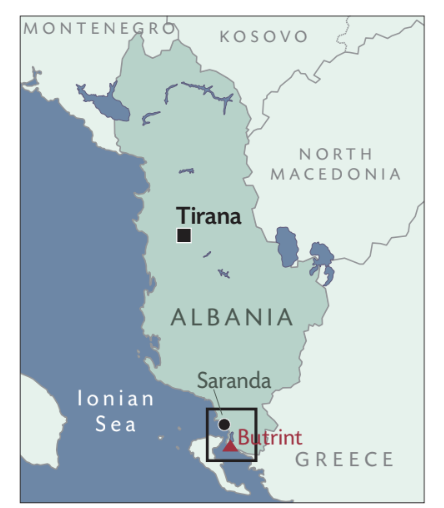
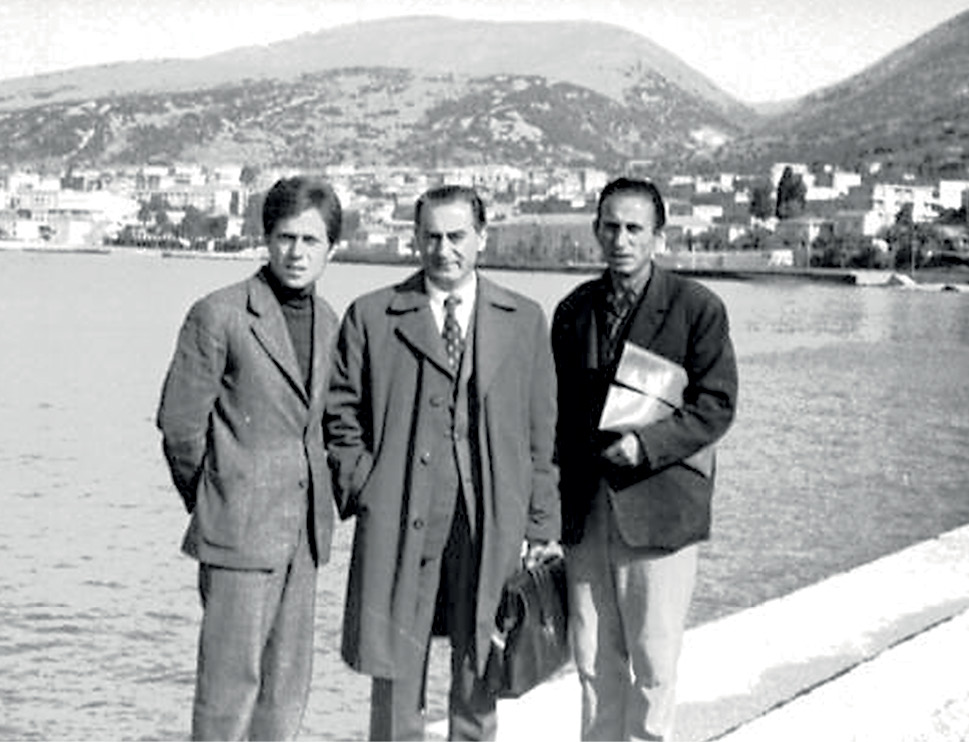
On my first evening in Saranda, I met Kosta Lako. It proved to be a Damascene encounter. Without realising it, he persuaded me that not only was the archaeology at Saranda and neighbouring Butrint well worth studying, but – with his quintessential modesty – that he was someone who, despite Communist obstacles, had excavated and published to a very high standard. Kosta had a prematurely careworn face but sharp dancing eyes. He was my age, I guessed (he was in fact three years older), yet in his body, as in his face, you could see – as you don’t in most men – the face and body of the boy he once was. There was an engaging yet restrained keenness trembling within him. With his Albanian colleagues, we had sauntered at an agonising pace along Saranda’s seafront. As we did this, I was struck by the brilliant scales of the sea reaching to the far silhouette of Corfu. The port was intimate, gentle, and belonged to a lost age before mass tourism. Our first objective was to visit the Late Antique basilica (and earlier synagogue) beside the Rruga Skënderbeu that Kosta had recently excavated, and then, close by, the wretched basement office where he and his two colleagues worked in a soupy light.

Kosta’s studies of Saranda’s archaeology immediately impressed me. Sitting in his office, conscious of the damp and the darkening light, I realised we were being royally treated as he took his doctoral thesis out and laid it graciously on the stained, unsteady table. Entitled Qyteti i Onhezmit në Antikitetin e Vonë (The City of Onhezm in Late Antiquity), it was the product of many small salvage excavations in the port made over the previous two decades. Flicking through it, the text was faintly blurred by a worn typewriter ribbon on wafer-thin paper, I instinctively marvelled at its cogent analysis. Thinking back, how glad I am that I breezily complemented the author. He screwed up his face a little, ageing before my eyes. In his husky English, he thanked me. He did not ask for anything more, then or ever again. Decades have now passed, and Kosta is no longer with us. I realise how fortunate I was to encounter him as I navigated the enigma that was Albania in the first flush of its liberty. In time, I came to appreciate that the end of Communism terminated the safe if unreal stability of his scholar’s life and compelled him to reckon everything in terms of dollars or drachmas to sustain his family. With altered priorities, Kosta knew that his thesis, an exercise made against the odds, was the apogee of his life, and destiny from that time had to be measured in terms of his family. His quiet defeat was my first lesson in Albania’s crushing post-Communist realpolitik – the transition economy years, as they were known. Even so, now two years after he has passed away, I still think of him, and this has led me and my colleagues back to re-examine and honour his work on ancient Saranda – Onchesmos – and the great Late Antique sanctuary above it, Santi Quaranta.
A place with many names
Saranda has changed its name several times, each one redolent of its connections. Its ancient name, Onchesmos, derives from Anchises, the Trojan whose union with the goddess Aphrodite on Mount Ida resulted in a son, Aeneas. Aeneas, according to many accounts, escaped the sack of Troy with his young son Ascanius and the crippled Anchises on his back – an iconic image fancifully embroidered during the late Roman Republic. Many versions of the tale survive, detailing the journey of the Trojan refugees through the central Mediterranean, and the fate of Anchises. Dionysius of Halicarnassus calls Onchesmos ‘the Harbour of Anchises’ and records that the Trojans dedicated a temple to Aphrodite here: ‘From Buthrotum, they sailed along the coast and came to a place which was then called the Harbour of Anchises but now has a less significant name; there they also built a temple to Aphrodite and then crossed the Ionian Gulf’. Aphrodite was a deity who had power over the sea and provided safety to all those who sailed. In this group were included sailors, shipowners, traders, and anyone else whose profession was involved with the sea. It was one of several Ionian temples dedicated to Aphrodite reported by Dionysius of Halicarnassus, the others being at ancient Leucas and at Ambracia. It is undoubtedly this tradition that underlies the local belief, mentioned six centuries later by the Byzantine court historian Procopius, that Anchises died at Onchesmos. Other ancient authors record that Anchises died in Italy, either at Drepanum, a Greek and later Roman forebear of modern Trapani in western Sicily that was favoured by Virgil, or at Lavinium, south of Rome, according to the accounts of Dionysius of Halicarnassus and Strabo; though Pausanias recounts that Anchises died in Arcadia in Greece, lending his name to Mount Anchisia.
When exactly and how Onchesmos took its name is not known. Among the Hellenistic tribes of Epirus, the Molossians – and, in particular, Alexander Molossus in the 330s BC, then Pyrrhus in 280-278 BC – cultivated a myth that they were descended from Achilles. However, as Butrint later showed during the early Roman Empire with its bid to associate itself directly with Aeneas and Helenus, the tradition of establishing an origin myth harking back to the Trojan wars was common in these parts.
Two other sources mention Onchesmos in the late Republic and early Empire, both in connection with seafaring and harbourage. Cicero, in his correspondence with Titus Pomponius Atticus, recounts: ‘we arrived at Brundisium on 24 November [50 BC], as favoured in the crossing as yourself, with a fair wind behind us. Softly, softly, from Epirus blew the Onchesmitic breeze’. Strabo, in his Geography, written in the Augustan era, recalls: ‘after these mountains one comes to Onchesmos, another harbour, opposite which lies the western extremities of Corcyra [Corfu]… After Onchesmos comes Poseidum, and also Buthrotum’.

A key 6th-century reference begs the question of when exactly the port changed its name and became Hagia Saranda or some version of the Forty Saints, as it was known to the Durrell family on Corfu in the 1930s. The Synekdemos of Hierocles, dating to about AD 527/528, lists it as Anchiasmos, one of the ten places in Epirus Vetus under the metropolitan see of Nicopolis.
In spite of this Late Antique reference, it is assumed that Saranda started to become associated with a new identity at precisely this time, when the sanctuary of Santi Quaranta dedicated to the Forty Martyrs of Sebaste – Christian Roman soldiers forced to die in a frozen lake – was built in the later 5th or early 6th century on the rocky hill overlooking the port. The first reference to the new name occurs much later in the chronicle of the crusader Roger of Howden, dating to AD 1191. He describes the deserted town with its deepwater harbour as Sancta Karentet. We must assume, therefore, that the new name came into usage between the end of antiquity and the High Middle Ages, and that already the distinction between the ancient port and the monastery – Onchesmos/Saranda and Santi Quaranta – was blurred.

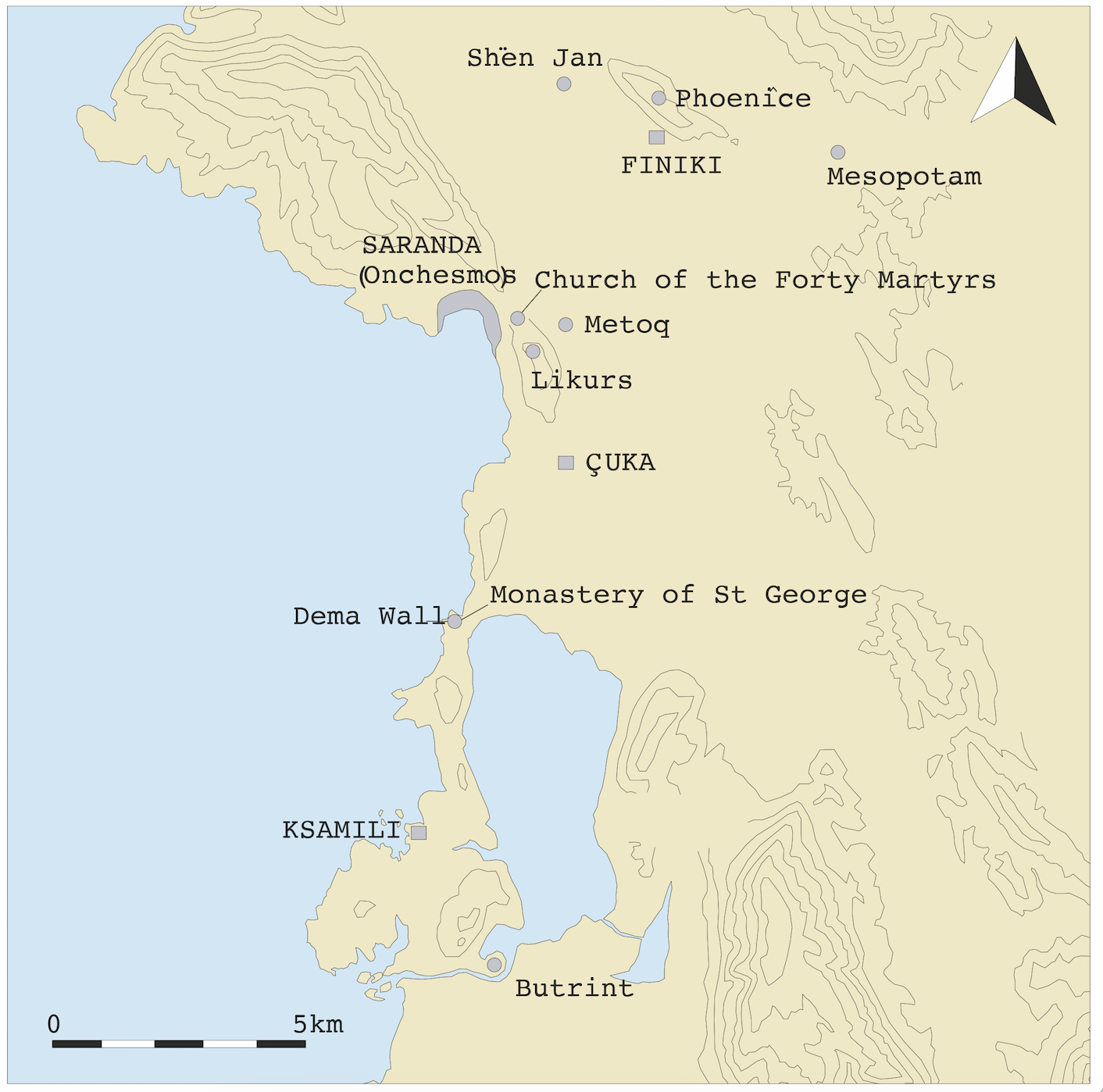
A third name also has to be considered. On the high hill immediately south of Santi Quaranta lies the fortress of Lëkurs, known to the Venetians on Corfu as Licursius. The British diplomat-spy William Martin Leake visited the village in December 1804 and believed it to be called Santi Quaranta. He describes it as ‘a small square white-washed fort’ built by Ali Pasha of Tepelenë, Byron’s friend. Leake provides an equally useful description of Saranda itself (which he called Skala – that is, the lower port of Santi Quaranta): ‘on the north-western side of the harbour… are some extensive ruins, situated on a gentle slope by the sea side, at the foot of the bare rocky hills… The ruins are those of a town of the better times of the Lower Empire. The walls forming an exact semicircle, the diameter of which is the sea beach, are flanked by about 20 towers; and contain within them the remains of churches, cisterns, and houses’.


All three places – Saranda, Santi Quaranta, and Lëkurs – feature in Edward Lear’s sketch of 22 April 1857 (now in the Ashmolean Museum, Oxford). He describes this as ‘Santa Quaranta (the Scala, or port of Delvino)’. In his limpid lines, he eloquently records the well-preserved western walls with their towers of the ancient town.
Arguably the first photograph of Saranda dates from 3 March 1913, and shows Greek soldiers in the main street during the course of the Second Balkan War. Substantial buildings line either side of the main street, and in the distance, to the west, two and possibly three tall towers of the town walls can be seen. Shortly after this, as a naval base during the First World War, the town gained in importance. By now Santi/a Quaranta or the Forty Saints or Aghios Saranda had been shortened to Saranda. The modest scale of this urban nucleus, overshadowed by the ruins of the sanctuary of Santi Quaranta, is emphasised in a photograph taken in May 1924 by the Italian archaeologist Luigi Maria Ugolini. His photograph of the bay, taken through a remaining arch at the west front of the sanctuary church, shows many boats at anchor, and a mass of perhaps a hundred buildings, beyond which a well-marked road runs across the ground where Lear mounted his easel in 1857.


The British Naval Intelligence Division’s Albania handbook of 1945 provides the bare bones of yet another name-change. In an act of June 1939, the town was briefly renamed Porto Edda by the Italian conquerors of Albania after the daughter of Benito Mussolini. This may have been prompted by the short-lived decision to call it Zogaj on the occasion of King Zog’s visit the previous year, 1938. In the case of Porto Edda, the association with the Italian leader himself almost certainly reflects its status as a strategic naval base, controlling traffic through the Straits of Corfu.
Saranda grew modestly in the post-war, Communist era. Essentially, the area within the Late Antique walls was steadily developed, while an extra-mural area to the west leading to a stadium and around the harbour was partially occupied. The overspill also spread along the eastern side of the bay, where the Hotel Butrinti was built. It was next to this hotel, in the Villa Kaoni, that the Soviet leader Nikita Khrushchev stayed in May 1959 on his visit to Butrint. Little had altered when I met Kosta Lako here in 1993.

Next to this hotel, the Soviet leader Nikita Khrushchev stayed in May 1959 on his visit to Butrint.

Saranda’s archaeology and archaeologists
Kosta Lako was a pupil of Dhimosten Budina, an archaeologist trained in Moscow in the early 1950s, who was dispatched to southern Albania to make sense of its archaeology. This veteran of excavations at Hellenistic Antigonea, Çuka e Aitoit, and Phoinike, as well as Roman Butrint, created an office at Saranda and mapped the port’s archaeology. A short man with a gaunt face and piercing eyes, Budina was enterprising and energetic. Under Budina’s tutelage Kosta, having cut his teeth on a major excavation at Butrint’s defences, set about mapping and making sense of the Late Roman defences at Saranda drawn by Edward Lear. Kosta drew attention to its double fortifications – a proteichisma – emulating the great double landward walls of Constantinople. Then he devoted himself to excavating a large area close to the old east gate on the Rruga Skënderbeu (which I visited with him on my first night in Saranda). Here, just off the main east–west street, Kosta uncovered a Roman townhouse that, judging from a floor mosaic depicting a menorah, became a synagogue. (A 6th-century tombstone from Apulia records a Jewish household that came from Onchesmos.) This house-synagogue was then transformed into a late 5th-century basilica with flanking aisles. Now conserved as a public monument, it was one of several churches – each with fine mosaic polychrome pavements – dotted around the harbour inside and outside the defences, recorded by one means or another by Dhimosten Budina and Kosta.

Saranda’s most remarkable Late Antique church, however, was well outside the town, visible to all who passed along these seaways as well as to distant Phoinike and the lands around Butrint and northern Corfu. Few places in the Ionian Sea are more spectacular than Santi Quaranta, the now-ruined sanctuary dedicated to the 4th-century martyrs of Sebaste.
Santi Quaranta
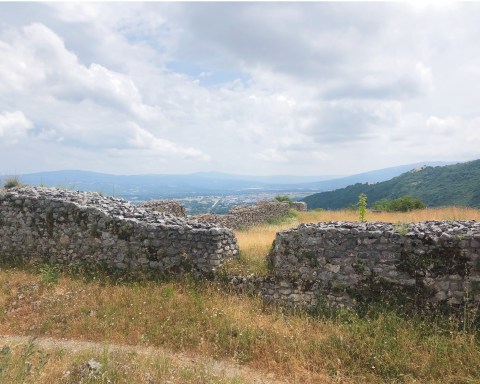
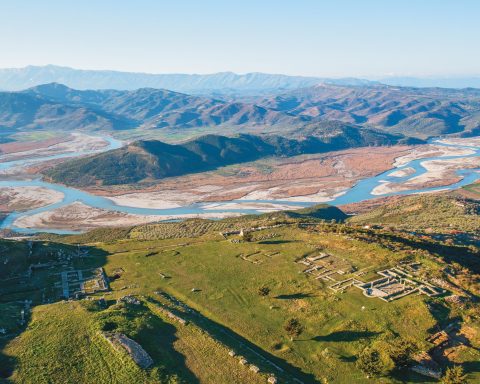
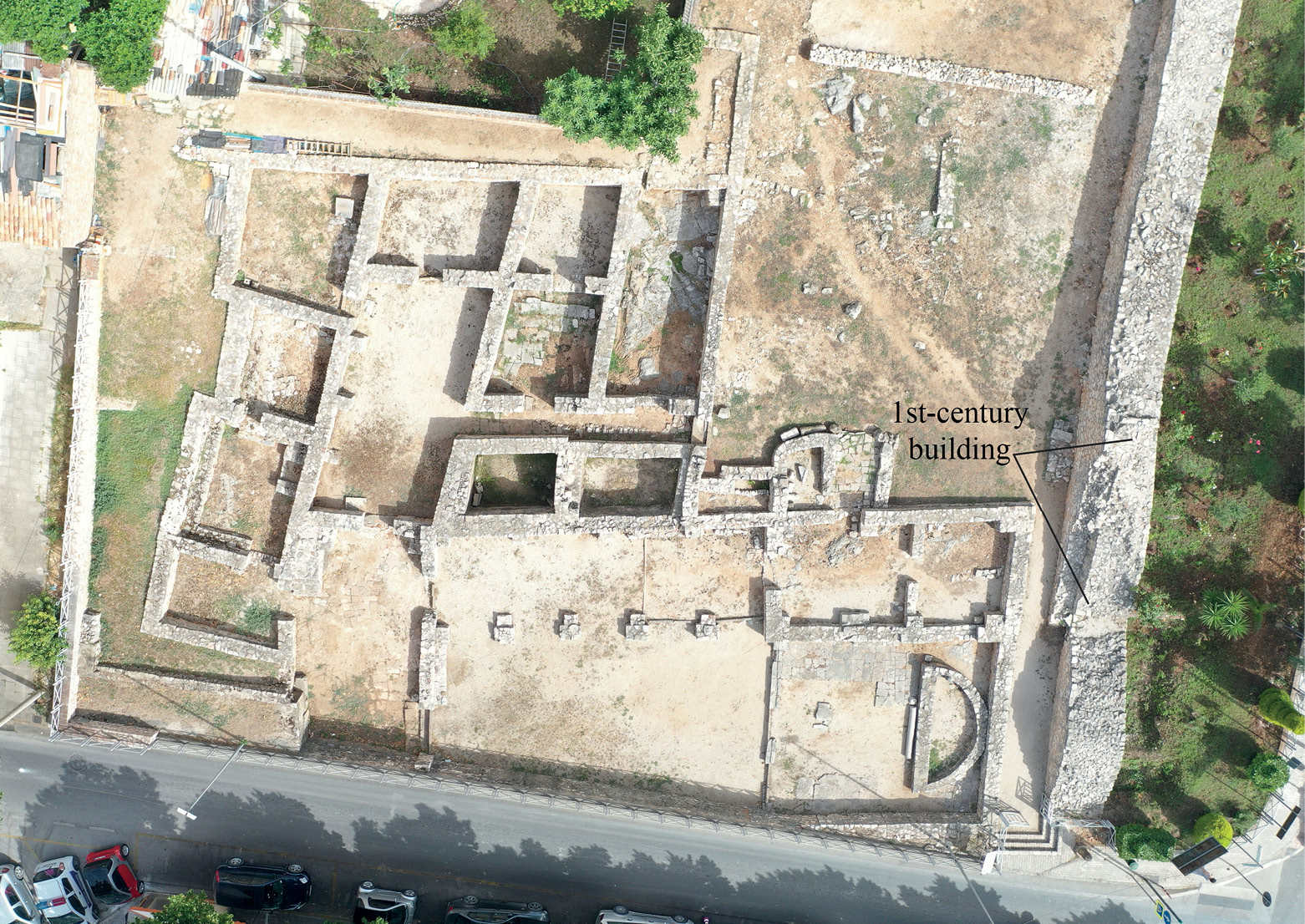
Santi Quaranta is an enigma. Excavated by Kosta in the 2000s after the Communist military camp made here in the 1960s was abandoned, the ruins cried out for re-examination. This I did in June 2024 with the help of three colleagues. Using drone photography and a new digital mapping programme, as well as assiduously studying photographs taken over the past century, we are close to cracking some of the secrets of this great seamark.


Luigi Ugolini showed it to be a huge standing ruin when he photographed it in May 1924. The original building was conceived with seven conches and domes supported on vaulting. Beneath this massive structure, ten crypts as well as an attached relic chapel were made, each painted with frescoes. To this, in a second phase was added a powerfully built west front. As a building, it ranked alongside the greatest churches of the age, such as Santo Stefano Rotondo in Rome and St Polyeuktos in Constantinople. Texts describing it do not exist, instead there is a curious miscellany of photographs that more than anything attest to its mystery. These photos include ones taken around 1913 by a Greek archaeologist, a First World War postcard, an Italian aerial photograph from 1937, and some post-war pictures of unknown origin. Each has helped to reconstruct the place, because in 1967 it was dynamited when Enver Hoxha banned religions and created a military camp here.
One abandoned military building survives, and this sits on ancient remains aligned on a different axis to the sanctuary church. My speculation – unfounded at present – is that this is part of the missing temple dedicated to Aphrodite mentioned by the 1st-century author Dionysius of Halicarnassus (see above). This element of the ancient building – a fine slab pavement – was repurposed for some baptismal rite when the first sanctuary was erected here in about AD 480/490. Quite who built this immense building, which was 40m long by 23m across with its underground crypts, is a mystery. Certainly at least ten donors claimed credit for a work of architectural genius. These donors are recorded in inscriptions, the Greek lettering fashioned from potsherds and tiles, inserted around the surviving outer faces of the building.

This was not exactly a straightforward church like the basilica Kosta excavated in Saranda. After the baptismal rite, visitors either entered the underground crypts, each painted with book-like imagery, or processed by way of, first, a small bath-block to a replica lake (a pool representing the frozen lake in which the martyrs perished) before entering the upper church, where healing basins were stationed in each of the great conches. Only after a generation, in the 520s, as the new walls at Saranda were erected, did Santi Quaranta affect some similarity to a more normal basilican form. At this time, a hostel with accompanying storerooms was built close to the exterior pool, while a stair was installed leading up to a new west front that would have stood out to anyone in the port or on the seaways below. Below in the crypts, new figural paintings overlay the earlier ones, including an image of Christ pulling the beard of St John.
Kosta thought that the Ostrogoths led by Totila might have brought about the downfall of the new front, but its collapse has the hallmark of a seismic event. Even so, soon afterwards, the sanctuary was revitalised with a makeshift chapel in its south aisle, as well as myriad poorly made satellite buildings for accommodation and healing practices. The associated pottery suggests pilgrims continued to climb up to this sanctuary until the mid- to later 7th century. Like the port below, its apogee was over. Even so, it must have stood as a seamark for crusaders like Roger of Howden. It was rebuilt on a smaller scale in Ottoman times, but had been abandoned by the First World War. Then, rather curiously, Santi Quaranta had a new lease of life in the Communist era after the Second World War, as a timber church was made inside the ruins to serve the local Greek minority. Even now, flowers are left in its crypts and in the relic chamber – small but vivid reminders of a deep memory of the extraordinary story of these seemingly anonymous ruins in this spectacular location. One old woman who lit a candle for her injured son explained that, as there were 40 saints commemorated here, one was certain to help her.

Kosta’s legacy
Thirty to forty years later, Kosta’s publications are a good point to reflect on Saranda’s past. Onchesmos and the Forty Saints/Santi Quaranta, although often interchangeable, appear to equate to two major phases of urban activity before modern times. The first urban phase belongs to the Roman imperial period, from the 1st to later 2nd or early 3rd centuries, when Onchesmos was probably a small walled port with modest urban features and undistinguished cemeteries. The second phase spans little more than a century from the mid- to later 5th to the mid-6th centuries when, with its prominent defences and an array of associated churches, the port served as an entry-point for Byzantine-era tourists to the major martyrial sanctuary of Santi Quaranta.
One minor phase cannot be ignored. Dionysius of Halicarnassus mentions an earlier temple to Aphrodite here, which may have been the seamark that led to it being an active harbour when Cicero set sail here for Italy in 50 BC. Was this temple set on the hill that was later occupied by Santi Quaranta, as I speculated after our survey of its ruins? Nonetheless, the virtual absence of archaeology pertaining to this period suggests that Onchesmos was little more than an outport for the inland Hellenistic regional capital at Phoinike in Republican times. Yet, we need to bear in mind, it was in this period that the place assumed its Trojan name, perhaps as Phoinike sought to establish the antiquity of its harbour, as well as its greater significance in its competition with other Epirote centres.
Exactly when in the early Roman Empire Saranda owed its transformation from safe harbour to urban centre is unfortunately not clear. On the basis of one standing segment of wall, Kosta proposed that it was awarded a walled circuit as well as urban monuments, including an odeon, by the early 1st century AD. It may seem far-fetched to project a whole circuit from one wall fragment, especially as neither nearby Butrint nor Phoinike were furnished with new walls. If Saranda did boast fortifications, it would have been a symbolic statement of passage from a harbour serving Phoinike to a town in its own right. For sure, only further excavations will shed light on the port’s first iteration as Onchesmos.

Late Antique Saranda is an altogether different issue. Kosta’s discovery of a well-appointed 4th-century synagogue occupying a townhouse may offer a clue. With the mid-Roman decline of inland Phoinike, Onchesmos found its future as the economy between the central and eastern Mediterranean grew after the Empire split in two. This newly found status is confirmed by the appointment of a bishop by the mid-5th century, essentially defining its urban status as now separate from inland Phoinike, which also merited a bishop. This appointment may have attracted the wealth and ambition to create the exceptional sanctuary dedicated to the 40 martyrs of Sebaste – Santi Quaranta – on the hilltop above the port. With the construction of Santi Quaranta, Saranda became the point-of-entry to the healing centre. Profiting from this status may account for the small port investing in landward defences, symbolically emulating Constantinople in miniature. In these remarkable circumstances, Onchesmos may not have been the principal outport for its immediate hinterland, but it was nonetheless a destination for Late Antique pilgrims following the seaways. Afterwards, revisiting Kosta’s reports and finds, it is clear that the port was not a victim of Slavic raids in the 580s, as he believed, but – judging from 7th-century and later pottery – it continued as a safe harbourage through the Byzantine Dark Ages. Even its fortifications, it is now clear, were refurbished around AD 1000, although none of the recent salvage excavations in the port have found evidence of High or Late Medieval occupation.
Was the temple of Aphrodite set on the hill that was later occupied by Santi Quaranta, as I speculated?
Saving Saranda?
Thanks largely to Kosta Lako, Saranda has a great history as a Mediterranean port. Few in the town know it. Tourism, quite frankly, has run amok. Today, its little museum – made in the 1980s to protect and display the polychrome mosaic pavement of an extramural Late Antique church – is closed. To be fair, the ruins of the intramural basilica beside the Rruga Skënderbeu are kept clean, but its true treasure, Santi Quaranta, is well off any beaten path and largely unknown. Honoring Saranda’s past will surely come, as Albania realises how rich its heritage is. At that moment, recognising Kosta’s legacy will suddenly seem all too natural. Until then, safeguarding every scrap of information about this town, its antiquity, and the magnificent ruins of Santi Quaranta, with its frescoed crypts and palimpsest of buildings, is an imperative.
FURTHER INFORMATION:
This project was generously supported by the Butrint Foundation. More detailed studies of Saranda are published in Richard Hodges and Nevila Molla (eds) Butrint 8: The Late Roman and Early Medieval Archaeology of Butrint, Çuka e Aitoit, and Saranda (Oxbow Books, 2025) and dedicated to the memory of Kosta Lako.
All images: courtesy of Richard Hodges

You must be logged in to post a comment.