Subscribe now for full access and no adverts
In a deep valley below Bomarzo’s Orsini palace lies the so-called ‘Monster Park’ – the Sacro Bosco, a Mannerist gem from the later 16th century. It is surely one of the most remarkable Renaissance gardens in Italy, if not Europe. Tufa outcrops of this secret wood have been sculpted into a company of fabulous figures, some monstrous in design. They hold visitors in thrall, as they have since their rediscovery by the Bettini family soon after the Second World War.

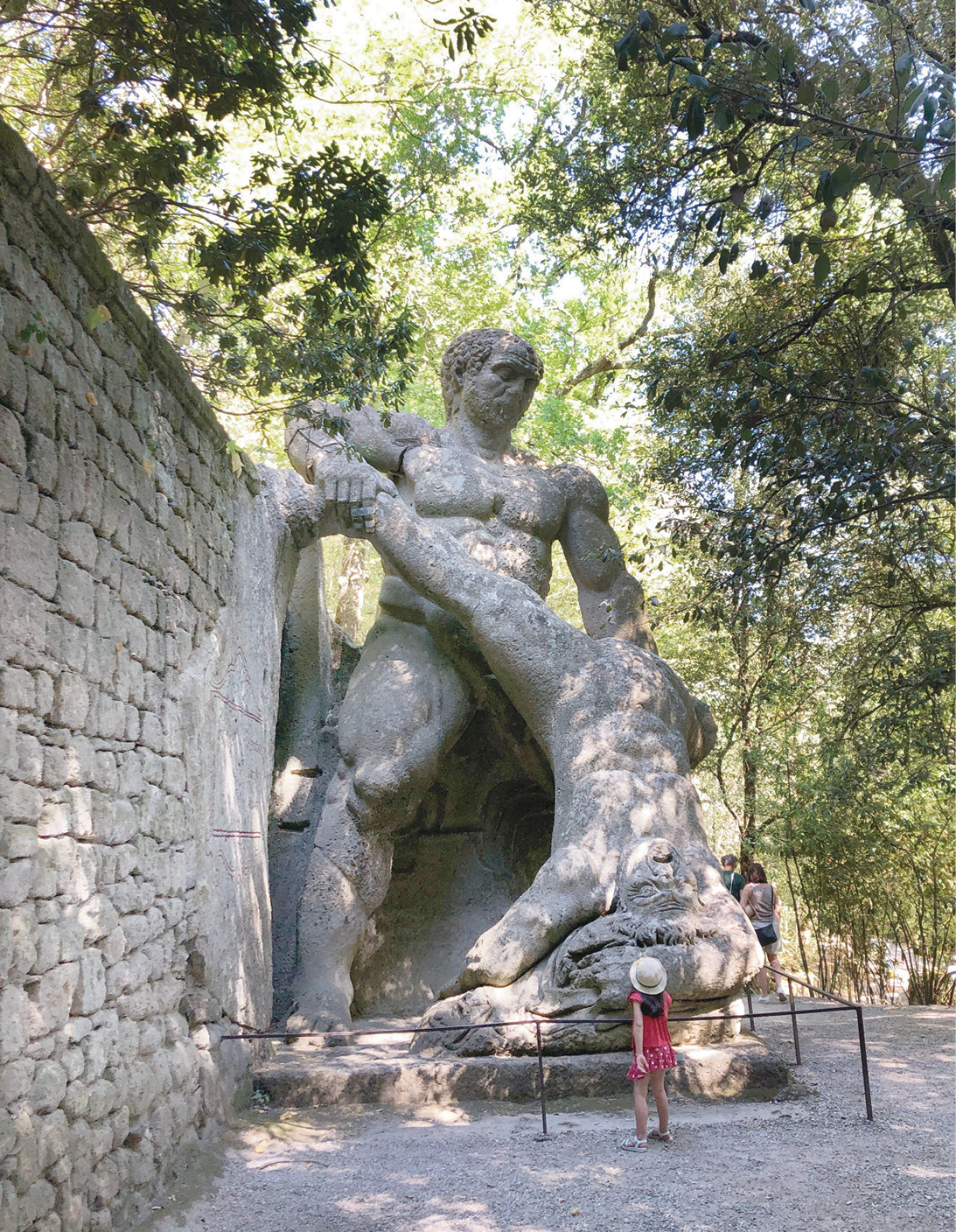
The walled garden lies beside a small dark stream that beforehand had served a water-mill. A sphinx with an inscription sets out the mysterious concept behind this extraordinary place. The words beneath the sphinx read: Tu ch’entri qui pon mente parte a parte,/Et dimmi poi se tante maraviglie sian fatte per inganno o pur per arte… (‘You who enter…tell me whether or not these marvels have been created through deceit or art’). Beyond, a massive monster with gaping teeth and an orb on his head stands guard close to the entrance, where a burst of water races over rocks into the wood. The path follows steps down towards the water-mill, and there a Hercules, 10m or more tall, struggles vigorously with a terrified upturned human. Further down, as the brook twists in the glade, a giant turtle balances an orb on its scaly back. Next to it is a dry fountain worthy of any piazza in Florence, and graced by a Pegasus. Beyond, partly obscured by the shadows of tall trees, are half-finished inscriptions in the volcanic rock face. The trail passes two pseudo-Egyptian obelisks, a line of cartoon-like busts atop tall columns, and a bizarre two-storey house comically tipped up as if riding an earthquake.

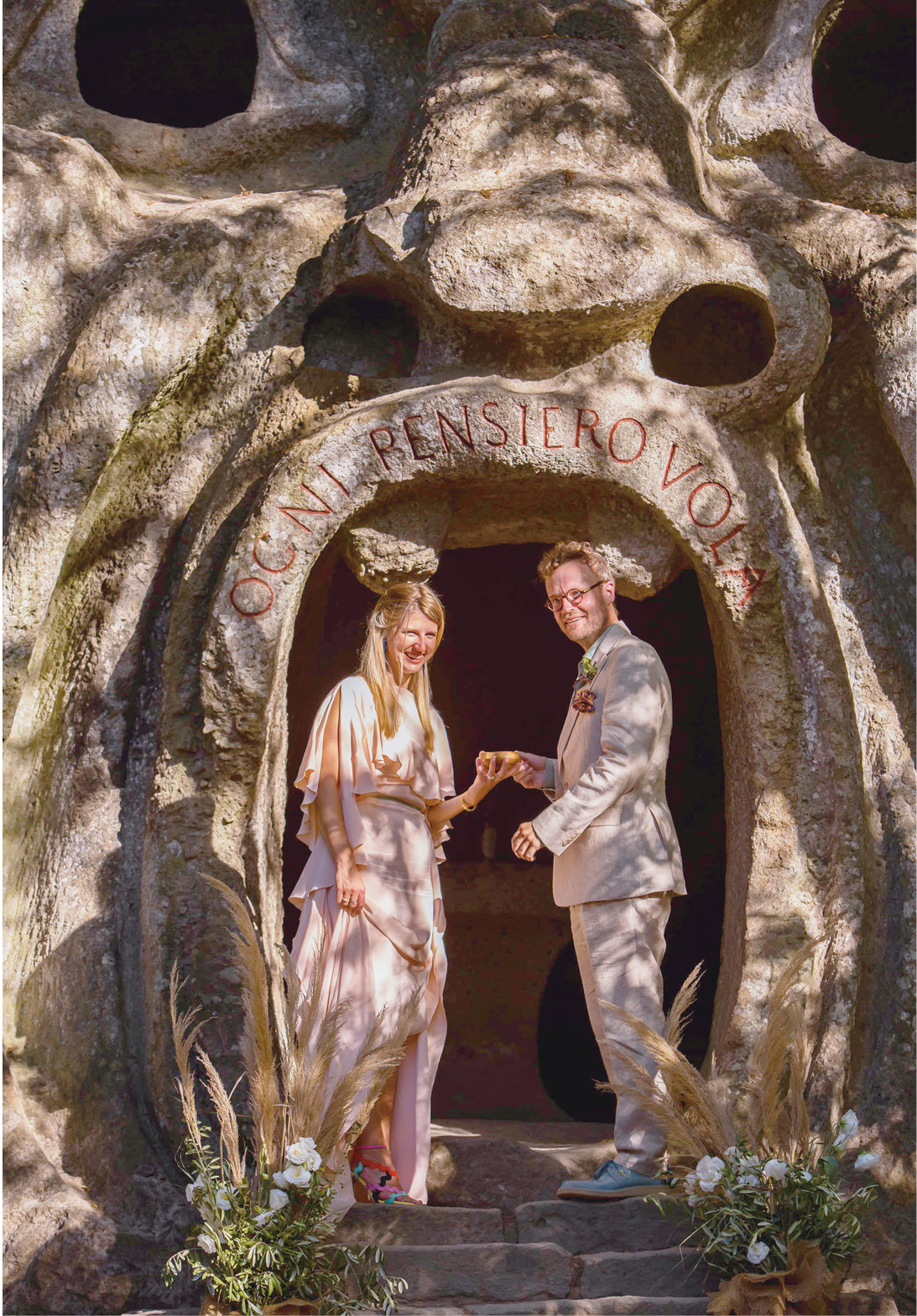
Now, arriving in the heart of the Sacro Bosco, is a full-sized elephant ridden by a figure that could be Hannibal, while an unfortunate Roman centurion is wrapped into the animal’s twisted trunk. This warrior beast stands close to Neptune, who is observing his fellow sculptures with intent, and a fiercely armoured dragon. Finally, tucked behind the elephant is a work of art that has long since branded Bomarzo. Here, an ogre has been carved into the rock face separating two terraces. His face is open, both inviting and menacing. His eyes and nose are drilled round, with a gaping mouth through which you may enter, dodging his gap teeth, to reach a table and dine where his tongue should be, as in an Etruscan tomb. Inscribed into his upper lip are the words Ogni pensiero vola (‘Every thought flies’). It is a reference to Dante’s Inferno, in which he writes Lasciate ogni speranza voi che entrate (‘Abandon all hope, you who enter’).
This Renaissance wonderland influenced Salvador Dalí’s art, and even an opera called Bomarzo (1967) by the Argentinian composer Alberto Ginastera. Created by the Duke of Bomarzo, Vicino Orsini (1523-1583), the park is thought to be his memorial to his wife, Giulia Farnese, a way of coping with his grief. Its design is often attributed to the great Renaissance artist Pirro Ligorio (1512-1583), while the grotesque sculptures are believed to be the work of the young Simone Moschino (1553-1610). Moschino was born in nearby Orvieto, son of a sculptor, and went on to have a more traditional career in Parma.
One thing about the Sacro Bosco is clear. The garden may be both ambiguous and terrifying in its odd satanic ecstasy, but the models for many of its sculptures are Etruscan and perhaps Roman. This was both a paean to the ancient past, which artists like Ligorio were studying and deliberately imitating, and a Mannerist attempt to meld it into Italy’s Medieval masterpiece, Dante’s Inferno. In its artistry it is, without doubt, a work of genius.
It was here, in front of this ogre, that my daughter chose to get married to her long-time Scottish partner as the temperature soared to 40°C. The guests were seated facing the monster as we padded along the woodland path – my daughter in very high heels and a flowing pale peach wedding dress – past Hercules, the Pegasus, the tipped-up house, and the elephant, with a bagpiper in his Gunn tartan kilt heralding the way. The ceremony itself was then held within the gaze of the menacingly carved ogre. It was quite unforgettable, as magical as it seemed surreal.

Thanks to the millennial wedding guests, I got to know Bomarzo as a place that was more than just Vicino Orsini’s secret garden. On the mornings before and after the wedding, several wedding guests hiked or jogged the trails around the little town. In one direction they found an Etruscan rock-cut cemetery on a rocky woodland spine that conceals a ruined castle every bit as unexpected as a sculpture in the Orsini park. In another direction they found a pyramid, no less. The sculptures in the Sacro Bosco, it seems, drew inspiration from the extraordinary density of ancient memorials carved out of the volcanic tufa rock in the wooded canyons dotted around this largely forgotten tract of northern Lazio on the edge of the Tiber valley. Thrilled by the ceremony in front of the ogre, many of the wedding guests, a mixture of artists and architects, encouraged me to get to know Bomarzo better.
Bomarzo
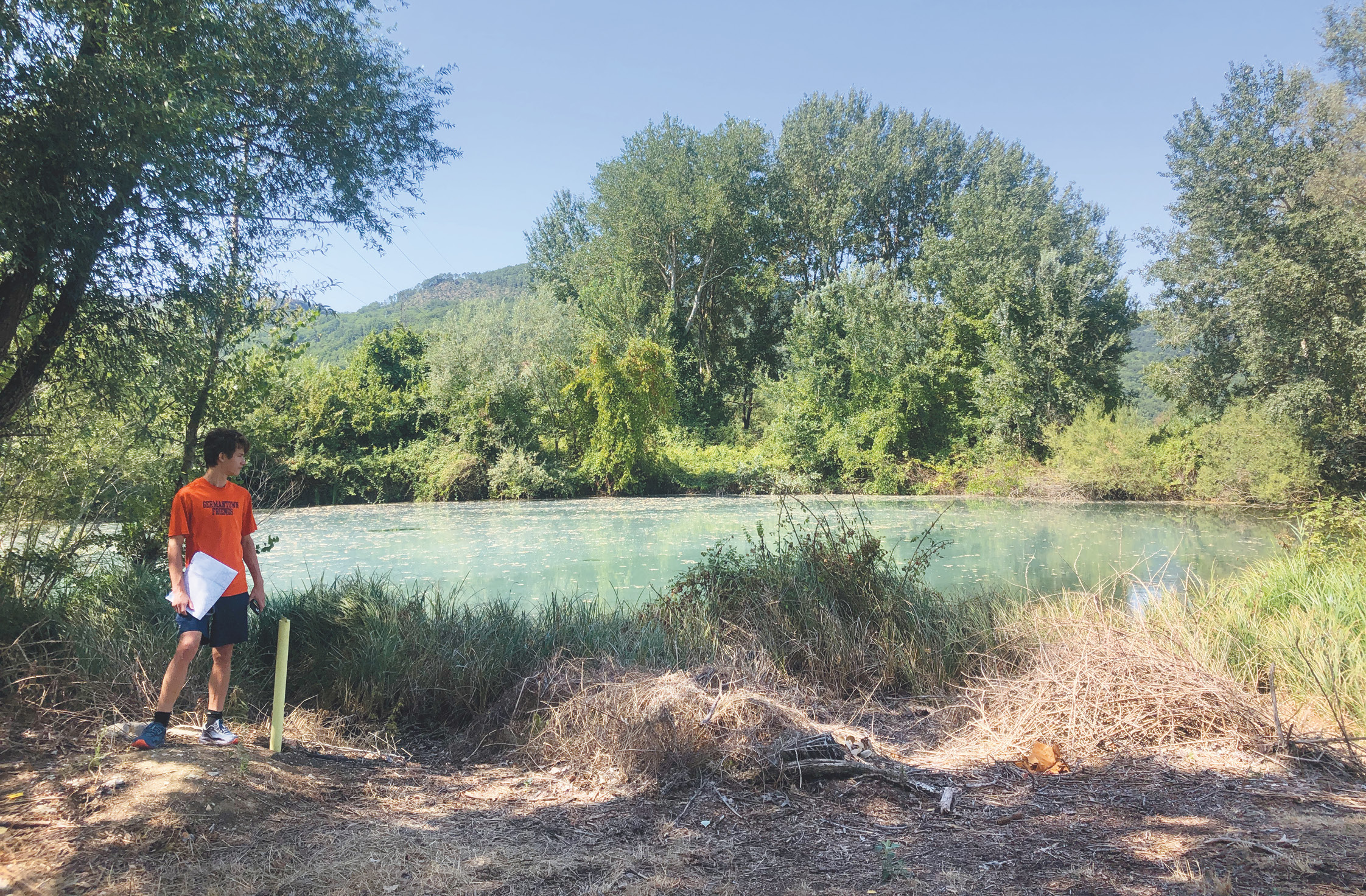
Bomarzo occupies a thin tufa ridge extending towards the Tiber valley, 3 miles to the north-east. Below it, Seneca and Pliny the Younger record, the Romans vanquished the Etruscans in 283 BC at a little volcanic lake, the lacus in Statoniensi (it takes its name from the nearest town, Statonia – see below). Legend has it that it was filled with Etruscan blood. Here, apparently, to paraphrase D H Lawrence in his Etruscan Places (1932), the Etruscan existence as a nation and a people was wiped out. Barely more than a pond, now called the Lago Vadimone, it lies close to Bassano station, surrounded by high canes and filled not with blood but spinach-green algae that attract dipping swallows. This point of conflict between powerful rivals is borne out by the wealth of archaeology in this area. Recent archaeological surveys show that Bomarzo’s side of the Tiber is thickly dotted with Etruscan and Roman settlements and cemeteries, quite unlike the east bank in northern Umbria, which appears to have been largely unoccupied.

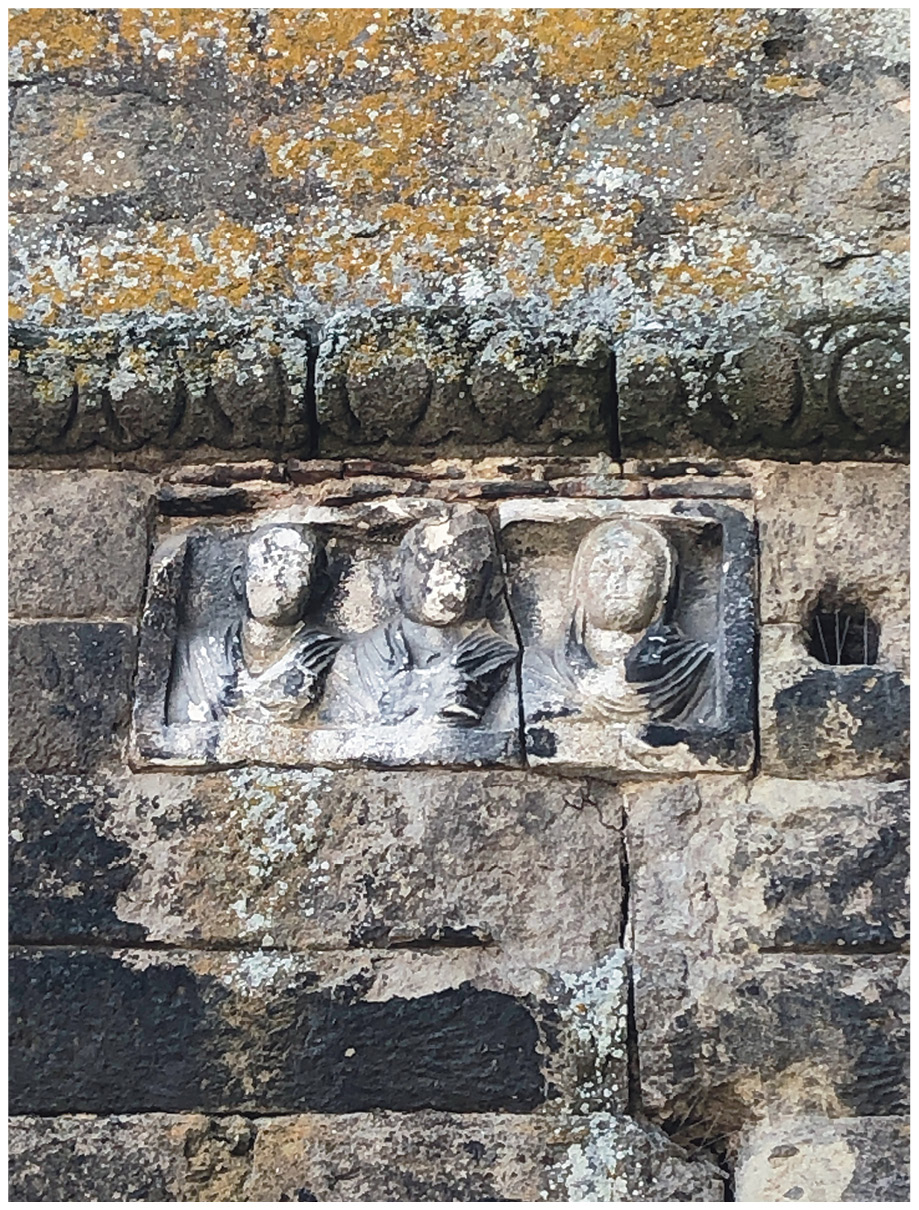
Bomarzo’s name is a derivation of Polymartium, first mentioned by the 8th-century Cassinese monk Paul the Deacon in his History of the Lombards. The etymology of polis martium – ‘city of Mars’ – suggests a Roman origin. But the Roman settlement here was to the north, on a flatter promontory overlooking the Tiber, called Statonia (more of this below). Among its citizenry was the Domitii family, who made their name in the brick industry. Domitia Calvilla was their most celebrated daughter. She was to become the mother of the emperor Marcus Aurelius. Some sense of this storied history can be found in Bomarzo’s little cathedral. The church and its bell-tower are packed tight up against the great Orsini palace. The bell-tower is made of blocks taken from some ancient monument, above which is a frieze of three Roman heads severed from a marble sarcophagus. Inside the baroque barn-like nave, an Early Medieval sarcophagus associated with St Anselm, the patron saint, dates to the 8th or 9th centuries, when Bomarzo lay on the northern frontier of the papal state. A miniature carved marble font belongs to this time as well.
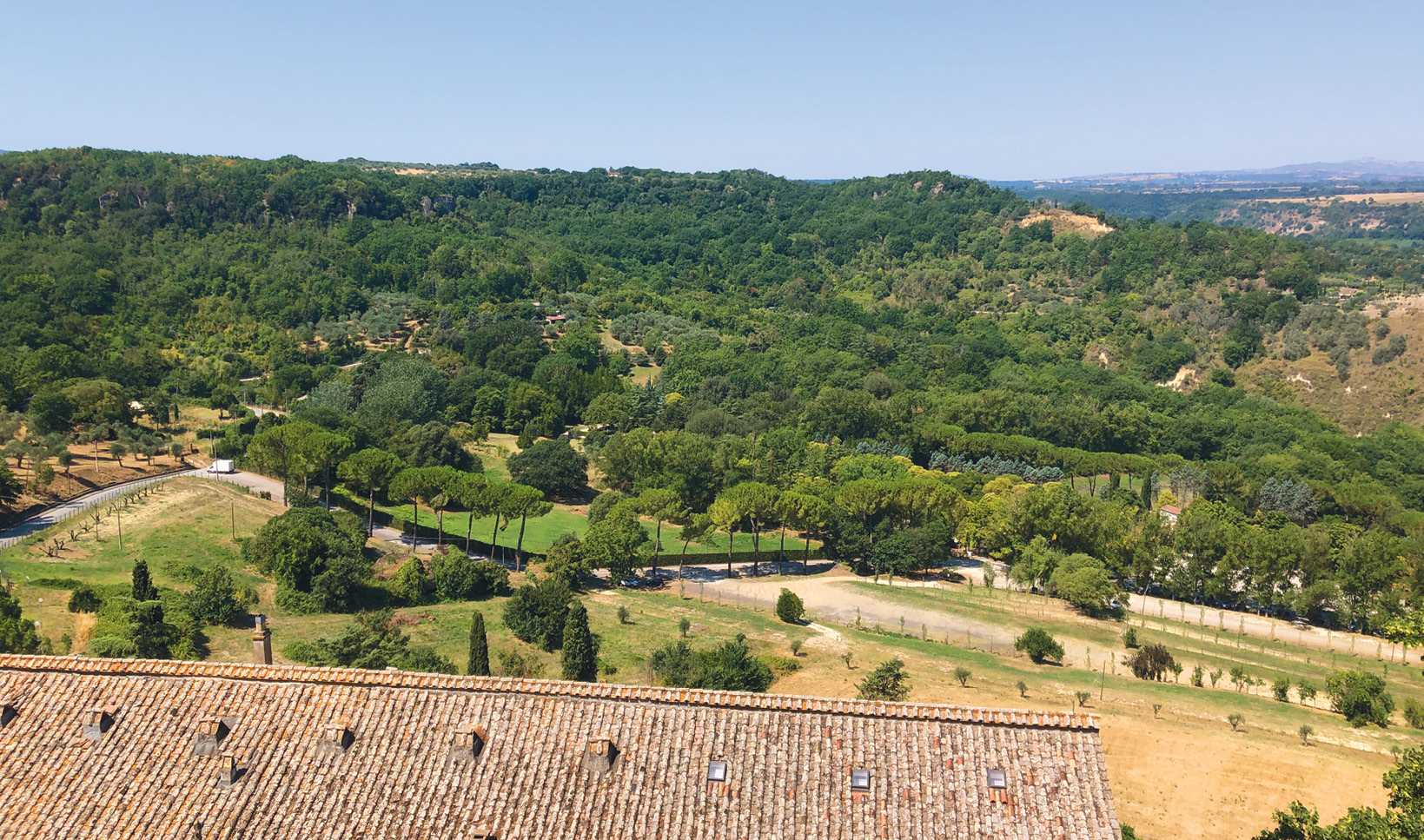
If the Domitii established Bomarzo, and the papacy re-established it in the 8th century, it was the Orsini family of Rome (who boasted five popes over the centuries) who created the village that dominates the skyline today. At first sight, it seems to be part of the dark rock. Bomarzo’s massive palace, within its dark ring of encircling houses, must have been a wondrous monument when it was first built. They were competing with the other affluent Renaissance property owners in these northern realms of the papal state. Caprarola, close to Viterbo and Giove, overlooking the east bank of the Tiber and facing Bomarzo, are just two of the great palaces expressing a new monumentalism at this time. On entering the palace, beneath the great emblem of the Orsini, a large salon with an open belvedere looks out over the valley and a line of corrugated ridges running away into the far horizon.
Bomarzo’s dukes in the 19th century encouraged local antiquarians to investigate the Etruscan and Roman tombs ranged around these neighbouring valleys. They are partly conserved in the collections of the Vatican Museums, as well as various foreign museums, such as the Louvre in Paris, the British Museum in London, the Staatliche Museum in Berlin, and the Museum of Fine Arts in Boston. One lucky archaeologist discovered the magnificent 4th-century BC sarcophagus of Vel Urinates – the name of the deceased – and sold it to the British Museum, where it remains today. These antiquarians concentrated principally on the wooded ridge known as Monte Casoli, 2 miles north of the Sacro Bosco. Fewer tombs, but an extraordinary monument – the so-called ‘Pyramid’ – are to be found on ledges on the wooded cliff-face known as Rocchette overlooking the brook, the Fosso del Rio, and close to the pencil-thin 13th-century tower of Chia, which was once owned by the idiosyncratic poet/film-maker Pier Pasolini. Reaching these two ancient nuclei, nestling in a boulder-strewn wilderness veined with streams glassily cascading from ledge to ledge, is easy. Setting out from Bomarzo village, the Monte Casoli hike takes about three hours; the walk to the Pyramid and back takes perhaps two hours maximum. Neither walk is particularly gruelling, and the landscapes are motionless, often mysterious, and full of antiquities.
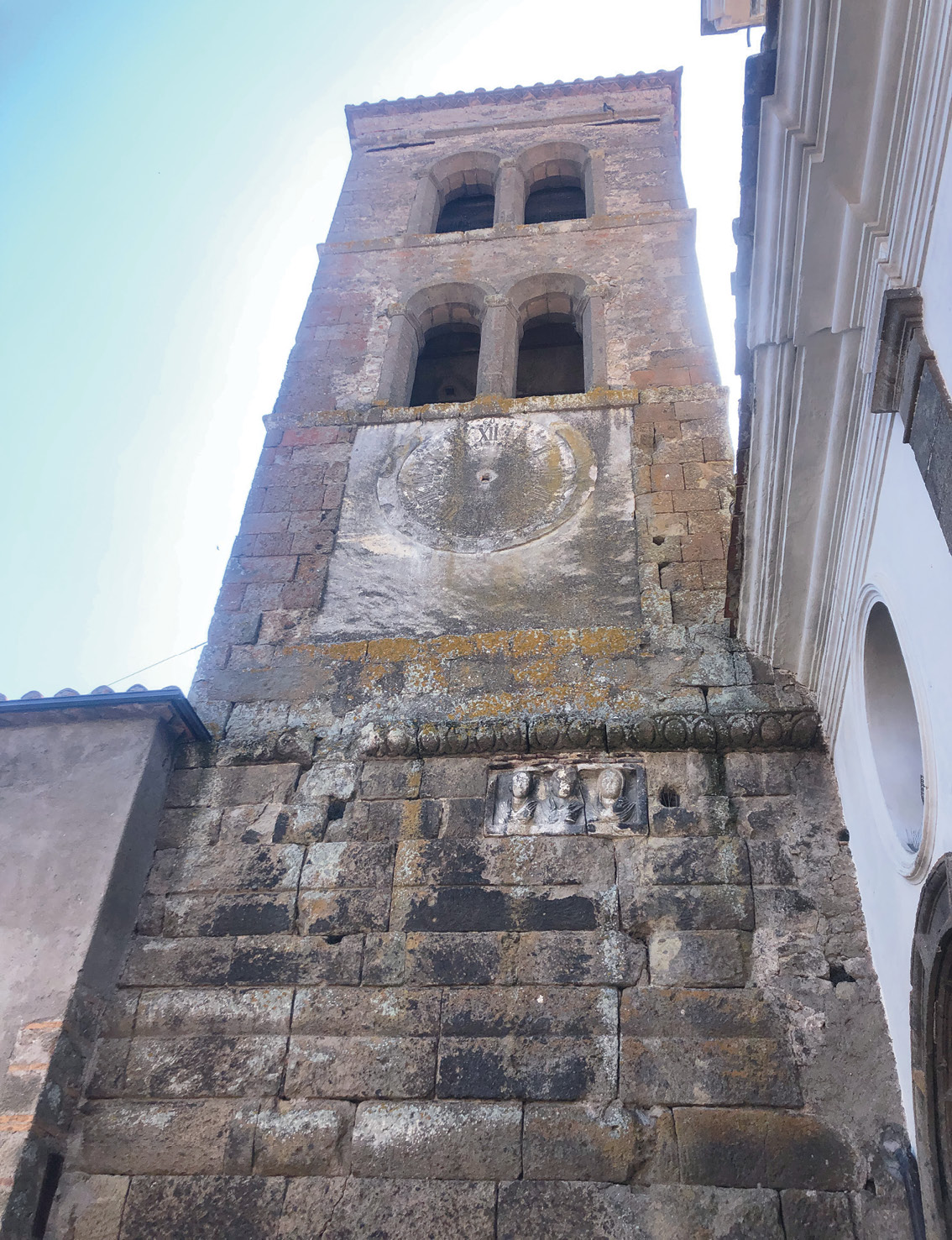
Above: The cathedral bell-tower in Bomarzo incorporates a fragment from a Roman sarcophagus featuring three heads (below).
Monte Casoli
A white gravel road leads from the entrance to the Monster Park, north to Monte Casoli. The road bends around the walled perimeter of the park and a monumental gate, before climbing a short hill to a junction.
Go right and the road leads along the corrugated ridge to a promontory 2 miles away, where excavations and surveys have found the late Etruscan and Roman town of Piammiano-Statonia. Its steep slopes – which descend towards the Vezza torrent to the west and north, while the Tiber lies to the east, and the Fosso Castagnolo to the south – guaranteed excellent natural defences for the site. Occupied uninterruptedly for a millennium from the early Etruscan period until the 6th century AD, it maintained a certain administrative autonomy within the Praefectura Statoniensis. Its very history suggests a continuity between local Etruscan clans and Roman overlords that D H Lawrence, for one, liked to envisage as violent and disruptive. Perhaps only after the Social War, during the 1st century BC, the settlement became a municipium administered by quattuorviri. Excavations at the west end of the flat-topped hill are now lost in thick shrubs, more’s the pity. Here was probably the public area of the town with at least a bath-block and a porticoed building – now known as S Lucia, perhaps named after a lost church – commanding views up and down the Tiber far below. The main residential area almost certainly covered most of the remainder of this hilltop – much of it planted with sunflowers today. Here lived the brick-making families who operated the kilns closer to the river below. Their products, many of them stamped, most famously by the Domitii family, were employed principally in making Trajan’s Market in Rome. Some stamped tiles made here were exported far further afield. Examples have been found near Cosa on the Tuscan coast, while the huge jars made in the same kilns were exported around the Mediterranean. Statonia may seem anonymous and empty today, but its farmers, seasonal brick-makers, built some very striking real estate in the Eternal City.

Turn left at the junction soon after the Monster Park and before very long the tombs cut into the distant hilltop of Monte Casoli appear like gaping wounds. These lie in a line, and would have been visible to travellers passing by way of Bomarzo to Statonia when the woodland was less dense. The road takes a circuitous route down to the valley, losing sight of Monte Casoli. It then passes along the north side of the hill beside the sparkling river Vezza. Following the road to the very end, another mile, it arrives at a place for picnics in front of the stark baroque church of St Mary of Casoli. The first church here lay outside the castle on top of Monte Casoli. Dating to the 11th or 12th centuries, this little three-apsed pieve was made within an earlier Etruscan tomb, now lost within the larger building you see today. A fresco of St Michael survives in the erstwhile central rock-cut apse. It once looked out towards a little castle that today has a fairy-tale quality in the dense oak woodland. Situated at the west end of Monte Casoli, the castle comprised a small tower made with well-cut tufa blocks, within a tight walled enclosure entered through a formidable gate. The gate is the best-preserved of its remains. Mentioned in 13th- to 16th-century sources, it was left to fall into ruins by the Orsini in the early 16th century. Instead, they invested in the church, making it a place for Easter processions that continue to this day. Beyond the castle, within the trees and thick undergrowth, the hill is peppered with rock-cut tombs, some with one room, some with several. Dozens of tombs are evident today, some entered through unappealingly deep shafts. A survey of the hill shows that the Etruscan cemetery was repurposed once this territory was conquered by the Romans. Memorials with inscriptions are dotted throughout Monte Casoli, showing how one civilisation replaced another.
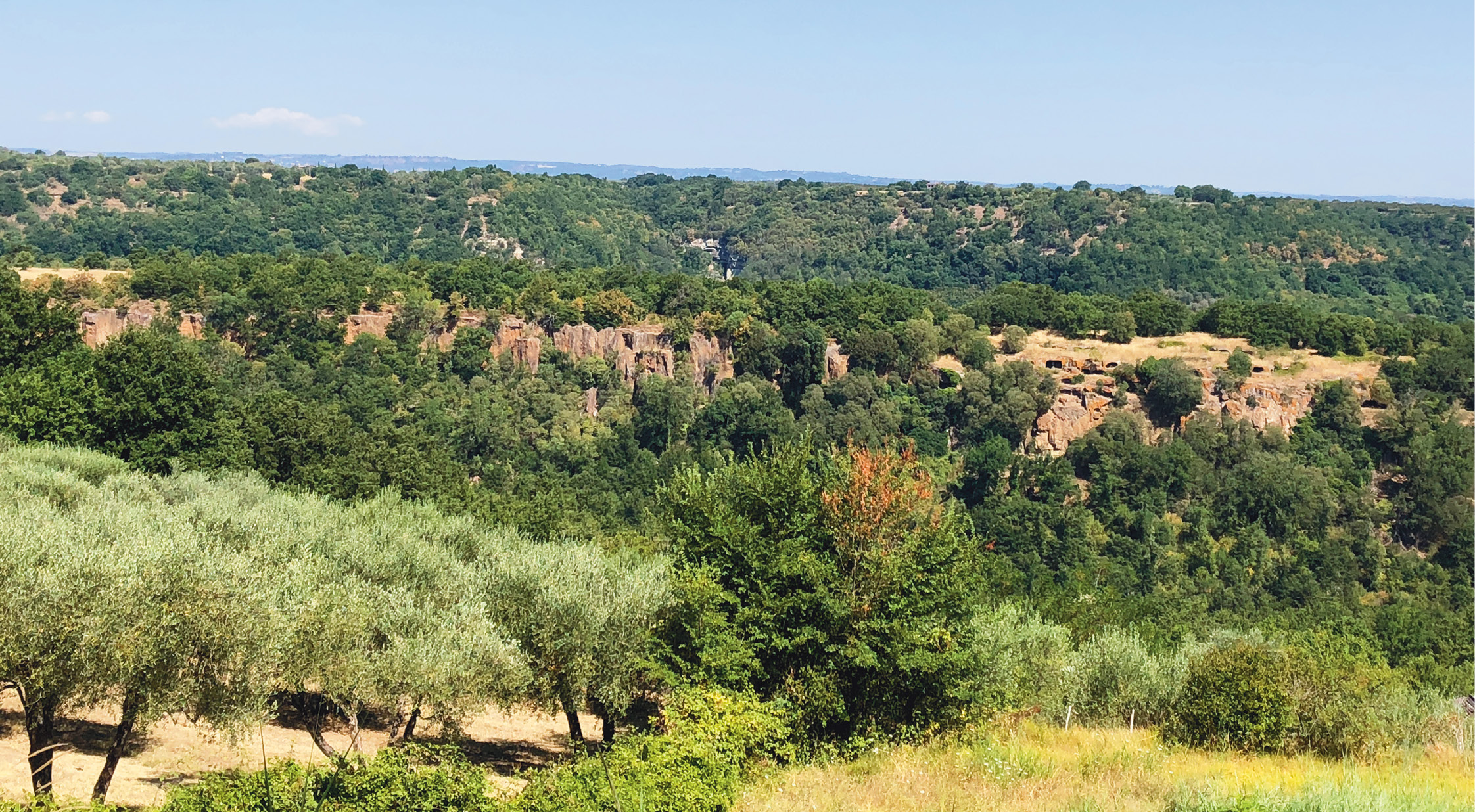
A remarkable cenotaph of the earlier Roman period lies about a mile beyond the church in the long Serraglio valley. It is not easily found, but is well worth the hike. The track to it leads up to open ground beyond the church, and then runs westwards in the direction of Monte Cimino, the dark extinct volcano that fills the far horizon. This track continues until it reaches the foot of a massive, wooded canyon, the Selva di Malano. The high hill above is known as Poggio Lungo. It is both magical and eerie. With long sections of rugged cliffs, this might be some African or South American valley, except a hazel plantation has now inveigled its way into the open oaklands. Continue upwards until a fork on the midslope, there bearing left and, after 200 yards, lies a remarkable monument. Originally a large boulder nearly 6m high, its top has been flattened for some kind of altar. This was reached by a steep staircase of eight steps on its back side, while the front – looking out over the canyon, back towards Statonia in the far distance – has been shaped into four sharply cut steps, with a long Latin inscription in two lines gracing the uppermost one. The inscription reads: ‘D Coelius Alexander and Quintia Hilara’ and dates to the 1st century AD. This couple’s cremated remains, presumably a man and his wife, were somehow placed here. Their impressive memorial belongs to a time when, given the density of tombs and monuments dotted around the Serraglio valley, the area was well populated. Did they live on the flat lands above the canyon, or were they citizens of Statonia, visible miles to the east overlooking the Tiber valley?
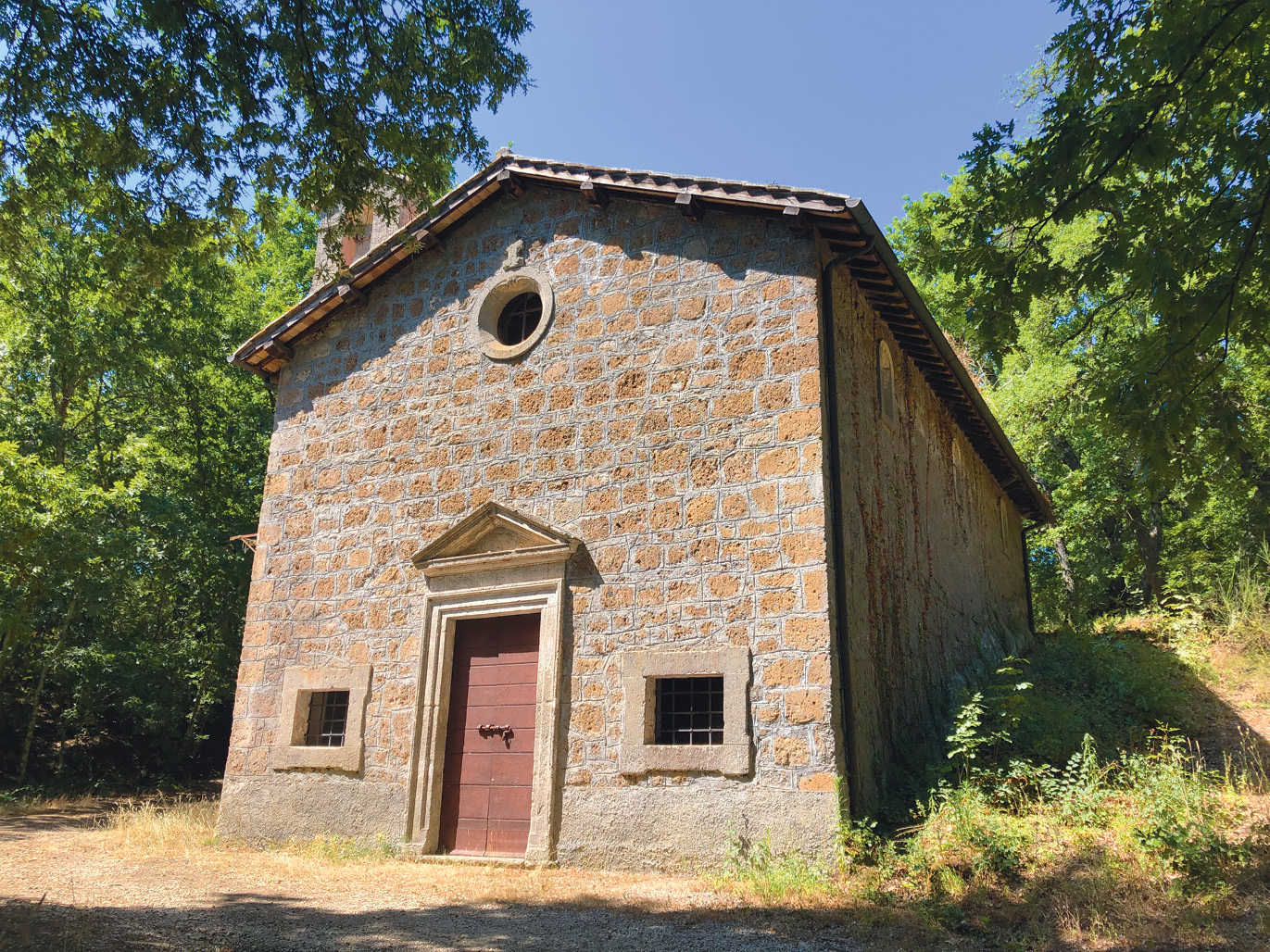
This cenotaph lost in the modern woodland appears odd, except there are numerous other examples in the hinterland of Bomarzo: one is a huge cube; others are shaped with steps. Many have modest inscriptions. But the most remarkable is known locally as the Pyramid.

Bomarzo’s Pyramid
The Pyramid, too, once commanded a grand canyon, less than an hour’s walk from Bomarzo castle in the area known as Rocchette. Taking the road out of Bomarzo for Viterbo, the path starts from the prominent water tower on the edge of the village. A track to the left leads past farms for half a mile, until a T-junction where an old rock-cut road bears to the right and on towards the edge of the canyon, the Tacchiolo valley, and the abandoned farm called Poggio Rocchette. A discreet little sign on the right, hardly worthy of the place, points to the Pyramid. Almost immediately, the path twists down a rock-cut route that is too narrow to call a road, yet is a man-made track through a fissure in the natural tufa rock. This track drops down to the upper wooded slope. Bending to the right, the well-trodden path winds through the woods to a clearing occupying a natural terrace about 200 yards away. The clearing is commanded by a huge boulder that has been shaped with steps to resemble a pyramid. Of course, with its dark volcanic mien it bears no actual resemblance to a pharaonic masterpiece, and yet…
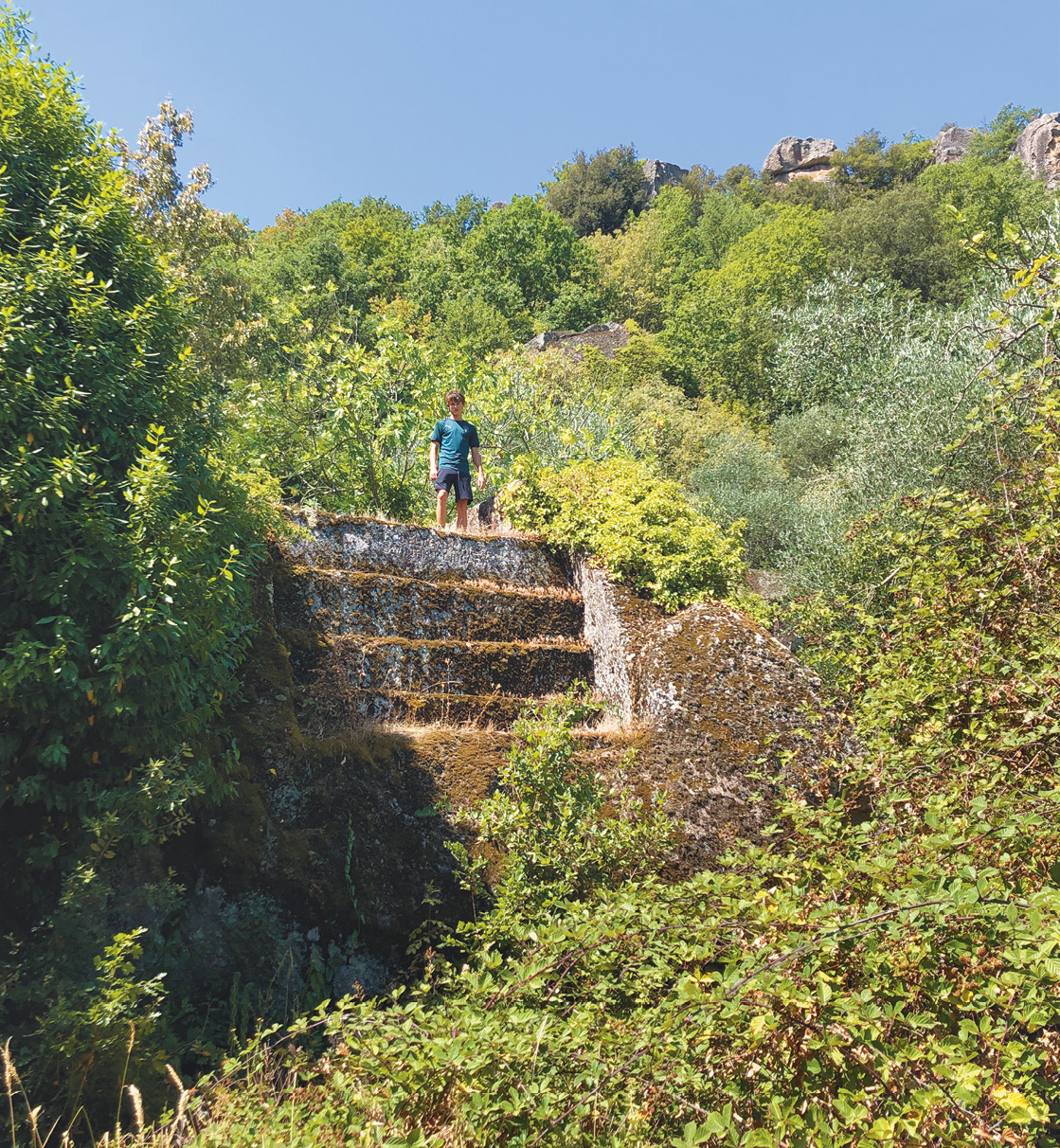
Remarkably, the Pyramid was only discovered in 2008, when a local farmer cleared it of vegetation and much of its lichen coating. Thirty steps lead up to settings for monuments – altars or tombs – long since lost. A drain runs down the face to keep these erstwhile altars or tombs clear of water. It stands about 10m high, and is thought to have been remodelled at least once. In its first phase, it had only steps. The second phase involved the altars or monument, associated with a tile-covered canopy supported by posts drilled into the Pyramid. The tiles from the canopy were stamped by the Domitii family, whose brickworks lay far below in the valley bottom leading to the Tiber.
In essence, it is probably a Roman imperial cenotaph that, by carving the natural rock, takes its cue from Etruscan traditions. (One interpretation is that the second phase is Medieval, but this seems improbable given the modest Medieval footprint in these valleys.) In scale and inventiveness, it matches the work of the Renaissance sculptors of the Sacro Bosco. Those sculptors, surely, were well aware of the work of these ancients, even if their memorials were coated in a fine lichen sheen.

The wedding
The wedding was a huge success. The owners of the Sacro Bosco, initially puzzled by the thought of taking vows in front of the ogre, used our photographs, and especially those with the bagpiper to drum up more matrimonial business. Thought-provoking and wonderful though the park is, it is the serene, wooded canyons around Bomarzo that linger in the mind. Unspoilt is the word that comes to mind. Here, vast tracts of liminal Latium have been left to the spectral presence of Etruscan cemeteries and the Roman citizens who hankered to be commemorated much as their erstwhile enemies had been. The vanity of the ‘pyramid-builder’ is as memorable as the ogre’s open gaze. Then, too, we now know, long before Vicino Orsini erected his great palace and took command of these canyons, this was densely settled country. This may explain why the Romans fought to defeat their neighbours and control both the Tiber and the deep valleys leading into it.

Further Reading:
• For the Sacro Bosco, see http://www.sacrobosco.eu/?lang=en.
• A good guide with a map, gazetteer, and, importantly, geo referencing is Stephan Steingräber and Friedhelm Prayon’s Monumenti Repustri Etrusco-Romani (Acquapendente, Associazione Canino Info Onlus, 2018).
• The best hiking map is Kompass 2472, Marsciano, Todi, Terni, Orvieto, Amelia, Narni (http://www.kompass.de).
All images: courtesy of Richard Hodges