Subscribe now for full access and no adverts
The Hurghada Museum opened in 2020 with the theme of celebrating beauty throughout Egypt’s long history. It is located in the south of the city, close to the airport. Construction of the building was financed by the private sector, leading to the unusual scenario of a two-storey museum, where the ground floor is a shopping mall, and the upstairs floor is the exhibition area.

Arriving at the museum is an odd experience. You buy your entrance ticket at the front gate and then walk through the grounds to get to the museum building. On your left is an abandoned Minions-themed children’s area, and on your right a row of boarded-up shops. On reaching the building, you must walk past more shops to find a nondescript staircase up to the museum. I spent about 90 minutes in the museum and saw very few other people in that time, which meant that I could take as long as I liked enjoying the exhibits and taking photos with my camera. There was no awkward discussion with anyone telling me to use my phone for photography.
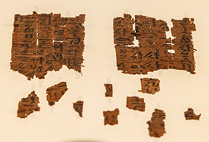
The exhibits are arranged in a broadly chronological order, from pharaonic Egypt through the Graeco-Roman period, Coptic period, Islamic period, to the modern era. At stages, there are thematic groups of objects exploring a particular topic related to beauty (such as perfumes) or music in ancient times. The lighting of objects is good, but unfortunately many items do not have a label.
The exhibits
From the Old Kingdom, there is an assemblage of husband-and-wife pair-statues in a display called ‘The Family Unit’. It is endearing to see the couples, side-by-side for eternity.
We next come to the highlight of the collection: a statue fragment of painted limestone found by Flinders Petrie in 1896, in a chapel north of the Ramesseum at Luxor. Unfortunately, no name is inscribed on the piece, so Petrie named it the ‘White Queen’. She remained unidentified until 1981, when a colossal statue inscribed for Meritamun was found at Akhmim bearing the same titles, suggesting that the ‘White Queen’ was also Meritamun.

Meritamun was a daughter of Ramesses II. On the death of Nefertari (Ramesses’ first consort), Ramesses married Meritamun and elevated her to Great Royal Wife. The Hurghada statue is life-sized and of the finest quality. The typical almond-shaped eyes are accompanied by a full mouth set in a slight smile. The ears are adorned with large circular golden earrings. The intricate wig is held in place by a diadem featuring twin cobras. On top of the wig, she wears a modius of cobras with solar discs. Originally the modius would probably have been topped by twin feathers, as in the Akhmim statue, but these are now lost. Around her shoulders, Meritamun wears a broad collar of five rows of repeated nefer symbols (meaning ‘beautiful’) and one lower row of droplet-shapes. In front of her right breast, she holds the counterweight of a menat necklace, a symbol of Hathor.

Tutankhamun objects
When I visited in autumn 2024, the Hurghada Museum was holding several important pieces from Tutankhamun’s tomb, though in due course these will be moved to the Grand Egyptian Museum (GEM) in Giza. In 2020, several Tutankhamun pieces were in London’s Saatchi Gallery in the Treasures of the Golden Pharaoh exhibition. When COVID-19 struck, the exhibition had to be closed early, and a decision made about what to do with the objects being returned to Egypt. Some of the exhibits were sent to the Hurghada Museum until the GEM’s Tutankhamun galleries were ready to open.

The statuette of Ptah, God of Memphis, is made of gilded wood, with a blue faience cap and a gilded bronze sceptre. He stands on a base in the form of the hieroglyph for maat (meaning ‘justice’). Tutankhamun would want to have figures of deities in his tomb to help him transition to the afterlife.
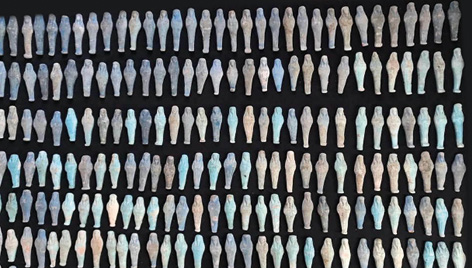
Shabti figures were placed in Egyptian tombs to work on the deceased’s behalf if any menial tasks had to be carried out in the afterlife. Tutankhamun was buried with 413 shabti figures – one for each day of the year, plus overseers. They vary in terms of quality and materials used. Three fine examples are displayed in the museum, carved out of gilded wood, with gilded bronze accessories.

Tutankhamun’s internal organs were removed from his body in the mummification process and placed inside four gold coffinettes, which were in turn placed inside a canopic chest. The space in the chest in which each of the coffinettes rested was topped by a beautiful calcite human-headed stopper, each representing the king wearing the royal nemes headdress. The facial features are delicately painted in black, with the lips painted in red. There is some doubt about whether this canopic chest was originally made for Tutankhamun, since the faces do not resemble other portraits of the boy king. Perhaps, as has been argued for other objects in the tomb, including some of the shabtis, they were unused items left over from some earlier royal tomb.


The word ankh in ancient Egyptian means ‘life’, but also means ‘mirror’, so a mirror and its case in funerary equipment would wish the deceased a good life in the afterlife. Two mirror-cases of gilded wood were found in Tutankhamun’s tomb, but neither mirror was present – they had presumably been stolen for their metal. The mirror-case in Hurghada has the king’s throne name written in coloured glass and semi-precious stones, encircled by a band of hieroglyphs.


The lotus chalice was one of the first objects found by Howard Carter, lying in the doorway of the antechamber of Tutankhamun’s tomb. It is carved from a single piece of calcite, in the shape of a lotus bloom. The handles depict the god Heh (representing eternity) seated on a basket, supported by lotus buds. Carter translated the text as:
May your spirit live, may you spend millions of years, you who love Thebes, sitting with your face to the north wind, your eyes beholding happiness.
He therefore named this object the Wishing Cup. The text of this wish is now written on Carter’s gravestone in Putney Vale cemetery in London.

Other objects
Moving on from the Tutankhamun display, there is a collection of royal statue heads. An attractive red granite head is labelled as Thutmose III, and would have been part of a larger statue. It was found at Karnak Temple, in the courtyard between the Eighth and Ninth Pylons. The king wears the red crown of Lower Egypt and has a uraeus on his brow to ward off his enemies.


The Valley of the Golden Mummies is a large burial site at the Bahariya Oasis, dating from the Graeco-Roman Period. Hundreds of mummies have been recovered, many of which were covered in linen, with a gilded mask, decorated with religious scenes on the chest. The deceased must have been wealthy in life to be able to afford an expensive burial.
Mummy portraits were attached over the face of high-status mummies in Roman Egypt, particularly around the Fayum region. They are painted in a naturalistic style on wooden boards. An example in the museum depicts an unnamed lady who lived in the Fayum in the 2nd century AD. Her hair is in the Roman fashion, parted in the middle then pinned above her head. She wears a necklace of oblong-shaped emeralds, and earrings of two pearls attached to a vertical bar. Hundreds of such mummy portraits are known, many perhaps giving an insight into the character of the deceased.

I finished my time in the museum in the Coptic section. The icon of St Cosmas and St Damian portrays twin brother physicians who were early Christian martyrs around AD 300. Being doctors, they are shown holding boxes containing medicines. Christ hovers above them, giving a blessing. In their lives, they practised medicine without charging a fee, attracting many to the Christian faith. They were arrested during the Diocletian persecution and beheaded.
Despite the unpromising location of the museum above the mall, and the lack of labels on many exhibits, I enjoyed my visit. The White Queen and the Tutankhamun pieces are exquisite, although the latter will be moved to Giza at some point. If you find yourself in Hurghada, I urge you to forgo your sun-lounger and take a few hours to admire the eternal beauty of Egypt at this excellent museum.

Geoffrey Lenox-Smith holds the Certificate in Egyptology from Birkbeck, University of London, and is one of our regular ‘Out and about’ contributors.
All images: the author, unless otherwise stated