

Subscribe now for full access and no adverts
The sun god Ra is the predominant deity in New Kingdom theology, as seen in previously explored texts the Book of the Heavenly Cow (AE 137) and Ani’s Book of the Dead (AE 145-149). However, this supremacy was taken to an even higher level in the Litany of Ra.
Books of the netherworld
Funerary texts relating to the journey of Ra through the underworld decorate the corridors of many of the royal tombs in the Valley of the Kings. It is this journey that each pharaoh must also make in order to be reborn and become one with Ra in the afterlife. The most common and oldest collection of these is the Amduat (‘That which is in the Underworld’), which appears in most of the New Kingdom tombs from at least Thutmose II to Ramesses IX.
There are, however, other texts:
The Book of Gates: As its name implies, this relates to the 12 gates of the night through which Ra (and, by implication, the deceased king) must pass in order to gain resurrection. It is inscribed in most of the tombs from Horemheb to Ramesses VII, mainly in the burial chambers. It appears on the sarcophagus of Sety I, too.
The Book of the Dead: This text is confined to the Tomb of Merenptah and four kings of the later Ramesside period (and was discussed in earlier articles relating to the Papyrus of Ani).
The Book of Caverns: This book is similar to the Book of Gates, but refers to the various caves through which Ra must pass. It is restricted to four later Ramesside tombs, with a complete version in the Tomb of Ramesses V/VI. The earliest version, however, is in the Osirion at Abydos.
The Books of the Heavens: Three later Ramesside tombs contain these books, which consist of the Book of the Day, the Book of the Night and the Book of the Heavenly Cow.
The Book of the Earth: This book is also found in three later Ramesside tombs, and describes the passage of the Ra through the underworld.
The Litany of Ra
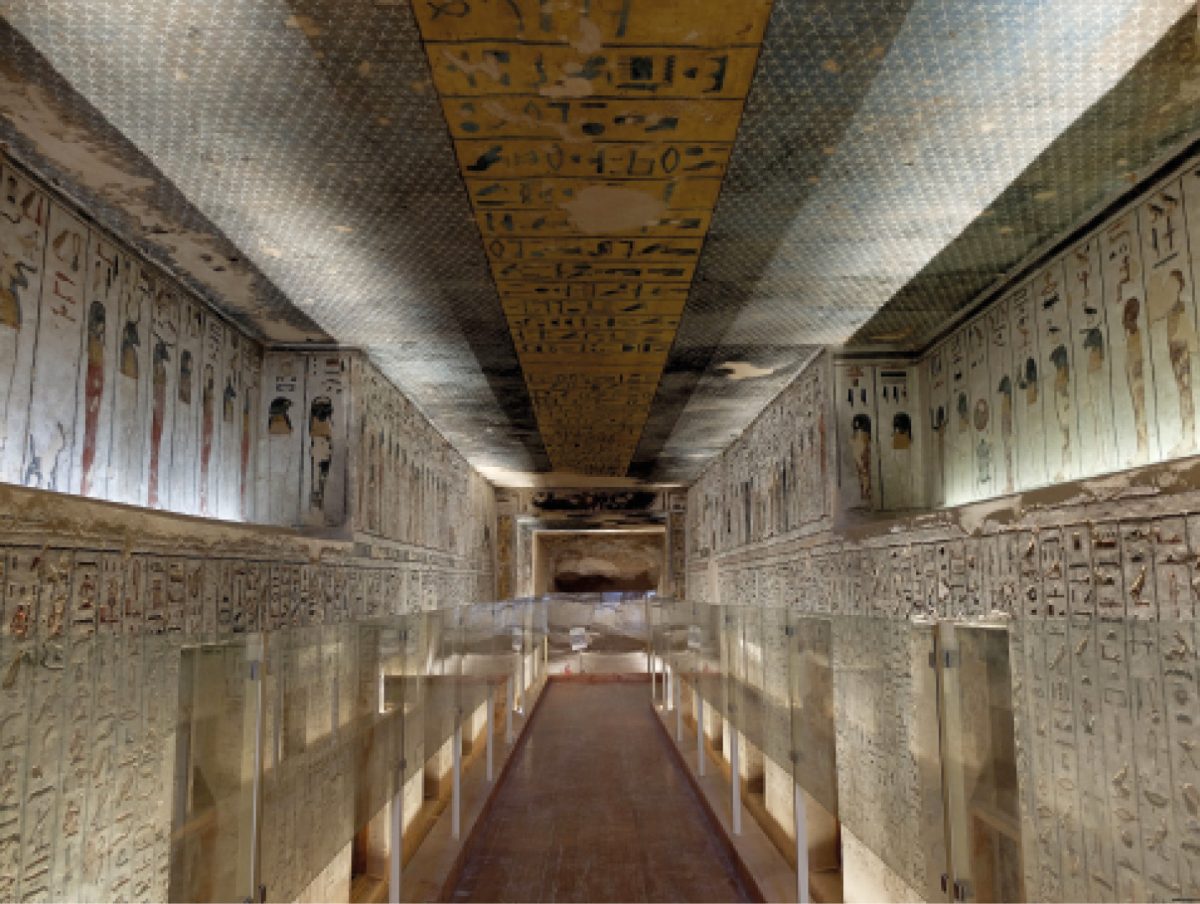
The Litany is present on the walls of the first two corridors in most royal tombs from Sety I to Ramesses X (with the exception of the Tomb of Ramesses V/VI – KV9). The text, however, first appears in an earlier Eighteenth Dynasty tomb – that of Thutmose III (KV34), although it does not figure in the tombs between Thutmose III and Sety I. In KV34, the depictions are painted on both columns in the burial chamber, with the text appearing separately on a mummy shroud dedicated to the king by his son and successor Amenhotep II. The tomb of the king’s vizier Useramun (TT61) contains the Litany too, but this is the only non-royal example before the various versions on papyri appeared in the Third Intermediate Period. Part of the text is inscribed on the sarcophagus of Sety I as well.
Although the Litany was mainly used by the deceased kings in their tombs, it seems that the text was used also in temple rituals, as it can be seen on the Column of Taharqa and in the chapel of the Twenty-ninth Dynasty king Hakor at Karnak, as well as in the Temple of Ramesses II and the Osirion at Abydos.
Structure
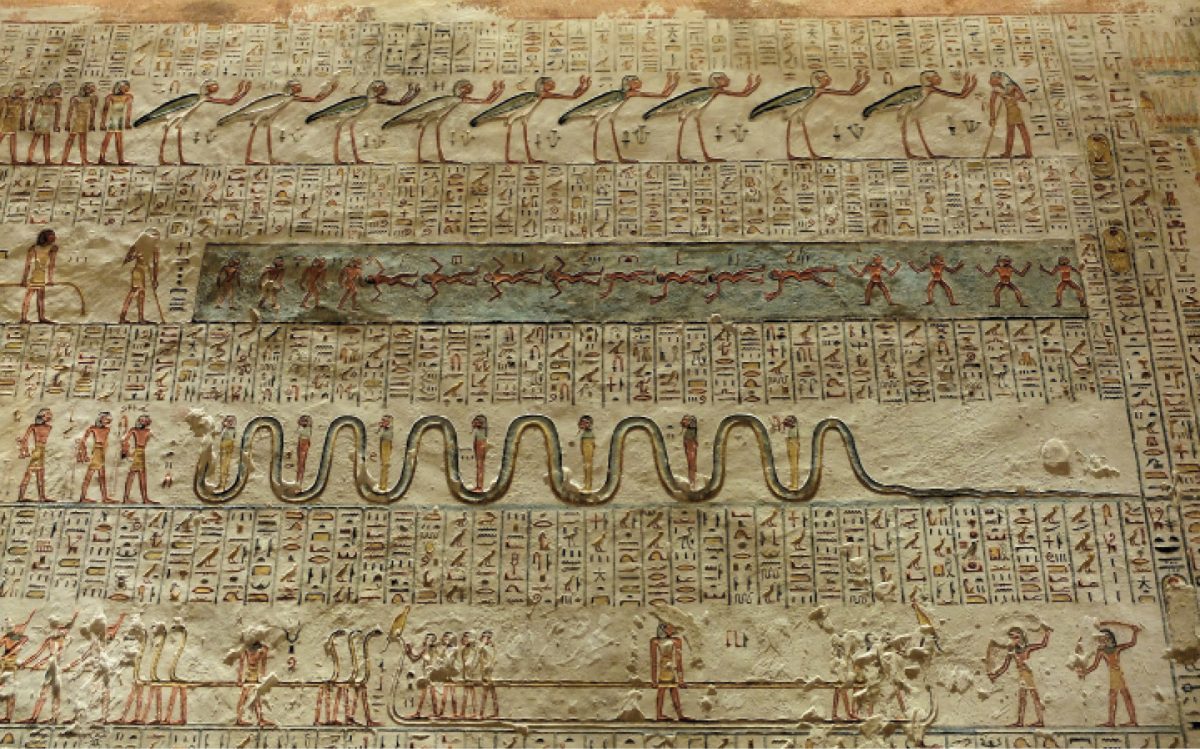
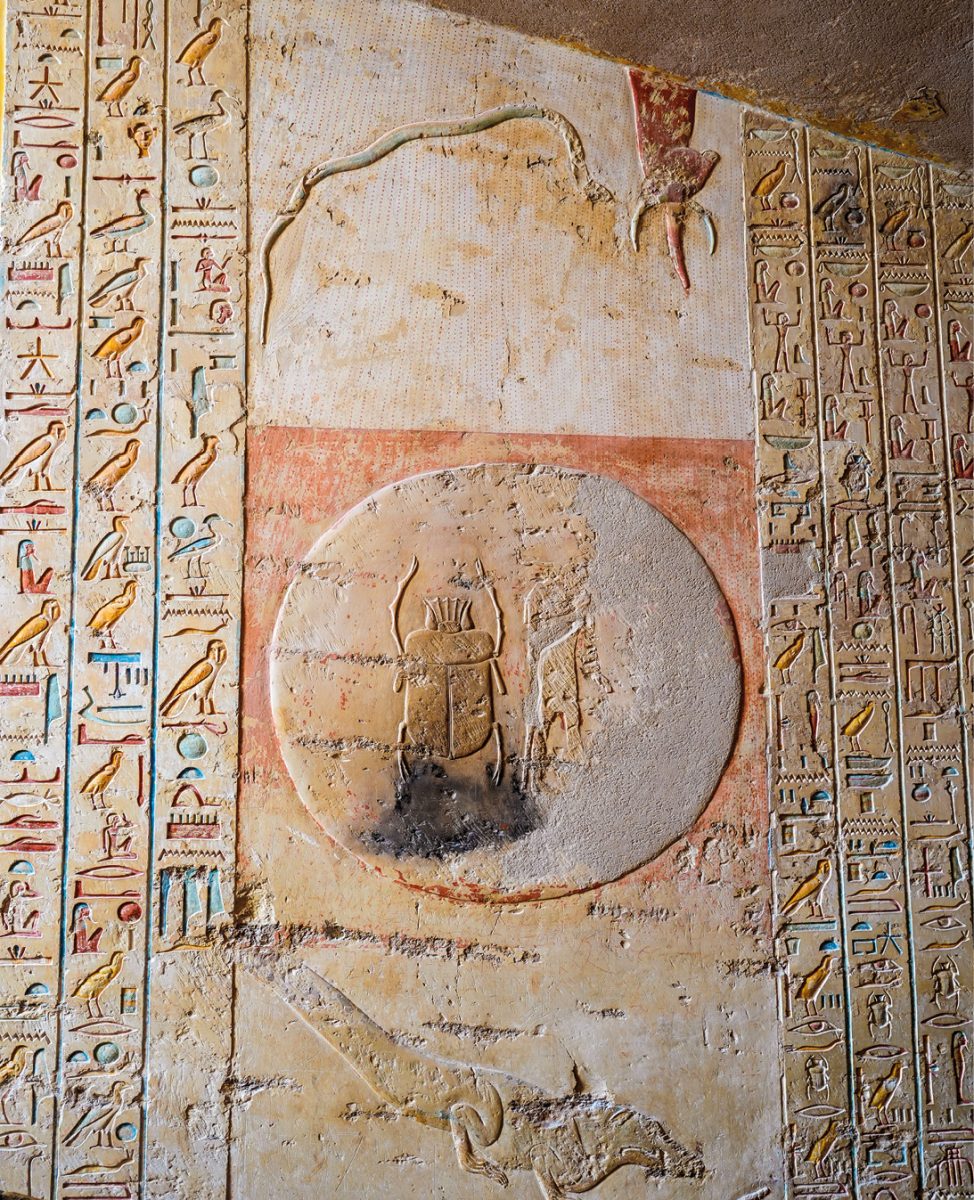
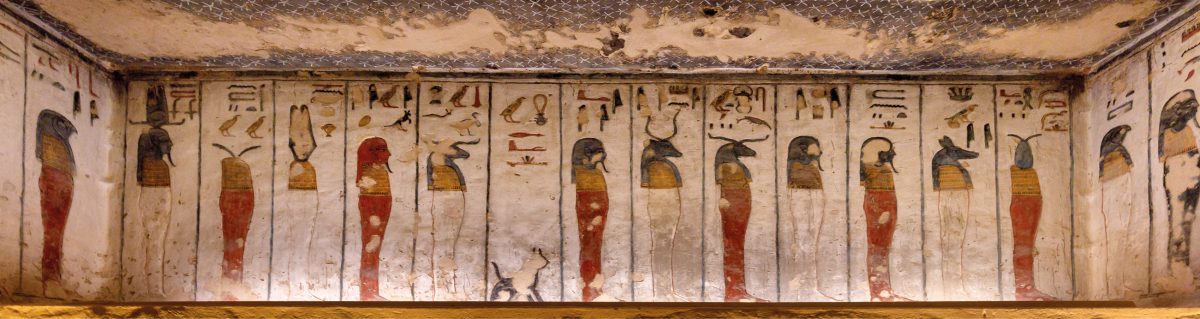
In the Ramesside versions, the Litany is inscribed vertically along the second corridor of the royal tombs. It starts with an introductory scene in which the sun disc encloses the scarab beetle Khepri (to indicate the rising morning sun) and a ram-headed male figure (to indicate the sinking evening sun, Atum). They are protected by a serpent and antelope above, and a crocodile and antelope below. Both antelopes seem to have a flame issuing from their heads. The crocodile and the snake are probably giving protection in the underworld, although the snake is not the cobra that we associate with kingship.
The accompanying text gives us the ancient Egyptian name for the text: Book of Praising Ra in the West, Praising the United One in the West. It goes on to say that the text should be recited on the ground at night, and that ‘this is the victory of Ra over his enemies in the west. It is profitable for a man upon earth; it is profitable for him after his burial’. Unlike the other books of the underworld, there are no gates, or caves, or hours for the god or king to negotiate. The emphasis is on the union (or merging) of Osiris and Ra, using the term ‘the United One’. Indeed, the first ‘Address to Ra’ emphasises this union with the name Djeba-demedj, the meaning of which is not clear, although the second part means ‘to unite’. The form portrayed is of a male mummy, with white crown and beard.
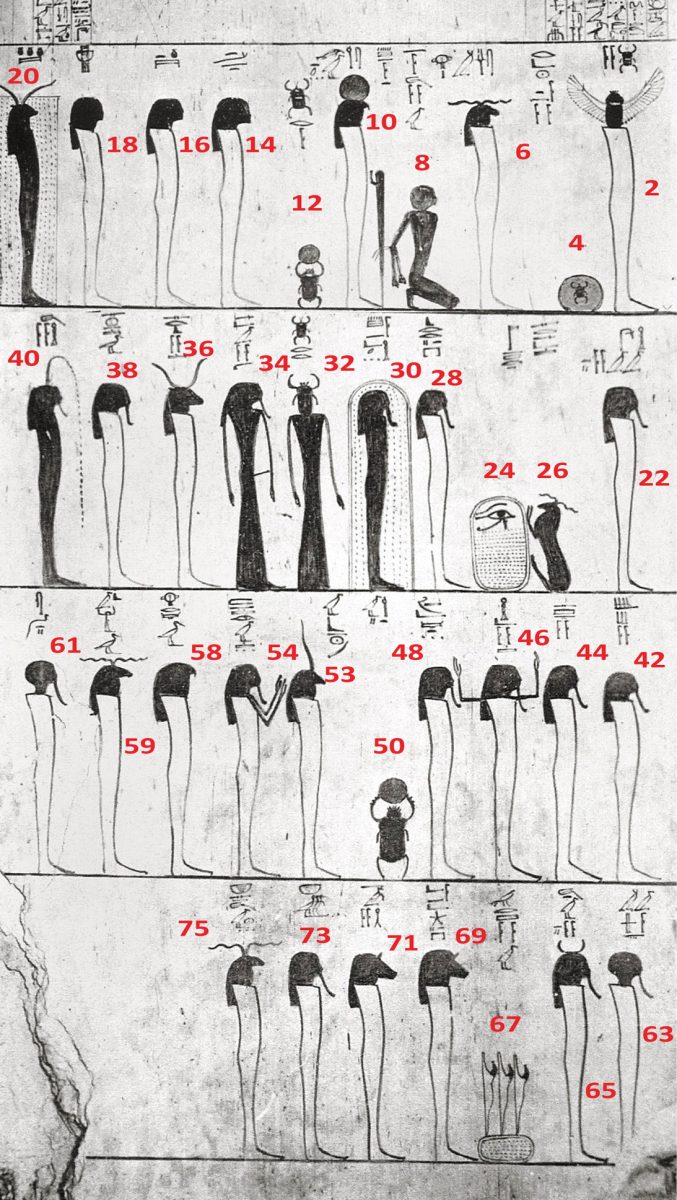
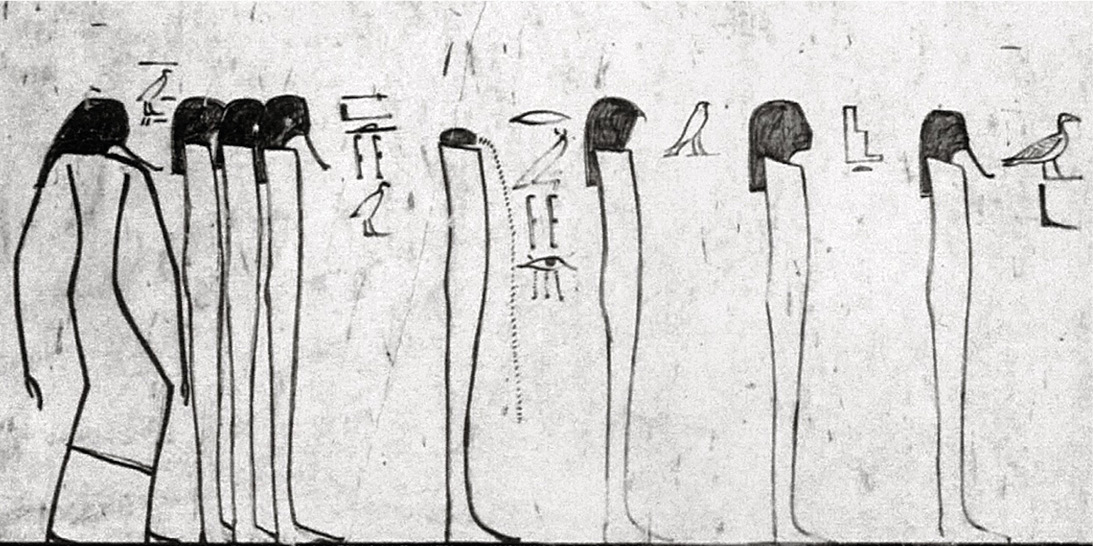
The Litany itself is divided into two parts, the first part of which invokes the sun god in his various forms – all 75 of them, mostly in mummified form. (The numbering system varies according to the scholar – here I refer to those set out by Darnell and Darnell, 2018.) There is a clear alternation between the forms, with the odd-numbered ones occurring on the left wall of the corridor, and the even ones on the right. This, however, changes at forms 53 and 54, which appear on the right-hand wall, so that even numbers occur on the left and odd ones on the right. Each figure is prefaced by an introduction in which Ra is addressed with the words ‘Praise to you Ra, great of power’, before describing the purpose or character of this transformed god, and ending with the words ‘You are indeed the corpse of…’ and then naming each. The exceptions to this ending occur in Addresses 1 to 10 which relate more to the transformative powers of Ra. All the forms addressed as corpses will, of course, rise again as the sun god.
Figures
As indicated, there are 75 forms of the sun god, mostly mummified, some of which are gods, and others goddesses. The male forms wear the divine beard, and three wear the Crown of Upper Egypt.
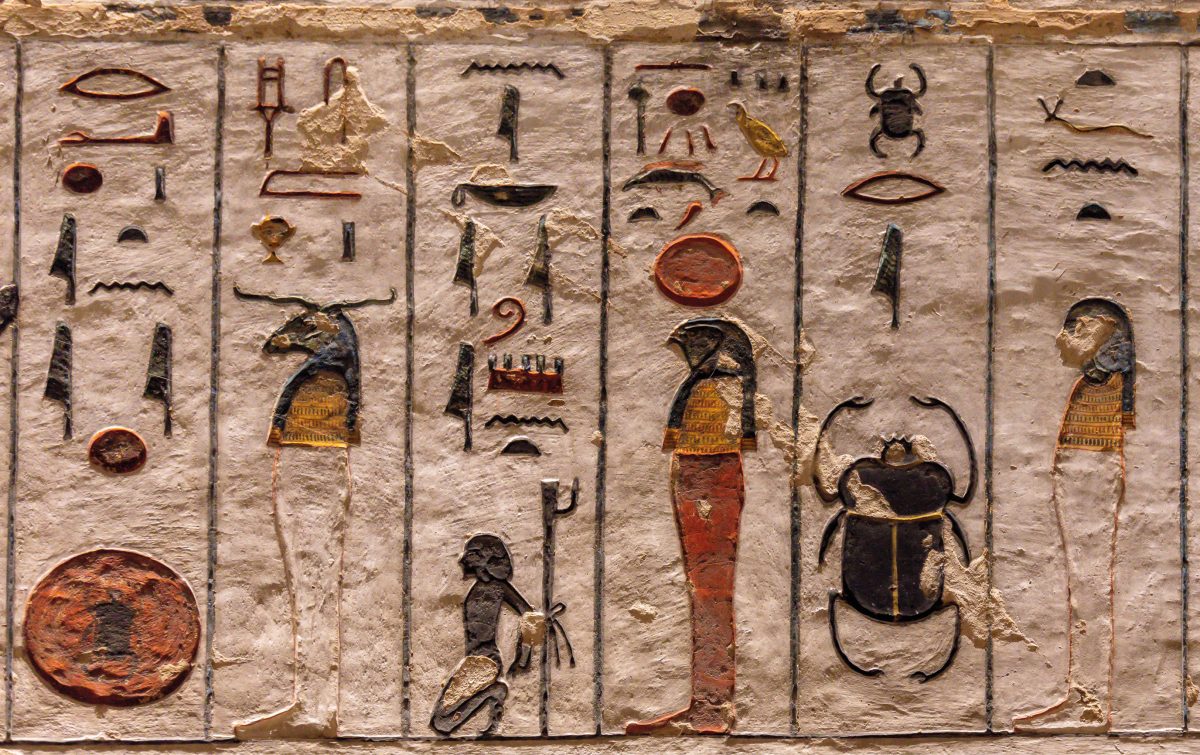
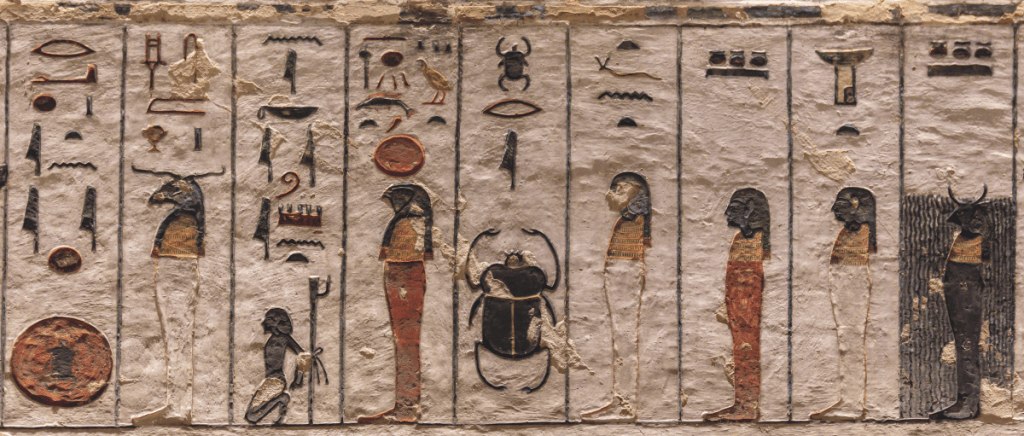
The Solar Disc: In the first (top) register of the Litany as it appears on Pillar 1 in the burial chamber of Thutmose III (KV34), from the right there is a mummified form with a winged scarab as a head. This represents Khepri (Address 2) and is described as ‘one who comes forth from his limbs’. Behind him is the sun disc itself, containing a scarab (Address 4) and described as ‘he who makes the Earth visible and illuminates those of the west’. His name is given as ‘He of the Great Disc (Aten)’. Further along the first row (behind the staked prisoner) is a mummified falcon with a sun disc on his head, called ‘the ba-soul of Ra’ (10). Next comes the scarab Khepri again, pushing the sun disc (12). This form also appears in the third register (50), where he is called ‘Illuminer’ or the ‘Lightning One’.
Some of forms on the Thutmose pillars are coloured red: these are mostly the sun disc itself, but include any forms associated with heat, such as the figure on the second row with a taper on his head (40), who is addressed as the ‘Burning One’ or ‘Flaming One’.
The deities of the Ennead/creation: Addresses 11-19 concern the Ennead of Heliopolis: Isis, Nephthys, Tefnut, Nut, Atum, Shu, and Geb, with Horus (instead of Set) and Khepri. The primeval god Nun (20) is in black and enclosed in lines of dots representing water. Osiris is not mentioned by name except as Khentamentiu (‘Foremost of the West’) or simply as ‘He of the West’ and is shown with the crown of Upper Egypt (31).
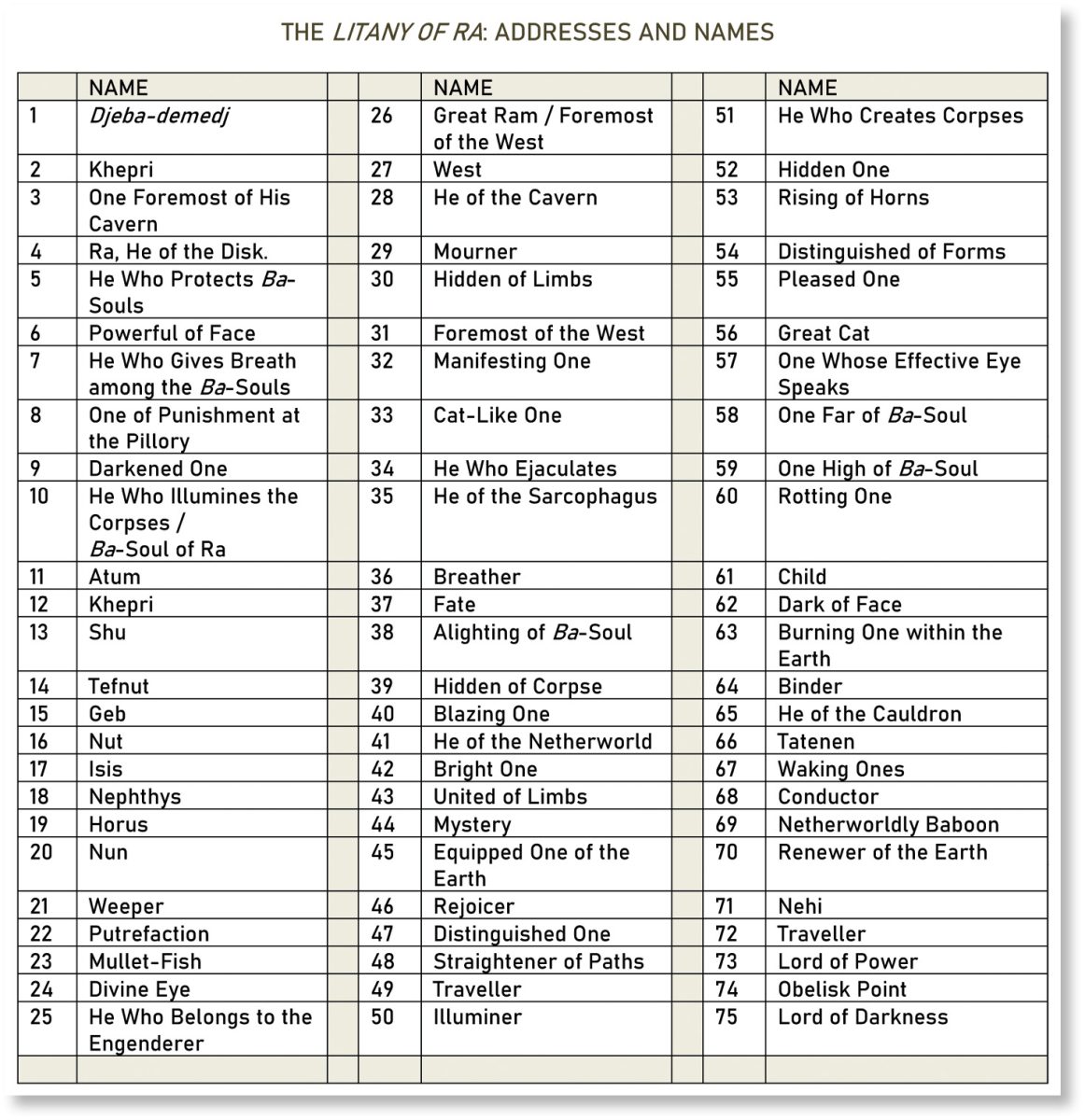
Decline and death of the sun god: Ra’s decline and death in the netherworld is shown by various forms such as ‘the Darkened One’ (Address 9), ‘He of the Sarcophagus’ (35), ‘Hidden of Corpse’ (39), ‘He of the Dark Face’ (62), and ‘Lord of Darkness’ (with a ram head – Address 75).
Ra is also portrayed as ‘a traveller’ (Addresses 49 and 72), presumably as he journeys through the netherworld, and as ‘Foremost of his Cavern’ (3), an important feature of the netherworld. A number of Ra’s other forms are difficult to understand and will not be commented on here.


Punishment of the damned: Many of the forms appear to be those that hand out punishment to the damned or the enemies of Ra. For example in Address 8, Ra is described as ‘He who punishes with a stake’ (with a graphic illustration of a prisoner tied to a stake). One is called ‘the Binder’ (64), who has what appear to be two ropes instead of a head. Another is called ‘He of the Cauldron’ (65), shown with a cauldron on top of his head. He is said to cut off the heads of those destroyed. One of the weirdest forms shows a mummified figure with a pot instead of a head, out of which comes flowing liquid (21). He is said to be the protector of Nun, and is called ‘the Weeper’.
Animal and bird forms
Animal forms are commonly represented in the Litany – the most interesting or mysterious ones are discussed below:
Baboon of the Netherworld: Baboons are normally portrayed greeting the rising sun (Khepri) in the east, but in Address 69, Ra is called a ‘jubilating baboon’, in a sense welcoming himself into a new day. The baboon here is called a ‘netherworld corpse’.

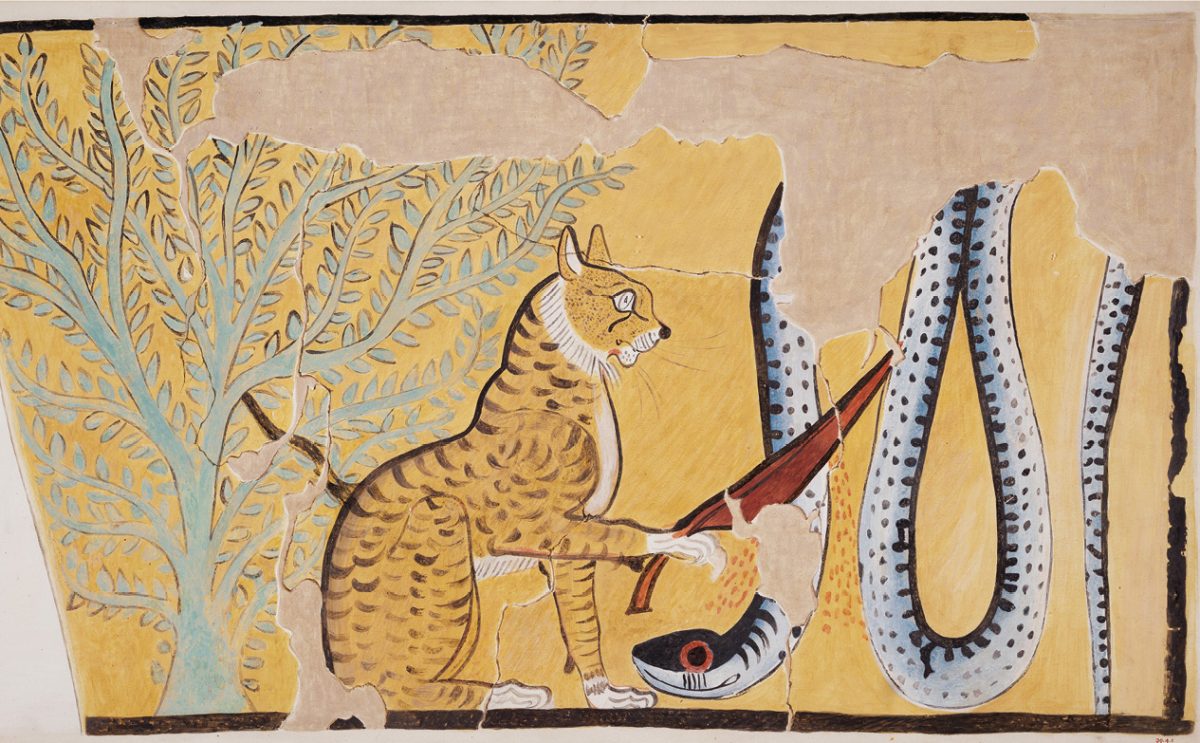
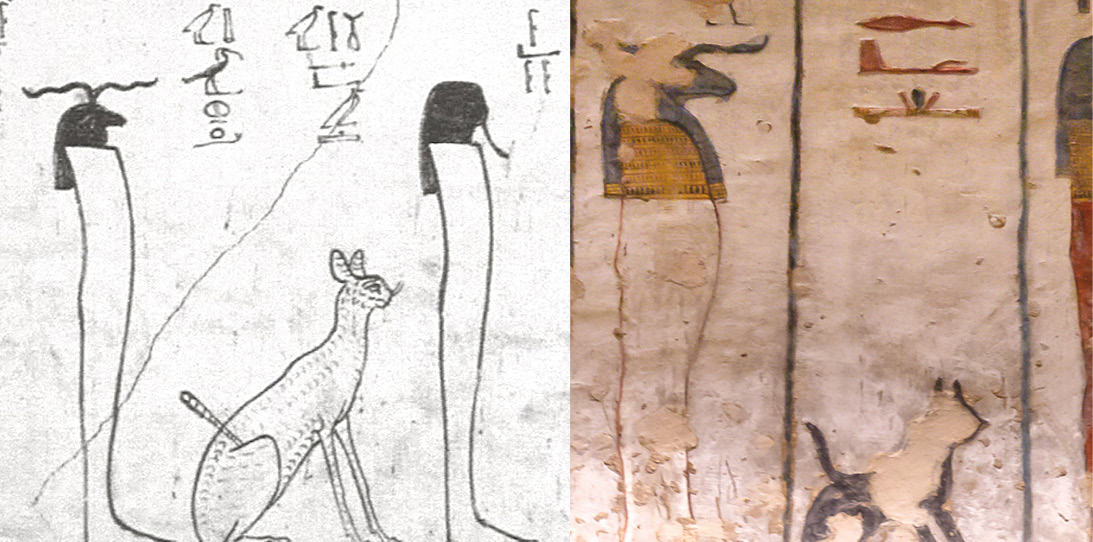
Great Cat: We are familiar with the Great Cat from Chapter 17 of the Book of the Dead, where he is seen slaying the arch-enemy of Ra, the serpent Apep (Apophis in Greek). He also famously appears on the walls of the Tomb of Senedjem (TT1) at Deir el-Medina, again slaying the serpent. In the Litany, the cat is not shown slaying the serpent. The version shown on the pillar of the burial chamber of Thutmose III has a knife in his back (Address 56), but is not depicted this way in the tombs of Siptah, Merenptah, and Ramesses III, where he is black and looks more like a domestic version of the species. The Address describes the cat as the ‘Protector of the Gods’, ‘Judge’, ‘Chief of the Council’, and ‘Foremost of the Sacred Caverns’. The cat is not mummified, but another Address (33) does show a mummified figure with a cat’s head called the ‘the Cat-like One’.
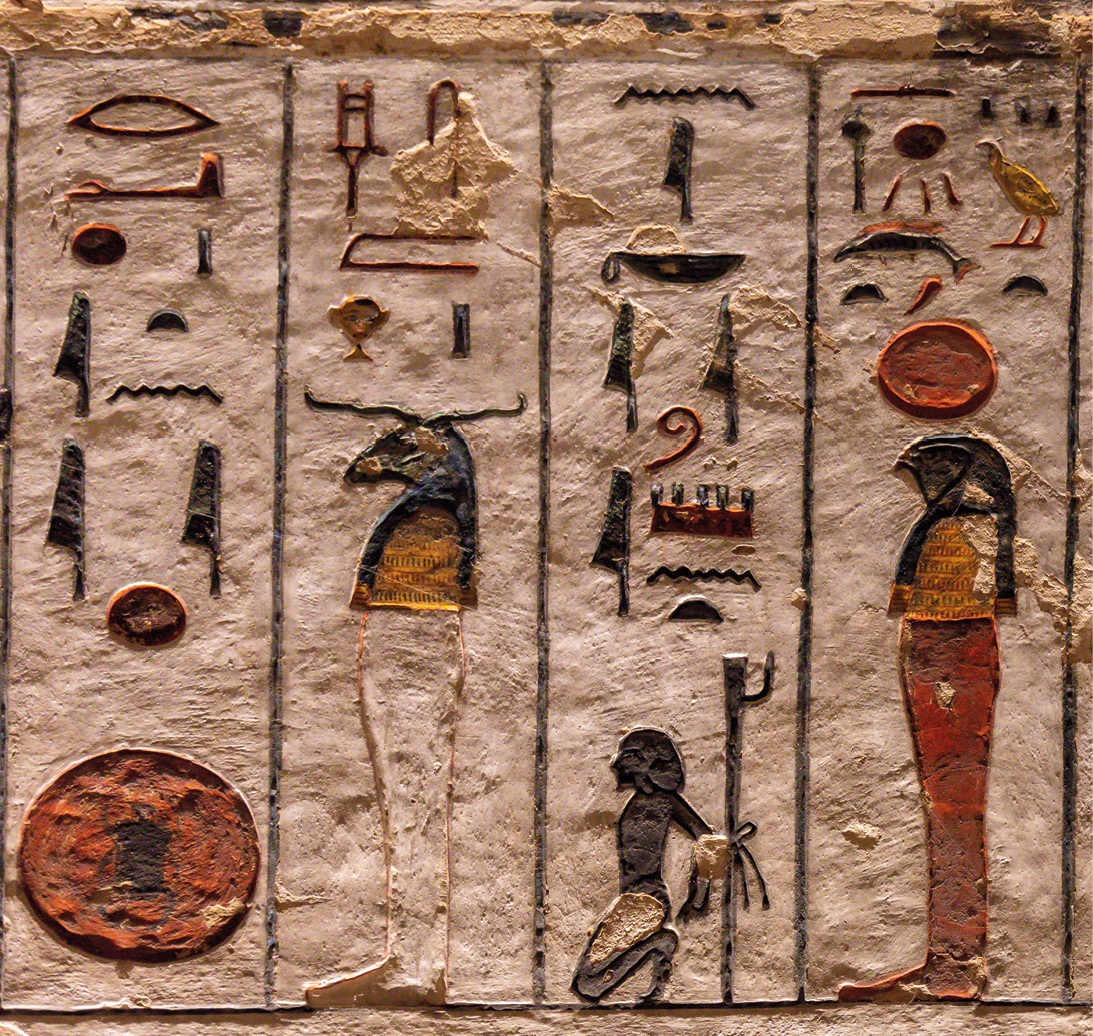
Oryx: The head of an oryx is portrayed in Address 53, describing the mummified figure as ‘Rising of Horns, Pillar of the West, dark of lock who is within the cauldron, you are indeed the corpse of Rising of Horns’. The oryx (certainly one of the most beautiful of the antelope family) is normally associated with the desert and hence with the god Set. Here, the association is with the cauldron, a form of punishment in the netherworld as portrayed in Address 65. In some versions, the Oryx is shown with one horn.
Mullet fish: Address 23 mysteriously shows three divine males with beards. The reference to mullet fish is unclear, but there must be some association with the sun god. The text describes the forms as belonging to his mysterious and hidden caverns.
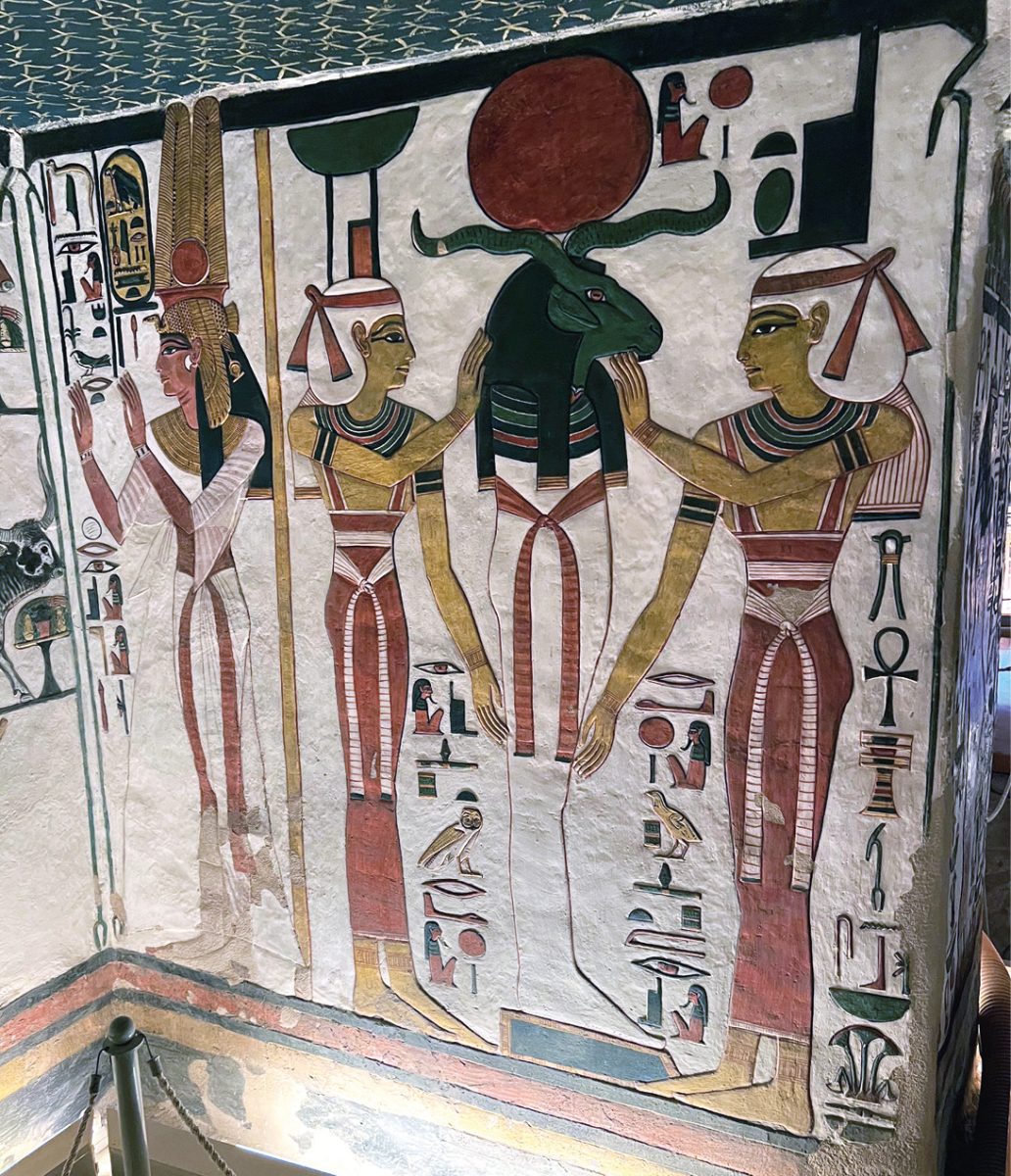
Great Ram: Address 26 shows a ram standing in adoration, described as Great Ram, ‘great of manifestations, begetting of horns’. In the Tomb of Thutmose III, the ram appears to rest up against the wadjet-eye, which is contained in an oval shape thought to be the sarcophagus.
Other animals portrayed include a boar named as Shai, the God of Fate (37 – whom we met when he stood under the scales in Ani’s papyrus), and a shrew which is described as the ‘One who is equipped of the Earth’ (45), the meaning of which is unclear. In the Litany, there are five mummified falcons portrayed as well.
Other figures
Most of the other forms portrayed are difficult to understand. Several refer to the ba-soul who accompanies the deceased in the netherworld as a mobile element, and illuminates the corpses as well as giving them breath. Address 61 refers to the corpse of the ‘Child’, which may relate to the rising sun, since Khepri is mentioned as rejuvenating after death. The Child has a red head on the Thutmose III column.
The nine litanies
The second part of the Litany is composed of a series of nine texts for further ritual use, in which the unity of Ra and Osiris is emphasised. The knowledge that the deceased king has acquired about Ra’s nocturnal forms will enable him to become one with the sun god. The Gods of the West are invoked to help Ra in his various forms to overcome his enemies, notably Apep. The triumph of Ra is also that of the king who finally becomes identified with the sun god.

The supremacy of Ra
Our encounter with the Litany of Ra shows that, in Theban theology, there was a belief that Ra was the all-encompassing god of creation who could incorporate many other forms, including even the gods of the Ennead. As he is the sun god, he is clearly visible every day from dawn until dusk. This concept would be taken to its zenith in the later Eighteenth Dynasty, when the sun disc as the Aten would take centre stage in the semi-monotheistic theology of Akhenaten. Nevertheless, despite his supremacy, the sun god dies at the end of each day and descends to the realm of Osiris, with whom he unites and merges. The Litany is reminiscent of Chapter 17 of the Book of the Dead, where Ra says of himself ‘I am yesterday, I know tomorrow’, yesterday being Osiris and tomorrow Ra. As part of the royal funerary ritual, the king is transformed from Osiris into Ra on a daily basis.
Andrew Fulton studied Theology at the University of Cambridge and holds the Certificate in Egyptology from the University of Manchester. He is a regular contributor to AE magazine, including articles on Vespasian in Egypt (AE 129) and Ani’s Book of the Dead (AE 145-149).
• A Piankoff (1964) The Litany of Re (Bollingen Series 40/4; New York: Pantheon Books).
• E Hornung (1999) The Ancient Egyptian Books of the Afterlife (translated edn; Ithaca: Cornell University Press).
• J Darnell and C Darnell (2018) The Ancient Egyptian Netherworld Books (Atlanta: Society of Biblical Literature).
• E Hornung (2005) The Ancient Egyptian Books of the Underworld (translated edn; London: Karnak House).