Subscribe now for full access and no adverts
…once the gods had partaken of the spiritual essence of the offerings placed on their altars, the physical remains of the food and drink could be removed for redistribution…

Temple archives recording deliveries of tribute, and calendars listing supplies designated for specific festivals, reveal that bread and beer, in vast quantities, were supplied for cult, mortuary, and funerary offerings. Egyptians believed that once the gods had partaken of the spiritual essence of the offerings placed on their altars, the physical remains of the food and drink could be removed for redistribution to temple workers – a practice known as the ‘reversion of offerings’. This was based on the sharing out of food according to rank, and created an effective salary structure for temple personnel, from the priests to the lowliest doorkeeper. Similar pay scales applied to other workers, especially state employees.

Rations
The supplies allocated as wages to the Giza pyramid-builders’ community of Heit el-Ghurab, and the tomb-builders of Deir el-Medina, varied in both quantity and quality, depending on the status of the worker. These supplies are conventionally referred to as ‘rations’, a term that hides the fundamental economic significance of food.
Grain is the basic exchange commodity offered in scenes of marketing, where grain sacks carried on the buyers’ shoulders were the equivalent of moneybags. In the Fifth Dynasty Tomb of Niankhkhnum and Khnumhotep at Saqqara, one purchaser asks for six loaves to be ‘placed on the mat’ in exchange for two measures of wheat, a rare instance of a ‘price’ being stated. This example of a ‘sale’ indicates a clear understanding of the relationship between the values of the raw ingredient (the grain) and the end-product (the loaf).

At all stages of its use, grain was measured by volume, rather than weight. Surviving mathematical texts contain many calculations concerned with finding the capacities of granaries and the comparative values of grain products, principally bread and beer. The units employed were the hekat basket measure, and the khar sack. A granary’s capacity was given as the number of khar needed to fill it. Although measurements were not precisely standardised, when calculating volumes, the cubic cubit is reckoned to be equal to 30 hekats or 1½ khar.

Edible wages
In the Lahun Temple Distribution List, each employee’s share of the god’s bounty was calculated in terms of loaves and beers of different qualities. A typical daily wage – for example, for a field labourer or porter – consisted of ten loaves of unspecified size or type, and a measure of beer, which might vary between one third of a jug and two whole jugs of unstated volume.


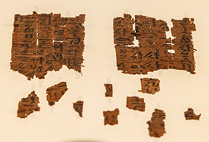
Problem 65 of the British Museum’s Rhind Mathematical Papyrus (RMP) purports to calculate the bread rations shared by a gang of ten workmen: ‘dividing 100 loaves among 10 men, including a boatman, a foreman, and a doorkeeper, who receive double portions’. The results show that seven of the gang receive ‘seven loaves plus nine-thirteenths of a loaf’ each, while the higher-paid men each receive ‘fifteen loaves plus five-thirteenths of a loaf’. Three double shares plus seven single shares should add up to 100. Such very precise calculations appear to allocate tiny, if not unmeasurable, fractions of a loaf of indeterminate size, but it is unlikely that men would have been paid in crumbs.

Theoretically, a higher-ranking official or skilled worker might be paid with more bread than he and his family could possibly eat in one day. Documentary evidence suggests that the rations issued to state employees were, to a certain extent, notional. Records were kept of each person’s entitlement, and he could take it in food or other goods of equivalent value from the storehouses of his employer. A legal case of the time of Ramesses II concerned accusations that family members of a middle-class state employee were taking more than their due from the royal stores. In modern terms, the extraction of goods to which they were not entitled, and the bartering of those goods for others, amounted to embezzlement and fraudulent conversion. Soldiers who were quite poorly paid had even less opportunity to steal. They were issued with bread tokens – loaves of bread carved from wood and inscribed with the number of that particular type of loaf to which the bearer was entitled. He could redeem his token at the army stores, where scribes recorded how often he made a withdrawal, and how much of his allotted wage he was owed. The granaries of the Middle Kingdom fortress of Uronarti held far more grain than would have been required to feed the garrison stationed there, suggesting that grain also served as an exchange medium for trade with the local population.

Beer and bread
Beer, that other grain-based dietary essential, was created from the fermentation of a yeasted bread dough and, being made with boiled water, it was safer to drink than water from wells or the river. Nutritionally, beer was high in carbohydrates, and the yeast provided a useful source of B-vitamins. The ‘strength’ of Egyptian beer was not necessarily an indication of alcoholic potency, but depended on the quality and volume of its grain or flour content. A jar of beer had the same value, in economic terms, as a loaf of bread made from the same flour. Several RMP problems deal with pesu, sometimes called ‘baking values’, which apply to both bread and beer. The pesu is calculated as the number of jars of beer or loaves of a particular type that can be made from one hekat of grain or flour. The higher the pesu, the poorer the quality of the bread or beer.

Meticulous calculations of conversions between grain and flour, and bread and beer of different pesu represent theoretical exercises in dealing with ratios and fractions, presented as real-life problems of rates of exchange, and comparative economic values. Similar calculations were employed in questions of livestock-feeding (for instance, in providing the needs of cattle or poultry kept in different conditions) or for different purposes. Fodder grain was just as valuable as seed grain or dietary cereals.
Surviving contracts of hire or purchase show that a metal standard was recognised for pricing more valuable goods, with a volume of grain being equated to a weight of copper which, in turn, was linked to silver or gold. However, the possession of metal in any quantity was far beyond the expectation of most Egyptians, while a system based on grain and bread was understood. Being paid in a currency with which you could feed your family, directly, was a highly practical way of life.

All images: Hilary Wilson (HW), unless otherwise stated