Subscribe now for full access and no adverts
In an article I wrote for the 50th issue of Ancient Egypt magazine (October/November 2008), I quoted from an ancient diplomatic letter addressed to Amenhotep III, in which an Assyrian king wrote ‘Gold in your country is like dirt; one simply gathers it up.’ This quotation, together with many other sources of inspiration, led some years later to my first book A Gift of Geology, in which I explored my deeply held view that the development of pharaonic Egypt owed a great deal to its vast mineral wealth, and the power and influence that such mineral wealth provided.

Metals
Pharaonic Egypt had abundant access to metals such as gold and copper, principally in the Red Sea Hills, the desert mountain range that lies between the River Nile and the Red Sea. Over immense periods of geological time, the ancient rocks of the Red Sea Hills had endured earth movements on a scale that is difficult for us to comprehend, from vast volcanic eruptions to collisions between long-lost continents. Tortured and. twisted over hundreds of millions of years, the naturally low and diffuse mineral content that is present in most rocks became concentrated into a network of mineral-rich veins that cut through the strata of the Red Sea Hills.
It appears that copper was the first metal to be exploited in the ancient world: the earliest evidence for smelting copper ores was discovered in Serbia, dating to c.5500 BC. However, it has not been possible to reconstruct how this technology developed. The first essential requirement for any metal-working technology is the development of effective prospecting methods to identify the metal-rich rocks. With copper, early prospecting is likely to have focused on the distinct blue or green colour of weathered copper minerals – colours that can be readily identified in the landscape. The second essential requirement was the ability to smelt the ores. Although camp fires would not typically reach the temperatures required for the first accidental smelting of copper, early pottery kilns are likely to have allowed sufficient temperatures to be sustained, heralding the beginning of the slow transition from stone to metal tools.

It seems likely that the technology to exploit and process copper was imported into Egypt sometime around 3500 BC. Evidence for the earliest trading in copper comes from the Predynastic Ma’adi culture, a distinctive group known only from a small number of sites around modern Cairo. The people of the Ma’adi culture had strong links with Palestine, and the copper trade in which they engaged probably involved donkey caravans crossing the Sinai Peninsula. Ironically, Sinai was to become one of ancient Egypt’s most active areas of copper exploitation, with evidence for mining copper and turquoise (a copper-based gemstone) known from at least the Early Dynastic Period.
Gold
In the Red Sea Hills, copper minerals will often have been found in association with white quartz veins. Quartz formations such as these may also have included gold. Unlike most copper deposits in Egypt, gold will have been present in its native metallic form, and therefore did not require smelting. Once again, our understanding of the archaeology of the earliest phases of gold exploitation in ancient Egypt is lacking. Maybe it was simply sunlight glinting on metallic gold exposed in the walls of the many wadis that crossed the Eastern Desert that first led to the identification of gold in this remote and mountainous region. Alternatively, as the wadi walls became weathered and eroded, fragments of gold would have been washed out of the exposed quartz veins and deposited among the wadi gravels.

There is evidence that both hard-rock quarrying of quartz veins and exploitation of alluvial or placer deposits from wadi gravels was undertaken in Egypt from the late Predynastic Period. This early exploitation of gold, however, was probably undertaken by the indigenous people of the Eastern Desert, whose familiarity with the landscape made them effective prospectors. It seems, therefore, that the earliest steps on ancient Egypt’s road to great wealth may not have been taken by the pharaonic Egyptians, but by the little-understood people who inhabited the Eastern Desert. For the cultures of the Nile Valley to benefit from the mineral wealth of the Red Sea Hills, they will have needed to mount trading expeditions, and to have maintained reasonable relationships with the indigenous desert-dwellers. These initial trading expeditions would not have been undertaken lightly, as the pharaonic inhabitants of Kemet (the ‘Black Land’) regarded the barren areas of Deshret – the areas beyond the Nile Valley – as places of spiritual chaos. Evidence suggests that in the period leading up to the Middle Kingdom, most of the sites of ancient gold exploitation lay in the northern and central areas of the Red Sea Hills. The early importance of these areas is highlighted by one of Predynastic Egypt’s most important regional centres, Naqada, which lies opposite the mouth of the Wadi Hammamat, a key route into the gold-rich regions of the central Eastern Desert. Naqada is a modern name for the site which was known to the ancient Egyptians as Nubt – the ‘City of Gold’, probably because of its importance as a gold-trading centre. New Kingdom conquests into Nubia (a name that is also derived from the ancient Egyptian term for gold) progressively allowed pharaonic influence to extend further south, expanding the areas of mineral wealth that were available. It was perhaps not until the New Kingdom, however, that the natural wealth of the Eastern Desert and Nubia came under full and direct pharaonic control. A range of new mining and mineral-processing techniques was introduced at that stage, together with a widespread expansion of gold-working across the area.


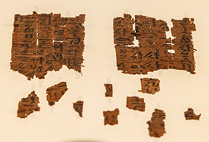
The New Kingdom prospectors extended the skills that had been developed in the earlier periods of the pharaonic era. One startling survival from this time is a map of part of Wadi Hammamat which was drawn on papyrus and, despite being some 3,500 years old, shares many features with modern geological maps. Nonetheless, the clearest evidence for the knowledge and skill of the ancient prospectors is the fact that almost every gold-mining site identified by modern geologists in Egypt and Nubia has been found to have been worked to some extent in antiquity.

Alloys
We tend to think of mineral deposits as containing only a single metal, perhaps gold or silver. In reality, these and other metals will combine naturally. Although silver was less common than gold in ancient Egypt, all the gold deposits of the Eastern Desert contain significant proportions of silver, and there does not appear to have been any ancient technology capable of separating these two metals. Rather than being deliberately produced, the metal known to the ancient world as electrum appears therefore to have been a natural alloy of gold and silver. By contrast, although ores of copper naturally contained some arsenic, there is emerging evidence to suggest that in the Old Kingdom arsenic may have been deliberately added to copper to produce more durable tools, particularly for use in stone-working. Subsequently, as technology developed, tin became alloyed with copper to produce bronze. Despite there being some evidence for mining of tin in Old Kingdom Egypt, there is little evidence to suggest that bronze was being produced at such an early stage in the pharaonic era.

Stones
The geological processes that led to the formation of metal ores in Egypt’s Eastern Desert also led to the formation of certain types of gemstones, including turquoise, jasper, amethyst, and beryl. The key features of each type of gemstone, such as the colour, depend on the chemistry of the fluids from which the gemstones initially formed. For example, emeralds are a form of beryl in which the green colour is derived from the presence of chromium or vanadium. Ancient mining of gemstones was widespread in the Eastern Desert, adding significantly to Egypt’s mineral wealth.
Another natural resource that was exploited extensively across Egypt was stone. A wide variety of stones were worked, from limestones and sandstones that were quarried close to the River Nile, to carefully selected decorative stones such as dark-coloured basalts, or the distinctive granites of Mons Claudianus, which could be found only in Egypt’s more remote areas.

The ancient Egyptians did not need to build in stone, at least not in the areas close to the River Nile, where large and often elaborate structures were built from sun-dried mud-brick, a versatile and durable construction material. The use of stone in construction probably developed with early concepts of the afterlife, and the identification of tombs and other ritual structures as ‘mansions of eternity’, structures that needed to last for ever. As the ritual function of stone developed, it seems likely that specific stones took on particular meaning.
For example, dark-grey and black rocks such as basalt appear to have been used in pyramid temple floors to represent the dark soils of the Nile Valley, with red stones perhaps developing associations with sun-worship. These ritual associations led to pharaonic mining expeditions to far-flung areas of Egypt to seek out particular rock types. Pharaonic ritual was not the only factor that influenced quarrying activity, however. The later Roman occupiers of Egypt saw similarities between the colour of the rocks at Mons Porphyrites, a mountain peak deep in the Red Sea Hills, and the imperial purple of ancient Rome. Extensive quarrying of this Imperial Porphyry was undertaken to provide monumental elements for some of ancient Rome’s grandest buildings.

In some cases, there is evidence that the natural resources of the Red Sea Hills were exploited for rather mundane purposes. In the western foothills of the Red Sea Hills are the remains of a small cluster of stone buildings, inside which are piles of green-grey, platy stone fragments. This unremarkable-looking material is natural talc, which had been quarried from a series of seams exposed in the surrounding hillsides. It appears that this small and rather remote site had been established solely for the extraction of this single natural resource. Judging by the ceramic fragments that are scattered around the site, it was active in the Graeco-Roman Period.
In addition to the wealth associated with metals, gemstones, and decorative stones, it is evident that the people of ancient Egypt were willing to endure the hardships of Egypt’s deserts to recover natural products that were suited only to more everyday uses.

Logistics
The prospecting and quarrying activities that developed in ancient Egypt varied in scope. Early activities by the indigenous inhabitants of desert regions are likely to have been relatively small-scale, as was the targeted exploitation of gemstones during most phases of the pharaonic era. As we have already seen, the settlements that formed the focus of mining activities for talc and gold were relatively small. These settlements were built from stone, not because of ritual considerations, but because stone was the most readily available material in these remote and arid areas.
From the New Kingdom onwards, the number of quarry sites expanded, taking on almost industrial scale in some cases. Ramesside texts indicate that quarrying expeditions despatched to Wadi Hammamat involved up to 8,000 people, with more than half of those being soldiers required for the security of the expeditions. Perhaps, by that stage, the indigenous people of the desert regions were aggrieved that their main source of wealth was under the direct control of ‘invaders’ from the Nile Valley? The scale of the Roman mining settlement at Mons Claudianus was similarly huge, with a vast fortified structure that served as the main accommodation area. A second, equally large structure was used to house the many draught animals that were required to transport the quarried products to the Nile Valley, often for onward shipment to far-flung places, including Rome.

Before being removed from the quarry, items such as columns, capitals, and lintels were worked so that they largely took on their finished form, avoiding the wasteful transfer of excess stone. However, the need for skilled stone masons added to the size of the desert expeditions, which required larger quantities of food and water to sustain them. The principal means of transport of the quarried goods was by cart. Reconstructions suggest that some of these will have been large, multi-axle wagons requiring large teams of powerful animals to haul them the many miles through the wadis and across the desert to the Nile Valley. Stone ramps used for loading the carts can be found across Mons Claudianus, and the remains of cart-tracks have been found extending along the most heavily used desert routes.

Wealth
The scale of mineral exploitation in ancient Egypt, both in terms of the territory covered and the manpower required, is a clear testament to the substantial wealth that these materials generated for those who governed Egypt: initially the pharaohs and, subsequently, the Roman occupiers. This mineral wealth, combined with the agricultural abundance brought about by the annual flooding of the Nile Valley, led to Egypt wielding great power and influence on an international scale throughout the 3,000 years of the pharaonic era. There is evidence for active mining and trade with nearby cultures from the time of the very earliest dynasties. Material from the reign of Egypt’s first pharaoh Narmer has been found in ancient Byblos. In the absence of currency, this trade is likely to have been sustained by the exchange of mineral and agricultural wealth. With such prosperity, ancient Egypt could maintain professional armies and hire mercenaries for specific roles, such as archers from Nubia. It could devote huge amounts of manpower and resources to the construction of the pyramids from as early as the Third Dynasty, and the enormous temple complexes such as Karnak in the New Kingdom.

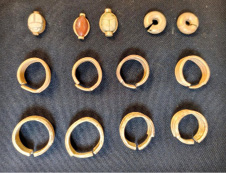
Despite ancient Egypt being largely self-sufficient in precious metals such as copper and gold, the power and influence that this great wealth created meant that foreign kings had to offer tribute. This was paid largely in the form of additional gold, silver, and gemstones, swelling the pharaonic coffers even further. There were, however, some natural resources that could not be exploited from the landscape of ancient Egypt, such as lapis lazuli, which had to be imported from distant Afghanistan.
Although it would be tempting to conclude that importing luxury goods rom far-flung places was only possible from the time of great empire, in the New Kingdom, this is not the case, as items carved from lapis lazuli are known from Predynastic contexts in Egypt. From very early times, therefore, the pharaonic cultures of the Nile Valley appear to have been wealthy and active participants in an extensive regional trading network. For the elite, these riches led to demand for the finer things in life, furniture and jewellery, which led to a need for skilled craftsmen – people who in other societies might have been needed to farm the land, but in Egypt were able to devote their working lives to specialist crafts. And, to keep track of the many developing strands of pharaonic society, methods of keeping records were required, including the ability to write and maintain numerical accounts. All of this led to the development of the complex society along the banks of the River Nile that we celebrate so widely today as ancient Egypt: the world’s first nation-state.

Colin Reader is a Chartered Geologist and a Fellow of the Geological Society of London. A regular contributor to AE magazine, he has written articles on early Saqqara (AE 105 & 106), a new dating for the Giza Sphinx (AE 84), and Tutankhamun the extra-terrestrial connection (AE 111). His latest book, Rewriting the History of the Great Sphinx (Archaeopress, 2026), is reviewed in AE 154.
Further reading:
• D Arnold (1991) Building in Egypt: pharaonic stone masonry (Oxford University Press).
• P T Nicholson and I Shaw (2000) Ancient Egyptian Materials and Technology (Cambridge University Press).
• C D Reader (2023) A Gift of Geology: Ancient Egyptian landscapes and monuments (American University in Cairo Press).
• J A Harrell (2024) Archaeology and Geology of Ancient Egyptian Stones (Oxford: Archaeopress).
All images: the author, unless otherwise stated