Subscribe now for full access and no adverts
Several French figures loom large in the history of Egyptology and its subsequent development into a sophisticated scientific discipline, among them Jacques de Morgan (1857-1924), who was Director of the Egyptian Antiquities Service from 1892 to 1897. His appointment to this prestigious post, which was traditionally held by Frenchmen, obviously did not please Flinders Petrie, who wrote: ‘Really he was the son of Jack Morgan, a Welsh mining engineer and a brother of a Parisian dealer in antiquities. He knew nothing whatever about Egypt but, as a capable businessman, made the most reputable head the French could find.’ This was, however, unfair. De Morgan had previously directed the excavation of more than 1,000 Iron Age graves at necropolises in the Caucasus (also producing an archaeological map of the region). During his five years in Egypt, he directed many excavations and made several significant discoveries: for example, the early First Dynasty ‘Royal Tomb’ at Naqada, and the Sixth Dynasty mastabas of Mereruka and Kagemni at Saqqara. De Morgan founded the Museum of Alexandria, too, and oversaw important restoration work at Kom Ombo Temple. (It is worth noting that his older brother Henri also excavated in Egypt, most notably at Hierakonpolis, Ma’mariya, and Adaima.) However, Jacques de Morgan is best known for the remarkable discoveries he made during his excavations at Dahshur between 1894 and 1895.

A sepia photograph of a young Jacques de Morgan – mining engineer and Egyptologist. Image: Gallica Digital Library, via Wikicommons
The jewellery of Sithathoryunet and Mereret
During his first excavation season at Dahshur (1894-1895), de Morgan investigated the enclosure surrounding the Pyramid of Senusret III, fifth king of the Twelfth Dynasty (c.1874-1855 BC), and in its north-west corner discovered a subterranean burial complex. In its lower gallery (galerie des princesses), he found eight burial chambers in which royal women of the Middle Kingdom had been interred. Unfortunately, tomb robbers had entered the gallery long before de Morgan and plundered the chambers, removing the mummies and, no doubt, many fine artefacts from the women’s coffins. However, the thieves had missed two boxes.
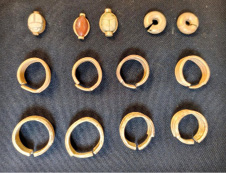
De Morgan discovered the jewellery box of Princess Sithathoryunet in a pit dug in the gallery floor, next to her wooden canopic chest enclosing four alabaster jars containing her viscera. Included among the various pieces of jewellery in the box were: two decorated gold armlets with fasteners in the shape of djed pillars; six small gold lions, perhaps from two anklets (or, alternatively, from a necklace); six large gold cowrie shells, probably from a girdle; and two gold cylinders with loops at the top for suspension, presumably used as pendants. The most spectacular artefact, however, was a pectoral made of gold, carnelian, lapis lazuli, and turquoise. This featured the cartouche of Senusret II, the father of Senusret III, flanked by two hawks wearing the double crown of Upper and Lower Egypt, and two cobras with sun-discs and ankh symbols.

A faience scarab found in the jewellery box bore the hieroglyphic inscription ‘King’s daughter Sithathoryunet, lady of honour’; another, made from amethyst, was inscribed on its underside with the throne name of Senusret III. It is probable that Senusret II was Sithathoryunet’s father, and that she was buried at the pyramid complex of her brother Senusret III. Alternatively, her father could have been Senusret III, or even his son and successor Amenemhat III (pottery found in Sithathoryunet’s tomb indicates that she may have been buried during the early years of the latter’s reign).
The very next day, de Morgan discovered another box in a different pit in the gallery floor, containing jewellery belonging to Princess Mereret. Many superb pieces were recovered from this second box, for example: a girdle with eight gold double leopard heads linked by amethyst beads; a huge gold shell pendant; two gold bird claws, probably originally attached to anklets; ten gold cowrie shells from a girdle; two silver mirrors; a gold shen ring; three ‘motto’ pendants; and 20 scarabs, several bearing the title ‘king’s daughter’ and the name Mereret. Best of all, though, were two pectorals – one bearing the cartouche of Senusret III, the other, the cartouche of Amenemhat III. This suggests that Mereret was a daughter of Senusret III, and was buried by her brother Amenemhat III. Both pectorals are decorated with a similar scene: each king is depicted smiting his fallen Asiatic enemies, protected by the vulture goddess Nekhbet. On the Senusret III pectoral, the king is depicted as a hawk-headed sphinx.

Senusret III’s funerary boats
In addition to finding the stunning jewellery of Sithathoryunet and Mereret, de Morgan was rewarded with the discovery of several ancient Egyptian boats, approximately 10 metres long. The boats, made of cedar wood, had been buried in two pits near the south-western corner of the enclosure wall.
In the initial excavation report, de Morgan recorded six boats in total – three in each pit (and several transportation sledges, although only one is known today). However, in subsequent reports, he amended the exact number of boats to five. Today, four survive in museums: one each in the Carnegie Museum of Natural History (Pittsburgh) and the Field Museum of Natural History (Chicago); and two originally in the Egyptian Museum Cairo, now in the museum at Sharm el-Sheikh.


If it survives, the whereabouts of the fifth boat remains unknown, although it is possible that it still lies buried somewhere near Senusret III’s pyramid, waiting to be discovered. In 2008, an American team carried out a 3D ground-penetrating radar survey at the site, but found only evidence of an empty, excavated pit. In 1902, S D Peet reported that a boat from the site was exported to a European museum, but this vessel cannot be found in any public or private collection in Europe. The four surviving boats were probably used in the king’s funerary procession, and buried near his pyramid to provide him with a magical means of transportation in the afterlife.


Second season
During his second season at Dahshur, de Morgan turned his attention to the ‘White Pyramid’ of Amenemhat II, third king of the Twelfth Dynasty, and found further Middle Kingdom burials in three underground galleries within its enclosure. The most notable were those of Ita, Khenmet (also known as Khnumit), and Itawaret, the daughters of either Amenemhat II or Amenemhat III. Yet again de Morgan struck lucky: the burials were intact, and yielded an outstanding collection of jewellery and other fine artefacts. Ita and Khenmet were buried alongside each other in one gallery; Itawaret and a woman named Sathathormeryt in another, although de Morgan left scant information about the latter’s burial in his excavation report. In a third gallery, de Morgan found the tombs of Queen Keminub and the ‘treasurer’ Amenhotep, but, unfortunately, ancient Egyptian thieves had removed their contents.

The ceremonial bronze dagger of Princess Ita, with decorative gold handle and pommel of lapis lazuli. Image: SG

The burial of Ita
Princess Ita’s mummy was accompanied by a rich array of grave goods – the star of the show a magnificent bronze dagger, with a gold handle decorated with 30 rosettes, and a large, curved pommel made of lapis lazuli. This ceremonial weapon was probably made solely for Ita’s burial and is a masterpiece of ancient Egyptian metalworking. Ita had been laid to rest wearing a broad collar of semi-precious stone beads with round silver terminals, as well as armlets and bracelets, and royal insignia comprising a flail, a mace, and sceptres. A second chamber contained further grave goods such as a set of bronze tools, a canopic chest containing four jars with human heads, and an incense burner or lamp.
Khenmet’s jewellery
In the tomb of Princess Khenmet, de Morgan made the most celebrated of his numerous discoveries at Dahshur. Like Ita, Khenmet had been buried wearing a broad collar, but hers was even more impressive, having striking falcon-head terminals made from gold; the collar itself featured more than 100 sheet-gold ankh, djed, and was pendants inlaid with semi-precious stones. Her burial also included a beautiful choker necklace adorned with various pendants and falcon-head fasteners, and two charming gold-chain necklaces, one with star and shell pendants, the other with stylised fly pendants. These necklaces were probably of Minoan manufacture, made somewhere in the Aegean – perhaps even on Crete, the homeland of the Minoan civilisation.

Perhaps the most sensational pieces of jewellery in Khenmet’s tomb were her two exquisite diadems, fashioned from gold and semi-precious stones. The lighter of the two has a delightfully delicate beauty and was made to resemble a floral garland. Its golden flowers are inlaid with carnelian, lapis lazuli, and turquoise, and attached to an intricate series of gold wires; five quatrefoils in the form of lotus blossoms are interspersed between the approximately 200 flowers.
The heavier diadem, which is nevertheless still a delicate object, is made from the same materials, and consists of eight identical decorative elements comprising rosettes, topped and flanked by U-shaped flowering rushes, inlaid with semi-precious stones. The front of the diadem is enhanced by a somewhat precarious-looking, tree-like decoration; the back, by a sheet-gold vulture with inlaid obsidian eyes.


The Tomb of Itawaret
Princess Itawaret’s mummy was adorned with a broad bead collar similar in appearance to that of Ita, and various armlets and anklets. Royal insignia comprising a flail, mace, and bow were placed next to her mummy, which de Morgan discovered in a superbly crafted, red-granite sarcophagus.
In a smaller chamber adjacent to the burial chamber, he recovered a varied and interesting collection of high-status grave goods. These included a bead diadem, a pair of sandals, dagger blades gilded with gold leaf, an inscribed canopic chest, round and rectangular tables, and a rare find – a finely carved, life-size wooden swan (wooden swans were found in Khenmet’s and Sathathormeryt’s burials, too).
Discoveries at the Black Pyramid
In de Morgan’s third excavation season at Dahshur, he began excavations of Amenemhat III’s ‘Black Pyramid’. As with those of the previous two Twelfth Dynasty kings, it was in a ruinous condition by the late the 19th century, although de Morgan did manage to recover the basalt pyramidion inscribed with the king’s name, which is on display in Cairo.

De Morgan’s workmen dug a tunnel some 225 metres long, from the north face of the Black Pyramid into its bowels, where a complex network of burial chambers and passages was revealed. De Morgan wrote of this impressive achievement: ‘Never had so considerable underground work been done in Egypt for the search of a tomb; it lasted a hundred days, from December 5, 1894, to March 17, 1895’. The chambers had been looted in antiquity, but many artefacts had nevertheless been left behind by the thieves, including two finely crafted stone sarcophagi, one in the burial chamber of Amenemhat III, the other in that of one of his queens, Aat. He left little information on the network of chambers and passages he found within the Black Pyramid, but the German Egyptologist Dieter Arnold shone much valuable light on its inner architecture during the excavations he carried out there between 1976 and 1987, publishing his findings in Der Pyramidenbezirk des Königs Amenemhet III in Dahschur (1987).
The ka statue of King Hor
During his work at the Black Pyramid, de Morgan was once again rewarded with a wealth of finds, the most famous being a wooden ka statue made to house the life-force or spirit of a previously unknown pharaoh, Hor Awibra of the Thirteenth Dynasty. The statue was found in the shaft-tomb of Hor (which had been disturbed by tomb robbers) in the northern part of the pyramid enclosure. It was lying on its back in a wooden shrine, or naos, in the passage leading to the king’s burial chamber. The passage was obviously too low to accommodate both in an upright position. It is likely that, originally, the naos and statue were meant to be placed in Hor’s cult temple, but as this was never built due to his short reign (of less than two years), they were deposited in the king’s tomb, instead.

This remarkable example of ancient Egyptian statuary was beautifully crafted by its talented maker, and, from its base to the three-dimensional ka symbol (a pair of upraised arms) that adorns the king’s wig, the statue measures nearly 2 metres high, its surface originally adorned with a thin layer of painted gesso, and gilded in some places with gold leaf. Undoubtedly, the most striking aspects of the ka statue are its extremely life-like eyes. These are rendered in bronze, rock crystal, and quartz, and lend the statue a rather haunting, human appearance. In the burial chamber, de Morgan found the king’s wooden coffin, which contained his ransacked mummy and a wooden funerary wooden mask that had originally been gilded with gold leaf. Various other items lay scattered around the chamber, such as the king’s canopic chest, numerous pottery vessels, fine alabaster jars, a circular offering table, two alabaster stelae inscribed with blue, painted hieroglyphs, and a second wooden ka statue of Hor, although this one was smaller and in a much poorer state of preservation than its larger counterpart.

After Egypt
After his Egyptian adventure ended, Jacques de Morgan was appointed director of the French archaeological mission to north-west Persia (present-day Iran), and worked there from 1889 to 1912. His excavations focused primarily on Susa – one of the most important cites of the ancient Near East. He made some notable discoveries at this famous site, for example, a wealth of archaeological evidence for the previously unrecognised Elamite civilisation, the Law Code of Hammurabi (a Babylonian legal text inscribed on a stela of black basalt), and the victory stela of the Akkadian king Narim-Sin. However, it is for his archaeological work in Egypt, and, in particular, the excavations he carried out at Dahshur, that Jacques de Morgan will be best remembered. The superb discoveries he made during these excavations, which have been only briefly touched on here, earned him the right to be considered one of the most notable archaeologists of 19th-century Egyptology.
Julian Heath is an author and freelance archaeological illustrator based in Wirral. He is a regular contributor to Ancient Egypt, including articles on George Reisner (AE 145) and Hierakonpolis (AE 150).
Further reading:
• W Grajetzki (2014) Tomb Treasures of the Late Middle Kingdom: the archaeology of female burials (University of Pennsylvania Press).
• J J de Morgan (1895) Fouilles à Dâhchour: mars-juin 1894 (Vienna: Adolphe Holzhausen); available at https://archive.org/details/fouillesdahcho01morg/page/n196/mode/1up.