
Subscribe now for full access and no adverts
When I think of spring, one of the first images that comes to mind in the depth of winter is the carpet of flowers at Byllis, high above the Vjosa valley. This is, in all but name, arcadia. No crowds. No tour buses. Just the silent treasures of a lost past, where the air is sweet and there is a compulsion to lie on the matted sward and lazily stare upwards at chattering skylarks. There are, of course, archaeological reasons for travelling to this little-known Graeco-Roman town in Albania. Despite its Illyrian antiquity and its apogee in the age of Augustus, few places summon up better the bewildering collapse of the Roman world. Here amid the pink anemones, you are forced to confront humanity’s fragility. We may seek explanations from nature and outside forces for human crises, but at Byllis you find yourself compelled to ask existential questions about who we were and, possibly, who we are.

Off the beaten track
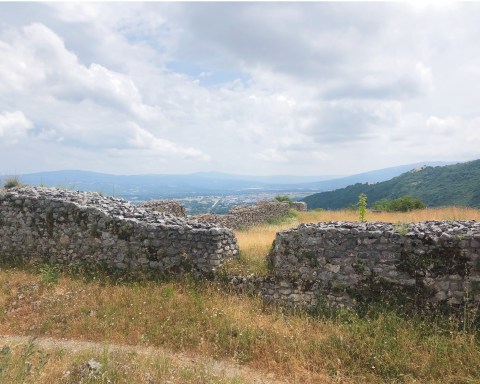
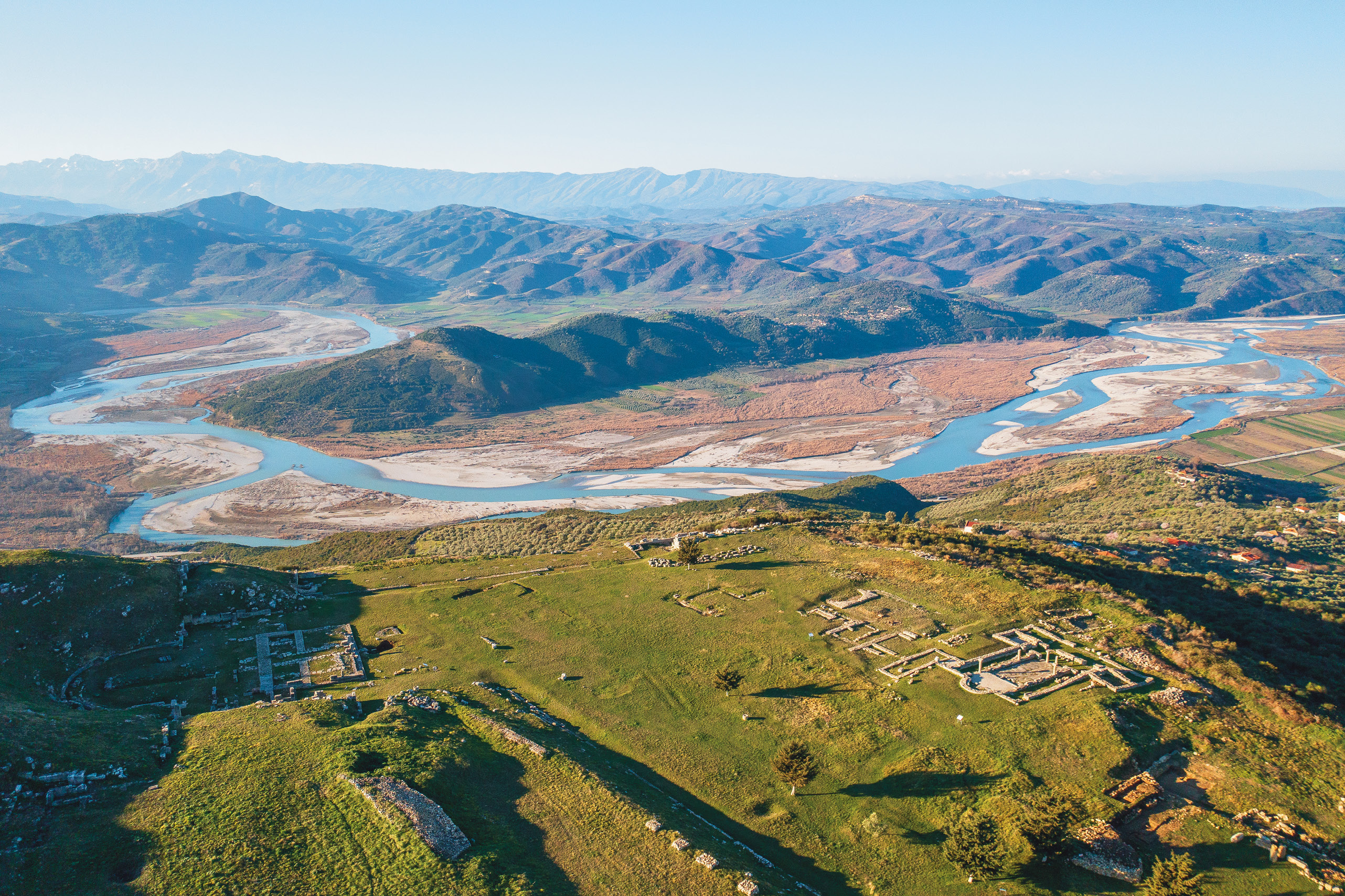
Byllis is a well-preserved green-field Graeco-Roman town in central southern Albania situated at 524m above sea level. Known locally as the fortress of Hekal (the nearest hamlet), it occupies a flat hilltop overlooking the river Vjosa (the ancient Aoös), which runs through a deep valley immediately to the west. A long meandering road takes you up to the ruins from the highway pursuing the valley. In the climb, you sense forsaking a cosy Mediterranean world for the mountainous interior. The road twists through an opulent modern cemetery and then, crowning the hill, confronts Byllis’s powerful ancient walls. On my first visit 30 years ago, two shepherds were grazing sheep here and, being bored, wanted to tell the story of this Illyrian town and its archaeologists. Apart from the archaeologists in summertime, there was a trickle of pilgrims. A Bektashi shrineto the 19th-century Dervish Baba Azeiz is modestly housed nextto the little restaurant where Beqo, the owner, prepares good lamb and salads with local ingredients.
In an instant, you realise that Byllis’s monuments are special,but their setting makes them spectacular. Apart from the spring flowers and the busy larks, it is the wide-angled view of the Vjosa from the ancient theatre that impresses most. Deep below, the plaited channels of the river –the so-called ‘last wild river of Europe’ – reaches to Vlora Bayon Albania’s Mediterranean coast. Looking westwards, the Vjosa is the foreground for serried ranks of mountains that rise to the heights of the Acroceraunian range, snow-capped until June, overlooking the Albanian riviera. In spring, the clouds swell and dance their way across this barrier between the Ionian Sea and the Balkan interior.
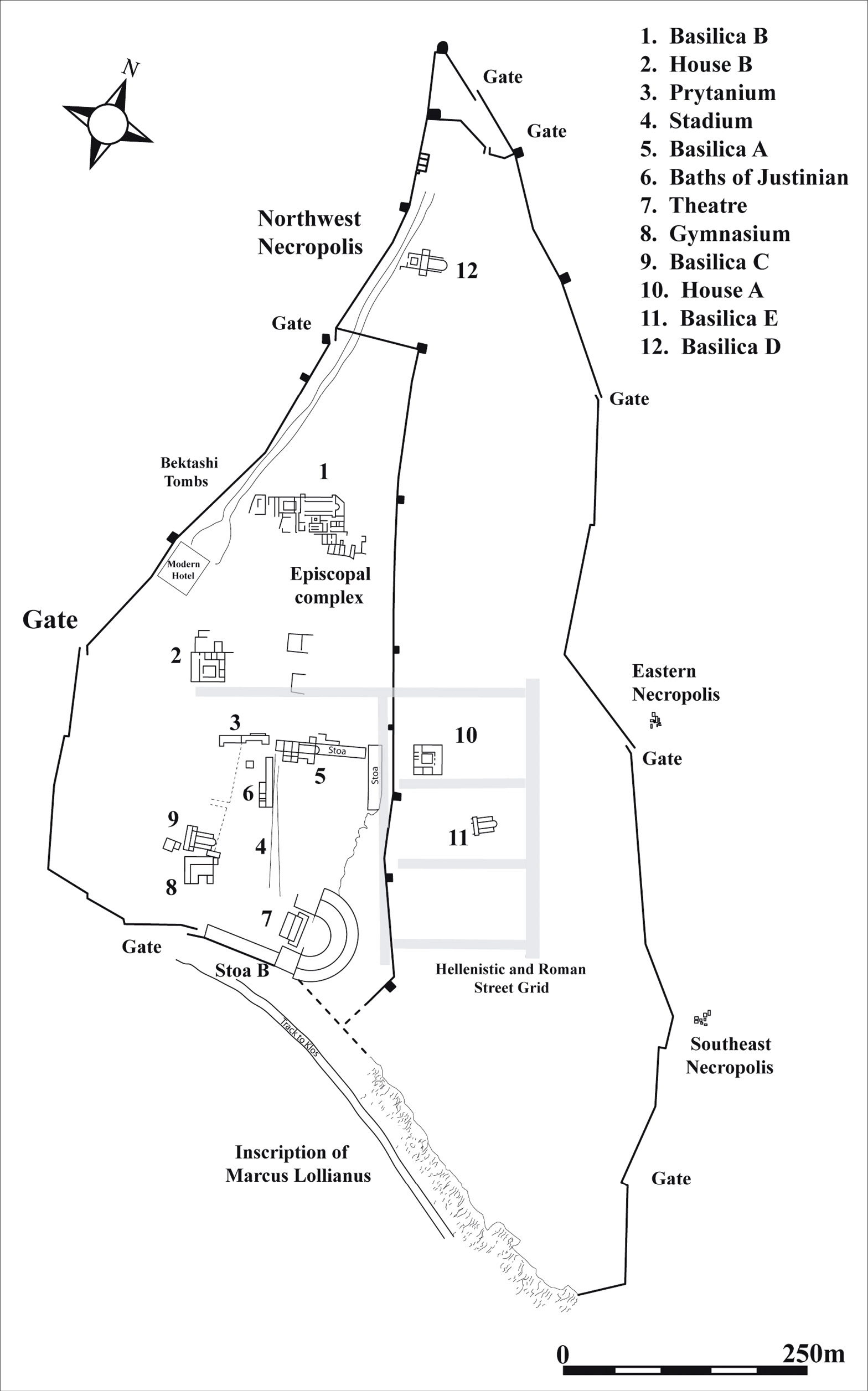
The ancient city occupies a perpetually verdant, triangular plateau covering about 30ha in area. It almost certainly lay on a route from ancient Apollonia, situated on the featureless plains to the north, leading to a plethora of other hilltop towns in central and southern Epirus. Byllis was created in the 4th century BC and remained occupied until the 6th century AD. Initially, it was one of several fortified Illyrian hilltops controlling the high hills of Mallakastër. By the 3rd century BC, it had become the centre of a koinon – an association of city-states – of the Bylliones tribe mentioned in an inscription at the (southern Epirote) sacred site of Dodona in Greece. From this period, the town was walled, with its urban buildings arranged on an orthogonal street grid. Within the grid were raised terraces on which were constructed a large theatre, a stoa, and gymnasium, besides other civic monuments. Outside the Hellenistic walls, remains of three cemeteries from this period have been discovered. In the 2nd century BC, it boasted an active mint.

Byllis is briefly mentioned in the civil war between Julius Caesar and Pompey, as the former fled south after suffering defeat in battle near Dyrrachium, a hundred kilometres to the north. Pliny the Elder notes in his Natural History that the town lost its autonomy and was designated a colony: Colonia Julia Augusta Byllidensis. Almost four centuries later, its bishop attended the Council of Ephesus in AD 431. By the 6th century, Byllis had become one of eight towns in the Byzantine province of New Epirus. Four inscriptions in Greek record the reconstruction of its fortifications by a certain Victorinus on behalf of the Emperor Justinian, now enclosing a much-reduced area of 11ha. No more than a generation later, by the later 6th century, the town was abandoned. Its citizens, it is thought, moved to Ballsh, 8km to the west, where a church – perhaps a monastery – had existed since the 5th century AD. Ancient Byllis was never reoccupied after about AD 600. Much of its fine cut stone was robbed in Ottoman times for construction elsewhere in the region, at places like Berat.
In the 20th century, Ballsh usurped Byllis’s erstwhile status, becoming a centre of Albania’s diminutive oil industry. Around it nodding donkey pumps were stationed, redolent of a pioneering oil-age in Texas, often as not partially immersed in viscous ink-black pools. The acrid smell, once encountered, is never forgotten. Spared this industrial blight, the serenity of nearby Byllis has been a magnet for generations of archaeologists.
Byllis was first described by the early 19th-century antiquarians François Pouqueville and William Martin Leake, before any investigations were made. The first survey and trial excavations at Byllis (of Tower V in the Late Antique fortifications and the orchestra of the theatre) were made during the winter of 1917/1918 by the Viennese archaeologist Camillo Praschniker. Fifty years later, in 1974-1976, the Albanian archaeologists Neritan Ceka and Llazar Papajani began investigations here. From the summer of 1978, the former then pursued large excavations with Skënder Muçaj. Since then, Ceka and Muçaj have been joined by a French mission led by Jean-Pierre Sodini. Today, an EU-funded initiative with a budget of €6 million is transforming Byllis into a notable destination, as it lies an hour south of a new airport being constructed at Vlora (on the coast). As such, Byllis would become the first point on an inland tourist trail encompassing the Vjosa valley as far south as the UNESCO World Heritage Site of Gjirokastra, about 80km distant.

Packed with monuments
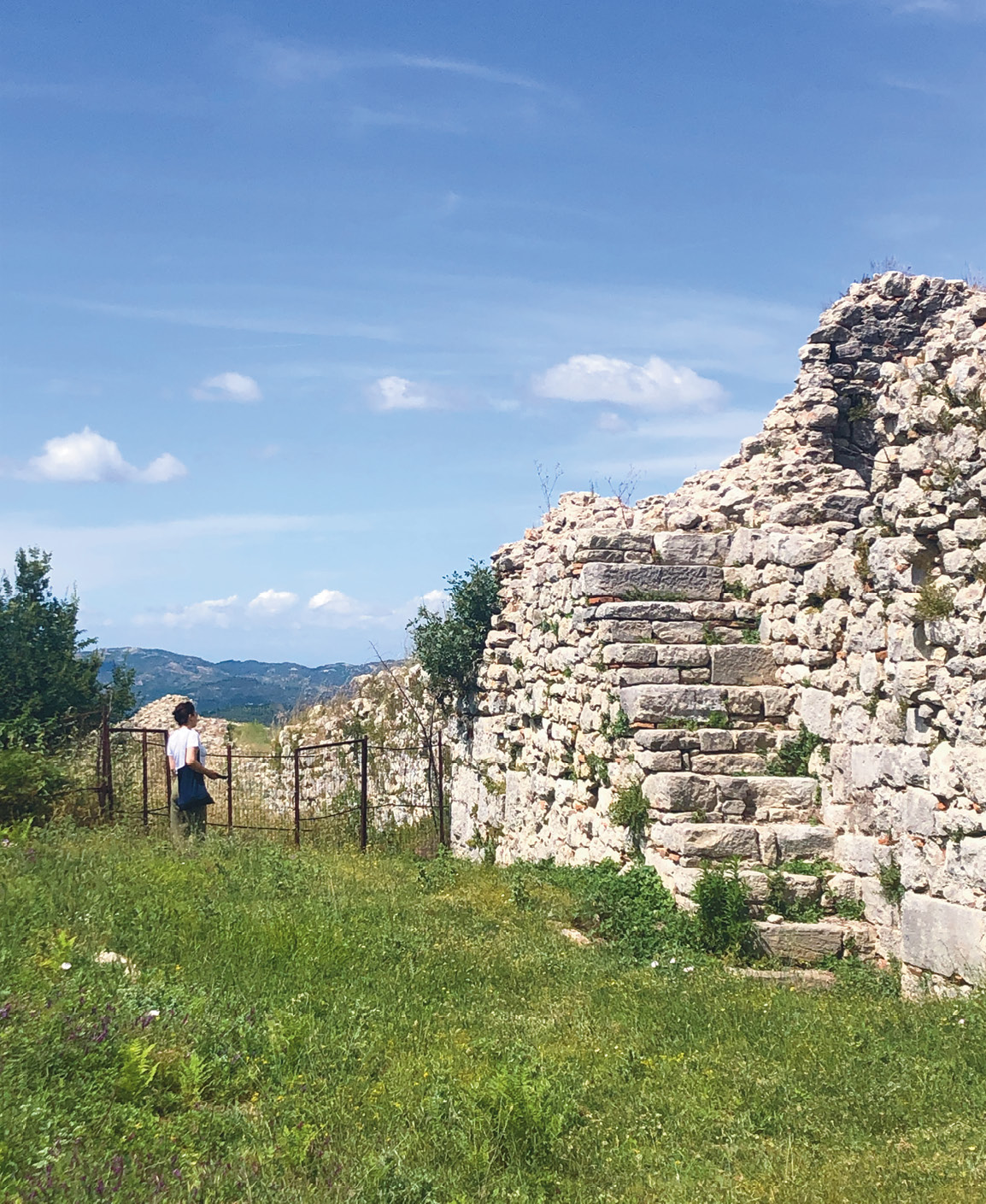
Monuments dot the landscape on this hilltop. Pride of place goes to the city walls. These earliest fortifications are perhaps the most majestic defences of any Illyrian town. First erected in the second quarter of the 4th century BC, the architect almost certainly worked on similar defences at nearby Amantia and Partha (Berat). These Hellenistic-period walls are 3.5m thick and constructed of large cutlimestone blocks. The wall once stood 8-9m high, with an inner fighting platform. Their plan took the form of a triangle, with the steep south side remaining open. Seven gates have been discovered. Gate 4, for example, on the east side, still stands 9m high. Five towers were added at the weakest pointsin the defensive circuit.
The Illyrian walls were preserved when Byllis became a Roman colony, but were almost certainly in poor shapeby the 6th century AD. This prompted Victorinus, according tothe four Greek inscriptions dating to Emperor Justinian’s era, totake charge of erecting a new circuit. The inscriptions were found in the monastery of St Mary at Balllsh: one inscription has now been lost, but the other three are housed in the National Museum in Tirana. All are composed in verse in poorly executed Greek. For example, the first states: ‘O foreigner, do not fail to look upon the beauty of Byllis, whose city walls, once in ruins, were rebuilt by the daring Victorinus’.

Occupying only a third of the earlier enclosed area, the new Byzantine walls now defended all sides of the town. HellenisticGate 6 remained the principal entrance into Byllis, while Victorinus’s circuit was built with blocks prised from earlier buildings in a palpably expedient way. The new arrangementwas strengthened by six three-storey towers standing 12m high.
Most of the exposed and excavated monuments lie within the reduced Byzantine wall circuit. The new walls wrapped around the ancient theatre in the south-east corner of the new fortifications. Together with the ancient stoa and stadium, it determined the architectural composition of the agora – the civic space – within gridded roads defining the earliest town. Probably built in the mid-3rd century BC, using the natural slope at this point on the hilltop, the theatre loomed over the associated buildings, while audiences on its elevated seating could gaze into wide lambent skies above the Vjosa river as it weaved its way northwards towards the coast. Little remains today, apart from the concave bowl, once graced with seats, as well as the site of the orchestra and the stage building behind it. The archaeologist Neritan Ceka has calculated that being 78m in diameter at its widest point, with about 40 ranks of seating, the theatre might have accommodated 7,500 people at one time.
Immediately in front of the theatre, occupying the exposed southern flank of the Illyrian town, lay the stoa. In many respects, this served as a place to relax before and after theatrical performances. No more than the ground plan of the stoa, 60m long and 11.4m wide, survives of what must have been a magnificent, airy, porticoed building, featuring a Doric colonnade on which was raised a first storey with an Ionian colonnade.
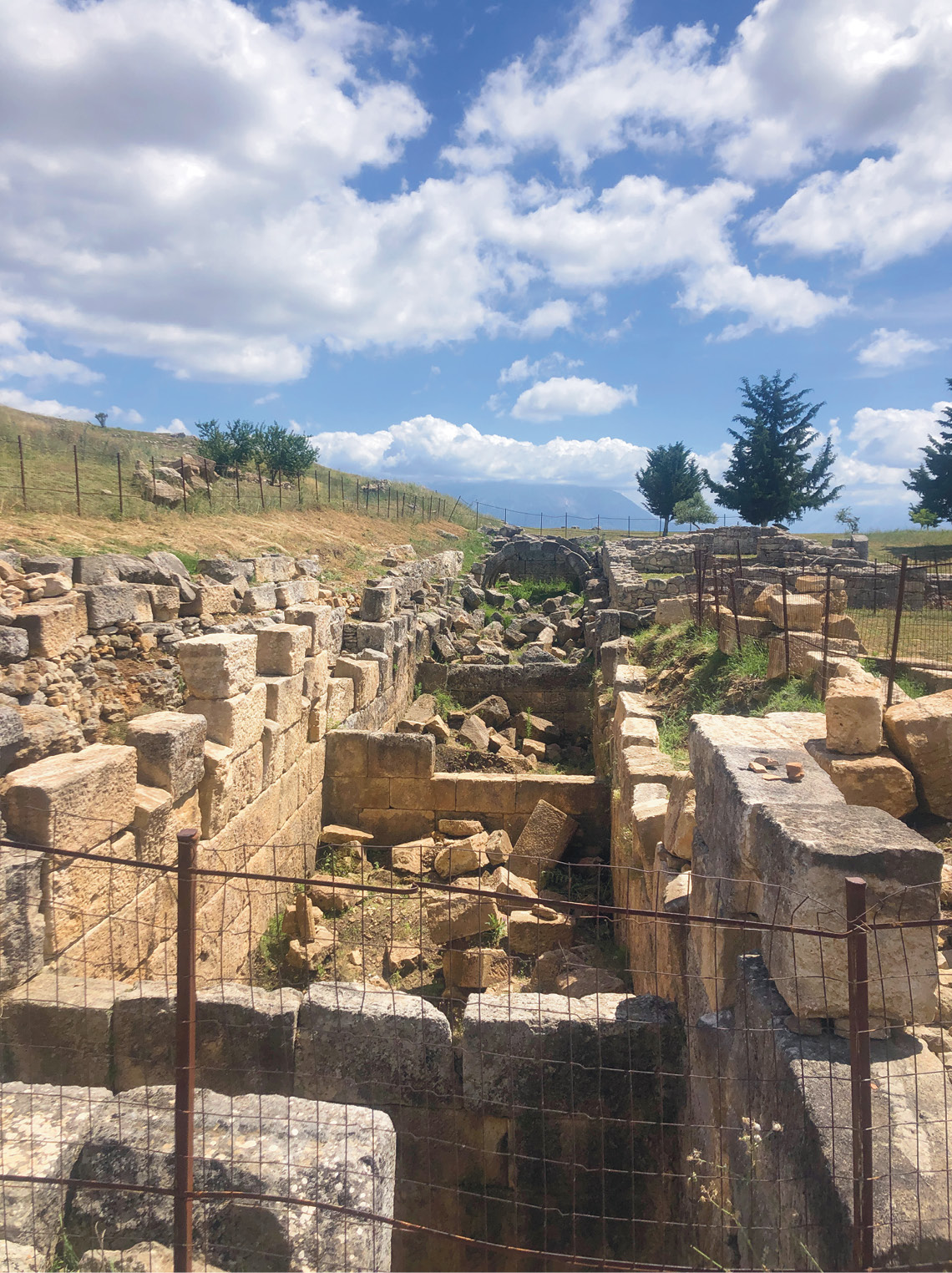
North of the theatre lie the foundations of a stadium about 190m long, beneath which was a large cistern collecting water from the ranked seating on its west-facing side. Close by, also dating to the 3rd century BC, are the gymnasium and the town hall (prytaneum). The latter overlooks the so-called ‘Residence B’, one of two large atrium houses of Hellenistic date. This townhouse took up a sixth of an insula in the first town. The house enjoyed a panoramic view to the north, and was maintained until the 3rd century AD. Subsequently, two 5th-century dwellings were made within its ruins, before it was finally deserted in the 6th century and became a small cemetery.
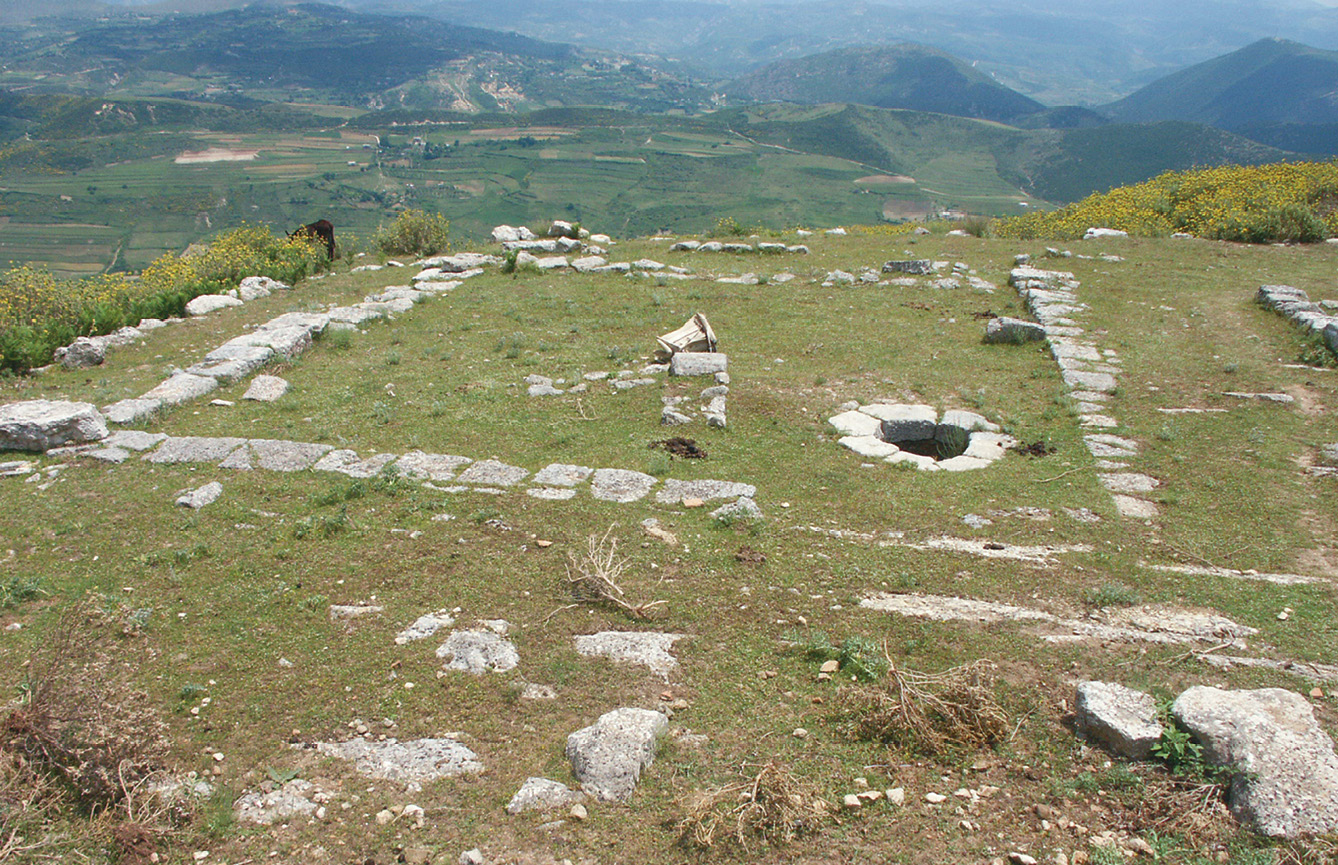
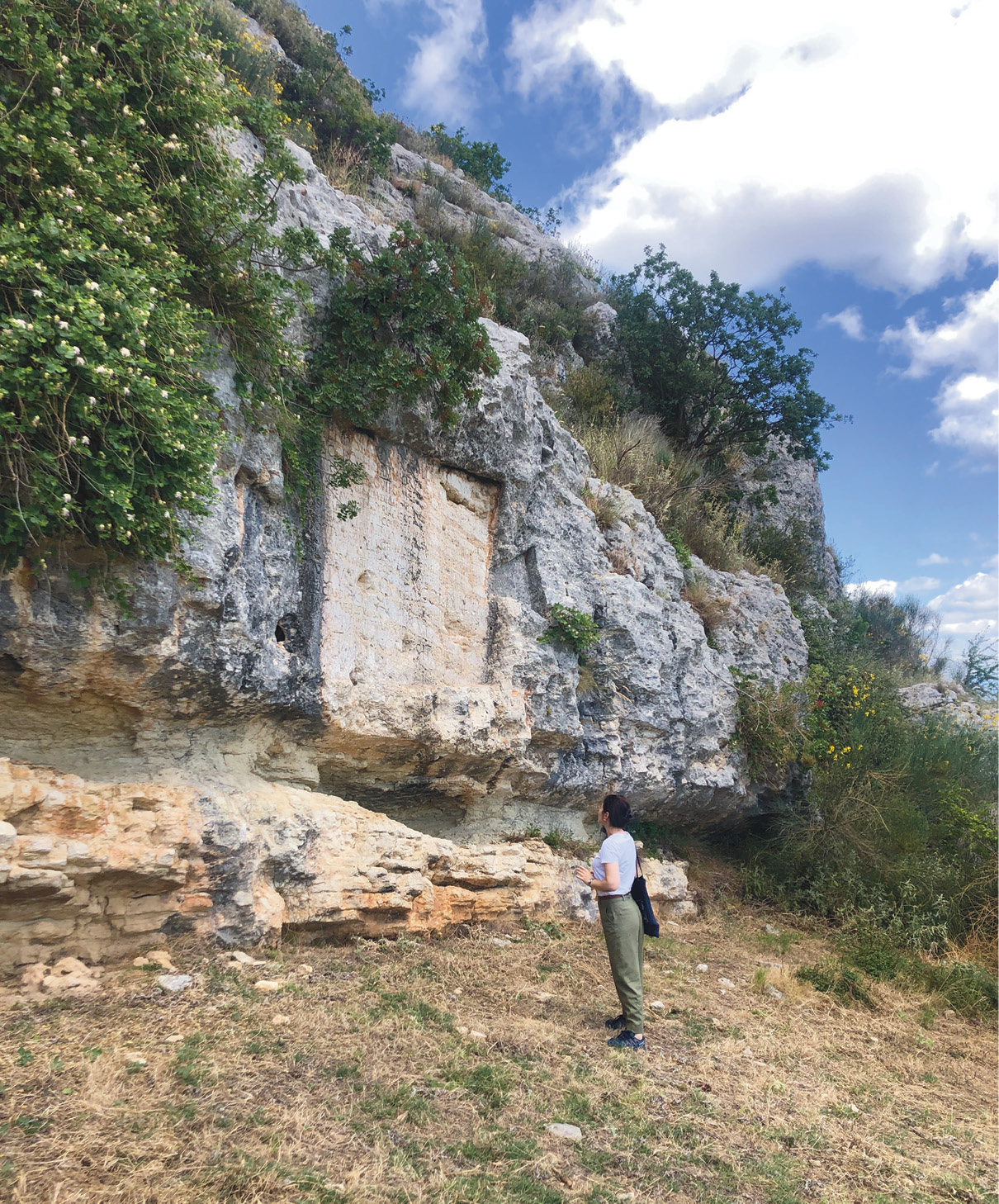
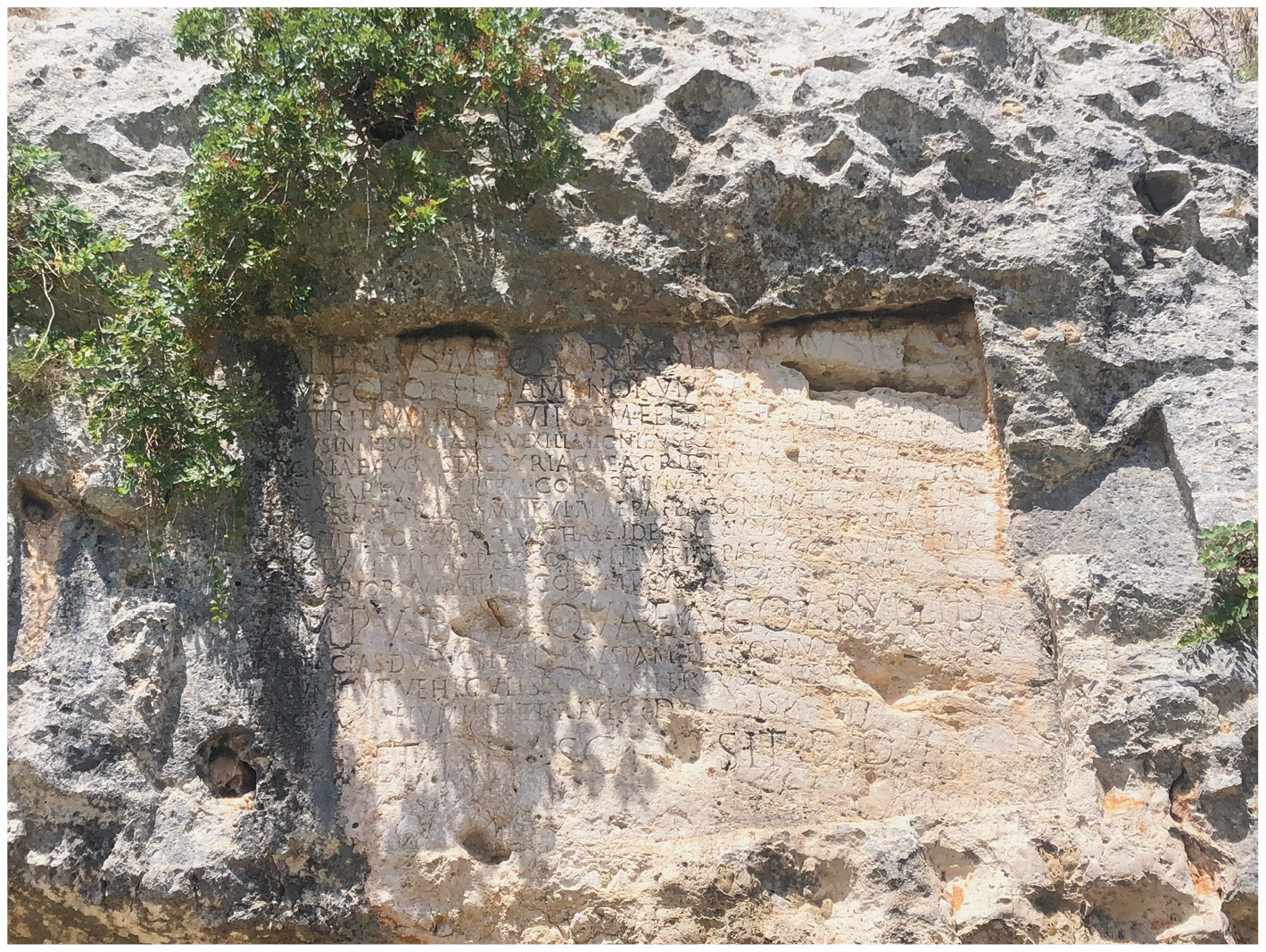
Of all the early monuments, however, perhaps the most striking lies on a west-facing steep scarp some way below the theatre. Reached by a narrow path that crosses the contours of the slope, a fine Latin inscription is cut into the natural rock face high above. The rock has been smoothed in the form of a tabula ansata with dimensions of just over 3m across and 2m high. The inscription was written in lines of differing lengths, squeezed at each end. This was a show of vanity by a certain Marcus Lollianus, a Roman citizen of Byllis in about AD 150, who had served in Trajan’s army and campaigned in Parthia. He proclaims that he built a road for carts from Byllis to Astacia, passing mountainous and dangerous places, and crossing the river Argias by a bridge (all places yet to be properly identified).
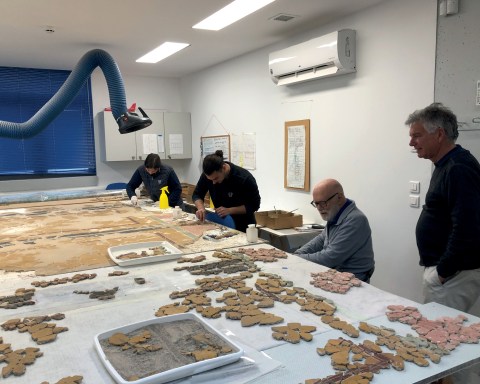
The finest monuments belong not to Byllis’s ancient apogee, but to the twilight of its millennium-long urban story. Five large basilicas were erected as the town acquired its reduced circuit of fortifications. The largest church is thought to be a cathedral, its associated ensemble of palatial buildings housing the staff and storage facilities of Byllis’s bishop, including a wine press. With its atrium, it was 67m in length, dominating the northern sector of the Late Antique town. The exonarthex of the basilica was paved with fine mosaics depicting scenes of pastoral life, as well as the lives of fishermen of Nazareth. The Purple Codex of Berat, 6th century in date, is generally believed to have originally been positioned on the high altar of this church. Sculptured church fittings litter the ruins, but perhaps the most remarkable discoveryin the excavation was an exceptional heap of musical instrumentsin its narthex. These had tumbled from the first floor, where they had been housed.
To the south of the cathedral, a smaller basilica (Basilica A) occupied the northern extent of the erstwhile agora. Nearly 40m long, with two aisles, as well as an ensemble of associated buildings, this church used plenty of cut stone taken from the once great Hellenistic civic monuments. Again, the basilica was blessed with fine capitals and limestone furniture, as well as elegant mosaic pavements depicting birds and beasts.
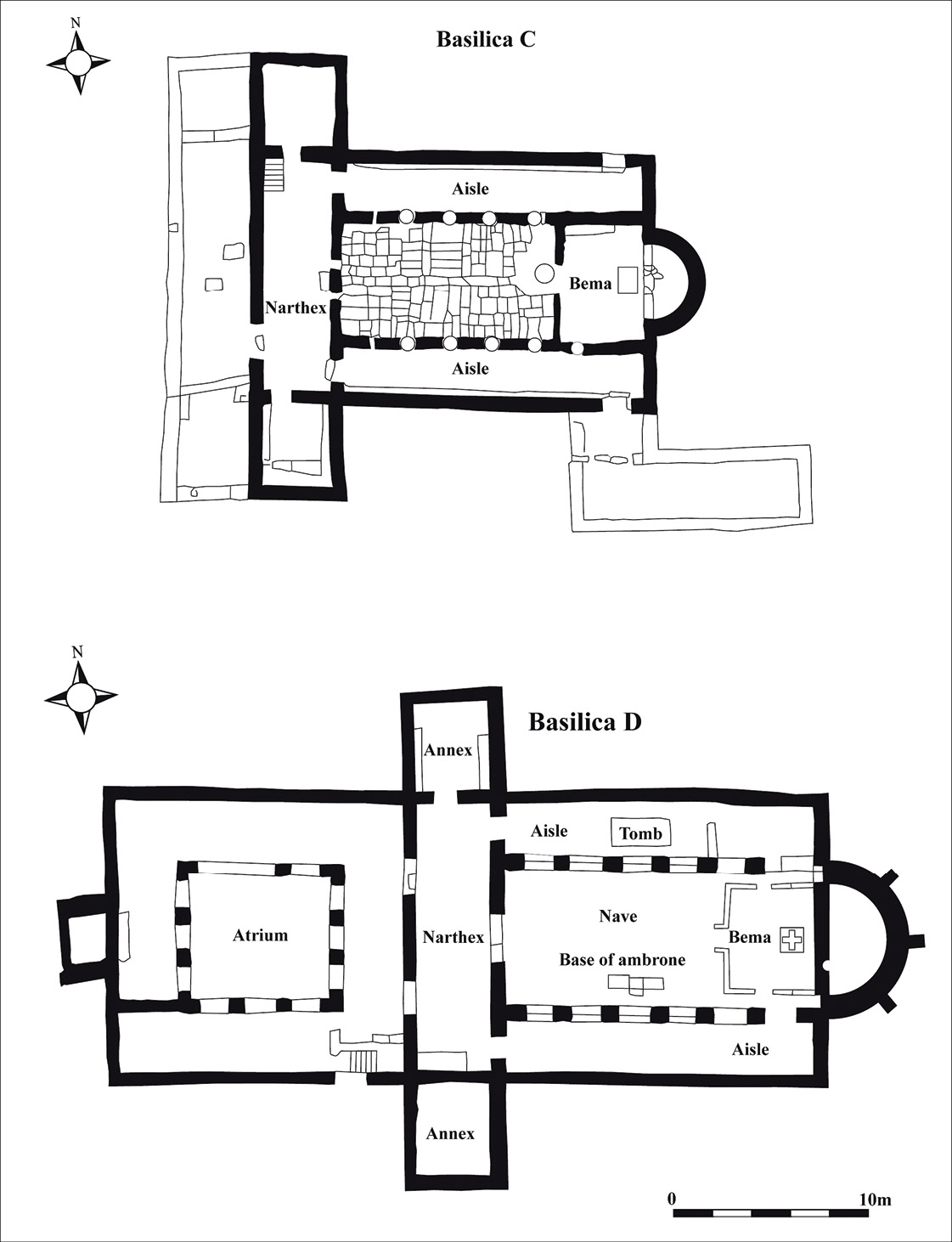
West of Basilica A, lay Basilica C, which occupies the western periphery of the reduced town. Its architecture follows the formula of the other two intra-urban churches. In this case, though, a dedicatory inscription in the mosaic describes its donor as Bishop Praisos, an otherwise unknown individual in Byllis’s late story.
With about half the walled space given over to three churches,two more basilicas were erected immediately outside the 6th-century defences. Basilica D lies beyond the northernmost part of the new defences. Again, this was a large church with associated buildings, and is notable for its mosaics, in this case depicting the Rivers of Paradise (each named in tesserae: Pishon, Gihon, Tigris, and Euphrates). Finally, traces of another, smaller church, Basilica E, lie immediately outside the east side of Victorinus’s wall circuit.
Apart from the five churches, remains of a bath complex belonging to the age of Justinian have been found occupying part of the former stadium (adjacent to Basilica A). A partially preserved inscription proclaims ‘I am the baths of the all-powerful [ruler] Justinian, a beneficial…’. This, along with numerous coins, confirms that these baths formed part of civic life when Byllis as a place was well and truly dominated by its clerical monuments.
Waiting for the barbarians?
The theatre speaks to the serene splendour of Byllis as a place. But what sticks in the mind, as much as flowers and larks, is the sheer dominance of the Church on the eve of Byllis’s abandonment.
The reduction of the fortified area of Byllis to a third of the enclosed area in the Hellenistic and Roman periods is far from unique. The Late Antique fortifications of Nicopolis – Augustus’s Victory City, in southern Epirus – likewise enclosed a much-reduced area that was also dominated by a constellation of sprawling churches, including an episcopal complex. The erstwhile Epirote hilltop capital of Phoinike, north of Saranda, was reduced to a small fraction of its immense Republican to mid-Roman size, too. By contrast, the Late Antique fortifications of Butrint broadly followed the line of the earlier Hellenistic defences. All the evidence points to this port somehow retaining much the same urban footprint that it had possessed at its apogee in the early Imperial period.
Of all these Epirote Late Antique fortifications, Byllis’s are the only ones dated by inscriptions – commemorating their construction by Victorinus on behalf of the Emperor Justinian. The other Epirote fortifications are assigned on archaeological evidence – largely ceramics – to the earlier 6th century. Byllis’s excavators ascribe these fortifications to the growing 6th-century threat posed by extra-regional forces. Who exactly was the source of this concern in the first half of the 6th century, a generation before the Slavic attacks, is a matter of speculation. Like the earlier Hellenistic defences, these powerful Late Antique walls may as readily be explained as bullish expressions of martial display, as well as indices of urban status.

What is especially striking at both Byllis and Butrint – the former in the Epirote uplands, the latter on the Ionian coast – is the exceptional presence of the Church. Churches mark the last palpable gasp of antiquity before an ice age, to quote the writer Lawrence Durrell, descended on the Roman empire. Generations of archaeologists attributed this extraordinary civic collapse to barbarians. As the poet Konstantinos Cavafy put it (in his poem Waiting for the Barbarians), ‘Those people were a kind of solution.’ ‘Now’, Cavafy asked, ‘what’s going to happen to us without barbarians?’ Recently, many scholars have tried to explain this crisis by turning to science to help uncover evidence that resonates with contemporary audiences. No surprise, then, that the two new theories include the impact of a Late Antique Little Ice Age – climate change – and the pandemic known as the Justinianic Plague that is first described by Byzantine sources in AD 541. Such explanations, of course, say as much about the times in which contemporary scholars are writing. At a town like Byllis, however, the archaeology points to one obvious fact, while other theories verge on speculation.

What is this fact? Almost half the walled area of Byllis was filled by churches and their associated buildings intended, it is presumed, for accommodation and storage. Much the same is true at 6th-century Butrint and Nicopolis, where in the course of extensive excavations inside the walled area, as well as in their suburbs and beyond, the presence of the Church is strikingly conspicuous. Imported commodities, especially from the eastern Mediterranean, were still pouring into Butrint, while small-scale productive activities continued to be practised by households that have largely eluded Byllis’s archaeologists.
Like so many towns throughout the 6th-century Mediterranean, those at Byllis, Butrint, and Nicopolis in Epirus were all experiencing the same transition of power from a rich aristocracy to clerical leadership. This was not so much a political revolution as a social one. Roman society was in thrall to new Christian ways of thinking, which evidently reached even this seemingly distant hilltop. Such thinking revolved around new attitudes to the future and, in particular, to the troubling search for salvation in the afterlife. Wealth in this world became subsumed to the social fashion of securing it in perpetuity. How was this achieved? Simply put, the rich in the late 5th and earlier 6th centuries were drawn towards not only joining the clergy, but also parting with their worldly goods on a spectacular scale. Great landowners passed the baton to an age of managerial bishops and their clerical staff, as the historianPeter Brown has observed.
Western Roman aristocrats, faced by economic stresses they had confronted for centuries, in a stunning volte-face were persuaded to redefine their worldviews. Salvation of the soul now took the form of prominent gift-giving. This became the driving ambition of Christian society, and was to remain so for the coming centuries. The written sources record donations of vast tracts of Mediterranean landscapes to the Church in a bid to ease the previous owner’s passage to the afterlife. The historian Ian Wood has argued that this excessive largesse ushered in an early medieval ‘temple’ society, hastening the end of the Pax Romana. Wood has drawn attention to the subsequent seismic impact on the later Roman economy brought about by the massive concentration of wealth in the Church. In these circumstances, where were the taxes to come from to sustain the armies and bureaucracies of the era, let alone support the building of defences? In a world of ‘democratised’ clergy, as Peter Brown put it, who was to build, make pots and tools, let alone manage livestock and cultivate landscapes? Certainly, little is known about the economy of the later Roman Church and the world that within the span of two or three short generations it mentally dominated. At Byllis, this tectonic shift is all too apparent. Tucked behind its much-reduced walls, the city’s priesthood now held sway, wherein once citizens managed a rich upland catchment.

Initially at Byllis, it seems, this era of largesse prompted even grander efforts to embellish the earliest churches. Byllis’s Basilicas A, C, and D show that each was remodelled after its construction. There was an emphasis on ever finer entrances. Associated with this may have been the increasing embellishment of the church interiors with extensive polychrome mosaic pavements and ornamental furniture. But the excavations at Byllis convincingly show that this was short-lived. Over-investment in conspicuous consumption rather than (as Byllis’s excavators believe) the arrival of the Slavs – Cavafy’s barbarians – may explain the sudden abandonment of this town and its Epirote peers. The archaeology of this abandonment phase has not yet been presented for Byllis. The apparently unworn pavements, for example, and the limited evidence of burning and destruction appear to rule out desertion following a cataclysmic event such as a sack. On the other hand, evidence of so-called ‘ruralisation’ within the ruined urban fabric in the mid- to later 6th century, such as was found at Butrint, has yet to be firmly identified at Byllis. One explanation for the absence of this ruralisation phase at Byllis is that the excavators overlooked these levels, the remains of later-6th-century dwellings being so insubstantial. No less strikingly rare are the intra-mural burials that occur in significant numbers at Butrint. Abandonment due to the Justinianic Plague in c.AD 541, on this evidence, seems unlikely. This suggests that the reign of Justinian may have marked not only the apogee of this Late Antique town, but also its desertion.
The end of Rome
On balance, there is a compelling argument that over-investment in church-building without evident returns in a place that had prized a rich pastoral economy perhaps best explains the otherwise inexplicable end of Byllis after a millennium of affluence. Rather than waiting for the arrival of the barbarians, as an explanation for the city’s demise, it appears more likely that increasing investment in display by the Church, coupled with gifts to win assurance in the afterlife, triggered a dramatic downturn within the later decades of the century.

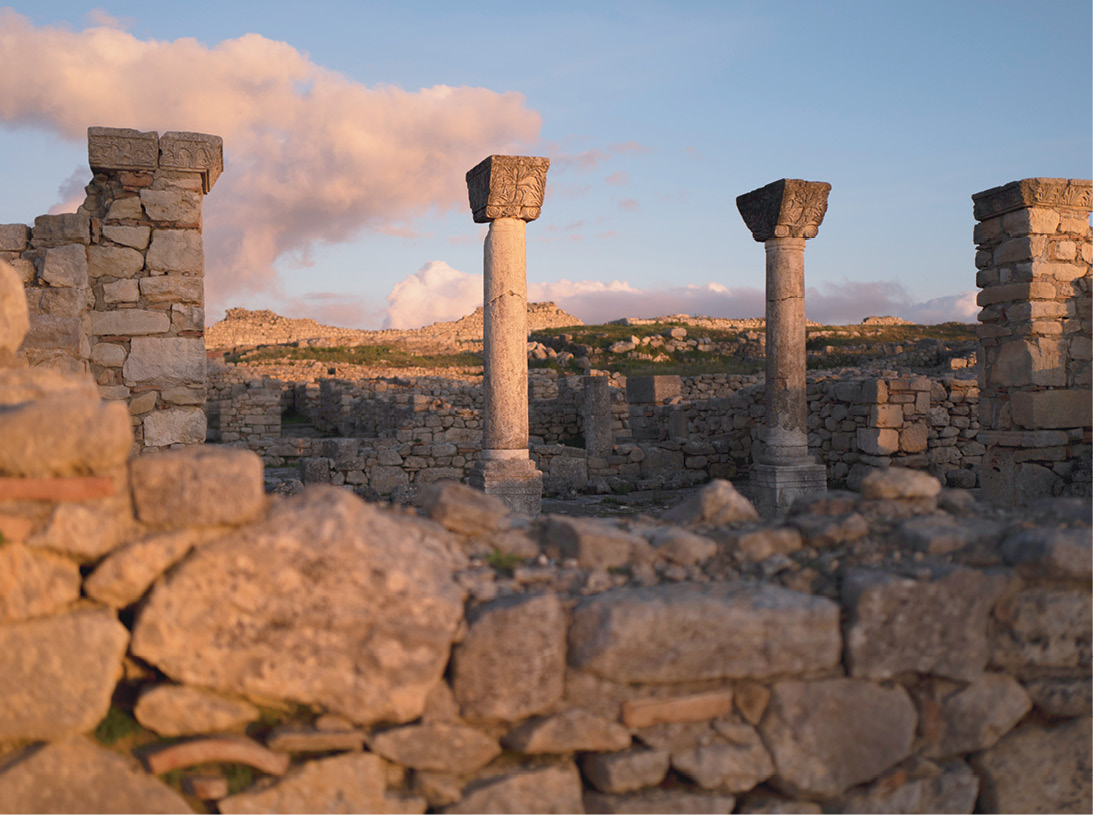
This urban story at Byllis is, of course, not unique. The Mediterranean region is famous for its Urbes Extinctae. Yet at this example, the prominent footprint of the Church, filling half the interior of the newly walled 6th-century town with its conspicuous architectural affluence and décor, prompts any visitor to think twice about the decline and fall of Rome. How could such grandiosity be afforded? The age-old desire to point the finger at some disaster caused by the advent of barbarians, or climate change, or a pandemic hardly hold water in the face of a simpler explanation. Here in Byllis, and indeed throughout the Mediterranean, including Rome itself, new thinking and a concern for one’s personal welfare –in this case in the afterlife – sparked an unceremonious end to a millennium-old pattern of life. As Peter Brown noted, complacency as much as anything else was a root cause of the end of Rome. Sitting on the cushioned grass amid the carpet of anemones with the timeless Vjosa valley as a backdrop, Byllis’s fate makes you think hard about the fragility of our world today.

THANKS
My thanks to Oliver Gilkes and Ilir Parangoni, respectively a dedicated albanologist and the architect of the new Byllis park, for their help and images.
All images: courtesy of Richard Hodges, unless otherwise stated