Subscribe now for full access and no adverts
A few months ago, I made my first trip to Meir in Middle Egypt to visit the rock-cut tombs of the Old and Middle Kingdom nomarchs (regional rulers and governors), who had once lived in the ancient city of Qis (Classical Cusae), the capital of the Fourteenth Nome of Upper Egypt. I was particularly interested in seeing examples in situ of what is known as the ‘Art of Cusae’ – a style of Middle Kingdom tomb decoration. Meir is in the Asyut Governorate, approximately 350 kilometres south of Cairo. I was lodging in Minya for a week, and had put aside a whole day for Meir. My driver, George Yanni, I have known for many years. Now in Cairo, George was born and brought up in Minya and knows Middle Egypt well, so he was an obvious choice for exploring the region.

Leaving my hotel just after breakfast, we crossed the Nile and took the West Bank concrete roads through lush agricultural farmlands. About 45 minutes after leaving Minya, we took a left on to the Western Desert Road’s smooth new tarmac, and for another 45 minutes drove through a beautiful low desert landscape. Taking a left towards the Nile, we moved back on to concrete roads, this time passing the many large polytunnels of dozens of modern tomato farms. As we approached the exact point where the desert meets the cultivation, we took a right turn and finally arrived at our destination. The tombs of Meir could be seen high up ahead of us, nestled on a ridge of rocky limestone amid giant sand dunes.
George quickly introduced me to the friendly team working at the site and I bought my ticket, which cost a very reasonable LE100 (about £1.50 at the time of writing). I then set off across the desert and up to the tombs, accompanied by an elderly tomb guardian and an armed security officer – standard practice when independently visiting the archaeological sites of Middle Egypt. There was a third man with us, Abd al-Aziz, a giant of a man, who was clutching a large wooden stick. I remember thinking this was quite odd, as he did not appear to have any mobility issues.
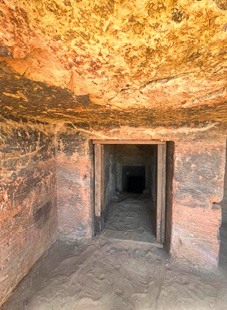
The route to the tombs took us first over a concrete path, then up some modern stone steps partially covered with drifts of loose gritty sand, and finally further upwards across a large stretch of soft desert sand littered with loose limestone rocks. My feet sank into the sand just as if I were walking through thick gloopy mud, and I was glad that I had my walking poles with me.

Tomb numbering system
The tombs at Meir, like many tombs in Egypt, were originally discovered – and subsequently robbed – in antiquity. During the early 1800s, local farmers were known to chop up any wooden coffins from the Middle Kingdom tombs, to repurpose the timber for making waterwheels and shadufs to irrigate their farms. There was some academic interest in the tombs at the end of the 19th century, but they were not studied in any detail until British Egyptologist Aylward Blackman carried out excavations for the Egypt Exploration Society between 1912 and 1950.
Although the tombs are from two different eras (the Sixth Dynasty and the Twelfth Dynasty), Blackman grouped them into geographical clusters (A-E) according to their location from north to south. Each tomb was then numbered individually within its cluster, and an identification system was devised: [A, No.1], [B, No.1], and so on. Today at the site the tombs that are open are simply identified numerically from north to south. For anyone planning a visit, please be aware that several of the modern-day labels, which include both these new numbers and a name of the deceased, are unfortunately incorrect regarding the tomb owner. In this article, I use the original Blackman system of numbering and identifying the tombs, as detailed in the ‘List of open tombs’ (see below).

I managed to enter nine tombs in total, and could stand outside a tenth [A, No.3] to photograph it from the outside, although it was impossible to enter. We started at the largest group of open tombs, which lie in the very middle of the long chain of cemeteries running along the plateau. These tombs are all dated to the Twelfth Dynasty, and form Group B. They also contain the artwork that I was interested in seeing. We then moved north to Group A, before walking much further south to a few isolated tombs located in groups C and D.
LIST OF OPEN TOMBS
[A, No.1] Niankh-Pepy-Kem, whose good name is Sobek-Hotep
[A, No.2] Pepy-Ankh-Kem, whose good name is Heny the Black
[A, No.3] Ukhhotep, son of Iam (viewed from the outside only)
[B, No.1] Senbi, son of Ukhhotep
[B, No.2] Ukhhotep, son of Senbi
[B, No.3] Senbi, son of Ukhhotep, son of Senbi
[B, No.4] Ukhhotep, son of Ukhhotep and Mersi
[C, No.1] Ukhhotep, son of Ukhhotep and Heny the Middle
[D, No.1] Pepy
[D, No.2] Pepy-Ankh the Middle, whose good name is Heny
Middle Kingdom tombs and the ‘Art of Cusae’
The tombs of Group B all belong to Middle Kingdom governors of the Twelfth Dynasty, most of whom were related to each other. Additionally, and rather confusingly, their names were either Senbi or Ukhhotep. Most of the Middle Kingdom tombs at Meir are in poor condition. The wall scenes became badly damaged during centuries of exposure to the harsh sand-laden winds of the high desert (before Blackman built the shelters around the tombs that we see today), and some of the ceilings and walls were quarried away completely in the 19th century. Recent conservation efforts, however, do allow the modern-day visitor to pick out some of the exquisite detail of the wall scenes that remain. I found the animals in the unfinished and unpainted Tomb [B, No.2] especially fascinating, despite being drawn on to rough and largely unprepared stone walls. The depictions of farm workers and nomadic herdsman in several of the tombs are so incredibly lifelike that the characters almost walk off the walls towards you. Another striking feature is the colour that was used inside some of the later tombs, where carving has been abandoned in favour of painted frescoes. These observations and others would certainly support, as Blackman frequently suggests, an obvious move away from the traditional Memphite style of tomb art of the Old Kingdom to a very distinct and local style he named the ‘Art of Cusae’.


In Tomb [B, No.1], the tomb owner (the nomarch Senbi, the son of Ukh-hotep) is shown aiming a throw stick at a flock of birds while clutching a trio of unfledged nestlings to use as a decoy. His wife stands in front of him, holding a duck from a previous catch. Blackman regarded the depiction of the clumps of water plants beneath the boat ‘waving to and fro in the current’ as one of the most outstanding examples of the flamboyant and realistic style of the Art of Cusae.
Also in Tomb [B, no.1] is one of several depictions of nomadic herdsmen in the Middle Kingdom tombs at Meir. This man has been identified from his hairstyle and other features as an ancestor of one of the Beja tribes of the Eastern Desert. He is most probably a member of the Bishari tribe I met in the Nubian Desert during a trip to Sudan in 2023. The Bishari are excellent herdsmen, and it is likely that they voluntarily travelled north to make use of the lush pasture lands between Asyut and the Red Sea, and were not slaves as is sometimes thought. The herdsman leads a young bull and leans on a wavy staff, typical of the closely observed detail of the Art of Cusae.


Another Beja herdsman is depicted leading a long-horned ox in Tomb [B, No.2]. Often mistaken as being in a state of starvation, the thin and sinewy physique of the herdsman is typical of the Bishari tribe who roam the Nubian deserts to this day.
Blackman regarded a fishing scene from [B, No.1] as a masterpiece of Middle Kingdom art:
The fat old fisherman, wading up to his knees in the water, is represented practically in real profile. The artist has succeeded admirably in his attempt to express in this figure the muscular strain entailed by the hoisting of a heavily laden net out of the water. The fish, both in the net and in the pool, are well rendered, infinite care having been shown in the painting of the minute details.
In another scene from Tomb [B, No.2], we see a giraffe, a jackal, and ‘one of the finest Egyptian representations of a Mesopotamian fallow deer’ according to Blackman. Except for two depictions of giraffes on a slate palette in the Louvre, this is probably the earliest known depiction of a giraffe in Egypt, an animal hitherto unknown in Twelfth Dynasty hunting scenes.

The tomb owner of [B, No.2] is the nomarch Ukhhotep, son of Senbi. He is shown presiding over a Hathor ceremony, holding a staff fashioned out of a long, jointed reed in his right hand, and grasping ‘what is undoubtedly an elaborate variant of the ukh emblem’ [Gardiner sign R16] in his left. Blackman thought that his large necklace was two menat necklaces rather than one broad usekh collar, because four, rather than the usual two, counterpoises (weighted pendants) appear to be hanging from the back. Later scholars have sometimes disagreed with this.
Three musicians – a flautist, a harpist, and a singer – are exquisitely depicted in [B, No.2]. The harpist and singer facing Ukhhotep’s wife (on the left) are blind, but the flautist, who is not blind, sits with his back to her. The scene is unfinished, and the strings and top of the harp have yet to be added. The detail of the open and closed eyes is remarkable.
Inside [C, No.1], tomb owner Ukhhotep, the son of Ukhhotep and Heny, is shown standing in a kiosk wearing a long blanket-like garment of green and white stripes, with a translucent grey undergarment. In his left hand, he holds a black staff and, in his right, a blue ankh and a white handkerchief. The text at the top of the kiosk lists some of his titles. Although the scene is badly damaged, the colours of the paint are still strong and vivid.


Tomb Group C
The walk from Group B over to Group A – at the northern end of the site – was quite strenuous due to the many rises and falls caused by the drifting sands. As we approached the impressive façade of the tombs of Group A, cut into the limestone ahead of us, I noticed that Abd al-Aziz was crouched low with his ear and eyes almost on the ground. I asked him if he was OK and he put his finger to his lips. He then pointed to some small marks in the sand which I took to be tracks made by birds. As he started to flick some sand under a nearby rock it dawned on me that he was looking for snakes. For almost 40 years, Abd al-Aziz has been the local sah-haar (magician) at Meir, going up to the tombs with visitors, armed with his stick to protect them from the local cobra population. When we later walked across to the tombs of Group C, I saw him in action again, tapping his stick on to outcrops of bedrock as he walked to shoo away the snakes and make our route safe. Some of the tombs we visited had not been opened for a few years and their padlocked iron gates were semi-buried below metres of drifting sands. This is exactly where desert snakes like to hide, deep down in the undisturbed and cool sand, and as a final show of his talent Abd al-Aziz found two sleeping cobras tightly curled up in the drifts of sand outside Tomb [C, No.1].

Old Kingdom tombs
The Old Kingdom tombs at Meir belong to a series of Sixth Dynasty nomarchs who served under Pepy I, Merenra, and Pepy II (c.2278-2184 BC). The artwork in these tombs is in the more traditional Memphite style found in similar tombs at Saqqara, but there are some interesting pen-and-ink sketches of unfinished scenes in room F of Tomb [A, No.2] that are worthy of note here. They depict various rituals from the funeral ceremony of the tomb owner Pepy-Ankh, including boats taking the deceased to and from the Tent of Purification and the Embalmers’ Workshop. Although this article is about the artwork in the Middle Kingdom tombs, I have included one photograph of these wonderfully preserved drawings. There is a limestone statuette of Pepy-Ankh and his wife in the small museum at Mallawi.

The funeral procession of Pepy-Ankh crossing the Nile to the Tent of Purification and the Embalmers’ Workshop is sketched on to several unfinished wall scenes in [A, No.2] in preparation for carving. On the main boat, the sarcophagus appears as a rectangular box with a palmetto-cornice lid, standing under a canopy supported by four slender posts. In the stern stands the Inspector of Embalmers, with a steersman in front of him, and one of a pair of female mourners, imitating Isis and Nephthys, squatting on either side of the sarcophagus. At the front are a Lector, the Master Embalmer, and a Master Mariner waving what looks like a handkerchief. The boat is either made of papyrus, or constructed to intimate such a boat.
In another scene from [A, No.2], a timber boat is depicted towing the main funeral boat to the West Bank. The mainmast, yardarms, and sails of this boat have been lowered and rest on two stout crutches, one amidships, and one to the rear of the boat. The text above indicates that the ships have arrived at their destination.
Whether your interest is in the traditional Memphite artwork of the Old Kingdom, or the more naturalistic Art of Cusae from the Middle Kingdom, a visit to the rock-cut tombs at Meir is highly recommended.

Further reading: A M Blackman (1914-1953) The Rock Tombs of Meir, vols I-VI.
All images: the author