Amarna (Part I)

Continuing his ‘Travels in an Antique Land’, Karl Harris presents the first part of his visitor’s guide to Amarna.
April 16, 2026
This article is from Ancient Egypt issue 154


Subscribe now for full access and no adverts

I first visited Tell el-Amarna, referred to more simply as Amarna, as part of a guided tour and felt that I had not spent nearly enough time at the site to do it justice. A couple of years later, I bought a book that inspired me to plan an independent return visit to Amarna, part of an extended trip I made to Middle Egypt last year. Amarna: a guide to the ancient city of Akhetaten was first published by the American University in Cairo Press in 2021 and marketed as a ‘fully illustrated guidebook’ to the archaeological settlement site of Akhetaten, the short-lived city first established by Akhenaten and Nefertiti c.1347 BC and largely abandoned about 15 years later. Written by members of the Amarna Project and edited by Dr Anna Stevens, the book is based on a series of earlier .pdf guides originally compiled by Professor Barry Kemp. These guides are available to download free from the Amarna Project website. Professor Kemp directed fieldwork at Amarna from 1977 until his death in 2024.
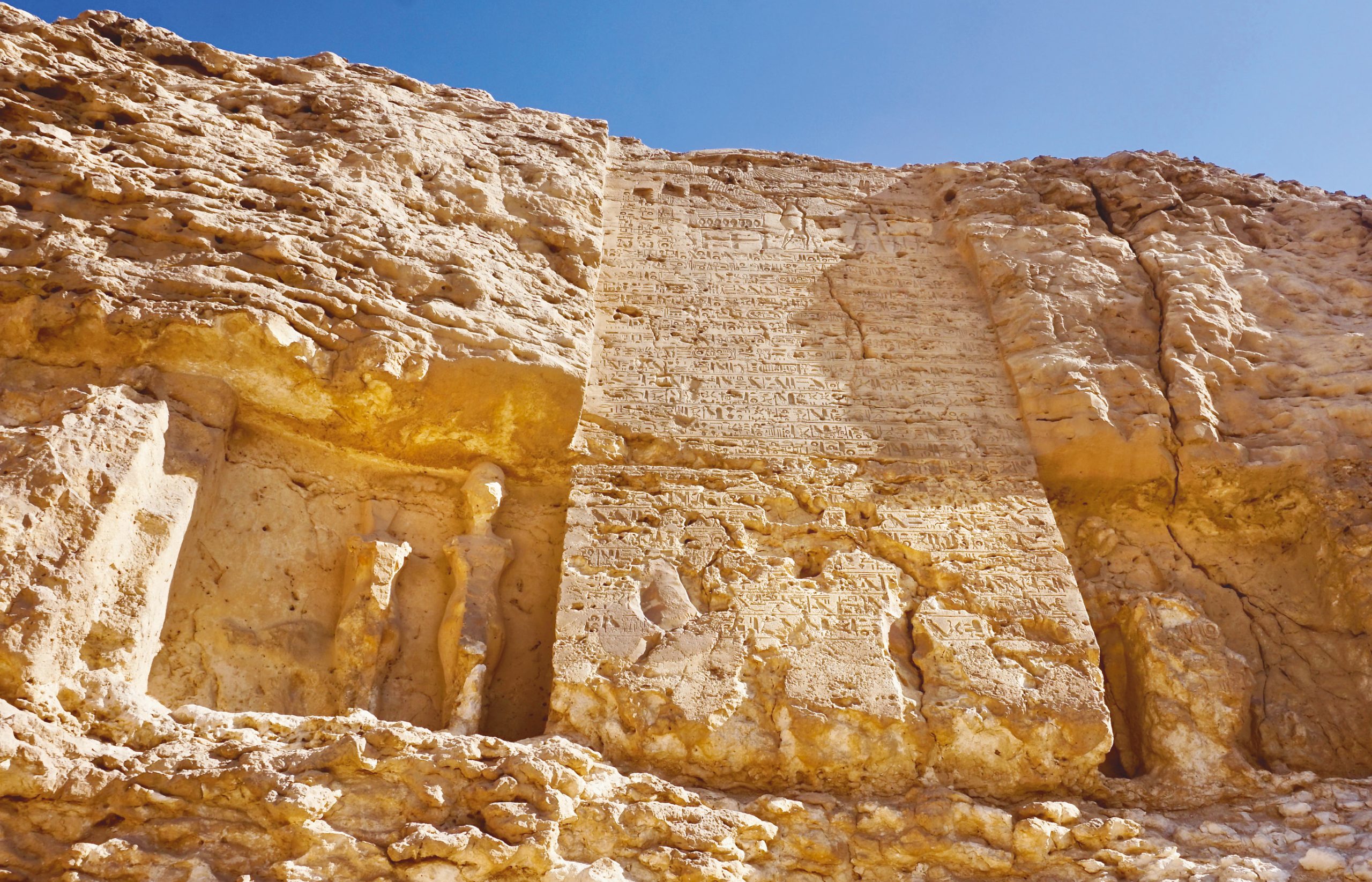
Akhetaten Boundary Stela U.

Amarna is in the Minya Governorate in Middle Egypt, approximately 310 kilometres (190 miles) south of Cairo, and 400 kilometres (250 miles) north of Luxor. Visiting Middle Egypt is much easier than it used to be, and you can independently visit by car, bus, train, or boat, as well as on a guided package tour. I travelled by car from Cairo – a journey of about five hours – and based myself at the Savoy Hotel in the centre of Minya city for a week to visit a variety of sites in the area. I had pre-booked Minya native George Yany to drive me around Middle Egypt while I was there, since a car is useful for visiting many of the archaeological sites in the region, and essential for the vast settlement site of Amarna. Together, we had planned two full days at Amarna, and I intended to use the AUC book as my guide. I found the information and plans of the individual tombs (described in easy-to-read detail) vital to my understanding and enjoyment of the site.

Akhetaten (‘Horizon of the Aten’) was built on the eastern bank of the Nile and lies about 60 kilometres (40 miles) south of the city of Minya. By car, you can take either a longer route on the Cairo–Aswan Eastern Desert Road, or drive on the more rustic and rural agricultural roads which follow the Nile. The journey time (just over an hour from Minya) is about the same either way, despite the difference in mileage, because of the many speed bumps present on the dusty agricultural roads. Both routes eventually merge south of the village of Deir el-Bersha, across the Nile from the city of Mallawi, where a small museum of local finds is located. There is a security checkpoint to enter the very northern end of the archaeological site.
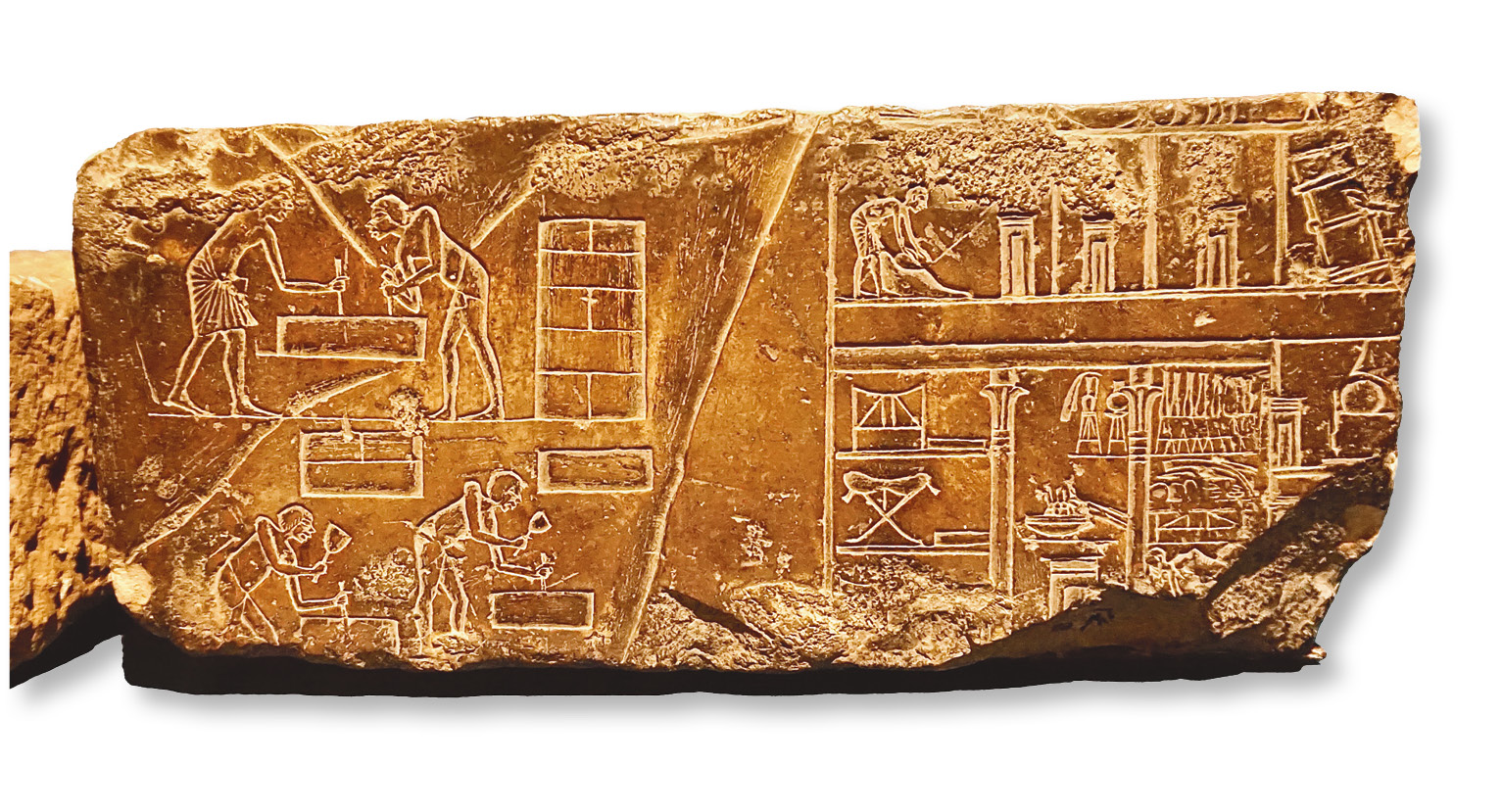
A limestone talatat block from Amarna, depicting quarry workers cutting talatat blocks with chisels and wooden mallets. The smaller size of these construction blocks meant they could be carried and laid easily by one man, so the new city could be built quickly. It is now in the Mallawi Museum.

North City

From the checkpoint, the road leads south with a high escarpment of parched limestone rocks immediately to the left and, to the right, lush farmland broken up by palm trees, and dusty tracks leading down the Nile. Stone was quarried from these cliffs in the form of easy-to-handle talatat blocks to build the temples of Akhetaten. This area of the site is known today as the North City, and probably housed workers from one of the two royal palaces located there. Very little evidence of their dwellings remains other than the occasional clump of mud-brick wall emerging from the dry and dusty landscape. A long stretch of mud-brick wall is thought to have been part of a checkpoint for goods such as oil and wines imported into the ancient city at this point.

 The open-air courtyard of the EES Dig House still has the original column bases from the two-storey central room of an Amarna Period house.
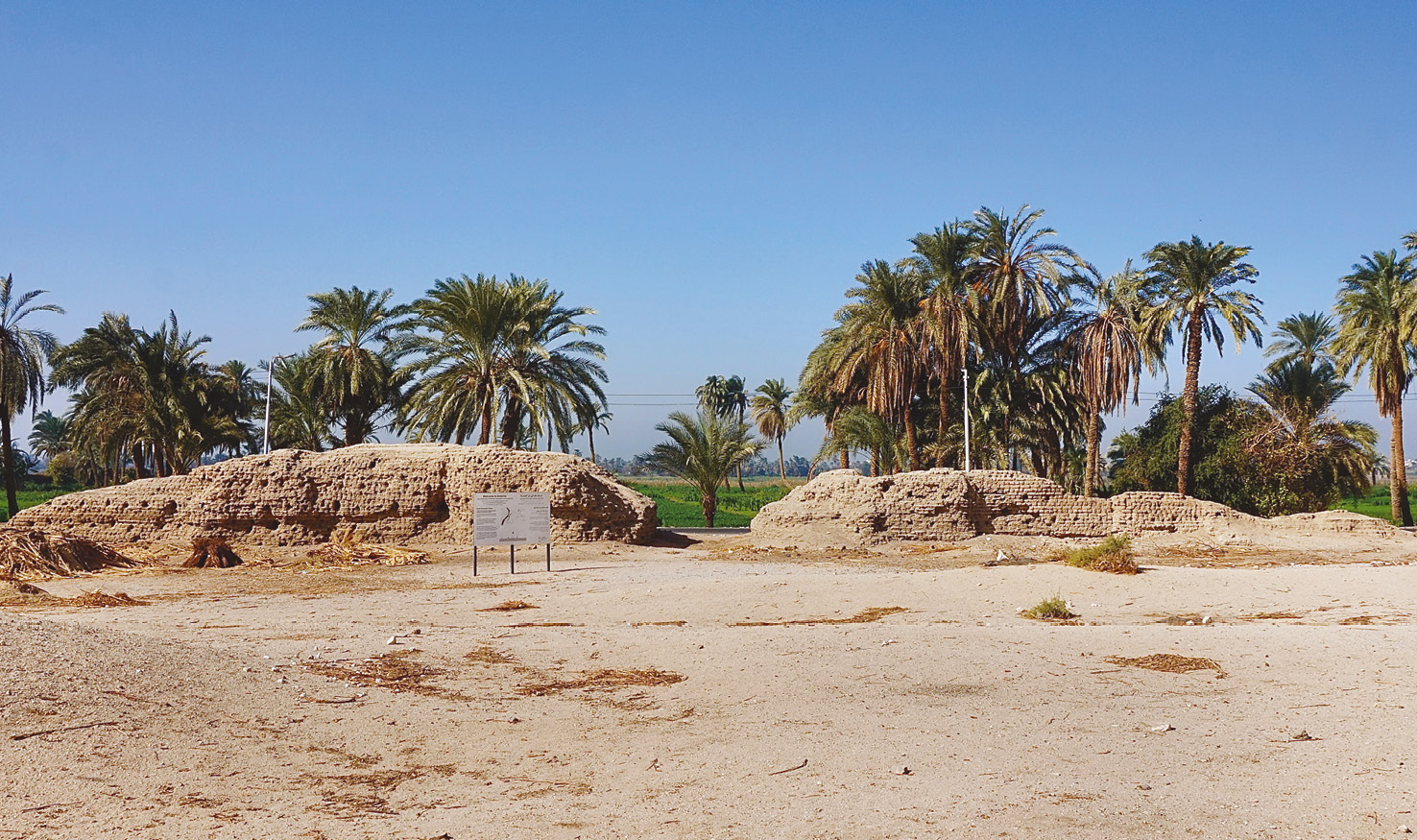
 The only part of the North Riverside Palace that remains today is a mud-brick gateway, seen here from the east, looking west towards the Nile. The bulk of the palace now lies largely unexcavated under the modern cultivation. The Royal Road, which started here in front of the gateway, would have run south (to the left), from where the modern signpost can be seen.

Nefertiti Lived Here

The first significant building on the left is an abandoned dig house used by the Egypt Exploration Society (EES) 1921-1937. It was featured in EES secretary Mary Chubb’s chronicle of daily life on a 1930s archaeological site, entitled Nefertiti Lived Here. The dig house was built on to parts of a restored North City villa from the time of Akhenaten, possibly originally belonging to one the palace officials. What remains of it now stands isolated and proud of the sands. Beside it is a new sign, in English and Arabic, with information about the building. This was the first of many new signs around Amarna, which enhance the visitor experience.

Limestone pillar bases surround an ornamental garden in one corner of the North Palace, while an area of animal enclosures, with feeding troughs and tethering stones, is next to it.

The royal apartment in the North Palace included a throne room and a pillared hall, possibly leading to an ornamental lake where the palm trees (in a thicket of grass on the right) can be seen today. A bathroom has been reconstructed and can be seen (in the middle distance, to the left of centre).

Next to the EES Dig House are the mud-brick remains of a monumental gateway to the North Riverside Palace, which now lies underneath farmland. Many scholars believe that Akhenaten used this palace himself as a quiet residential retreat from the bustle of the city. It also marks the beginning of the so-called ‘Royal Road’, a processional route that runs through the city of Akhetaten. As a public display of his divinity Akhenaten often rode the length of the Royal Road in a chariot.

 A scene in NT1, the Tomb of Huya. Akhenaten leads his mother Tiye towards her Sunshade Temple, while her daughter Baketaten can be seen immediately behind her in front of a group of servants.

The North Palace

A little further along the modern road lies the North Palace. It is believed that this palace was originally built for either Nefertiti or Kiya (a secondary wife of Akhenaten), but was mostly used as the residence of Meritaten, the eldest daughter of Akhenaten and Nefertiti, and the Great Royal Wife of Smenkhkara. The preservation and restoration of this palace is very good, which means that you can clearly make out many features, including a pillared garden court; an area where animals such as ibexes and antelopes were kept; a throne room and royal apartment (complete with a reconstructed bathroom); and a large sunken area with a well that may once have fed an ornamental lake within the palace grounds.

 Princess Baketaten is seen several times in NT1, including in this tiny scene of the chief sculptor Iuti carving a small statue of her on a pedestal.
 In Tomb NT2, there is an important scene of the ‘Reception of Foreign Tribute’ seen on the whole length of the wall behind one of two columns in the form of a bundle of papyrus stems.

Ticket office and resthouse

The ticket office and welcoming resthouse (with refreshments and good toilet facilities) is located a little further down the road, at a turn-off to the left. At the time of my visit, general admission tickets cost LE200, with an additional LE120 for the Royal Tomb (the equivalent of around £5 for both), and payment could only be made by card. George (my driver) knew many of the workers at the office and, after a few introductions and a cup of tea, I explained which tombs I wanted to visit that day. Phone calls were made to organise security and tomb guardians to meet us before we set off. Amarna does not receive many independent visitors, so little details like this are important to ensure a smooth visit at such an enormous site.

In the scene of ‘Reception of Foreign Tribute’ in NT2, Akhenaten and Nefertiti are shown seated together on a throne with the six royal princesses behind them.
 The remains of a dwelling from one of two early Christian monastic communities that repopulated parts of Amarna. This structure was attached to the exterior wall of NT4, the Tomb of Meryra.

The Desert Altars

On the way to the cluster of rock-cut graves of high officials, known as the North Tombs, there is an opportunity to stop the car and walk over the sands to the ‘Desert Altars’. These curious structures, located in the middle of an area of open desert, are better seen from above, although it is possible to make out the occasional ramp and section of mud-brick wall from the ground. Their exact purpose is not known, but they might have been used as part of burial ceremonies for the elite officials whose tombs are nearby.

Akhenaten and Nefertiti make offerings to the Aten in NT4. The tomb owner Meryra is the first of two bowing figures shown in front of the king. 

The North Tombs

I was able to visit all six of the North Tombs. These are in two separate clusters, three-quarters of the way up the cliff face, on either side of a wadi leading to the North Tombs Cemetery, an area of pit graves for labourers that is off-limits to visitors. A guardian and security officer accompanied me up a steep flight of stone steps to the first cluster of two tombs: Huya (NT1) and Meryra II (NT2). Huya was Steward to Queen Tiye and an overseer of the Royal Harem and the Treasuries. Tiye is believed to have lived in Akhetaten during her last years, and was probably originally buried in the Royal Tomb. Meryra was a royal scribe and held similar titles to Huya, but in the household of Queen Nefertiti. Both tombs contain scenes of a diplomatic ceremony known as the Reception of Foreign Tribute, sometimes referred to as the Amarna Durbar, which occurred in Year 12 of the reign of Akhenaten.

Amarna princesses Ankhesenpaaten and Nefernefruaten shown riding in a chariot in NT4.
A plan of a royal palace depicted on the walls of NT4.

The second cluster of four North Tombs is located on the other side of the wadi, a little further to the south. To visit these tombs, you ascend a less steep flight of stone steps with a different guardian and security officer, who met us, as arranged, at the bottom of the steps. The tombs here are: Ahmes (NT3), Meryra (NT4), Penthu (NT5), and Panehsy (NT6). The tombs of Ahmes and Meryra are located at the top of the steps, but you need to walk further south along a roughly hewn ancient pathway to reach the tombs of Penthu and Panehsy. The views across the plain of the ancient city from this great vantage point are dramatic. In common with other tombs in Amarna, the royal family appear prominently in the North Tombs, along with interesting scenes of temple and palace life, detailed plans of buildings, and various hymns to the Aten. There are no depictions of gods such as Osiris or Anubis, and no scenes of the ‘Judgement of the Dead’ or the ‘Journey to the Underworld’. Under the Aten cult, the deceased were believed to remain in the world of the living, sleeping at night and rising early each day to worship the sun god at dawn. Most of the elite tomb occupants at Amarna were buried elsewhere after the city was abandoned, and several of the North Tombs were occupied by a Christian monastic community during the 6th to 7th centuries AD.

The main burial chamber in the Royal Tomb, with the location of the sarcophagus of Akhenaten clearly marked. It is believed that Tiye was also originally laid to rest in this chamber.

NT4 is the Tomb of Meryra, High Priest of the Aten – the most senior priest in Akhetaten. A scene in his tomb shows Akhenaten and Nefertiti making offerings to the Aten, with the princesses Meritaten and Meketaten following closely behind them. The depiction of the Aten has a series of unexplained arcs (clouds?) drawn underneath it. In other scenes in the tomb, Amarna princesses Ankhesenpaaten (future wife of Tutankhamun) and Nefernefruaten Tasherit (‘the Younger’) are shown riding in a chariot, and there is a detailed plan of a royal palace.

The Tomb of Panehsy (NT6) was converted into a church during the 6th to 7th centuries AD. The fresco in a semi-dome of the apse once depicted a six-winged eagle.

Visiting all six of the North Tombs took up the rest of the morning, so we had a lunch break at the bottom of the steps of nearby Boundary Stela U. The boundary stelae were carved on to rock faces in assorted locations around Akhetaten to demarcate the boundaries of the city and agricultural lands that surrounded it. Akhenaten had them inscribed with his vision for Akhetaten and his intention to repair the stelae should they ever become damaged.

The Royal Wadi

Our last stop of the day was at the Royal Tomb, which is located roughly 6 kilometres (4 miles) up a metalled road (part tarmac/part levelled crushed stone) that snakes its way deep into the Royal Wadi. Over the millennia, the wadi has been subjected to many flash floods, and the road now has purpose-built irrigation channels running alongside it to help prevent further damage to the royal tombs.

Above & below: A scene in the Meketaten suite showing the royal family giving praise to the princess, who may have died in childbirth. Beside it is an in image from elsewhere in the tomb of a new-born baby.

The Royal Tomb and the Amarna cache tomb (KV55)

Akhenaten controversially chose to bury the royal family in tombs located in a wadi at Amarna rather than in the traditional royal burial place of the Valley of the Kings at Thebes. The tombs were all unfinished. Today, the wall scenes are all in a very poor state due to looting, vandalism, and flooding. Evidence suggests that Tiye, Akhenaten, and Meketaten were all buried within various side rooms inside the main Royal Tomb, with a large suite of rooms possibly intended for Nefertiti.

In one of the rooms in the Meketaten suite, a scene depicts the royal family giving praise to the deceased princess. She is depicted under a canopy covered in leaves and flowers, common symbols of fertility, suggesting that she possibly died while giving birth to the child seen in other scenes within the tomb.

There are three more known tombs that were started in the immediate area, which are unfinished and undecorated. (All of them are currently off-limits.) Could these have been intended for the burials of Smenkhkara, Meritaten, and even Tutankhaten? At some point after Amarna was abandoned, possibly during the reign of Tutankhamun, mummies and artefacts from the Royal Tomb were transferred to the Valley of the Kings, most notably to a cache tomb known as KV55. Many of the artefacts from KV55 have been on display at the Egyptian Museum on Tahrir Square for years, but some of the more unusual items, such as the ‘Magic Bricks’ and a golden collar found placed on the head of a male mummy, are now on display at the Grand Egyptian Museum in Cairo. The mummy might possibly have been that of Akhenaten or Smenkhkara.

Coming in Part II: Karl visits the temples and royal palaces of the Central City of Akhetaten, plus the rock-cut graves of high officials known as the South Tombs.

Further reading:
• A Stevens (ed.) (2021) Amarna: a guide to the ancient city of Akhetaten (Cairo: AUC).
• B Kemp (2012) The City of Akhenaten and Nefertiti (Cairo: AUC).
• M Chubb (1954) Nefertiti Lived Here (Syracuse: Thomas Y Crowell Co.).
• Download the free .pdf guides by Barry Kemp from http://www.amarnaproject.com.

All images: the author, unless otherwise stated


By Country

Popular
UKItalyGreeceEgyptTurkeyFrance

Africa
BotswanaEgyptEthiopiaGhanaKenyaLibyaMadagascarMaliMoroccoNamibiaSomaliaSouth AfricaSudanTanzaniaTunisiaZimbabwe

Asia
IranIraqIsraelJapanJavaJordanKazakhstanKodiak IslandKoreaKyrgyzstan
LaosLebanonMalaysiaMongoliaOmanPakistanQatarRussiaPapua New GuineaSaudi ArabiaSingaporeSouth KoreaSumatraSyriaThailandTurkmenistanUAEUzbekistanVanuatuVietnamYemen

Australasia
AustraliaFijiMicronesiaPolynesiaTasmania

Europe
AlbaniaAndorraAustriaBulgariaCroatiaCyprusCzech RepublicDenmarkEnglandEstoniaFinlandFranceGermanyGibraltarGreeceHollandHungaryIcelandIrelandItalyMaltaNorwayPolandPortugalRomaniaScotlandSerbiaSlovakiaSloveniaSpainSwedenSwitzerlandTurkeySicilyUK

South America
ArgentinaBelizeBrazilChileColombiaEaster IslandMexicoPeru

North America
CanadaCaribbeanCarriacouDominican RepublicGreenlandGuatemalaHondurasUSA

Discover more from The Past

Subscribe now to keep reading and get access to the full archive.

Continue reading