Subscribe now for full access and no adverts
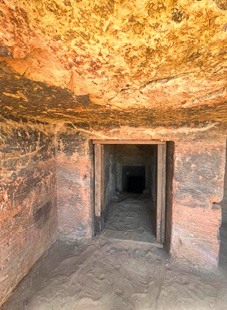
In February 1925, a team from Harvard University and the Museum of Fine Arts, Boston, working on the Giza Plateau under the direction of Dr George Andrew Reisner, discovered the Fourth Dynasty Tomb of Queen Hetepheres I. Hetepheres was the wife of King Sneferu (c.2613-2589 BC) and the mother of Khufu, whose Great Pyramid dominates the Plateau. The tomb entrance, which is situated close to Khufu’s pyramid, is currently surrounded by a metal fence and the open tomb-shaft is covered by an iron grille.
Once the importance of the tomb had been recognised, it was resealed to await Reisner’s return to Egypt from the USA. The tomb was reopened and the excavation by Dows Dunham began, under Reisner’s supervision, in January 1926. The most important finds in the tomb were the fragmentary remains of a set of gilded furniture, a head rest, and a bed canopy. Meticulous excavation and recording of this material took 17 months to complete and has provided an extraordinary insight into how the contents of the tomb were found and recovered. It would fall to William Arnold Stewart to rebuild much of the furniture that was discovered in the tomb.

An education in Yorkshire
Stewart was born on 17 July 1882 in the former spa town of Ilkley, West Yorkshire, the youngest of at least six children born to John Reich Stewart and Naamah Arnold. He commenced his secondary studies at Bradford Technical College in the Department of Textile Industries as a full-time day student in September 1897, aged 15. Students would undertake practical activities in specialist dye and loom workshops, and pursue their academic studies in lecture rooms equipped to teach spinning techniques or set up with testing equipment. By 1905, Stewart was employed as head designer at Lister and Co. in Manningham, the largest silk mill in the north of England.

During his college years, Stewart gained a reputation as a proficient independent artist, first in the field of photography. He was appointed librarian of the Bradford Photographic Society in January 1901, aged 18, and in the following year, with three other students from the Bradford School of Art, founded the Bradford Loft Arts Club. An extraordinary Arts Club committee meeting was summoned at short notice for Wednesday 16 August 1911, at which a letter from Stewart was read out, tending his resignation from his post as Honorary Secretary due to his appointment to the Department of Applied Arts at the Technical College in Cairo. In 1911, Stewart left England for Egypt to take up his new post in Cairo.

Cairo and Jerusalem
In 1918, he was seconded to work for a period of three months in Jerusalem as an adviser, with a brief to propose a plan to rebuild Palestine’s war-damaged industrial economy. During his time in Jerusalem, he formed a close working relationship with Charles Robert Ashbee (1863-1942), an architect and designer who had been appointed as the Governor’s civic adviser. The two men shared a flat until Ashbee’s wife Janet and their four daughters arrived from the United Kingdom. During the sea journey, Janet was accompanied by her cousin Kathleen Margaret Beardshaw, who helped Janet with the children. A year later, Stewart and Kathleen Margaret married in Cairo. They had two daughters and a son.
Stewart’s previous petitioning of the Cairo education authority for technical studies courses to be introduced into the curriculum was successful, and in 1920 the Egyptian School of Arts and Decorations was founded with Stewart as its first Director.

Hetepheres’ tomb
Stewart’s reputation as a fine artist who played an active role in the cultural life of Cairo was recognised by Reisner, who asked him to paint a watercolour of the interior of Hetepheres’ tomb before the clearance of its contents in 1925.
By the summer of 1927, William Arnold Stewart’s contract with the Egyptian government as Director of the School of Arts and Decorations had finished, and he was engaged by Reisner to undertake the reconstruction of the gilded furniture excavated by Dows Dunham. He worked on the project from September 1927 to January 1930, when he left Egypt to take up a post in Palestine.
Stewart completed the reconstruction of armchair no.1, the carrying chair, the bed-frame, an anklet/bracelet box and its contents, and the queen’s head rest. He began work on the bed canopy, which was completed by British artist and furniture designer Bernard Rice after Stewart left the project.

The carrying chair
The first piece of furniture that Stewart rebuilt was the queen’s carrying chair. Its parts were mostly on the top level of the tomb deposit, and the gold framework was easily recognisable as it had been embellished with a fine reed-mat pattern in low relief. The actual gold was thick and had retained its form very well. Moreover, the expedition had discovered the Tomb of Meresankh III, the great-granddaughter of Queen Hetepheres I. In the relief decorations of her tomb chamber was represented a carrying chair, almost identical to that of Hetepheres I, with the same side view and the same palm capitals on the ends of the carrying poles.
… the heavy gold casing of the chair’s framework showed evidence of its structure.
Except for the palm-capital handles, the poles had not been covered with gold. However, the heavy gold casing of the chair’s framework showed evidence of its structure. The chair had been put together with mortise and tenon joints, some of which were found inside the casing and retained well-defined holes for the pegs that had held the joints together. A fine reed-mat pattern had been carved on the original woodwork. When complete, the chair had been taken apart and the wooden pieces covered with gold sheet, which had been pressed into the low-relief carving. Stewart made a new wood framework slightly smaller than the inside measurements of the gold casing. He then painted the hollows on the inside of the gold with a mixture of gesso, animal glue, and plaster, until he had levelled up the inner surfaces. This dried hard and preserved the relief from damage when put under pressure. The original gold casing was then glued on to the new wood framework. The frame of the carrying chair’s back panel had been mitred together at its upper corners; a new wooden panel was fitted in the frame.
The gold palm-capital handles needed very special treatment. One of them was badly buckled and all were a little split and out of shape. Stewart repaired all the bulges by working them on a specially made steel stake held in a vice. The gold was put over the stake and worked gently from the outside against the stake inside. Where the gold was split, he worked the metal together and sealed the joint with tape and celluloid glue, applied on the inside. He then filled the capitals with a glue and plaster mixture.


After the carrying chair was completely erected, Stewart cleaned all the gold with ammonia and warm water applied with a sponge. All uncovered woodwork was stained brown – the original was probably made of cedar – and was oiled and waxed. All the gold work was given a coat of celluloid varnish.
The armchair
The second piece of furniture reconstructed by Stewart was the queen’s armchair (no.1). It had collapsed, with the wood framework and cores having decayed to a consistency that resembled, according to Reisner, cigar ash. The meticulous records and drawings made at the time of the discovery allowed Stewart to reconstruct the armchair from its fragmentary remains.
From the actual gold casing and fragments, Stewart made drawings of the papyrus flowers and stems that decorated the arm panels. He laid each half of a gold flower on to cotton wool to preserve its shape and sealed up all holes and breaks with wax. He then filled the space between the wood core and the gold with thin plaster. When the plaster had set, he removed the gold very carefully, scraped away any remaining wax, and hand-modelled the plaster, correcting any faults due to slight breaks or bulges in the gold. He cleaned all the wax from the gold with hot water and then applied the gold – piece by piece – to the plaster form with hot glue.

Throughout the reconstruction process, Stewart experienced annoying nightly interference by mice who would nibble off the gold to reach the protein-rich animal glue.
The semi-circular section of the arm rests was covered with gold in a ribbed pattern in high relief. The end-cap on the arms gave him the cross-section of the arm rests, so he had a piece of softwood made to this cross-section and more than twice as long as the arms. Using this as a support for the gold, Stewart fixed the breaks together with gummed paper. When each arm was completely repaired, he laid the gold on to the hard wood arm already prepared by the carpenter, and glued the gold foil into position.
The most difficult part of the armchair’s reconstruction was the manufacture of its lion legs. Stewart found he could not manufacture them in new wood and reapply the gold. He developed a unique and remarkable process of manufacturing the legs in plaster, and then reapplying the gold.

The bed-frame
The reconstruction of the bed was comparatively easy, because the gold was thicker than that of the armchair, though not quite as thick as the framework of the carrying chair. The end-knobs of the side rails and the legs were well preserved. Two of the legs still contained the original wood, although much shrunk and decayed.
The footboard was not on the bed, and there was no trace of it, yet it must have been part of the bed to prevent the mattress sliding off. Stewart searched the store trays and the records, and at last found a long narrow panel of coloured faience which he glued on to a framed wood panel made to fit the bed.
The restoration of the bed legs proved more difficult. Stewart used a core of zinc rods that he encased in wet plaster. To the upper end of these zinc rods, he fitted a wooden top to act as the leg’s tenon.

The bracelet box
The identification of all the gold sheets for the bracelet box was a straightforward matter, as far as the outside measurements of the box were concerned.
A fine ribbed pattern covered all the outside sheets, while the inside sheets were quite plain. Stewart had new wood boards for the sides, lid, and bottom of the box cut to fit the gold sheets. He filled the underside of each sheet with gesso, and then covered each board with a coat of ‘plastic wood’, a commercially available mixture of celluloid, sawdust, and pigment. He covered the underside of the gold sheet with ‘necol glue’, a celluloid cement, and laid it over the wood board.

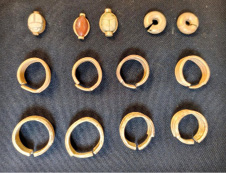
The bracelets were of silver, inlaid with a pattern of butterflies, whose wings and bodies are of turquoise, lapis lazuli, and carnelian. Those bracelets that were in good condition were coated with celluloid varnish. Those that were broken were fitted together inside two circles of pins, drawn close by putting an elastic band round them, and then coated with necol cement.

The head rest
The gold and electrum plating of the head rest was found reasonably intact, but Stewart had to replace its wooden core. The slight bulges were pressed from the inside and easily resumed their original form. Stewart carved the 20 flutes on the column to fit the electrum sheet covering, coated the wood with necol glue, and laid on the electrum piece by piece, as it was in fragments. The top and base were sufficiently intact to be fitted to new wood cores. The whole assembly was fixed together with necol glue.
The canopy
The great gold-covered canopy was the largest piece of furniture and had been constructed so that it could be carried in sections from place to place, and erected in a few minutes. All its joints were furnished with copper sheaths which, although much corroded, were intact.
Stewart had to leave the canopy unfinished to take up an official post in Palestine, but all drawings and measurements had been taken, so the carpenter was able to continue the construction. The rest of the gold work was completed by Bernard Rice.
Stewart’s Hetepheres manuscript
Stewart prepared the first draft of his Hetepheres manuscript between 1947 and his death in 1953. The manuscript, which is preserved in the Griffith Institute, Oxford, consists of a series of chapters and drawings that discuss each piece of furniture he rebuilt. A detailed diary from 28 September 1927 to 23 January 1930 provides vivid detail of the execution and progress of the day-to-day work in his small mud-brick workshop in the shadow of the Giza pyramids.
Stewart left Reisner’s team at Harvard Camp, Giza, in January 1930 to take up the post of Supervisor of Technical Education in Palestine. After the Second World War, he lost several close friends in the 1946 King David Hotel bombing in Jerusalem. He retired in 1947 and returned to live in England. In the final years of his life, he lived in High Wycombe, and continued to write and paint. He also began the task of completing his Hetepheres manuscript. He managed to finish the first draft, but sadly it remained unpublished by the time of his death at his home on 18 January 1953.
The manuscript, which contains 181 documents of written, typed, drawn, and photographic material, came to the attention of Egyptologists on the death of Stewart’s eldest daughter Jean in 1981, when it was found in a shed in Pitlochry, Perthshire. Cyril Aldred, who had been Keeper of Art and Archaeology at the Royal Scottish Museum in Edinburgh, read the manuscript and suggested that it should be given to the Griffith Institute at the University of Oxford.
The reason Stewart wrote his manuscript apparently relates to a conversation he had with Alfred Lucas (1867-1945). Lucas said:
You know, Stewart, you ought to write up and publish this work, as nothing quite like it has ever been done before. The Tutankhamun furniture was intact and only needed cleaning and preserving; there were very few broken objects, and nothing was in the condition in which this much older furniture was found. This work you are doing may be of value to others and you really should put it into some permanent form.

Publication
The work of the team involved in every aspect of the Hetepheres’ furniture project in the 1920s is, of course, a product of its time, but there can be little question that the intellectual rigour, practical precision, and care that were applied to it represented good practice at that period. I have now edited Stewart’s manuscript, with contributions from Helen Farrar, Curator of the Textile Archive at Bradford College, and Julie Dawson, former Head of Conservation at the Fitzwilliam Museum, Cambridge, and it has been published in book form by the Griffith Institute, Oxford, and Peeters of Leuven. It demonstrates William Arnold Stewart’s important contribution both to our understanding of the current state of the furniture, and to the development of technological studies and conservation practice.
Dr Geoffrey Killen is a leading ancient furniture historian and Egyptologist, who has written four major works on his specialism and a number of articles and papers in conference reports, Festschrifts, books, journals, and magazines. He has also led in the field of experimental archaeology by making and using replica woodworking tools and equipment to test archaeological hypotheses.