Subscribe now for full access and no adverts
The temple of Qasr el-Sagha (‘Fortress of Gold’) stands in the desert north of Lake Qarun. The lake today is much smaller than it was in pharaonic times. It receives all its water from the Bahr Yusuf, a collateral branch of the Nile, which enters the Fayum around Lahun. Various pharaohs carried out water-management schemes throughout the ages to reduce the lake and create new fertile agricultural land. While the temple today is around 8km from the lake, in ancient times it would have stood only a few hundred metres from its shore.
The temple is unfinished and bears no inscriptions, so it is difficult to date its construction accurately. However, as discussed below, academic consensus now dates it to the Middle Kingdom.

Excavations
The temple was first documented by Georg Schweinfurth, a German botanist/explorer, who visited the site in 1884 and carved his initials on a nearby stone.
Flinders Petrie visited in 1888. He drew a plan of the temple and made some sketches, but he wrote: ‘What age this building is I could not determine. It has no trace of inscriptions… Some more excavation might disclose a clue to its meaning.’
It was not until 1977 that Dieter and Dorothea Arnold took up the challenge on behalf of the German Archaeological Institute, working at the site for a month.


The temple building
The temple is constructed of large blocks of limestone, presumably from a quarry nearby. The front of the building is largely smoothed down, though a few building bosses remain. The side and back walls are unsmoothed and are built of somewhat smaller stones.
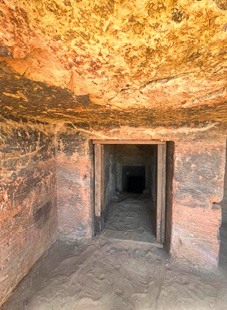
The main entrance held a single door that pivoted on the left – the pivot hole is visible today. There is also a smaller doorway in the front wall that leads to a narrow corridor towards the main entrance. A hole at the end of the corridor passes into the side wall of the main entrance. An earlier commentator suggested that a guard could hide inside the corridor and, through the hole, keep watch on who was coming and going into the temple. The Arnolds believe that the main door of the temple was locked shut by a bolt passing through the hole. Their theory is that entry to the temple was a two-stage process: first, a visitor had to enter the narrow corridor to pull back the bolt; then the main door could be opened on its pivot.


The main hall contains seven shrines on a raised platform. Two pivot holes are visible in the ceiling of each, so each shrine was designed to be closed by double doors. Because there are no inscriptions, we do not know to whom the shrines were dedicated, but the most likely deity is the crocodile god Sobek. Most of the temples of the Fayum are dedicated to that god.
To the left of the main hall is a western room, and a room with no doors or windows (called a ‘blind room’). Blind rooms can be found in other Egyptian temples – for example, in the Temple of Sety I at Abydos. It has been suggested that the room there served as a secret crypt, where the most valuable treasures could be stored. The Arnolds propose a similar function for the blind room at Qasr el-Sagha. Others have suggested it might be a grain silo, with the opening at floor level allowing grain to flow out. Entry into the blind room today involves an undignified crawl through this opening.
Location of the temple
Why was the temple built at this location? We know that the basalt quarries of Widan el-Faras (‘Horse’s Ears’) were worked extensively in the Old Kingdom for stone for the floors of pyramid funerary temples, most famously the one beside the Pyramid of Khufu. The world’s oldest known paved road was built to transport the blocks by sled the 11km from the quarries down to the lakeside at Qasr el-Sagha, from where they could be carried by boat to their destination.


The harbour beside Qasr el-Sagha may have been a bustling place in the Old Kingdom, but when the Arnolds examined the construction rubble of the temple, the oldest ceramics they found dated from the reign of Senusret II (c.1845-1837 BC) in the Middle Kingdom. (For more about Senusret II, see p.32.) Senusret II is known to have had a special interest in the Fayum area, choosing to build his pyramid at Lahun, so he is a good candidate to be the builder of the temple. Most commentators now believe that the temple is of Middle Kingdom construction. However, there is little evidence for the use of basalt in the Middle Kingdom, and there is no explanation for why the temple was built so long after the area was at its busiest.
The temple of Qasr el-Sagha is interesting because so much is uncertain. The large stones on the front of the temple look Old Kingdom in style, as if the Middle Kingdom builders were trying to make a structure that looked archaic – such archaism is common throughout dynastic history. The multiple shrines inside are similar to those at the Temple of Medinet Madi in the south-west Fayum, which also dates to the Middle Kingdom.

Visiting the temple
Previously it was difficult to reach the temple site, needing a four-wheel drive vehicle to follow tracks in the desert, starting from the eastern edge of Lake Qarun. However, a highway has now been built that passes within a few kilometres of the temple, so it is easy to reach using a regular car – for example, from Giza. My Egyptian driver and I had no problems getting there following GPS coordinates. The temple now stands inside a nature reserve offering petrified trees and other items of geological interest to visitors. I hope that in the future this site gets the closer attention that it deserves.
Geoffrey Lenox-Smith holds the Certificate in Egyptology from Birkbeck, University of London, and is one of our regular ‘Out and about’ contributors.
Further reading:
• W M Flinders Petrie (1890) Kahun, Gurob, and Hawara (Kegan Paul and Co.).
• D and D Arnold (1979) Der Tempel Qasr el-Sagha (Philipp von Zabern).
• K Hamilton (2020) Qasr el-Sagha Temple: a layman’s guide, http://www.academia.edu/42343573/Qasr_el_Sagha_Temple_A_Laymans_Guide.
All images: the author, unless otherwise stated