Bluetooth’s Kingdom

July 16, 2024
This article is from World Archaeology issue 126


Subscribe now for full access and no adverts
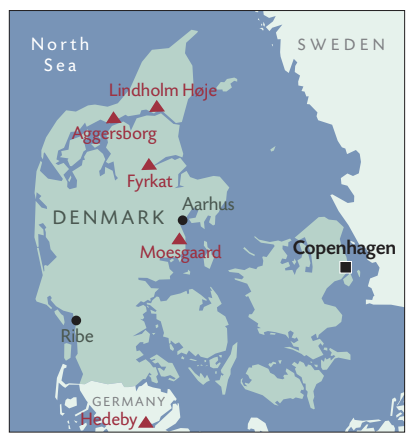
I have embarked on an odyssey to revisit Viking Denmark decades after I first became familiar with it through editing Klavs Randsborg’s landmark book The Viking Age in Denmark (1980). Randsborg’s book was regarded as heresy at the time, but as my trip to the key places in his narrative now shows, dates may have changed, but his world of evolving civic sophistication and state formation has truly ousted the Hollywood image of Vikings as violent warmongers. Today, it is not hard to trace the roots of modern Denmark in the new museology of its major Viking Age sites. My tour took me to Hedeby, Ribe, Aggersborg, Fyrkat, Lindholm Høje, Aarhus, and the extraordinary new museum at Moesgaard. In these places, I was introduced to the legacies of the Viking kings Ongendus, Godfred, Harald Bluetooth, and Sven Forkbeard.
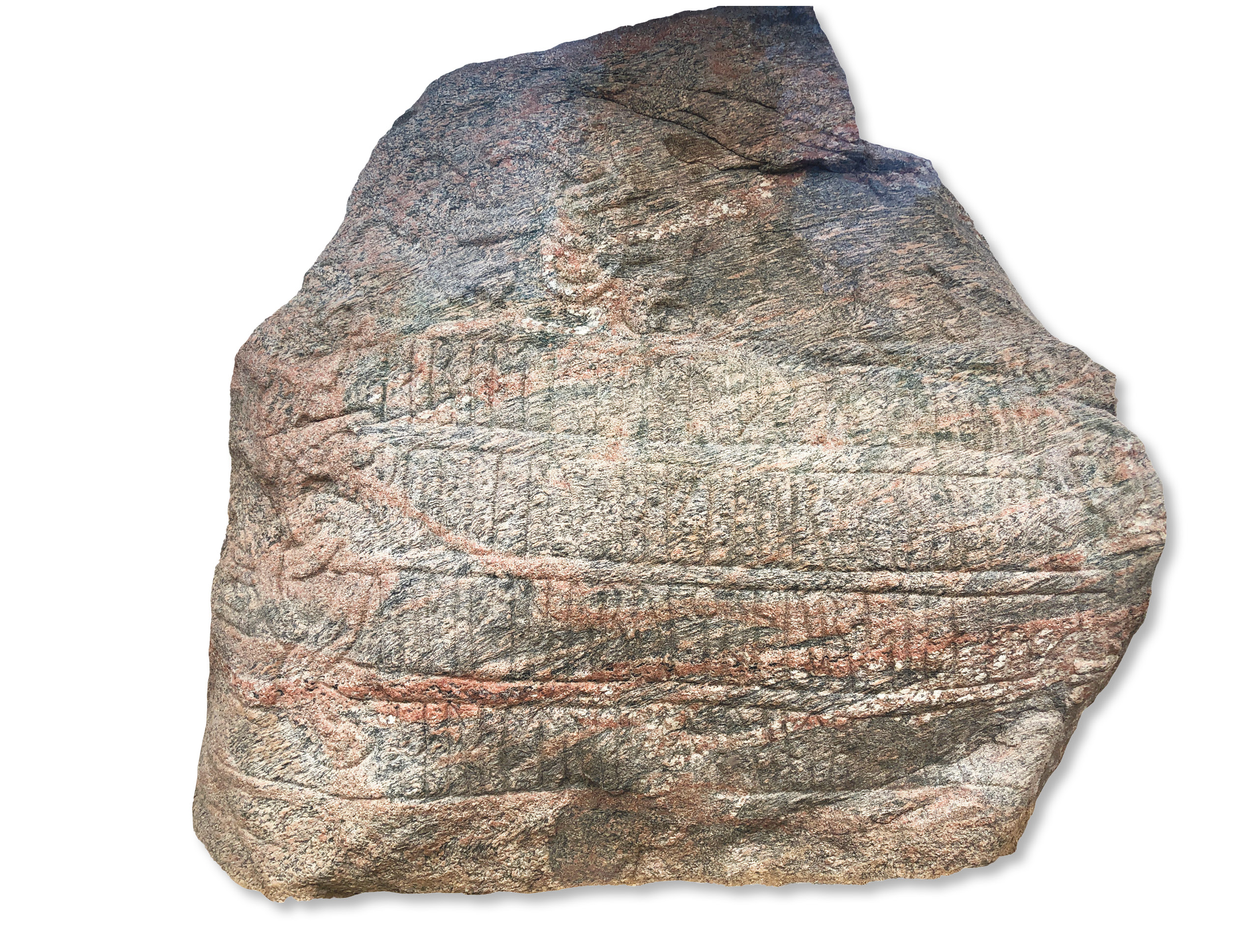
This runic stone was installed at Jellinge in the 10th century AD on the orders of King Harald Bluetooth. It includes an early reference to Denmark, saying ‘King Harald commanded this monument to be made to the memory of Gorm, his father, and in memory of Thyra, his mother – that Harald who won the whole of Denmark for himself, and Norway, and made the Danes Christian’.  

Hedeby (Haithabu)

Denmark enters European history with King Godfred. According to the 9th-century Frankish Annals, Godfred made his mark in AD 808 by taking the traders from Reric, a port near Kiel on the Baltic Sea, and forcibly moving them to Hedeby. This was an inland bay at the eastern end of Denmark’s southern frontier wall, known as the Danevirke. Godfred’s action roused the Emperor Charlemagne’s ire. By this time an old man, the Carolingian Emperor raised an army and brought along with it a gift from the Abbasid Caliph, Harun al-Rashid: a white Indian elephant called Abul-Abbas. Charlemagne, it would seem, perceived that Godfred posed a threat to his burgeoning northern economic strategy. The elephant died before any confrontation occurred. So too did Godfred at the hands of his peers, who sued for peace with the Franks. Hedeby, rather than Reric, outlived this political squall to become, in the 20th century, one of the cornerstones of European medieval archaeology.
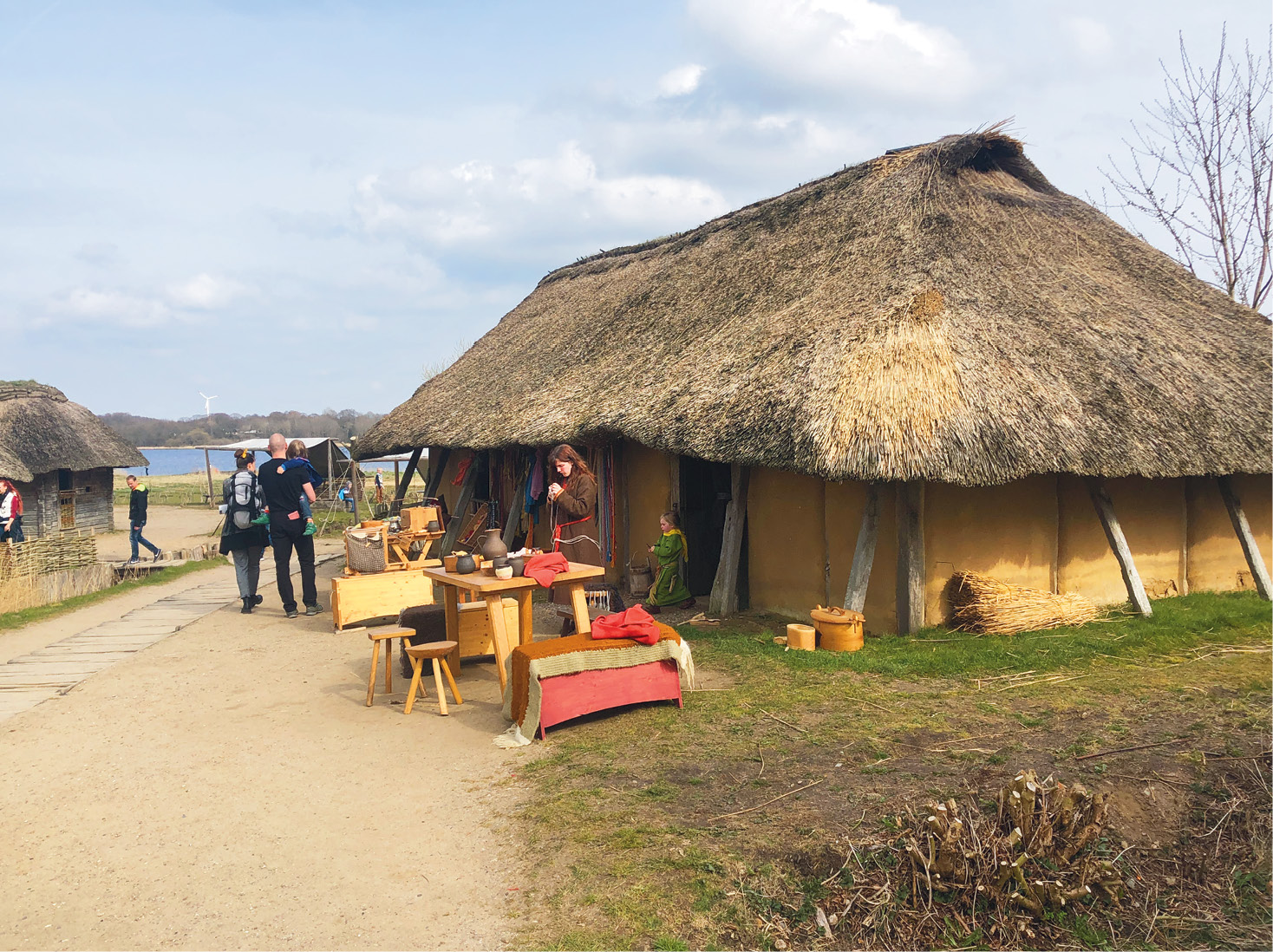
 The reconstructed buildings at Hedeby provide a sense of how the Viking town would have appeared, and host re-enactments and a fair.  

Situated today on the bay south of Schleswig, Hedeby (or in Old German, Haithabu) lies just inside the north German border, conquered by the Prussians in the Holstein-Schleswig war of 1864. German it may be, but its ethos remains Danish. A hundred years of excavations here have filled an exquisite museum with fine early medieval treasures from the Viking Age, as well as a largely reconstructed boat. The excavations have also given purpose to a small nucleus of reconstructed buildings, associated with which are re-enactments and a Viking fair. In recent times Hedeby has justifiably won UNESCO World Heritage Site status.

Hedeby is a beautiful place – both serene and majestic, contained within an immense half-circular rampart. Much of this majesty derives from unparalleled scholarship that has embroidered a remarkable history. Few places in Europe have been studied in such depth. We know a great deal about its formative years in the late 8th century, its 9th-century early urban topography, its harbour, the arrival of Bishop Ansgar to found a church here in 849/854 (a 24kg bell was found in the harbour, but the church probably lies under the large Romanesque church near the modern car park), its episodic transformation as the town adapted to trade with the eastern Baltic and the Rus, and finally in the mid-11th century its abandonment in favour of Schleswig on the north side of the sweeping bay. Its immense rampart dates to a halfway point in its history as an emporium, to the mid-10th century. The Danevirke – Denmark’s long southern border wall – was connected to it, making the town a kind of neutral point on the frontier. The neutrality was ignored in the 970s when the Ottonian Franks seized it, only to be dislodged in the next decade by the Danish king Harald Bluetooth.

As the museum and reconstructed dwellings and workshops make clear, Hedeby is the archetypal Viking town. It served as the interface between the Frankish empire and the Danes, between the West and the East. More than any other place, its archaeology introduced us to the Vikings as merchants, traders, and peerless craftsmen, impresarios who long before Columbus reached eastwards to Byzantium and westwards to Vinland. Peace-loving citizens aside, it must be said however, that pride of place in Hedeby’s museum goes to a warship excavated in its harbour. Unlike the many other finds on display, it speaks to the Vikings we are familiar with. The maritime archaeologist Ole Crumlin-Pedersen believed that this ship was a longship of royal standard, designed for high-speed sailing and rowing in relatively protected waters. This royal vessel was built around AD 982 (following dendrochronological dating) and, judging by the wear and some repairs, must have been in service for 5-15 years before it finally sunk sometime between AD 990 and 1010. Based on its date of construction, it must originally have been commissioned by King Harald Bluetooth. Its loss around AD 1000, then, is likely to coincide with the deployment of the royal fleet, the Þingmannaleið, for the conquest of England during the reign of Bluetooth’s irascible son, Sven Forkbeard.
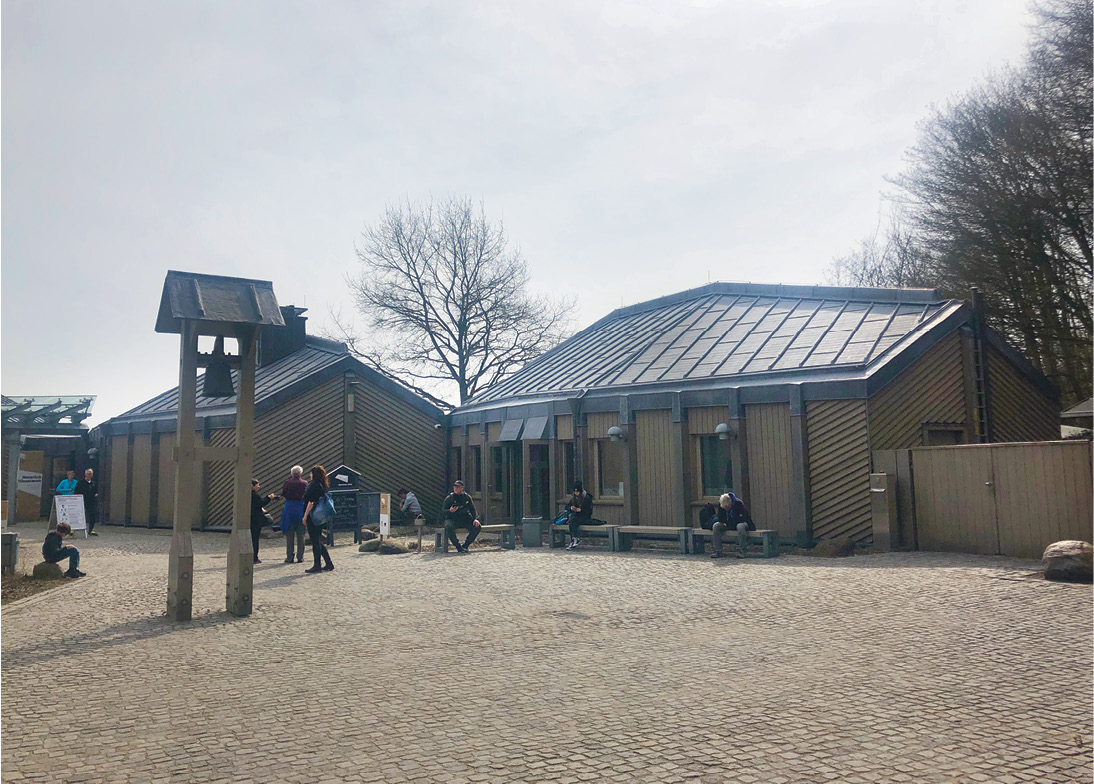
Above: The exterior of the modern museum at Hedeby evokes Viking longhouses. Among the finds presented to the public within are the remains of a 10th-century royal vessel (below), which was excavated in Hedeby’s harbour. It is possible that the ship was lost during Sven Forkbeard’s preparations to invade Britain.  

Apart from this royal warship, ‘civilised’ Vikings are all the rage. The rampant Viking raiders may have made these Scandinavians a global brand, but in old and modern Denmark these late Iron Age peoples are presented as the forerunners of Scandinavia’s stable middle-class values. Yes, the global and national perceptions could not be more different. At Hedeby, the museum – its architecture cleverly evoking a cluster of Viking longhouses – displays its finds with German and Danish captions. Hedeby may just be German in the strict sense today, but it is a thought-provoking portal to Godfred’s world and, as my Viking odyssey was to reveal, a great deal more besides.

And Reric, the port that fell victim to Godfred’s bold seizure of its traders? Recent excavations close to Groß Strömkendorf on Wismar Bay have found the remains of the small sunken huts that comprised the very first trading port in these parts. The Frankish story that brought Godfred into history seems to be true.

Ribe

A century before Godfred imprudently challenged Charlemagne, Denmark boasted a king called Ongendus, reputed to be as hard as stone. Nothing more is known of this leader. In his time, though, on the eve of the 8th century, he founded or at least supported Hedeby’s North Sea predecessor at Ribe. Set back from the frayed coastline on the canalised Ribe river, traders here initially reached out to the celebrated Frisian merchants operating out of the mouth of the Rhine. Eastern England lay within the range of their new sailing craft, too, where Anglian migrants from an earlier age evidently welcomed mercantile connections.

 Ribe reconstructed: an evocation of the waterside of the Viking-era settlement on display in Ribe museum. 

The little town of Ribe today is arguably Jutland’s jewel. Its earliest history, however, has lent the port international fame in recent years. Fifty years of excavations of early Viking Ribe have revealed a small version of Hedeby. It lay to the immediate east of a river, parallel to which ran an axial wooden corduroy road. Workshops, gardens, and jetties stretched from the road down to the river. A recent excavation by the Northern Emporium Project led by Professor Søren Sindbæk has shone an amazing spotlight on Denmark’s earliest town. One plot was excavated in intricate detail, providing what Sindbæk has called ‘high definition’. Compacted layers of a building rebuilt repeatedly have been peeled back one by one to reveal almost every decade of use. This sandwich of black and burnt layers is stuffed with archaeological riches. Each of about 14 iterations of this property’s early Viking history from c.AD 700-850 throws new light on one or more craftsmen simultaneously at work here. The detail is staggering: the debris and working materials of bead-makers, comb-makers, and brooch-makers, when analysed, bring to mind the technical manuals of the later Middle Ages.

The remains of 8th-century buildings at Ribe. Meticulous excavation of the site has revealed how these structures underwent repeated rebuilding.

Ribe is an archaeologist’s dream. It is a miniature Pompeii in all but name. The wealth of archaeology is well displayed in the town’s Viking Museum, which also introduces the medieval port that prospered until nearby Esbjerg eclipsed it. The medieval town itself migrated across the river from the earliest emporium to occupy the ground around a church founded by the restless missionary, Bishop Ansgar, in about AD 860. Today, Ribe is ranged around a towering Romanesque cathedral, next to which is a beautiful new museum devoted principally to excavations in its cemetery. The present town of timber-framed houses is both enchanting and blessed with good restaurants. Put the archaeology of Ribe together with Hedeby and Schleswig, and 1,500 years of European urban history emerges from the black earth of the Viking Age.

A statue outside Ribe cathedral celebrates Bishop Ansgar, who founded the first church at the settlement c.AD 860.

Jellinge

If Denmark entered history with Godfred at Hedeby, the nation found its voice in Harald Bluetooth’s re-envisioning of Jellinge.

Jellinge lies in the centre of Jutland. Here, as the extraordinary new visitor centre makes crystal clear, Denmark as a country was born. Two great stones with runic descriptions planted in front of the porch of a whitewashed church dominate the immaculately maintained cemetery. The huge boulders were situated to make a point to all who visited after the 980s. The smaller of the two stones is King Gorm’s monument to his queen, Thyra. It bears, in vertical bands, the following inscription: ‘King Gorm made this monument in memory of Thyra, his wife, Denmark’s adornment’. This is the first reference to Denmark. The larger of the two stones is King Harald Bluetooth’s elegantly decorated monument to his parents, King Gorm and Queen Thyra, and to his own achievements. The runes spell out: ‘King Harald commanded this monument to be made to the memory of Gorm, his father, and in memory of Thyra, his mother – that Harald who won the whole of Denmark for himself, and Norway, and made the Danes Christian’. Bluetooth – an emblematic word of our digital age, as visitors to the centre learn – took its name from Denmark’s first Christian king and statesman. Born in about AD 911, he possessed a distinguishing blue or black tooth according to a 12th-century chronicle, the Chronicon Roskildense. He succeeded his father, Gorm in AD 958 and ruled until AD 985 or 986. The short-range wireless programme was named after this Viking following a conversation in 1997 between Jim Kardach, the founder of Intel, and Sven Mattisson. The latter was fascinated by the Danish king as a uniter of peoples, and has given him a new worldwide lease of life as a uniter of devices. The Bluetooth logo consists of a Younger Futhark bind rune for the king’s initials H and B.

A view of the stone church at Jellinge, which occupies the site of several earlier timber structures and lies nestled next to a great burial mound.  

Jellinge has been lent a striking facelift on becoming a UNESCO World Heritage Site. The new visitor centre provides a vivid introduction to the narrative of this sacred place. In words and digital imagery, it explains how originally this was a large setting of boulders arranged to look like a Viking boat. Immediately beyond the metaphorical boat lay two great burial mounds. The dedication stones were positioned between the mounds, a continuity of tradition if not of religion. Here, too, would be erected Bluetooth’s church and ultimately a royal burial place. A large quasi-palisade enclosed this sacred spot. Several large bow-shaped halls lay just inside the immense timber walls some distance from the sacred centre.

Deep in the heart of Jutland and situated on a small rise, this place possesses an ethereal quality. Here Denmark not only became a reality – as did Christianity – but it speaks to the growing desire of a successful late prehistoric state to define itself clearly on the eve of the 2nd millennium. It is an unlikely source for digital technology, but in many ways – given Harald Bluetooth’s vision and energy – wholly appropriate.

The runic stone that Harald Bluetooth installed as a memorial to his parents, Gorm and Thyra, also features the earliest surviving depiction of Christ from Scandinavia.
 An arrangement of boulders, recreated here, created a ship setting between the pair of burial mounds at Jellinge. 

Aggersborg and Fyrkat

Far to the north, at the point where Lim Fjord narrows close to Aggersund, lies the Viking fortress of Aggersborg. The fortress commanded the north shore overlooking the straits. It was one of five, distributed across Denmark, probably constructed as Harald Bluetooth sought to strengthen the defences of his kingdom in the 980s. Aggersborg was the largest of these immaculately planned fortresses. Inside the perfectly circular rampart lay four equally arranged quarters, each made up of a square of four bow-shaped houses, similar to the halls inside the palisade at Jellinge. Excavations suggested that this fortress had a short working life. What prompted its construction, along with its peers? Was Aggersborg intended to assist Harald Bluetooth confront a southern invasion by the German emperor Otto, or, as was once believed, as military barracks from which to mount an assault on England? The revised dating now strongly points to the Ottonian threat as the urgent motive. This said, the organisation and extraordinary symmetry of each fortress shows that the pride vested in Jellinge’s two great stones was by no means hollow. Harald Bluetooth was imposing a martial organisation on Denmark. Harald’s son, the hot-tempered Sven Forkbeard, was to draw on this organisation when he usurped his father’s throne shortly after the erection of the Jellinge stones, and subsequently conquered Norway and England.

 Here, the circular rampart of the Viking fortress at Aggersborg arcs towards the skyline, where the medieval church is visible.  

Aggersborg is a blissful place today. A little uphill from the fortification is a whitewashed Romanesque church, set in its own drystone-walled enclosure. From here, the water stretches away many miles towards the North Sea. Only the busy chatter of skylarks disturbs the serenity of this haven.

At some distance to the east, the fjord leads into a river that weaves into the eastern rising hills of Jutland around Hobro. At a point close to the source of the river lies a smaller peer fortress of Aggersborg, known as Fyrkat. Here, close to a picture-postcard water mill, one of Fyrkat’s great timber halls has been reconstructed outside the restored circular rampart. Imagining 16 of these halls squeezed inside the fortress, each home to a brigade of warriors, this gentle place takes on an entirely new aspect. Providing for such a camp with all the issues of procurement was no mean feat for Bluetooth’s early state apparatus. This may explain the discovery of a cemetery of women and children immediately outside the walls. Men were in the minority. Were these people responsible for maintaining the place in a time of urgency? To give some sense of this question, a reconstructed Viking village was created in the 1990s a mile away from the fortress. Here local families re-enact Viking life in the company of visitors on a daily schedule. Visitors are put through their paces with wooden weapons and introduced to village crafts. Modern Danish middle-class values shine through. Then, too, in this arcadian setting, the wild fowl enjoying the river valley below are busy and noisy, as are the swans that circle the camp and its village in formation.

 A reconstruction of one of the 16 timber halls that once stood within the Viking fortress at Fyrkat. 

East of Aggersborg, on a sandy ridge above the fjord where it narrows at Aalborg – a picturesque medieval town – lies Lindholm Høje. The village has deep roots in prehistory and is now known for the hillside of innumerable stone Viking ship settings that sits below a stand of elms, home to a colony of rooks. Dozens of ship settings are dotted across the hillslope in no particular pattern. Excavated between 1952 and 1958, after which the hillside was sown with grass, the apparent lack of organisation on display is very much at odds with Harald Bluetooth’s fortresses. Forty-one inhumations and 700 cremations were found here, dating to between AD 400 and 1000. The excavations also uncovered a village that shifted around AD 700 and lasted until about 1200. The hillside cemetery at Lindholm Høje is testimony to a mortuary tradition that envisaged the dead sailing off to Valhalla. Each household, of course, envisaged this journey on a much smaller scale than the great metaphorical vessel at Jellinge. This cemetery bears witness to a society with strong, continuous values until Christianity arrived at the village in the late 10th century. This unenclosed graveyard has a magical sense to it, a high place looking out on an otherwise flattish Nordic landscape. Sense is lent to its story by a new visitor centre, discreetly set below the trees. Here, the exhibition of site finds is complemented by a small, busy restaurant. Dining with the dead in Denmark, it has to be said, is tastefully done.

A Viking village, where families now gather to re-enact life in the era, has been reconstructed a short distance from the fortress at Fyrkat.  

Aarhus and Moesgaard

Aarhus is today Denmark’s second town. Its prosperity is especially evident in its so-called ‘Latin quarter’ of cafes and restaurants immediately north of the cathedral. This is an inheritance with a deep history. Opposite the late Romanesque cathedral of St Nikolaj is an undistinguished empty building – a rare sight here – once a commercial bank, which houses Aarhus’ Viking Museum in its lowest level (now being rethought). Excavations 50 years ago determined that the town owes its origin as Aros to the era of Godfred’s gesture at Hedeby. The early 9th-century port settled on a river set back from a sweeping bay, a deep-water harbour that continues to handle Baltic Sea traffic. Like Hedeby, a rampart was erected around the port, probably by Bluetooth in the face of Ottonian aggression to the south. In this case, the new fortifications buried earlier sunken, timber workshops.

The basement museum is currently a two-room affair that makes a good attempt to describe Viking life here, as well as exhibiting some of the quotidian objects found in the excavations. Much hinges on the burnt remains of several small workshops found by the excavators. Was this catastrophe brought on by an attack, such as was discovered at Hedeby late in the 10th century (Sven Forkbeard’s insurrection against his father, Harald Bluetooth, for example) – or was it one of many fires that were regularly suffered by the timber town, a peril now well documented in the recent ‘high-definition’ excavations at Ribe? Only further excavations will find the answer. One thing is certain: there is great scope at this depth below the cathedral square for further excavations to bring a vibrant Viking destination to Aarhus’s shopping and restaurant district.

The museum beneath Aarhus’ spectral ex-bank is managed by Moesgaard Museum. Moesgaard used to be a sleepy if memorable country-house museum about six miles south of Aarhus, in rolling countryside that runs down to a shingle bay. Today it is triumphantly transformed. The new museum designed by Henning Larsen architects and opened in 2014 is already an iconic architectural wonder. It is an immense wedge of white concrete embedded in a long grassy slope. Its bold starkness in this baroque rural setting is breathtaking. The museology is no less radical. Inside, at first it feels like a shopping mall milling with people. This confected atmosphere draws visitors into a steep cascading staircase either up to an ethnography section or down to the archaeological exhibits.

Viking ship settings in the cemetery at Lindholm Høje.

The descent is made either side of full-size figures of a Neanderthal, an Aboriginal Australian, and a Mesolithic hunter-gatherer. Small children are magnetically drawn to these life-like figures, reminiscent of Ötzi, the Bronze Age iceman found on the Italian alpine border with Austria. These serve as an introduction to hominid origins in the atrium, before one enters the darkened choice of exhibitions. Here Viking Aarhus is once more presented, in this case as a place on the Viking journeys to the East. The full-size figures, the ethereal sounds and pitch-black rooms certainly have a powerful effect on one’s senses. By comparison, the Viking exhibit under the bank in downtown Aarhus seems sleepy. Yet amazingly, Moesgaard’s Vikings are eclipsed by two magnificent galleries: those devoted to the bog people, the Bronze Age individuals apparently sacrificed in a lake in central Jutland, and the extraordinary experience of the Illerup galleries.

Illerup is a lost lake in central Jutland. Here the arms and military gear of an army numbering about a thousand were found in excavations made over many years. Human remains were puzzlingly absent. Dating to about the early 3rd century AD, when the Roman Empire was feeling the first major convulsions of change and economic crises, this exhibition is an assault on one’s senses. You enter a darkened upper room to find yourself immediately standing between two extremely life-like digital armies. Within moments, jostling and screaming at each other, archers on one side shuffle to the front and launch a stream of arrows over your head to plonk loudly on the shields of their enemy. Then you are caught up in the terrifying mayhem. What follows is the misty aftermath of a violent conflict, as the arms are collected from the slain warriors. The battle has taken no more than five minutes of your time – five pulsating minutes. No less memorable is the next gallery. Descend to the lower rooms and there, in Victorian order, but lit and explained to the highest contemporary standards, the military gear sacrificed to the swamp waters is displayed. Hundreds of weapons are regimentally ordered from the horse-riding commanders through to the ranks of spearmen. Illerup is a Roman battle in all but name, the weapons and coins being produced in the Empire. The effect – first the reconstruction, then the marvellously researched museology – is little short of sensational. Of course, the lack of human remains is quite baffling. Did these two Roman-period Scandinavian tribes show Scandinavian largesse to the defeated and respect for the dead that has come to characterise a world known for its Norsemen?

 The museum at Moesgaard opened in 2014 and contains a range of galleries, including those devoted to its prehistoric and Viking collections.

A present past

Moesgaard is simply extraordinary. But then so is the little visitor centre at Jellinge. In both places, children are drawn into a past that is authentic rather than a confection of Hollywood narratives about vicious Vikings. Added to this, a century of diligent research beginning at Hedeby and culminating recently in the intricately high-calibre excavations at Ribe have brought to light the origins of not just Viking urban history, but its pathway to nationdom under Harald Bluetooth. These places must have had a deep psychological impact in their age. We cannot doubt the impression they made on Bluetooth’s subjects, as well as foreign visitors. At a time when few people could read, architecture was one of the means available to the king to express his political dominance. Royal monuments were part of a language of power: they embodied what an ambitious king wished people to see. After Harald Bluetooth’s death, many of his monuments were apparently abandoned. But rather than reading this as a sign of his failure, it may well be a mark of his success in establishing a new form of kingship and a platform for his successors, who turned their attention elsewhere and who no longer had need of this form of monumental expression. Yet, as much as this archaeology nourishes academic thinking about state-formation, as Randsborg advanced in his landmark book, it is the spirit of these places that lingers long in the mind. Hedeby is simply serenely beautiful, as are Aggersborg, Fyrkat, and Lindholm Høje. No less magical is Ribe, in the lea of its great brick-built cathedral. The past is very present in Denmark. Any Viking odyssey, as a result – with the exception of the confected eruption of violence at Illerup – is essentially a celebration of civic achievements in a seemingly timeless countryside.

This selection of swords found at Illerup forms a small portion of the wealth of military gear that was deposited in a watery setting during the 3rd century AD. 

Richard Hodges is President Emeritus of the American University of Rome.

Further Reading: Two excellent introductions to this archaeology are Morten Søvsø’s Ribe 700-1050: from emporium to civitas in southern Scandinavia (Moesgaard: Jutland Archaeological Society, 2020) and Sven Kalmring’s Towns and Trade in Viking Age Scandinavia (Cambridge: Cambridge University Press, 2024).

All images: courtesy of Richard Hodges

By Country

Popular
UKItalyGreeceEgyptTurkeyFrance

Africa
BotswanaEgyptEthiopiaGhanaKenyaLibyaMadagascarMaliMoroccoNamibiaSomaliaSouth AfricaSudanTanzaniaTunisiaZimbabwe

Asia
IranIraqIsraelJapanJavaJordanKazakhstanKodiak IslandKoreaKyrgyzstan
LaosLebanonMalaysiaMongoliaOmanPakistanQatarRussiaPapua New GuineaSaudi ArabiaSingaporeSouth KoreaSumatraSyriaThailandTurkmenistanUAEUzbekistanVanuatuVietnamYemen

Australasia
AustraliaFijiMicronesiaPolynesiaTasmania

Europe
AlbaniaAndorraAustriaBulgariaCroatiaCyprusCzech RepublicDenmarkEnglandEstoniaFinlandFranceGermanyGibraltarGreeceHollandHungaryIcelandIrelandItalyMaltaNorwayPolandPortugalRomaniaScotlandSerbiaSlovakiaSloveniaSpainSwedenSwitzerlandTurkeySicilyUK

South America
ArgentinaBelizeBrazilChileColombiaEaster IslandMexicoPeru

North America
CanadaCaribbeanCarriacouDominican RepublicGreenlandGuatemalaHondurasUSA

Discover more from The Past

Subscribe now to keep reading and get access to the full archive.

Continue reading