Subscribe now for full access and no adverts
There are many ways an independent traveller can visit the archaeological sites on the West Bank of Luxor, and I have tried most of them over the past few decades: tour bus, taxi, tuk-tuk, with the locals on an overcrowded microbus, hitching a lift on the back of a small service truck full of bottled water and cans of soft drink, hanging on the back of a friend’s moped, and of course walking until my feet are sore. But having never ridden a bicycle in Egypt, I decided to tick ‘Luxor Bicycle Ride’ off my bucket list.

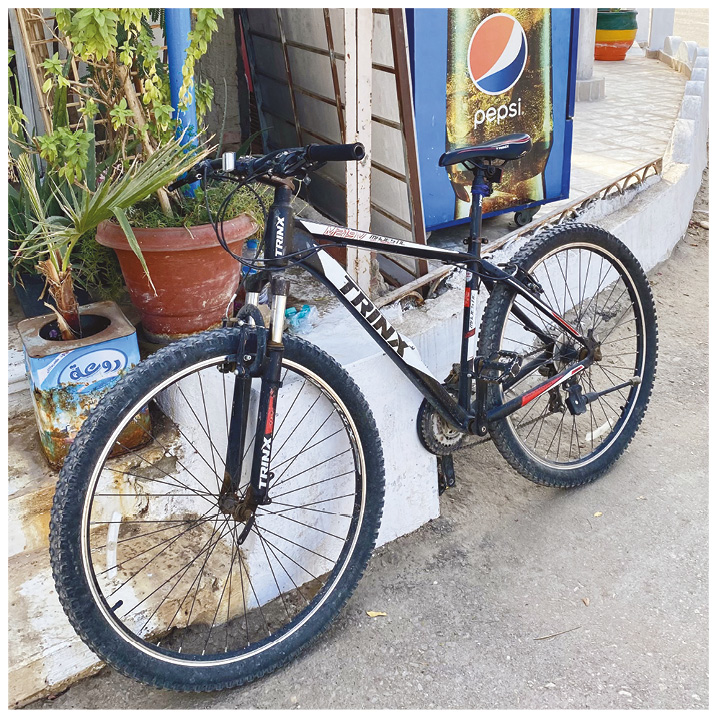
Setting off
As I am not a confident cyclist, I decided to venture out to some sites away from the more famous temples and tombs. I planned to head south as far as the small temple of Isis at Deir el-Shelwit, which I had not visited for several years. This route would take me away from the busy tarmac roads and allow me to cycle safely over the flat sands of low desert that define the area. I hoped to be able to cycle past the spoil heaps of Birket Habu, a large lake/harbour that the Eighteenth Dynasty ruler Amenhotep III built during the second half of his reign; past the site of his royal palace in an area now known as Malqata; and look for a curious structure associated with him that lies nearby. I had read that this monument is located at a place called Kom el-Samak (Arabic for ‘Mound of the Fish’), but I had never visited it. I asked a local friend whether I would encounter any difficulty with the local police, and he informed me that visits by an independent traveller are allowed anywhere between Medinet Habu and the Hotel Al Moudira.
For the first couple hundred metres, I was on the dreaded tarmac road that I had wished to avoid, but it was too early for large tour buses. Turning left out of the hotel, I took a two-minute detour by the ticket office to see how the excavations of the so-called ‘Golden City’ were proceeding. Since I last saw the settlement, the serpentine mud-brick walls have been cleaned, and the whole site was looking smart and presentable. As I was on a bicycle, it was possible to stop by the roadside and take a photo.
I was now on the road leading to the workers’ village of Set-Ma’at (‘Place of Truth’) at Deir el-Medina, and the Valley of the Queens beyond it. As I passed, I stopped to look back and took a photo of one of my favourite sites in the whole of western Thebes. I have many photos of the remains of the houses in the grid-like streets of Set-Ma’at, and inside the intensely decorated tombs of the village workers themselves, but I had not fully appreciated the beauty of the wider setting, where the village fits neatly into the folds of the Theban hills.
Continuing south, I cycled a further ten minutes behind the walled settlement of Medinet Habu where the tarmac road starts to turn into a dirt track. Although a totally different experience, the going was not uncomfortable, and I soon passed the remains of the Mortuary Temple of Ay, which had been usurped by Horemheb. Ay was responsible for the inner part of the temple, many pieces of which are still lying on the ground. When Horemheb succeeded to the throne, he added three pylons and a small palace building inside one of the courtyards.
Beyond Medinet Habu, there is a modern concrete wall enclosing a village to your left. This was built in 2010 to protect the archaeological area and unique structures under threat from modern settlement. Several years ago, I stayed in a private villa in this village on the very edge of the modern-day settlement of Habu. It was a peaceful place to lodge, with horse stables, several small family-run farms, and lush fields of greenery all around. However, there is little doubt that some of it was built on top of, or very close to, the ancient sites. Beyond the concrete wall is the barren, low-desert landscape of Malqata. To my right in the near-distance, I could just make out the remains of a terraced mud-brick temple, enhanced with sandstone architectural elements – a ‘House of Amun’ temple first published in 1917 – while Deir Shahid Tadros el-Mohareb (the Coptic monastery of St Tawdros/Theodore) was far more visible a little further south.


‘House of Rejoicing’
Almost directly opposite el-Mohareb, to the left of the dirt track as you travel south, are the remains of the large palace-city of Amenhotep III and Queen Tiye, known as Per-Hay (‘House of Rejoicing’). Construction of the numerous mud-brick palaces and villas began earlier in the reign of the king, but the whole court is believed to have permanently moved to the city in Year 29, in preparation for his first Heb-Sed, or jubilee, c.1360 BC. Amenhotep III ultimately celebrated three jubilees in this palace-city during the last seven years of his reign. Scenes depicting elements of these jubilees are recorded in various places, including on the walls of Soleb Temple in Sudan, and inside the Theban tombs of Khaemhat (TT57) and Kheruef (TT192). There is evidence to suggest that Tutankhamun and Ay both used the palaces after the return to Thebes from the royal city of Akhetaten, but it was largely abandoned during the Ramesside Period, when the new capital city of Pi-Ramesses was established in the Delta. The mud-brick buildings were originally brightly painted, and there are fragments of the decorated plaster in museum collections around the world. The palace-city is currently off limits to visitors without special permission, but it is possible to stop by the roadside and glance across the site. (I had visited before with an official guide, so have included some photographs taken during that previous visit.)


A royal lake and harbour
The two parallel lines of spoil heaps of Birket Habu (Arabic for ‘Lake of Habu’) start at the southern end of the palace area and run south. A large T-shaped lake/harbour was artificially created by cutting a channel from the Nile, but that no longer exists. During David O’Connor and Barry Kemp’s joint excavations in the 1970s, they discovered that the spoil heaps – mounds formed by the mass removal of sand, earth, and gravel to form the lake – were landscaped and laid out deliberately to form an attractive harbour frontage, which was used for both ceremonial and practical purposes. They also ascertained that the palace-city that Amenhotep III had built was part of a considerably larger settlement than had been previously thought. It was in fact an enormous royal city, stretching from the memorial temple being built at Kom el-Hattan, down to the area south of Malqata.

The very last mound at the southern end is much whiter than the others and it was this mound that is now referred to as ‘Fish Hill’, although the mound that gives the area its modern name of Kom el-Samak is no longer there. I knew that I was now nearing the location of the ‘curious monument’, and very soon I could see a modern mud-brick enclosure in an area of desert to my left.
I did not know what to expect at Kom el-Samak. I had read about a ‘ceremonial ramp’ and a ‘desert altar’ in various books on Amenhotep III, but none of them elaborated much on the subject. I found a photograph of a long sloping stairway, taken in 1974 during the first season of excavation by the archaeological mission of Waseda University (Japan), so I thought I knew what the monument might look like.
When I looked over the enclosure wall, however, it did not really look the same. I could see a ruined mud-brick structure with what looked like the foundations of an enclosed courtyard area (in fact, it is the remains of a raised platform), and a thick wall with an entrance in the middle. At the rear of this, the two sides of a slope gently led away to open ground. I took a few photographs and made a note to read up about it that evening.


In a report from 1986, I discovered that the original Fish Hill was an oval bisected mound that covered the monument when excavations by Waseda University began in January 1974. Over three further seasons, they discovered cartouches stamped on to three mud bricks, confirming that it was a structure from the Amenhotep III era: the foundations of a raised mastaba-shaped platform at the centre of the structure (the ‘enclosed courtyard’ that I could see now; a colourful painted stairway of 20-30 steps to the north; and a smooth ramp to the south). They deduced that there had been two buildings built approximately 20 years apart, and that the earlier structure had been totally restructured/renovated to build the later one. Since it was built of mud brick and not stone (which was reserved for religious buildings at the time), they thought it was a raised festival pavilion rather than an altar. It must have been either a resting place for the royal party after a hunting expedition (which Amenhotep III was known to enjoy), or a kiosk for the king to view ceremonial events such as military reviews and parades at his Heb-Sed. It was deliberately dismantled and buried using desert sand after the king’s death. There was evidence of looting during the Roman Period (causing the original mound to be split into two), and of its use as a cemetery around the same time. It then became a sacred site for Coptic settlers who placed mummified fish on the mound, giving it the later name of Kom el-Samak. Frustratingly, I could not find out where the fragments of painted mud brick from the staircase (depicting bound captives and tied pairs of bows) are now located.

Isis in the Land of Amun
I cycled another 250 metres south from Kom el-Samak to the Roman temple of Isis, known as Deir el-Shelwit. All that is left of the complex today is a compact sanctuary of 13 metres by 16 metres, the ruins of a monumental sandstone propylon entrance 60 metres to the east, the suggestion of a large mud-brick temenos wall enclosing the whole complex, and a well. The temple was probably originally constructed in the Ptolemaic era, but finished in the first two centuries AD during the reigns of Hadrian and Antoninus Pius. Their names can be found written in hieroglyphs within Egyptian-style cartouches along with those of three of the four Roman emperors (Galba, Otho, and Vespasian) who ruled in AD 69, the so-called ‘Year of the Four Emperors’.

No earlier building is known to have stood on the site, although evidence of a small Roman settlement was discovered during excavations in the early 1970s. There is very little decoration on the exterior walls of the sanctuary building, but the interior reliefs of various Roman rulers offering to the Egyptian gods are well preserved. They are, however, very difficult to photograph as there is little light and space available in the cramped corridors and side chapels that run around the central naos or shrine.
Having explored the site, it was time to cycle back to my hotel for lunch. Was it something that I would do again? Absolutely, and next time I will cycle further south and look for another curious structure of Amenhotep III at Kom el-Abd.

Further reading:
• B Kemp and D O’Connor (2007) ‘An Ancient Nile Harbour – University Museum excavations at the Birket Habu’, in International Journal of Nautical Archaeology.
• Y Watanabe and K Seki (1986) The Architecture of ‘Kom el-Samak’ at Malkata-South (Waseda University Culture Center).
• ‘iMalqata – A Joint Expedition: the Metropolitan Museum of Art and the Ancient Egyptian Heritage and Archaeology Fund (2007-2019)’, https://imalqata.wordpress.com.
All images: the author, unless otherwise stated