Cover Story
 The magic and power of hair in ancient Egypt Amandine Marshall investigates the magical significance of the various hairstyles that ancient Egyptians adopted.
 Features
 Senusret I: The Twelfth Dynasty king who transformed Egypt Wolfram Grajetzki explores the life, reign, and legacy of one of Egypt’s lesser-known pharaohs.
  Robert Talbot Kelly – Egypt: Painted and Described Lee P Ruddin explores the life and work of an artist whose beautiful paintings of Egyptian life are now sadly overlooked.
  The rediscovery of Thutmose III and Hatshepsut Aidan Dodson retraces the very first discoveries and excavations that restored these two New Kingdom pharaohs to their place in ancient Egyptian history.
  Illuminating Antiquity: The Pharos lighthouse in Alexandria Andrew Michael Chugg explores and reconstructs this famous architectural wonder, the inspiration for spectacular feats of Alexandrian science.
  Hilary Wilson on… Horned beasts: 1 In the first of a two-part article on the symbolism attached by the ancient Egyptians to beasts with horns, Hilary looks at cattle.
  Ani’s life after death – 3: Declaration of innocence and weighing the heart Continuing his series exploring specific vignettes from Papyrus of Ani, Andrew Fulton focuses on the most famous scene from the Book of the Dead.
 News
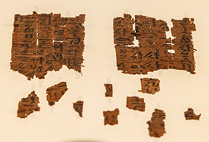
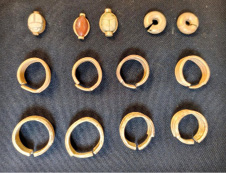
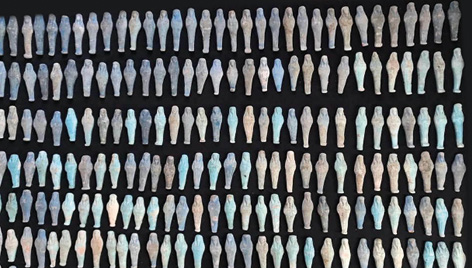
 Deir el-Bahri treasures A joint Egyptian mission (from the Zahi Hawass Foundation for Heritage and Antiquities and the Ministry of Tourism and Antiquities) has revealed a large number of finds made at Deir…
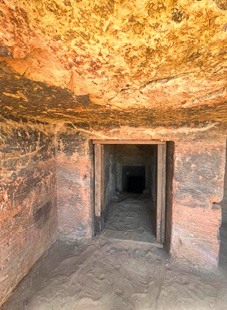
  King Pepy II’s doctor The beautifully painted tomb of the Chief Palace Physician Tetinebfu from the Old Kingdom reign of Pepy II (c.2278-2184 BC) has been discovered at Saqqara by a joint French–Swiss mission.…
  Old and New Kingdom tombs at Saqqara In another area of Saqqara, a joint Egyptian–Japanese mission, led by Kanazawa University, has discovered a further four Old Kingdom tombs. The two mud-brick mastabas and two rock-cut tombs date…
  Golden tongues Thirteen mummies with golden tongues in their mouths have been discovered at el-Bahansa (Minya) by the Oxyrhynchus Archaeological Mission, a joint Spanish–Egyptian team led by the Institute of Ancient Near…
  Taposiris Magna finds A small white marble head of a Ptolemaic princess or queen has been discovered in a foundation deposit at the Taposiris Magna Temple by an Egyptian–Dominican mission. The team believes…
 Views
 Win a copy of The Mysterious Fayum Portraits: Faces from Ancient Egypt by Euphrosyne Doxiadis Competitions Where in Egypt is this? If you know, email the Editor: peter@ancientegyptmagazine.com before 30 April with your answer, giving your full name, address, and a contact phone number. One lucky…
  Cycling Around Malqata Travel Karl Harris sets off on two wheels to visit the site of Amenhotep III’s palace on the West Bank of the Nile at Luxor.
 Ancient Egypt February listings What's on UNRAVELLING THE MYSTERIES OF ANCIENT EGYPT FROM BROOKLYN MUSEUM A selection of 150 masterpieces from the Brooklyn Museum’s ancient Egyptian collection, including sculpture, coffins, jewellery, pottery, papyri, and human and…
  The discovery of the Narmer Palette The Picture Desk The Narmer Palette may be regarded as the world’s first historical document, recording the unification of Upper and Lower Egypt in about 3000 BC.
  Belt of Ramesses III Objects Dr Campbell Price describes an item of clothing that belonged to a New Kingdom pharaoh.
 Reviews
Cycling Around Malqata Karl Harris sets off on two wheels to visit the site of Amenhotep III’s palace on the West Bank of the Nile at Luxor.  Luxor Illustrated with Aswan, Abu Simbel and the Nile REVIEW BY SARAH GRIFFITHS Ever since Michael Haag’s Luxor Illustrated was published in 2009, it has been an indispensable guide for travellers visiting Luxor and other sites in Upper Egypt.…
  Recycling for Death: Coffin Reuse in Ancient Egypt and the Theban Royal Caches REVIEW BY CAMPBELL PRICE Much-anticipated from the prolific pen of Kara Cooney, the undisputed queen of coffin (re)commodification, this enormous tome is not for the faint-hearted. Introductory chapters gather, reformulate,…
  Landscapes: Studies in Honour of Steven Snape REVIEW BY ROGER FORSHAW This volume is a collection of papers published in recognition of the retirement of Professor Steven Snape from the University of Liverpool. Over his distinguished career,…
  Howard Carter: From Tracer to Tutankhamun REVIEW BY SARAH GRIFFITHS This slim ‘Spotlight’ volume is the first in a new series of EES publications highlighting the society’s collections and projects, and it is only fitting that…
  The Mysterious Fayum Portraits: Faces from Ancient Egypt REVIEW BY J PETER PHILLIPS This seminal work was first published by Thames & Hudson in 1995. The reprint is described by the publishers as a ‘compact hardback edition’ and… Ancient Egypt February listings UNRAVELLING THE MYSTERIES OF ANCIENT EGYPT FROM BROOKLYN MUSEUM A selection of 150 masterpieces from the Brooklyn Museum’s ancient Egyptian collection, including sculpture, coffins, jewellery, pottery, papyri, and human and…
From the editor
Much time and effort were expended by ancient Egyptians of both sexes in the styling of their hair. Research by Amandine Marshall, summarised by her in this issue, has shown that this was not merely a matter of personal vanity. The ancient Egyptians considered that hair was a vital part of a person’s essence, and had magical properties that could be used for good or evil.
Hopefully, a person would avoid employing such magic for evil purposes; at the end of life, the weighing of the deceased’s heart against the feather of maat, as depicted in the Papyrus of Ani described by Andrew Fulton, would determine whether he could pass into the afterlife or be devoured by Ammit.
Headgear of a different type was used in statues and reliefs of deities, many of which incorporated the horns of cattle, as Hilary Wilson explains in the first of a two-part article on the significance of animal horns.
The most famous artistic depictions of ancient Egyptian scenes are undoubtedly by David Roberts, but readers who are familiar with the monuments he painted will know that he frequently employed ‘artistic licence’ in his works. Lee P Ruddin tells us that the paintings of Robert Talbot Kelly, which have been much neglected, are of equal quality, and are a much more accurate record of the scenes he witnessed.
One monument that Kelly could not paint was the Pharos, the giant lighthouse that stood in the harbour at Alexandria – it was destroyed by an earthquake 700 years ago – but there are many depictions of its presumed appearance. Andrew Michael Chugg has studied these and a wide variety of sources to create an accurate reconstruction with astonishing features.
We are familiar with the series of articles by Karl Harris describing various sites he has visited by car or taxi. Now, for the first time, he hires a bicycle to make an excursion from his West Bank hotel in Luxor to the Birket Habu and some rarely visited nearby monuments.
The lives of three pharaohs are discussed in this issue. Aidan Dodson explains how the decipherment of hieroglyphs enabled early Egyptologists to rediscover the forgotten story of Thutmose III and Hatshepsut, now two of the most famous of all the ancient rulers. Much less famous, but also hugely significant, was Senusret I. Wolfram Grajetzki celebrates the pharaoh’s achievements in transforming Egypt into the traditional pharaonic state we would recognise today.
J Peter Phillips, Editor