Subscribe now for full access and no adverts
Senusret I (c.1971-1926 BC), also known as Sesostris I or Senwosret I, was perhaps one of the most-important Egyptian kings of all time. He ruled the country for more than 40 years, during which period Egypt changed in many ways, becoming what we regard as typically Middle Kingdom. However, despite his many monuments and inscriptions, it remains difficult fully to assess his reign. The personality behind the statues and depictions remains unknown. Unlike Thutmose III, Amenhotep III or Ramesses II, Senusret I is not seen as one of the famous Egyptian kings. While we have some hints of the characters and personalities of the great New Kingdom pharaohs, the kings of the Old and Middle Kingdom remain in the shadows – often merely names.

Early life
Senusret I was the son of Amenemhat I (c.1991-1962 BC), the founder of the Twelfth Dynasty. He was named after his grandfather Senusret, who appears in a few later sources as ‘god’s father’, and as the founding figure of a new line of kings. The mother of Senusret I was a woman called Neferitatjenen. Her name sounds somehow strange, and is indeed only known from a 19th-century copy of a statue inscription. The statue depicted the queen, but is now lost, so there is no way to check if the name is correct. The woman herself remains a mystery.
Nothing can be said about the king’s childhood. We do not know where and when Senusret I was born. At the beginning of his reign, Amenemhat I moved Egypt’s capital from Thebes to the North, founding a new city Itj-tawy (‘seizer of the Two Lands’) about 60km south of modern Cairo. Itj-tawy’s exact location is still unknown, but it was highly symbolic: sited at the border between Upper and Lower Egypt in the area regarded by the ancient Egyptians as the middle of their country. We do not know exactly when this happened or whether or not Senusret had been born by that time.

Amenemhat I, father of Senusret I, depicted with Anubis in a relief on a lintel. Images: Metropolitan Museum of Art (MMA)
The young Senusret was probably educated at the royal court either by a private tutor – perhaps a high official – or by several teachers, perhaps joined by other royal children and the children of courtiers. Here, he must have met Intefiqer, who later bore the title ‘foster child of the king’. Intefiqer was therefore raised at the royal palace together with royal children, evidently under Amenemhat I. He later became vizier and was one of the leading officials under Senusret I.
Co-rule
It seems that around the 20th year of the reign of Amenemhat I, Senusret reached an age that in ancient times might be regarded as ‘adult’. Amenemhat I then decided to make Senusret his co-regent, as Kheperkara Senusret. Egypt now had two kings. This was not a new arrangement. During the Old Kingdom, there were times when a mother ruled for her son. Egypt, in effect, had two rulers: the official king (most often a young boy), and his mother the real power behind the throne. Nevertheless, the co-regency between Amenemhat and his son was something new, with both kings given full royal titulary.


Amenemhat I was perhaps too old to be solely in charge, but the main benefit of this new arrangement was to secure the succession. The death of a king is often a critical point in a monarchy, particularly at the start of a new dynasty, and power struggles are not uncommon. With this new arrangement, there was no doubt who would be the next king, as he was already ruling. The rule of both kings lasted almost ten years, until the death of Amenemhat I in his 29th year. Two famous texts (the Instructions of Amenemhat and the Tale of Sinhue) suggest the old king was murdered while Senusret was away on campaign. However, for several reasons, the texts are problematic and their use as a historical source should be taken with great reservation. Unlike previous Middle Kingdom rulers, Amenemhat I was buried in a pyramid at Lisht, perhaps not far from the new capital city.
Senusret I as sole king
On becoming king, Senusret I received the full titulary of an Egyptian pharaoh. His names were Kheperkara (‘the ka of Ra is created’), Senusret (‘man of Wosret’), and his other three titles (Horus, Golden Horus and Nebty or ‘Two Ladies’ names) were all Ankhmesut (‘Living of Births’). On monuments, his throne-name Kheperkara is the most common name used, although in a tradition going back to Manetho’s history of ancient Egypt (written during the Ptolemaic Period), Egyptologists prefer to label kings according to their birth-names, and use a modern numbering system – hence ‘Senusret I’.

As with most Egyptian kings, we actually know very little about the reign of Senusret I. There are no ancient Egyptian historians who describe his rule in detail, and references in Manetho are very short. There are few historical inscriptions from his reign, and, as with all historical sources, it is often hard to tell whether we can trust the information provided in the texts we have. We need to ask: why were these facts recorded and what was the interest of the writer? Such inscriptions and texts are composed for a purpose, and often do not tell us the exact truth.

Nevertheless, it is clear that three important events occurred during Senusret’s reign. First, the king was involved in a huge construction programme, rebuilding many of the country’s temples. Second, the king conquered parts of Lower Nubia and built a chain of fortresses there, along the Nile. Finally, Egypt was placed under much tighter state control: those living in the outer reaches of the country also had to pay taxes, and most people had to do corvée work – hard unpaid labour for the state.

Building programme
In the Old Kingdom, most provincial temples in Egypt were quite small, rather unimpressive mud-brick structures. There were few statues and the walls were not adorned with reliefs – except in royal temples, such as those at the pyramids, and in temples dedicated to the sun god Ra. But, in the Middle Kingdom, this changed. Many small local temples were dismantled, and replaced by state buildings that were full of reliefs and statues. The reliefs most often depicted the king among different deities – evidently he wished to confirm his divine status. Religious matters were no longer under the jurisdiction of locals, being instead directly controlled by the king.
Under Senusret I, this temple-building programme became systematic, and it seems that all temples across the country were replaced by new stone buildings. The most-famous example is perhaps the Amun temple at Karnak. The building laid down by Senusret I became the main foundation of the later great temple. Very little remains of that oldest building, but many of its reliefs have survived.

The most-important and best-preserved part of Senusret’s temple is a small limestone chapel for a cult barque, known today as the ‘White Chapel’. The stones of this structure were found reused in a New Kingdom pylon and were reassembled, restoring one of the most beautiful buildings of the Middle Kingdom.
Another monument that was probably fully rebuilt under Senusret I was the Temple of Ra-Atum at Heliopolis. Little has survived, but we have a New Kingdom copy of an inscription that describes the building of the new temple. The best-preserved part, however, is Sensuret’s obelisk, the oldest obelisk still standing in Egypt, and one of the main tourist attractions of the site.

Sensuret also rebuilt the Temple of Osiris at Abydos. In the Middle Kingdom, Abydos became one of the most important religious centres in the country. A temple to the jackal-headed deity Khentiamentiu had stood on the site since the Old Kingdom. In the First Intermediate Period, Khentiamentiu became identified with Osiris who, during the Middle Kingdom, was the main deity of the town. Again, not much is known about the Senusret I temple, but even 200 years later, in the Thirteenth Dynasty, the Osiris temple was referred to as the ‘Temple of Senusret I’.
State control
Gaining full control of Egypt was the main aim of the king’s reign. At the edges of the state, in the Eastern and Western Delta and in the oases, lived many hunter-gatherers, referred to in Egyptian texts as the ‘marshland dwellers’. Under Senusret I, these peoples were placed under the control of an official and were used for state projects, including building the king’s pyramid.

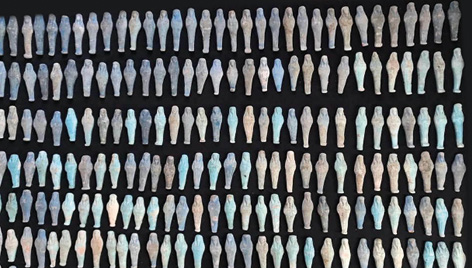
Further evidence for Sensuret’s tighter grip on the country is the ‘great enclosure’. This was an institution that organised work for the state. Most Egyptians had to work there at least for a certain amount of time. The work was not popular. The famous shabti spell is directly related to that work:
O, this ushabti, if one counts you, to do all the works that are to be done there, now indeed obstacles are implanted there with – as a man at these duties, ‘here I am’ you shall say when you are counted off at any time to serve there.
Evidently, the small shabti figure was supposed to step in and do the work in place of its owner. The ‘great enclosure’ was evidently so much a part of the life of the ancient Egyptians in the Middle Kingdom (when the spell was composed) that they thought it would continue even in the Underworld!


Military action
Sensuret I’s reign was not without problems. An inscription at the Temple of Montu at el-Tod appears to mention cases of local unrest. Furthermore, there is evidence for a devastating famine in Year 25. This is only mentioned in two inscriptions, but dated monuments after Year 25 are simply missing, suggesting something happened on a large scale.
Senusret I was perhaps the first Egyptian king to conquer a foreign country. In Year 18, the king launched a huge attack on Lower Nubia and succeeded in bringing it under Egyptian control. Little is known about the battles in any detail, but many inscriptions in Egypt and in Nubia report this event. It seems that the whole of Egypt was mobilised for this campaign, and many local governors took part as generals, with the people of the provinces employed as common soldiers. As a result, Nubia was conquered as far south as the Second Cataract. Nubia was important. As well as the large amount of gold that could be mined, there were trade routes from there into the African interior, a source for further raw materials such as ivory. This new province of Egypt was secured with a chain of fortresses along the Nile. These structures were made of mud brick, and yet were still well preserved up to the mid-20th century. Sadly, following the construction of the Aswan Dam, they have disappeared under the waters of Lake Nasser.

Senusret’s officials
Senusret was only able to carry out these extensive projects with the help of a number of important officials, in particular the ‘treasurer’ Mentuhotep. He was the main builder of the temple at Karnak, and was also in charge of constructing the Osiris temple at Abydos. Mentuhotep had a huge tomb at Lisht, close to the pyramid of the king.
Another official was Intefiqer, who was vizier in the first half of the king’s reign. He was involved in the Nubian campaigns of Amenemhat I, and most likely under Senusret I as well. Intefiqer was in charge of the building work at Abydos and was also involved in expeditions at the Red Sea. He was succeeded as vizier by the official Senusret. Little is known about the king’s namesake except that he was granted a huge tomb at Lisht, providing evidence of his power.
Best known are the local governors in the provinces. Amenemhat, buried at Beni Hasan, was involved in the king’s Nubian campaign, as was Sarenput (I) the Governor of Elephantine. He appears to have enjoyed special relations with the king, who sent royal craftsmen and artists south to build and decorate Sarenput’s tomb at Qubbet el-Hawa.

The royal family
Senusret’s consort was queen Neferu. She was the daughter of Amenemhat I, and therefore sister or half-sister to Senusret I. Neferu’s mother is not known. She was the mother of Amenemhat II, who would become the successor of Senusret I, and bore the most prestigious titles: ‘king’s daughter’, ‘king’s wife’, and ‘king’s mother’ (the title ‘great king’s wife’, which became so important, was introduced some 200 years later). Otherwise not much is known about the family of the king. Only two daughters have been identified for certain: Itakayet and Sebat. No further son has yet been attested.

Burial and legacy
The king was probably buried at Lisht, the location of his pyramid. This structure was built of stone, but little has survived, although his pyramid temple is the best preserved from the Middle Kingdom. This temple is an almost exact copy of a late Old Kingdom pyramid temple. Of the surrounding smaller pyramids for the royal women, only two have names preserved: Neferu, the wife of the king; and the daughter Itakayet.
The king ruled for 45 years and transformed Egypt in many ways, creating the ancient Egyptian state that we now regard as standard. Temples were erected in all parts of the country. The state held tight control of its people, and foreign countries were conquered. It does not come as a surprise that Senusret was, in later times, worshipped as a god.

Wolfram Grajetzki is Honorary Senior Research Associate at University College London, and a regular contributor to AE magazine (most recently in AE 137, AE 138, and AE 145). He is the author of several books focusing on the Middle Kingdom, and publishes a range of Egyptology books through his company Golden House Publishing (http://www.goldenhp.co.uk).
Further reading:
W Grajetzki, The Middle Kingdom of Ancient Egypt: History, Archaeology and Society (2nd edn, London: Bloomsbury, 2024; 1st edn, London: Duckworth Books, 2006).