Subscribe now for full access and no adverts
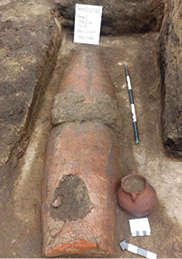
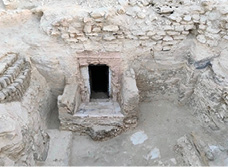
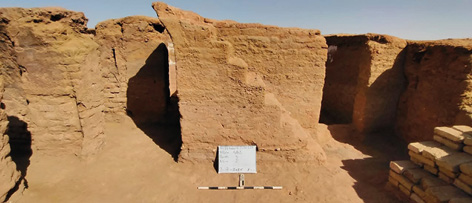
The archaeological site of Kom Abu Billou is located in the western Nile Delta, in the vicinity of the Wadi el-Natrun. In antiquity, the site was the hallowed cemetery of Terenouthis, a rural town founded during the Old Kingdom or even earlier. The inhabitants developed a local industry centred on the mining of the natron deposits that occur naturally in the Wadi el-Natrun. This natron was exported throughout Egypt for use in cosmetics, mummification, and industrial purposes such as glassmaking. Until the Ptolemaic Period, the town carried the name Per-Hathor-nebet-mefkat (‘Estate of Hathor, Lady of Turquoise’), in honour of its chief deity. For simplicity, most people simply referred to the town as ‘Mefkat’, with the name Terenouthis not attested prior to the Ptolemaic Period. We can surmise that this is a Hellenised form of Ta-Renenutet (‘the Land of Renenutet’), and that the name invokes the serpent goddess, an aspect of Hathor, who presided over the harvest, as well as the fate of newborn infants.


Mefkat in the Late Period
Prior to the politically fragmented Third Intermediate Period, Mefkat had been politically insignificant. This changed during the 9th century BC, when the town was the residence of influential and well-connected officials who owed allegiance to the Libyan pharaohs ruling from the Delta cities of Tanis and Bubastis. Djedbastetemtehou, a female member of one of these prominent families, was even sent to the southern city of Thebes to become ‘Singer of the Interior of Amun’, thus joining the retinue of the powerful priestess God’s Wife of Amun. This lady’s beautifully carved funerary stela, which undoubtedly once marked her grave or cenotaph at Mefkat, depicts her holding a mirror (an attribute of Hathor) and is inscribed with a votive prayer asking the goddess for wine, cakes, and other delicacies in the afterlife.

The annals of the neo-Assyrian king Ashurbanipal (ruled 669-631 BC) record the abrupt end of Mefkat’s political prosperity. They tell us that Mefkat and the surrounding region were under the control of a governor named ‘Iptihardishu’, probably an Assyrian form of the Egyptian name Padihordisu. The previous Assyrian king, Esarhaddon, had invaded Egypt in 671 BC, temporarily pushed the Twenty-fifth Dynasty Nubian pharaoh Taharqo (c.690-664 BC) into the south, and accepted the submission of the various local rulers in the north. Taharqo had then made a comeback, leading to a new invasion in 667 BC by the new Assyrian ruler Ashurbanipal. The northern rulers again submitted to the invader, but soon attempted to switch their allegiance back to Taharqo. In response, they were deported to Assyria. All – including Iptihardishu – were executed there, except for Nekau I of Sais, who had maintained his allegiance to the Assyrians. It was ultimately his son Psamtek I, who would become king of a reunited northern Egypt in 664 BC, with Thebes and the rest of southern Egypt absorbed in 656 BC.

Graeco-Roman Mefkat
Mefkat seems to have faded into political insignificance in the wake of these events. However, the local temple complex maintained its position as a regional cult centre of Hathor. Under the name Atarbechis, likely a transmuted and Hellenised form of (Per-)Hathor-nebet-mefkat, the town was recorded by Herodotus during the 5th century BC as an important sanctuary with a cattle cemetery. This cemetery was identified during 19th-century archaeological surveys of Kom Abu Billou, and was undoubtedly used for the interment of sacred cattle associated with the bovine goddess Hathor.
The town’s fortunes began to change again during the reign of Cleopatra VII (51-30 BC) as a result of the expanding political and cultural ties between Egypt and Rome. The long-distance trade routes of the ever-expanding empire of the Roman Republic brought goods and people to the most remote corners of the known world. Mefkat, now known as Terenouthis, quickly found itself in the fortuitous position of being a major exporter of natron, a vital ingredient of glass, an immensely popular product throughout the empire. A local variant of Greek with discernible Egyptian influences emerged during the Ptolemaic Period, as the Greek-speaking Ptolemies exercised strict control over this profitable natron industry, and demanded that the records be written in Greek. Egypt was formally annexed by Rome in 30 BC, becoming a special province of the empire. Archaeological excavations of the Roman Period cemetery in Terenouthis have yielded hundreds of funerary stelae, predominantly inscribed in Greek, and decorated in a hybrid iconographic style combining Egyptian and Graeco-Roman elements. This suggests that, around the time of the Roman conquest, a new socio-economic elite emerged in Terenouthis who aspired to adopt various elements of Graeco-Roman culture while maintaining their indigenous Egyptian identity and honouring their ancient roots.

Trading hub
Located on the now-extinct Canopic branch of the Nile, Terenouthis enjoyed convenient river-access to the trading centre of Naukratis and the port of Alexandria. Perhaps wishing to model themselves on these Greek-speaking cities, the inhabitants had established a gymnasium no later than the 2nd century BC. Here, sons from wealthy families received Greek-style education and physical training under the tutelage of the gymnasiarch, a magistrate overseeing the daily running of the school and its curriculum. However, the continued use of Demotic for funerary commemoration into the Roman Period suggests that Egyptian scribal education persisted, probably under the auspices of the local Hathor temple.

Surviving Roman Period papyri from the Fayum also document the trading of livestock, between Terenouthis and Soknopaiou Nesos (Dimeh es-Seba), which included camels, a relatively recent arrival in Egypt. These sturdy animals were undoubtedly used for the transport of tools, supplies, and natron between Terenouthis and Wadi el-Natrun. Some of the camels recorded in the papyri are described as carrying ‘Arabian markings’, which perhaps represent characters from one of the ancient North Arabian scripts. We may infer from this that Terenouthis was part of a trade network that extended beyond the borders of the Roman Empire into the Arabian Peninsula.

The natron-mining season fell in the scorching hot summer, and was heralded by the rising of the star Sirius, which was believed to be a visible manifestation of Hathor. After processing at Terenouthis, the natron was transported by river to Alexandria, where it was shipped off to towns and cities all over the Roman Empire. It is likely that the economic hub of Terenouthis was the local agora, a Greek-style market, which is known from the funerary stela of the local market-regulator Susanaios. Nonetheless, despite the presence of Greek-style institutions, it is likely that Terenouthis in the Roman Period physically resembled Karanis in the Fayum, with its traditional mud-brick structures and irregular winding streets, rather than Alexandria with its open squares and grid-lined layout.
Religious beliefs
The funerary stelae from Terenouthis reflect a multicultural, multilingual, and multi-ethnic community. The personal names carried by individuals reflect a propensity for giving children Hellenised or Greek names that were translations of, or equivalents to, Egyptian names. The majority of names attested in the stelae are theophoric in nature, meaning that they invoke particular deities, and the names therefore provide us with valuable insights into the religious beliefs of the inhabitants.
Hathor, Horus, and Osiris were apparently the principal gods worshipped, both in their own right and connected with many other deities from the Egyptian and Greek pantheons. Hathor was therefore identified with Egyptian goddesses such as Isis and Renenutet, and Greek goddesses such as Aphrodite and Artemis. Horus was identified with Herakles-the-Snake-Strangler and with the healing deity Apollo, while Osiris was identified with Dionysos. Together Hathor-Aphrodite and Osiris-Dionysos formed a divine couple who presided over alcohol and drunken ecstasy, and we may surmise that copious amounts of wine and beer were consumed during sacred festivals in their honour. Many of the stelae, such as that of 30-year-old Abestion, depict the deceased performing a sacred libation for the gods.

A popular way of depicting the dead in Terenouthis, as seen on the stela of 60-year-old Phoebus, was to show them reclining on a cushioned couch, holding drinking vessels. This so-called Totenmahl-motif, the ‘feast of the dead’, originated in the eastern Mediterranean before spreading into Egypt and Europe. In Terenouthis, the deceased person was typically shown holding a kantharos, a wine jug of Greek origin strongly associated with Dionysos. We may surmise that in Roman Period Terenouthis, the kantharos was considered to be an attribute of Hathor-Aphrodite and Osiris-Dionysos, and that the dead were believed to take on the characteristics of these deities in the blissful afterlife.
At the same time, there was a fearsome aspect to the gods. As ruler of the underworld and king of the dead, Osiris embraced the functions of both the Egyptian fate-deity Shai and the Alexandrian god Serapis, who himself embodied characteristics of both the Egyptian Osiris and the Greek Hades. In Egyptian tradition, Hathor had a manifold aspect called ‘the Seven Hathors’ who, like Renenutet, were responsible for decreeing the fate of newborns. It therefore required no great leap of logic to identify Hathor-Renenutet with Nemesis, the vengeful Greek goddess of fate and divine retribution. Among the inscriptions from Terenouthis, we find a significant cluster of names invoking the fate-aspects of Hathor and Osiris, perhaps in the belief that such names carried an apotropaic effect and could ward off ill-fortune.


Health at Terenouthis
At a time when medicine was intrinsically tied to religion, people turned to the gods to seek relief from physical maladies. Many inscriptions, such as the stela of 60-year-old Herakleia and 52-year-old Hares, commemorate groups of people who died on the same day; this suggests a high mortality rate from seasonal epidemics. Religious practices only had a limited effect in shielding people from disease, malnutrition, and premature death. Approximately 30% of the surviving epitaphs from Terenouthis commemorate children who died under the age of 14. The youngest children attested in the Terenouthis corpus are a baby girl named Aphrodite, who died at the age of 8 months, and a baby boy named Nemesas, who died at the age of 7 months. We also have the stela of 12-year-old Athenarion, commemorated as a wife and mother, who may very well have died in childbirth. The stela of 6-year-old Kopres depicts him as an adult man, reflecting his idealised mature form in the afterlife. These inscriptions serve as a sobering reminder that lack of effective medical treatments, high childhood mortality, death in childbirth, and child marriage were all conspicuous elements of life in antiquity.
A stela from Terenouthis depicting a young woman with her arms raised in a gesture of greeting carries the laconic inscription: ‘Herous daughter of Munatius, [dead] in childbirth. 18 years old’. The name Munatius is of Latin origin, attesting to some degree of immigration from Latin-speaking parts of the Roman Empire. Indeed, several epitaphs from Terenouthis commemorate Roman veterans and their families, such as the soldier Helvius, who may have originally come from Gaul. Another inscription commemorates two men, perhaps brothers, named Gaius Julius Phrates and Gaius Julius Pareilis. The cognomina Phrates and Pareilis are both names of Parthian origin, an ancient Iranian language spoken in the easternmost part of the Roman Empire and beyond.

We also have the Latin-inscribed stela of 3-year-old Gaius Julius Valerius, son of retired soldier Gaius Julius Severus. The inscription tells us that the father served with the legion stationed at the fort of Nikopolis near Alexandria. The little boy is depicted holding a situla, a sacred vessel used in libation rituals for the goddess Isis, and is wearing the so-called ‘sidelock of Horus’, an Egyptian hairstyle associated with children. For his protection on the dangerous journey to the afterlife, his family ensured that he was depicted in the presence of Horus and Anubis, shown in their traditional Egyptian avian and canid forms. The distinction between ‘Egyptian’ and ‘Roman’ was far from clear-cut in Terenouthis.
First surveyed by Francis Llewellyn Griffith in 1887/1888, Kom Abu Billou continues to be excavated by the French Institute in Cairo. Future fieldwork will undoubtedly uncover more aspects of life in the ancient town, and bring to light the stories of ordinary people whose voices have been silent for two millennia.

Maiken Mosleth King is a heritage practitioner and Egyptologist, with a BA and MA in Egyptology from the University of Liverpool. She completed her PhD thesis, Social Identity as Constructed and Expressed on Funerary Stelae from Terenouthis, at the University of Bristol, and is currently turning this thesis into a monograph. Her research interests include gender and ethnicity in the ancient Mediterranean, material culture in Roman provinces, and reception studies.
Further reading:
• R V McCleary (1987) Portals to Eternity: the necropolis at Terenouthis in Lower Egypt (Michigan: Kelsey Museum of Archaeology).
• K Lembke (2010) ‘Terenuthis and elsewhere – the archaeology of eating, drinking and dying in Ptolemaic and Roman Egypt’, in D Robinson and A Wilson (eds), Alexandria and the North-Western Delta (Oxford Centre for Maritime Archaeology Monographs), pp.259-267.
• M M King (2018) ‘The Christians of Terenouthis: a modern myth’, Göttinger Miszellen 256: 107-114.
• M M King (2025) Social Identity as Constructed and Expressed on Funerary Stelae from Terenouthis (University of Bristol: http://www.bit.ly/49cus2o).