Subscribe now for full access and no adverts
Dear Editor,
In your latest issue (AE 146), Egyptologist Colin Reader (CR) raised several questions and comments regarding a paper we published in the peer reviewed journal PLOS One, entitled ‘On the possible use of hydraulic force to assist with building the step pyramid of Saqqara’ (https://journals.plos.org/plosone/article?id=10.1371/journal.pone.0306690) and an accompanying supplement (http://www.bit.ly/4jpbPfY).
We appreciate CR’s interest in our paper, his willingness to fuel the scientific debate on the Step Pyramid complex, and the opportunity provided by Ancient Egypt magazine to respond to CR’s comments. This discussion opens an academic debate on the mastery of hydraulics by the ancient Egyptians, and the many possible uses of water during the Old Kingdom. In this letter, we can only concisely respond to some key points raised by CR: we acknowledge that more room would be necessary to debate the evidence and intuitions everybody gathered.

Gisr El-Mudir
CR indicates that ‘the fact that the Gisr el-Mudir was built across the mouth of a wadi… does not prove that it was built to store water’ and claims that controlling the flow of surface water along the wadi system may not have been deliberate.
Our hydrological analysis of the Abusir Wadi catchment divides shows that the 600-metre-long west and east walls of Gisr el-Mudir entirely close a valley that drains a watershed of at least 15km². We classify this structure as a dam, first purely on topographical facts. During periods of heavy rainfall – now rare at Saqqara but more frequent in the past – flash floods could occur within this valley. These floods have the potential to scour the desert surface, leading to highly destructive events. Structures experiencing such events, if not specifically designed or adapted to withstand overtopping by floodwaters, would inevitably fail under such conditions, either during the first significant flood event, or after repeated occurrences. Yet the Gisr el-Mudir has endured in its current location for over four millennia. This longevity strongly suggests that it was at least modified to function as a dam and, more plausibly, that it was initially engineered with this purpose in mind.
Finally, the 15-metre-thick walls of the Gisr el-Mudir exhibit an internal structure that is interestingly characteristic in the context of hydraulic engineering, and are strangely similar to that of the Sadd el-Kafara dam [near Cairo]. This latter structure, which the late Ian Mathieson has documented, bears the technical signature of a zoned earthen dam. It comprises a broad embankment featuring a central impervious core, flanked by transition filters composed of fill materials with progressively coarser grain sizes. These filters aim to prevent erosion, migration, and potential piping of the core fine material due to seepage. Semi-dressed limestone walls stabilised the inner material and protected it against erosion when water flowed against and above the dam.
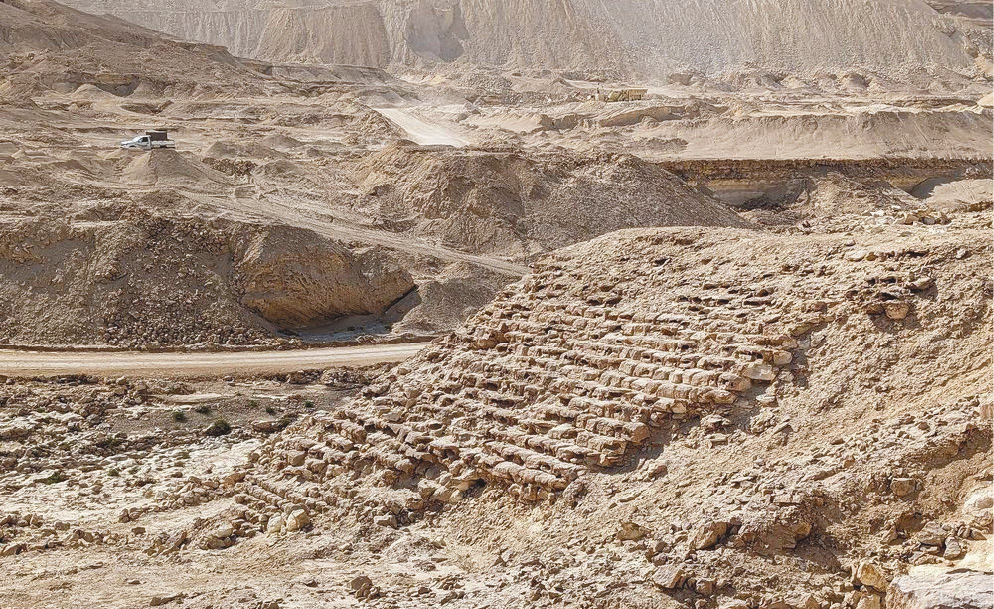
CR claims that ‘the very different configurations of the Gisr el-Mudir and the Sadd el-Kafara dam indicate to me that the two structures were intended to serve very different purposes’. Both dams were constructed around the same period [Old Kingdom] but are quite different in design. The Sadd el-Kafara dam is significantly taller than the Gisr el-Mudir dam, standing at approximately 14 metres compared to Gisr el-Mudir’s height of 3 to 5 metres. This represents a considerable difference in engineering. Additionally, Sadd el-Kafara is over five times shorter, measuring about 100 metres in length. Also, the Sadd el-Kafara dam is built across a wadi that is more than ten times larger (185km² of catchment, according to Murray 1954). In essence, its designers tried to constrain much more water on a narrower section perched over a higher structure. It is, therefore, not surprising that it is analysed as having probably failed due to overtopping during its first significant event. Conversely, Gisr el-Mudir resisted, most probably because it dams a much smaller wadi (15km²) and spreads the water on a more extended area over a smaller dam. Did the designers draw lessons from the first failure (or others now lost in the desert) when deciding to implement this dam on Saqqara? Their design and implantation are thus very different, as stressed by CR.

Flooding of chambers and construction sequence
CR also points out:
The authors of the PLOS One paper provide no evidence for widespread flooding of the Step Pyramid’s substructure, nor do they provide any discussion of the construction sequence they have assumed… They might argue, for example, that some chambers were built only after the pyramid was complete and, therefore, these chambers were never flooded… I have read no account of the archaeology of the Step Pyramid that provides any evidence for such widespread flooding.
Our model aligns with the progressive building stages suggested by J P Lauer (see our Supplement to the PLOS One paper). Based on archaeological evidence, several Egyptologists (for example, R Stadelmann and L Borchardt) have already claimed that Djoser’s pyramid may have reused a pre-existing substructure. We agree with CR that no known archaeological record explicitly mentions water-use in these underground structures. Still, they were excavated in the 1930s and ’40s. Egyptologists now employ a more comprehensive approach when excavating sites, considering environmental factors such as hydrological connections.
While excavations at Saqqara have been extensive over the past century, this structure remains poorly understood, with much still unexplored. The function of the 7km of underground tunnels and shafts, excavated to a depth of 28 metres, has yet to find a satisfactory explanation, and is still debated between experts. Furthermore, these aspects are rarely investigated in other scientific fields, such as structural mechanics, rock physics, hydraulics, or hydrology.
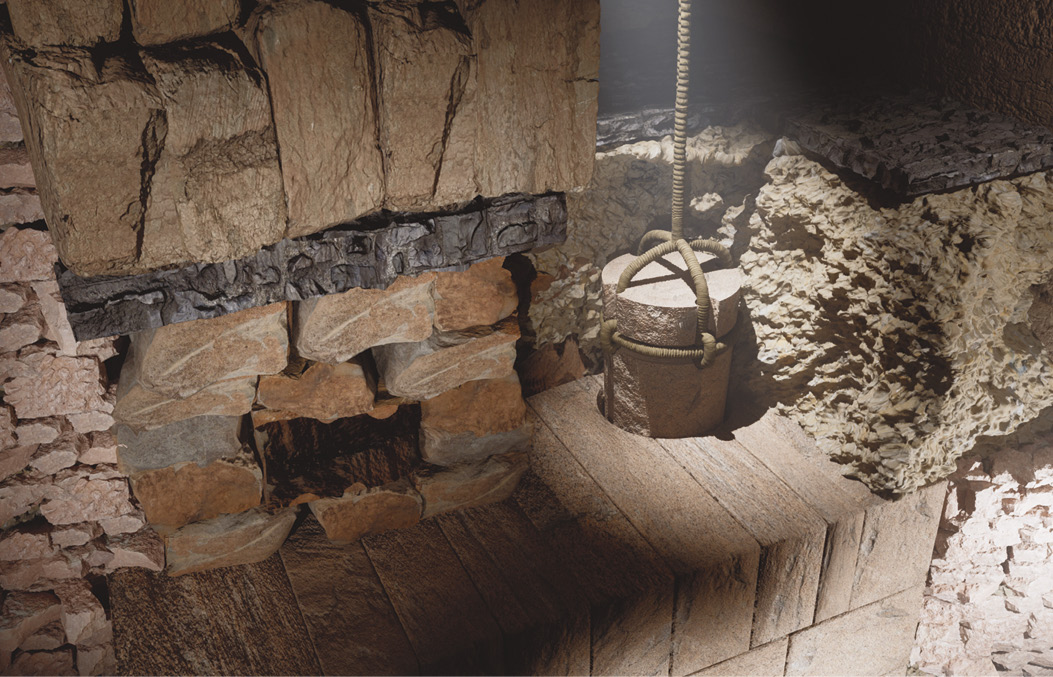
It is true that after almost 5,000 years, evidence of subterranean water flow is limited. But have we even been searching for it up until now? Given the broader hydrological context of Saqqara, including its position at the outlet of a watershed, and possible hydraulic installations such as the Gisr el-Mudir dam, the possibility of filling a structure located 28 metres below ground on a hydrological path remains plausible. Further analyses, such as examining sedimentary traces in the conduits and the unexcavated parts of the Deep Trench compartments, should be conducted to confirm or refute this theory.
While it is accepted that the ancient Egyptians were very skilled in managing the Nile, irrigation networks, and [the movement of] cargo on boats, the use of the water flowing from its wadi tributaries was poorly addressed until recently. We agree that many points remain to be confirmed in the theory we proposed in the PLOS One paper (we suggest further investigations throughout the paper); whatever the extent to which our ideas prove to be correct in the future, we hope our work will increase the interest of Egyptologists in hydrology and hydraulics, and that other water-management structures will thus be (re)discovered in the region.
Dr Xavier Landreau & Dr Guillaume Piton
Email the Editor: peter@ancientegyptmagazine.com with your comments.