
Subscribe now for full access and no adverts
Shining a light on Reedham
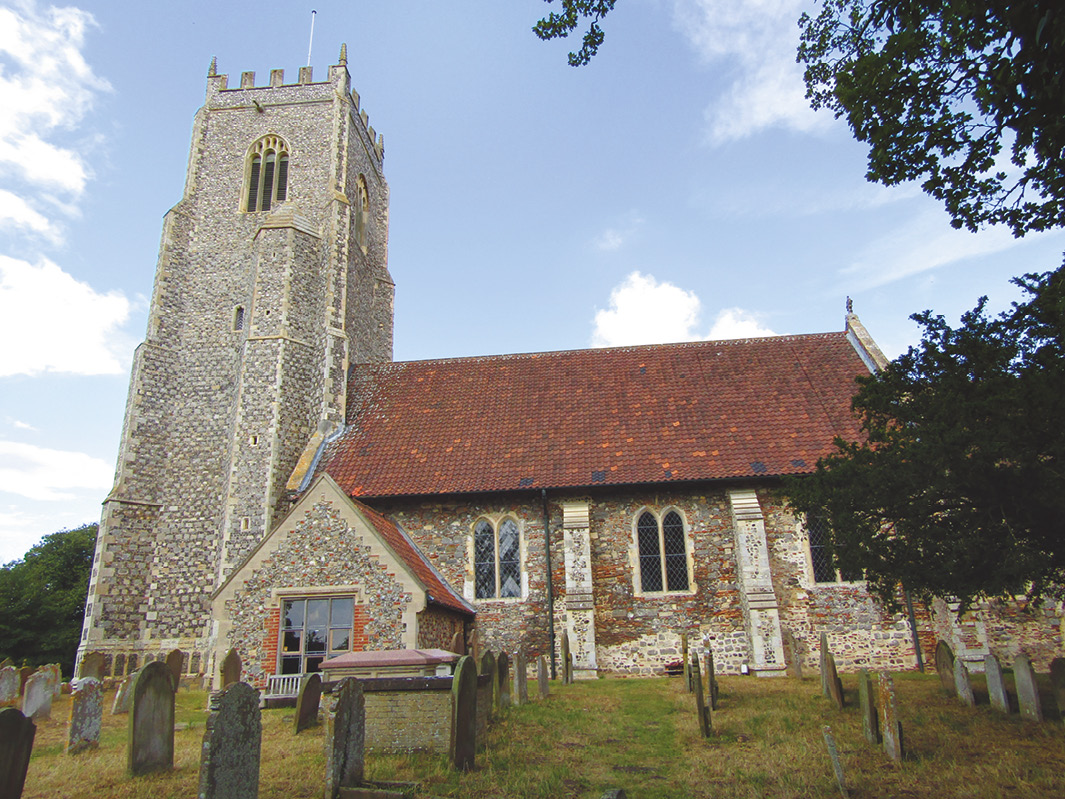
I was delighted to read Mike Fulford’s article on Reedham (CA 420). In 2021, as part of a Diploma in Archaeology at Oxford University Department of Continuing Education, I wrote a long essay about the Roman supply chain in East Norfolk, focusing on the relationships between the two shore forts at Caister-on-Sea and Burgh Castle, and the civitas at Venta Icenorum. The Great Estuary is, of course, now silted up, but it must have been a very important area for supplying the Roman army in its various locations. Towards the end of my project, I visited the church at Reedham to look at the Roman materials in the Church. I completely agree with Fulford that this is a good location for a pharos/signalling station. However, I took the perspective of the site in terms of navigation (I come from a sailing family!).
Reedham sits on a promontory, where the rivers Yare and Bure met. Looking at the immediate geology, I could see a sheer bank where the waters of the Great Estuary could have lapped, and, beyond the cemetery, contours that could have been a gently shelving beach, ideal for beaching boats. I took the perspective of a barge coming up the Great Estuary, using the tides, perhaps in the dark of night, or in a thick fog, or driving rain or snow. Reedham would have been an important waypoint: turn to port (left) up the Yare, and you went to Venta Icenorum, turn to starboard (right) and you headed to the potteries at Brampton on the Bure. Similarly, coming down from Venta or Brampton, the light at Reedham would tell you when you were entering the Great Estuary, where weather conditions might be different. A lighthouse at Reedham would have been essential to safe navigation. I also highlighted lighthouses as a topic for future research, so I’m thrilled with Mike Fulford’s article.
I see you have a page on North Leigh Roman Villa as well, where I am an English Heritage volunteer. So, for me, a brilliant edition of Current Archaeology! Thank you.
Rosemary Dearden, Oxford
Hiding hoards
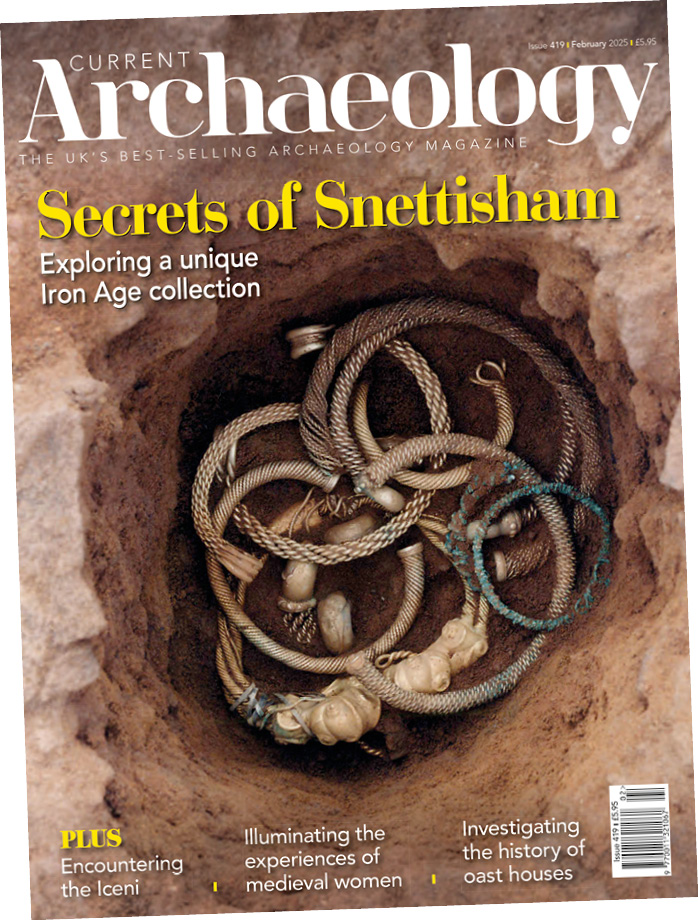
The thought-provoking article on the Snettisham Hoard(s) (CA 419) suggests that the finely worked gold and bronze torcs may have been buried because ‘they were too important to be destroyed’, and that they were taken out of circulation when their value came to be eclipsed by that of coinage which created ‘new forms of authority and new forms of interaction between people’. I find this cause–effect linkage troublesome. First, it is unlikely that the people burying the hoards would have had such insight into the future modelling of social relations. We cannot assume that people would have believed the advent of coinage to be permanent. Second, and critically, the value of these torcs when melted down into coins would have been enormous.
Rather than a graceful making way for the new, I suggest a transitional scenario: the owners of these torcs could have been hiding them from compulsory handover to the authorities for melting down (and/or from thieves interested in selling them to coin-makers). Importantly, each – probably extended – family/clan is likely to have deposited their beloved hoard in the expectation of retrieval. To avoid potential dispute during retrieval, the most distinctive item recognisable by everyone in the community would have been placed on top (as shown in the image of Hoard G).
We should also imagine a very different landscape to the bare field of today. Holes for the hoards would have been dug among vegetation that would immediately have hidden their location. Once buried, only their owners using their indigenous knowledge of landscape and plants would have known the precise spot.
Cathy Rozel Farnworth, Warleggan, Cornwall
Adding to vanished voices
While reading CA 419 – from cover to cover, like I have each of the issues for the last 20 years – the article on ‘Vanished voices’ struck a major chord with me. In the article, on p.30, there is a mention of a farmer’s roll listing the payment of men and women bringing in the harvest in Stebbing, Essex. Well, this just jumped off the page: I was born and raised there over 70 years ago. Back in the late ’50s, my mother used to take us with her while she worked in the fields picking peas, potatoes, and singling the sugar beet, and guess what – the pay difference was still happening. Given that the level of graft was the same for both, and our mother was having to multitask keeping us safe while still managing to do more work than the men, it just does not seem to be fair. Thanks for bringing back some happy memories.
The magazine is a fantastic read and very informative – keep up the good work.
Garry Matthews, Waterlooville, Hampshire
Edible Archaeology
Being the partner of Dr Kevin Hayward, currently a Building Materials Specialist in relation to Archaeology and Standing Buildings, I feel challenged each year to produce a fitting birthday cake that reflects his work. I have previously constructed a Roman temple and Stonehenge in sugar paste, but my most recent attempt was a mosaic. Having decided on this, I browsed many, many mosaic images, and started to feel the project would be impossible until someone mentioned the legendary ‘Wonky Wolf’.
When I looked him up and saw him described as ‘the lopsided lupus with an unmistakable sloping stance and famous winning smile’, I felt I probably had the capability to produce a ‘lopsided’ mosaic in sugar. Hence my attempt…
It was 8 by 8 inches, and the mosaic effect was achieved by pressing a darning needle into the sugar paste, starting from the outside and working inwards. The pattern this yielded was ‘wonky’ in itself but, looking at pictures of ancient mosaics and the way the tiles were placed, I saw that often the effect was not symmetrical. This made me quite satisfied, and I felt that my attempt was viable. All that remained was to reproduce the image of the wolf by painting it on with edible paint. Wonky he turned out to be, but I think I got away with it!
Hilary Griffiths, Salisbury

CA ONLINE: What you shared with us this month
Helen Gittos @helengittos.bsky.social
My (very short!) review of A Date with the Two Cerne Giants in @currentarchaeology.bsky.social. https://the-past.com/review/books/a-date-with-the-two-cerne-giants-reinvestigating-an-iconic-british-hill-figure/

National Trust Archaeology @nattrustarch.bsky.social
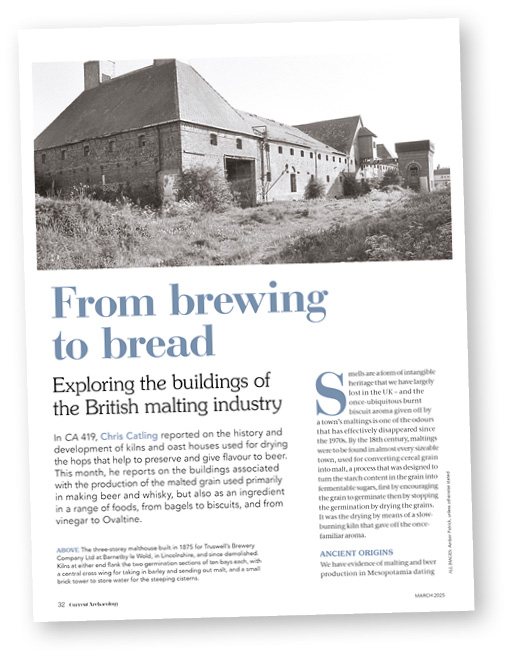
Lots of @nationaltrust.bsky.social places featured in this fab article by Chris Catling in the latest issue of Current Archaeology magazine –which explores the history of oast houses!
The Classics Library @StephenJenkin
Roman recycling at Reedham: exploring the imperial origins of a Norfolk church – Current Archaeology

The 2025 CA Awards results:
Archaeologist of the Year (sponsor: Andante Travels) Professor Joyce Tyldesley
Research Project of the Year (sponsor: Wessex Insurance Brokers Ltd) Pioneering spirit: exploring the archaeology and history of The Glenlivet whisky
Rescue Project of the Year (sponsor: Peter Sommer Travels) From stronghold to Steel City: uncovering the ‘birthplace of Sheffield’
Book of the Year (sponsor: Cardiff University BioArchaeology) Crypt: life, death, and disease in the Middle Ages and beyond
Write to us at: CA Letters, Current Publishing, Office 120, 295 Chiswick High Road, London, W4 4HH, or by email to: letters@archaeology.co.uk For publication: 300 words max; letters may be edited.