
Subscribe now for full access and no adverts
Visitors to the Roman regional capital of Venta Icenorum, at Caistor St Edmund, just south of Norwich, usually find themselves walking the impressive earthworks that, together with thick flint walls, once formed the settlement’s late Roman defences. This rectangle defines only part of a larger area of occupation, however, with the formal street-grid extending out beyond its lines. Excavations led by Professor Will Bowden of the University of Nottingham in 2009-2012 (see CA 270) established that these gravel streets began to be laid out from c.AD 100, possibly developing gradually over the course of the 2nd century. This period also saw the creation of a monumental triple enclosure ditch that surrounded the settlement with a circuit of c.2.5km (1.6 miles). This impressive boundary was first recognised through partial cropmarks, and before the 1990s it was thought to relate to a presumed Roman fort pre-dating the town. More detailed studies of the data by the National Mapping Programme, though, combined with extensive geophysical surveys, have documented a large, kite-shaped enclosure that is now generally accepted as civil defences dug to encircle an already-established town.

Sample trenches opened across all three ditches (exploring a section to the south of the walled town in 2012, and to the north-east in 2016) indicate that they had all been created within a short timeframe around AD 120. These once-imposing features were short-lived, however: following a period of initial silting, the ditches were partly infilled and their banks possibly slighted from the mid-2nd century or later, and by the mid-3rd to 4th century they had been reduced to shallow, linear hollows with no surviving earthworks.
As well as illuminating the chronology of the ditches, these investigations revealed evidence of ‘structured’ deposition – that is, the deliberate burial of selected material for a purpose beyond simply disposing of unwanted rubbish. In 2012, for example, fragments of pipe-clay figurines of Mercury and Venus were recovered from 2nd-century deposits in the outer ditch, while fills of the same period were found to contain an articulated human burial. The partial remains of a second individual, this time of late Roman date, were found within the ditch’s uppermost fill, and a third burial was encountered during 2019’s excavation of the ditch circuit at Caistor Old Hall.
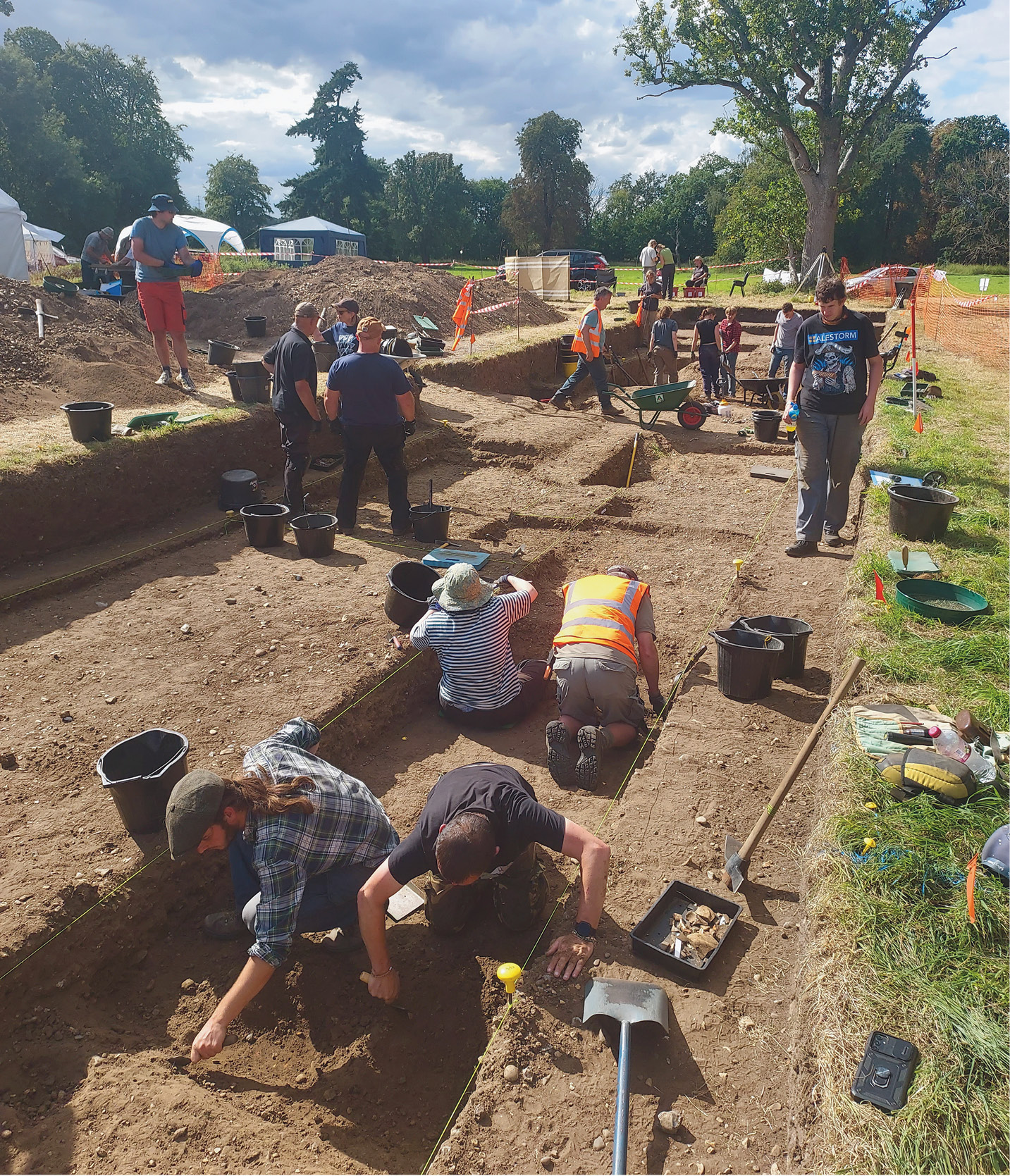
Nor was it only human remains that were buried within these features: at Wymer Field in 2016 we found the sacrificed remains of a foal that had been placed at the base of the inner ditch with smashed Roman pottery vessels. Taken together, these finds suggest that, from their creation, the ditches played an important role in the beliefs of those living in and around the town. This assumption (admittedly based on a small sample of an immense circuit) was tested again during our most recent work last summer, with volunteer-led excavations supported by Giles Emery of Norvic Archaeology exploring ditches to the east of the Roman town in our third season at Brasteds’ Caistor Hall hotel.
Deliberate deposits
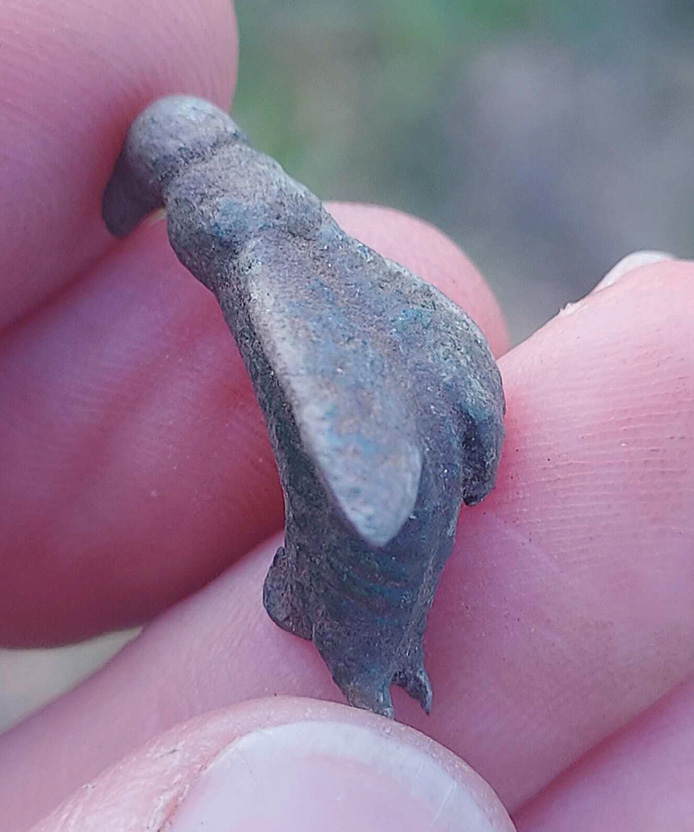
During our previous two seasons in the hotel grounds, excavations and geophysical surveys had revealed an array of finds and features dating to the cusp of the Late Iron Age and the Roman period – intriguing echoes of activity pre-dating the town (see CA 419) – as well as a semi-industrialised area that included a Roman pottery kiln (CA 406). We were able to add to this picture in 2025, opening a 3m by 6m (10ft by 20ft) evaluation trench south of the kiln, which revealed a complex series of 2nd- to 3rd-century gullies and pits. This trench produced one of the season’s more characterful finds, too: a complete 2nd-century brooch whose shape closely resembled the many horseflies that had caused consternation during the first few days of the dig.
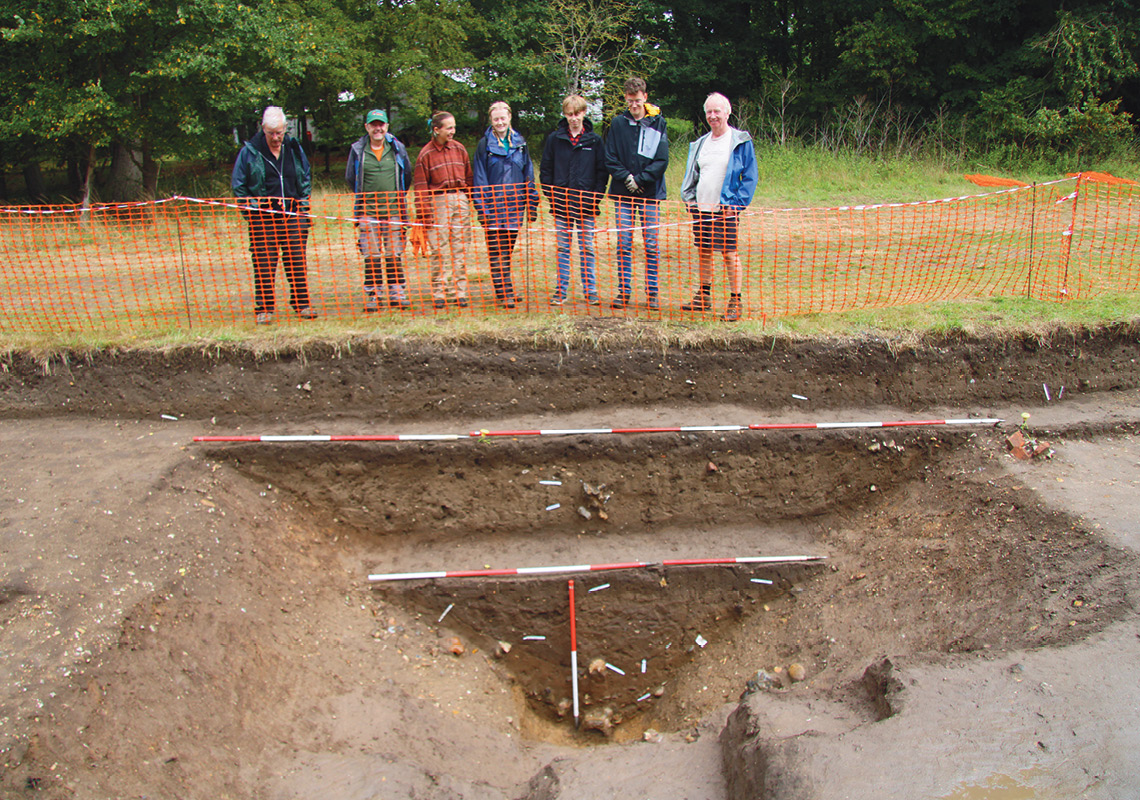
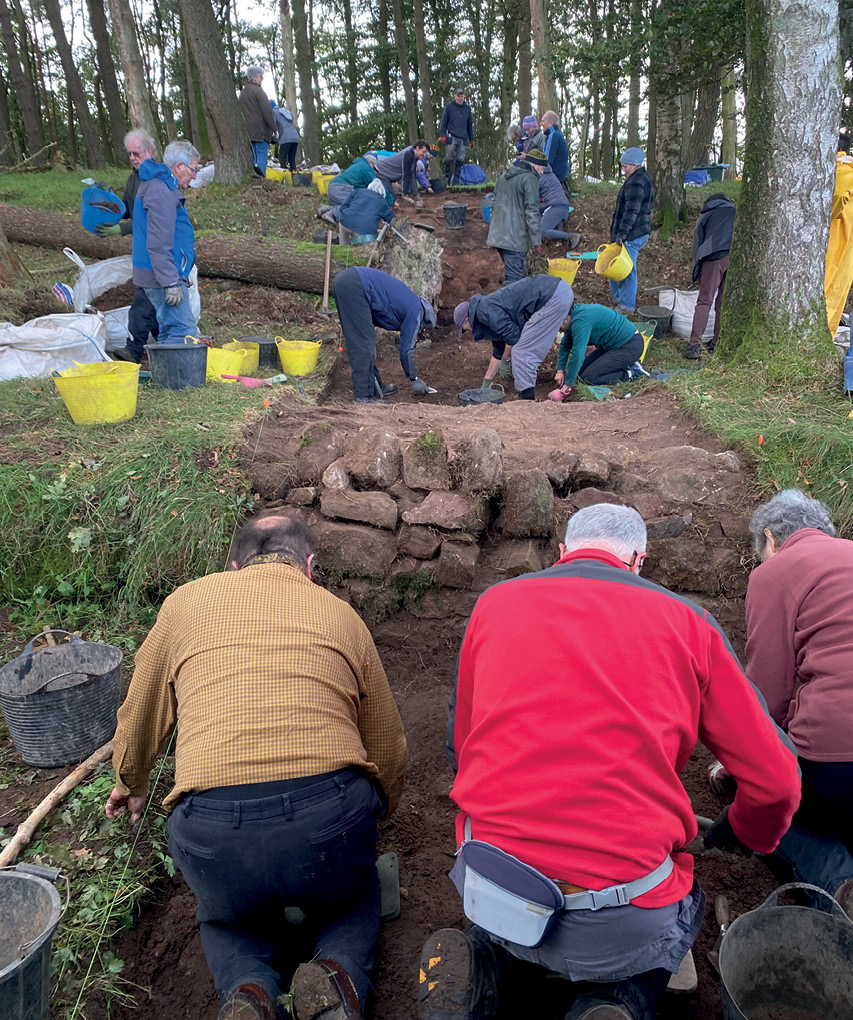
We also opened a large, 35m by 5m (115ft by 16ft) trench across the line of the triple ditches in this area. They were found to be slightly smaller in scale than their equivalents south of the town – with the inner and outer ditches measuring around 5m (16ft) wide and up to 1.8m (5.9ft) deep, and the middle c.3m (10ft) wide and 1m (3ft) deep – but they still had the same wide, V-shaped profile, and shared a similar history of initial silting followed by more deliberate infilling.

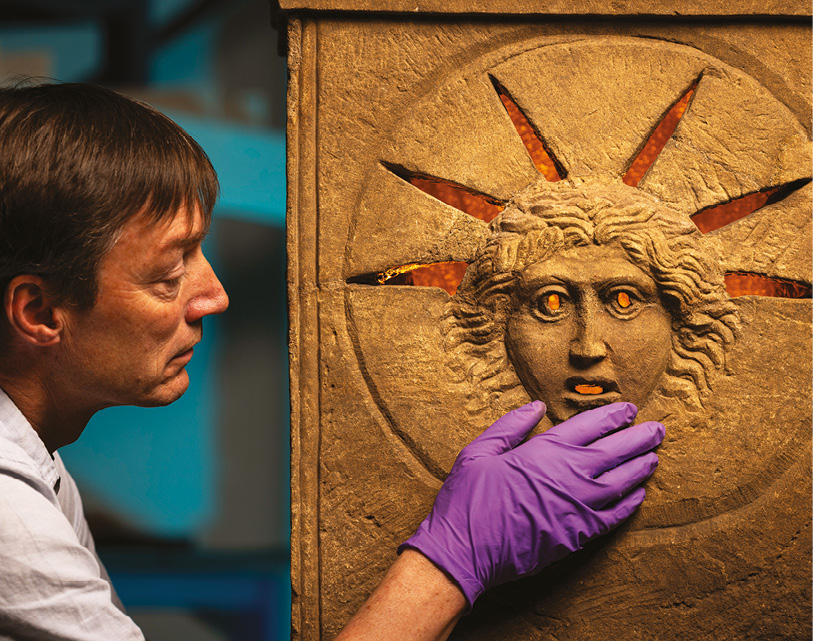
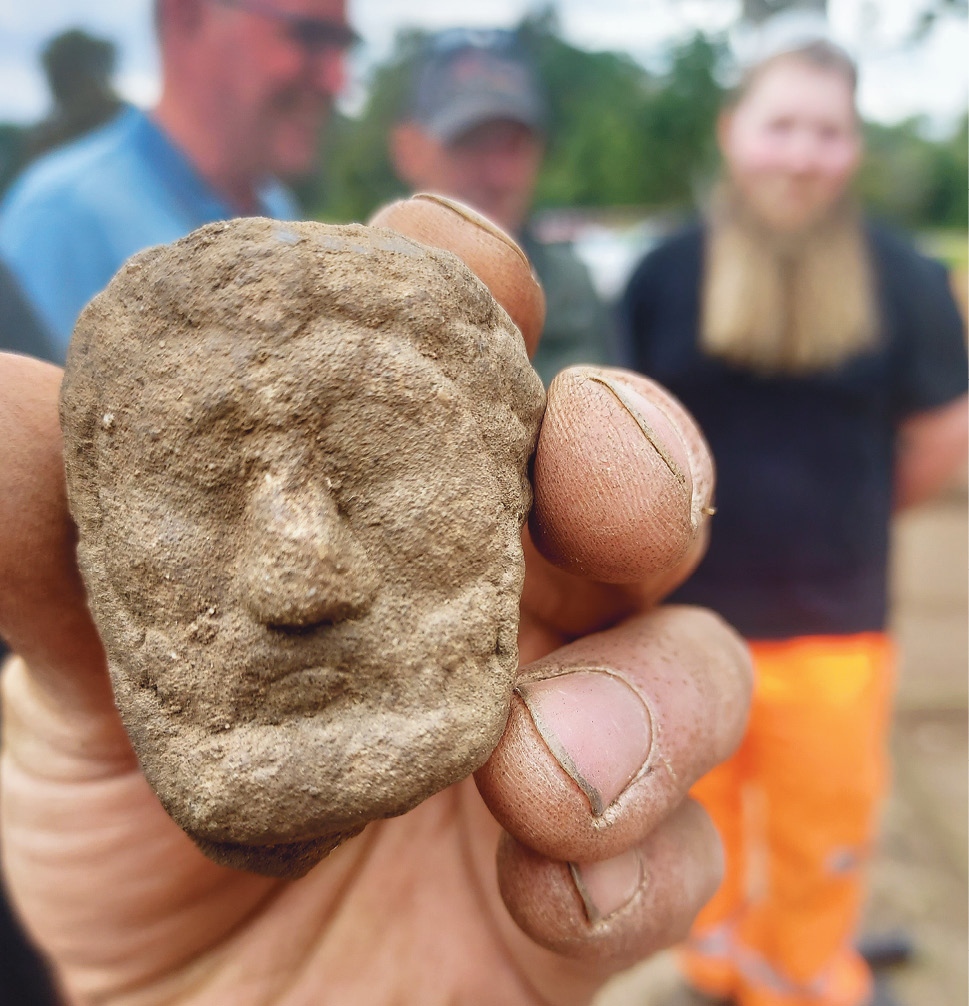
Unlike previously excavated sections, however, where the majority of finds came from the inner ditch, at this location it was the outer ditch that proved busiest. There, we uncovered numerous finds-rich deposits, often mixed with dumps of charcoal, which contained a significant quantity of butchered animal bone (including large parts of cows and sheep – jaws, shoulder blades, fragments of pelvis, and pieces of limb bone) – and the remains of birds, including cockerels and geese. Alongside these were various sherds of 2nd- to 3rd-century pottery (including smashed drinking vessels), as well as other ceramic creations such as a face that was possibly part of a pottery vessel or even an an antefix, a decorative element of a high-status tiled roof. Layers of cobbles within this sequence show that the deposits had been purposefully sealed rather than simply tipped into an open cut – behaviour that is reminiscent of a series of Roman pits and ditches that we excavated c.100m (330ft) to the east in 2024 (CA 419).
No similar deposits were found within the large inner ditch, but we did encounter another burial – this time the partial remains of a large dog whose jaw, shoulder blade, vertebrae, and some limb bones had been selectively interred not long after the deeper V-shaped part of the ditch had silted up, leaving a gentler, concave earthwork around 1m (3ft) deep. Dog remains (both whole and partial) are frequently found as deliberate deposits in Roman Britain, seemingly relating to ritual practices.
Repeated rites
Finds from the last few years indicate that various parts of the triple-ditch circuit had been regularly visited for the burial of offerings and other objects well away from the households and individuals that they had once furnished. Both of our previous excavations to the north and south of the town identified clusters of shallow pits in the space between the middle and outer ditches in each location and, remarkably, we saw the same phenomenon in 2025, uncovering caches of smashed finewares and household pottery alongside butchered animal bone.
Perhaps this inter-ditch zone held some particular symbolic significance, representing a liminal point between the town boundary and the outside world, which was shielded from direct view by earthen banks. The use of the ditches for human burials, too, reinforces this interpretation and echoes Iron Age traditions of placing the dead at marginal boundaries on the edge of spaces for the living. Boundaries in the Roman period also seem to have carried both practical purposes and spiritual meaning – might this association explain the presence of so many unusual deposits in the ditches at Caistor?
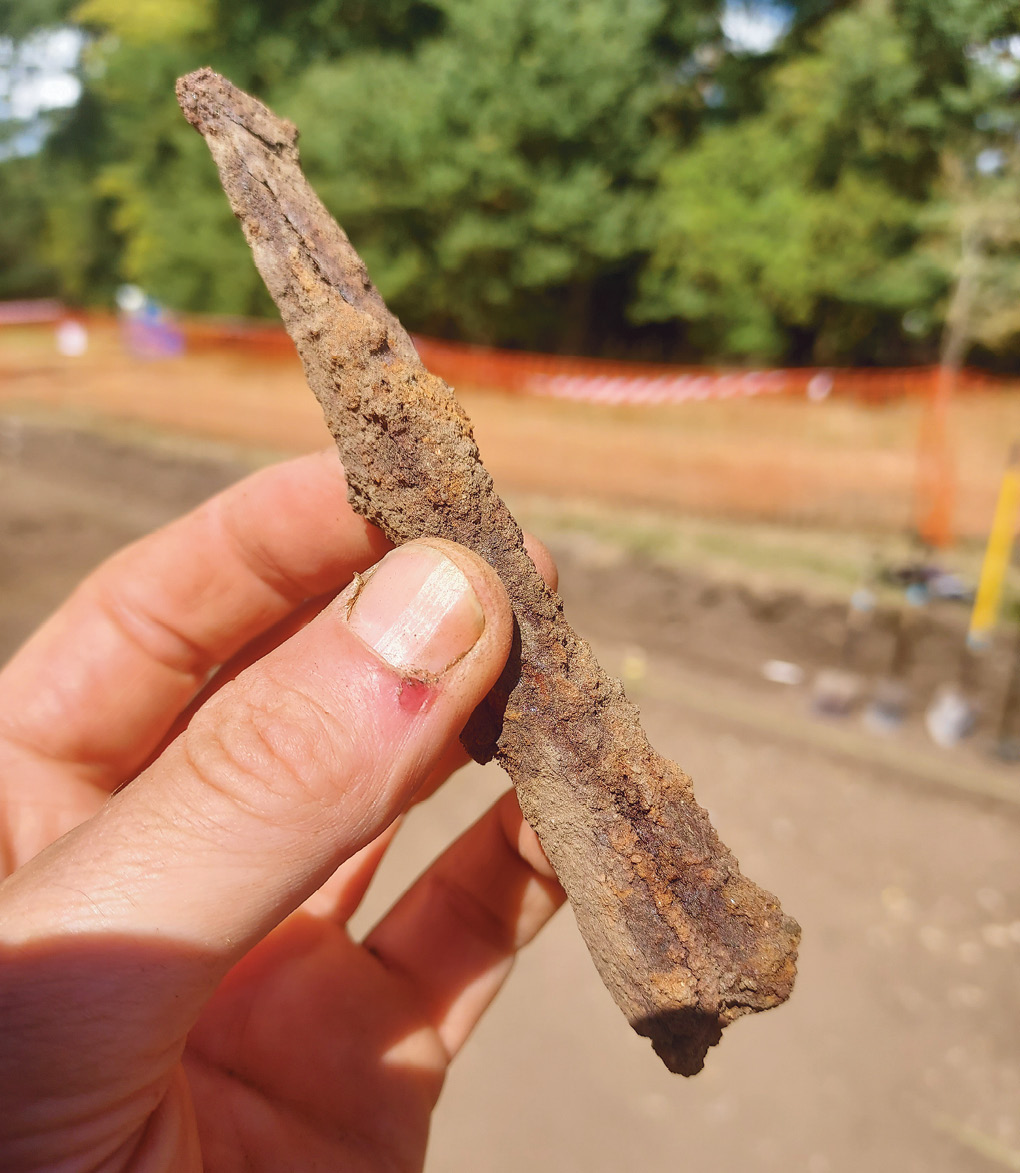
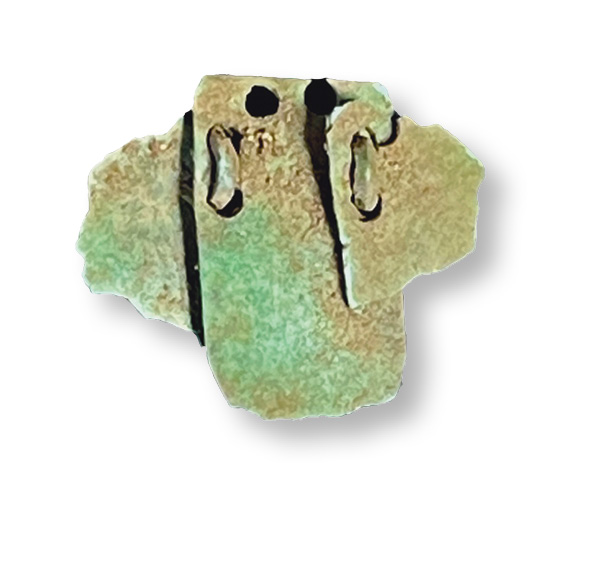
As for the triple ditches themselves, during 2025’s three-week excavation our team spent many hours musing on who dug these features and why – particularly while on hot and unforgiving mattock duty. There is no clear answer, but given the scale of the earthworks it is possible that such a significant exertion of manual labour would have required military help. The discovery of two iron spearheads in the ditch fill (adding to two more 1st-century examples found the previous year) hints at a martial presence, as do two small pieces of scale armour, one of which can be identified as a fragment of 2nd-/ 3rd-century lorica squamata.
However impressive their construction, however, the ditches would have presented a serious inconvenience to Venta Icenorum’s inhabitants, slicing across gravel roads and controlling access to the town for perhaps the first time since it was founded. Their relatively swift slighting suggests that the populace preferred a more open-plan settlement, a model that endured at Caistor until the 3rd-century town walls cut off much of the street pattern for good. As to why the ditches were dug, they date to the early 2nd century, a period when investments in civic building projects and strengthening provincial administration can be seen across Roman Britain. Venta Icenorum’s forum was established at this time, and we also know that around then the extramural temple north-east of the town (CA 356 and CA 380) was rebuilt on a much grander scale, with a monumental gateway and temenos. Is it possible that the town underwent a rapid facelift on the orders of, or possibly even ahead of a potential visit from, Emperor Hadrian or another dignitary?
Surveying the town
Last summer also saw the start of a new programme of ground-penetrating radar (GPR) survey at Venta Icenorum. Caistor Roman Project and the University of Nottingham had already used magnetometry to examine the entire walled town and much of the surrounding fields, but initial trials with GPR had suggested that further work would be fruitful. So it was that a small team led by CRP members Richard Gibson and Geoff Lunn carried out detailed new surveys of two areas of the Roman town: a bathhouse, and the forum and basilica. Both zones had been excavated in the past, but the recent radar survey revealed important new details.
The basilica and forum were first excavated by Donald Atkinson in 1931 and 1933, and these investigations (eventually published by Sheppard Frere in 1971) had identified two masonry-built phases of the forum, dating the first to c.AD 150 and the second to the later 3rd century. Further small scale excavations by the University of Nottingham and CRP in 2011 added another, earlier timber phase to the forum’s story (possibly dating to the late 1st century) and demonstrated that the final phase was much later than Atkinson had thought, placing it not much earlier than AD 350.
One of the curious aspects of this last phase is that its north and south porticoes (A and B on the GPR plot below) had been built afresh rather than reusing any of the earlier structural elements, indicating that the 2nd century stone forum must have been entirely demolished long before it was replaced in the 4th century. The 2011 excavation had found little trace of the north portico, and the recent GPR survey suggests that the 2nd-century version had been robbed to its foundations well before the construction of its 4th-century successor – an intriguing reflection of the short-lived nature of this aspect of Roman civic life in the capital of the Iceni. We have also learned new details about the basilica (C), which seems to have served both stone-built incarnations of the forum: the survey revealed earlier buildings beneath its southern end.
In contrast to the forum, the bath complex had seen less previous work. Atkinson had carried out limited excavations there in 1935, and this was published in summary form by Frere, with the only available plan coming from a lantern slide used by Atkinson for lectures. Our radar survey has now clarified the complex’s layout, and has revealed extensive further elements.
The bathhouse seems to have been a much more substantial structure than was previously envisaged: it was fronted by a long corridor or portico running parallel to the north–south road that defined the eastern side of the bathhouse insula (urban block). This opened on to three elements of what was probably a unified complex. To the north was a large, irregularly shaped open area (D), possibly a palaestra or exercise yard, and this was bounded by a wall with large internal buttresses, while a narrow range of rooms lay behind the eastern portico.
Immediately to the south lay a rectangular porticoed courtyard (E), which had been partly excavated by Atkinson, who identified a large room with a tessellated pavement (which he interpreted as a frigidarium or cold room, though this seems very speculative) further to the west. This room can be seen on the GPR plot, though it is quite indistinct, perhaps due to overlying layers of gravel obscuring the signal – something that might explain, too, the apparent absence of a room with a hypocaust that Atkinson described nearby.
Strikingly, superimposing the plan of Atkinson’s discoveries on the GPR results reveals significant inaccuracies in what Frere published (perhaps unsurprisingly given the nature of the surviving records he was working with). This is evident in the southern third of the insula, where GPR revealed the presence of an additional rectangular peristyle courtyard (F). This intersected with a circular heated room which had been partly excavated by Atkinson (though our survey places it considerably to the east of its published position), and the awkward relationship of the two structures suggests that they are unlikely to have coexisted.
Above all, these initial surveys testify to the potential of GPR at Caistor: showing significant structural remains surviving to a depth of over 2m (6.6ft) below the present ground surface, clarifying details from previous excavations, and revealing entirely new aspects. Upcoming work will explore land on either side of the town’s main east–west street, linking the two areas surveyed in 2025 and adding more information to our understanding of this key central area of the town.

For more information about the Caistor Roman Project, see  www.caistorromanproject.org.

All images: Norvic Archaeology, unless otherwise stated