
Subscribe now for full access and no adverts
Around 2,000 years ago, an Iron Age community came together in what today is North Yorkshire to make a truly spectacular sacrifice. They had amassed more than 800 pieces of ornately decorated metalwork – parts from chariots and wagons, horse gear, weaponry, feasting vessels, an iron mirror – and then they set about deliberately destroying them, bending, breaking, and burning the valuable items before burying them in two adjacent groups.
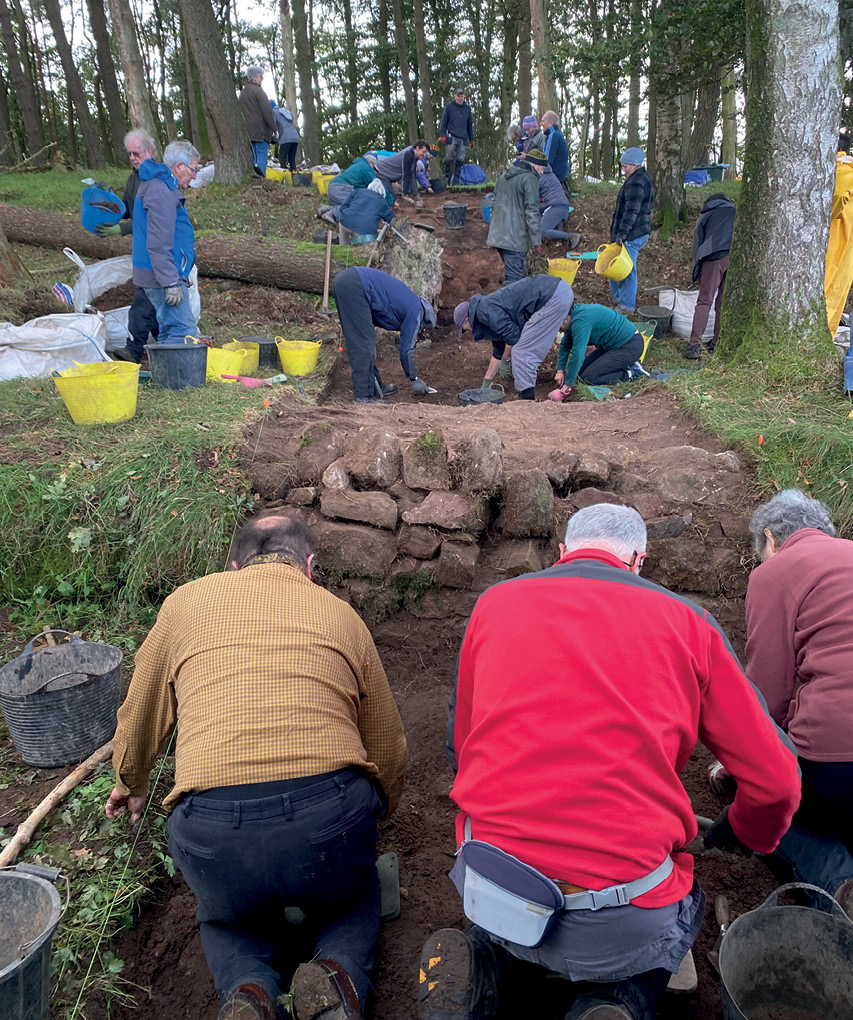
Collectively known as the Melsonby Hoard (after the village on whose outskirts it was rediscovered in 2021), this impressive assemblage represents the largest Iron Age metalwork hoard ever found in Britain. Fortunately, its finder, metal-detectorist Peter Heads, swiftly reported his discovery, allowing the artefacts to be carefully excavated by Durham University archaeologists, with advice from the British Museum and funding and support from Historic England (see CA 423), and processed as a Treasure find by the Portable Antiquities Scheme (see http://www.finds.org.uk/treasure). Now, following expert conservation by Durham University, and a crowdfunding campaign that recently allowed the Yorkshire Museum to acquire the hoard, around 20% of its contents have gone on display in York, just 80km (50 miles) from where it was buried.
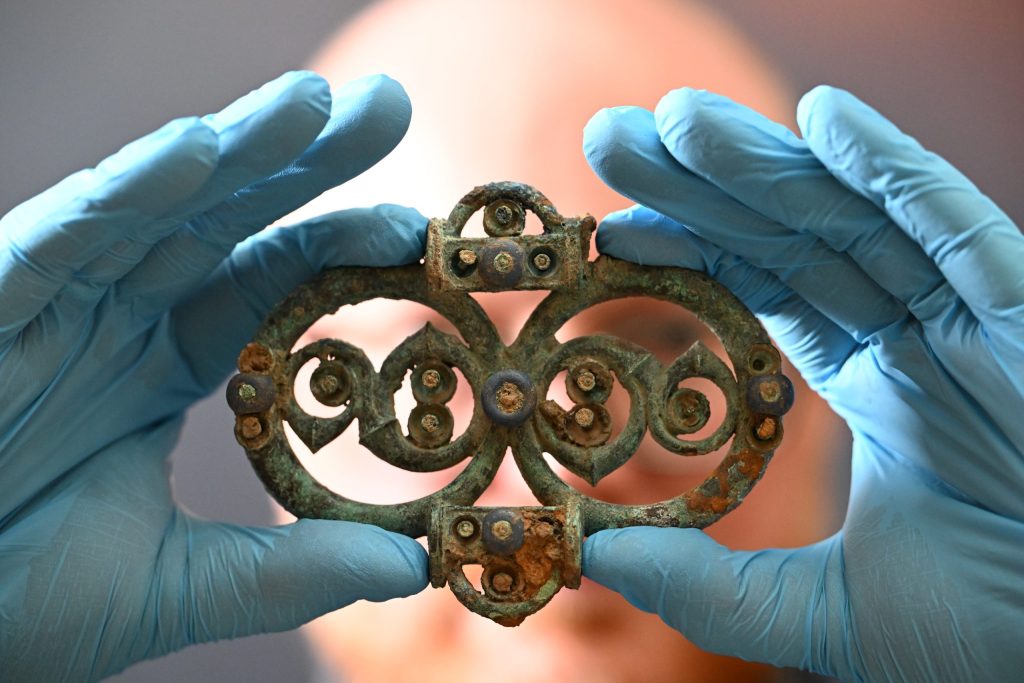
Chariots, Treasure and Power: Secrets of the Melsonby Hoard explores why this mass of metal was consigned to the ground, putting forward four possible explanations, with displays of artefacts illustrating each theme: ‘Feast’ (a display of power marking the meeting of local leaders), ‘Festival’ (a religious celebration or other special occasion), ‘Fight’ (destroying or sacrificing captured war trophies), and ‘Funeral’ (the grave goods of a powerful individual – who, the exhibition suggests, was probably a woman).
The land in which the hoard was buried lay within the territory of the Brigantes, a powerful people who controlled much of the north of England. Their capital, Stanwick, lay just 0.8km (0.5 miles) from the findspot, and previous excavations of this fortified settlement have highlighted its influence and access to luxury goods from across Britain and further afield, including contact with the Roman world long before its legions annexed this region (CA 119 and 325). The Melsonby Hoard, too, points to far reaching trade links: many of its items are decorated with Mediterranean coral, while a wine-mixing bowl from the assemblage has parallels with earlier Etruscan vessels. This was clearly a community that was not only able to acquire exotic goods but could afford to lose them. Certainly, as you move through the exhibition’s displays, the scale and splendour of the hoard’s contents is vividly clear. A colourful information board demonstrates the dizzying diversity of artefacts: 200 parts from chariots and wagons (including 28 iron tyres); 139 pieces of horse harness (some of them gilded and adorned with coral, glass beads, and vibrant enamel); nine examples of weapons and armour; two feasting vessels; and many more enigmatic objects. Within the objects on show, too, there is a real sense of showing off. Some of the spearheads are much too large to have served any practical purpose, while the harness fittings are oversized for the ponies that would have worn them.
Exploring interpretations
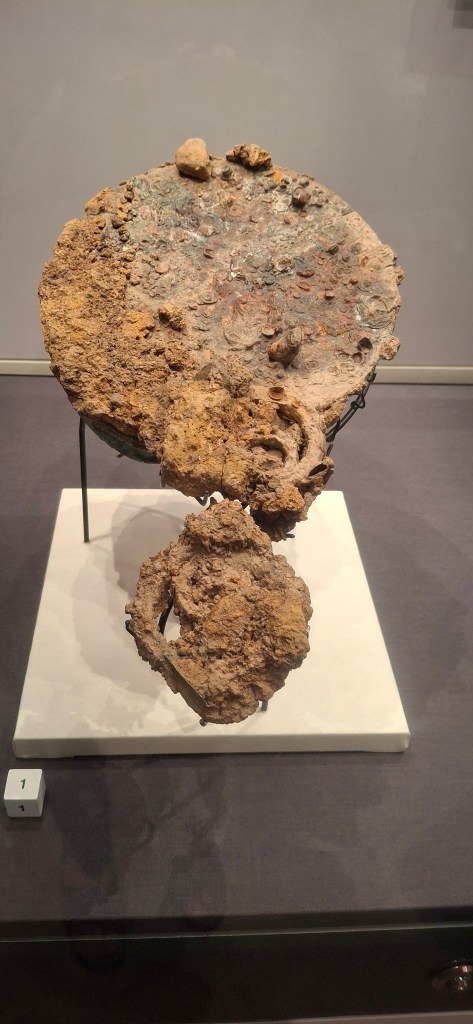
Themed sections discussing possible interpretations are arranged around the edges of the gallery, while at its heart a circular space houses information about the find’s historical context, as well as video interviews with Peter Heads and Durham University’s Professor Tom Moore and Faye McLean, who describe the experience and the significance of the hoard’s discovery. Elsewhere in the exhibition, other videos feature Dr Sophia Adams of the British Museum, who explores the artefacts’ Mediterranean links, and Professor Melanie Giles of the University of Manchester, who speaks about weaponry and a particularly intriguing object: the large, iron mirror. Fewer than 50 Iron Age mirrors are known from Britain, and where they are found, they tend to be made of more-reflective bronze or copper alloy, rather than the heavy, duller material of the Melsonby Hoard example. In the Iron Age, mirrors are particularly associated with high status female burials, and the exhibition asks whether the presence of such an object in the Melsonby assemblage might suggest that the hoard represents the grave goods of an elite woman. Many of its contents are scorched, melted, or fused together, indicating that they had been exposed to intense heat – although no human remains were found on the site, could the metalwork have been placed on a funeral pyre?
Complementing such thought-provoking displays, there is also plenty of information to whet the appetite of those eager to learn more about the scientific research that is currently focused on the Melsonby artefacts. Within the central circle, interactive elements include a touchscreen where you can examine videos and images from the University of Southampton’s CT scans of the hoard, while elsewhere other displays illuminate techniques from metal analysis to radiocarbon dating. There are hands-on aspects to appeal to all ages, too, from adding magnetic cut-outs of decorative metalwork to a wall-mounted image of a pony and chariot, to X-rays that can be placed on a lightbox to examine intricate details now concealed by corrosion.
I have not yet mentioned the most visually striking aspect of the exhibition, which greets visitors as they enter: the second group of hoard objects, which has been dubbed ‘The Block’. At the time of their burial, 88 artefacts had been looped together and wrapped in cloth. Over the centuries, corrosion bonded them into a single lump almost 1m (3ft) across and weighing more than 150kg (330lbs). Rather than damage the items by teasing them apart, the conservators decided to preserve The Block’s original appearance, and this mass of metal, intricately interwoven and bristling with eclectic items, is displayed for you to pore over, spotting something new every time you circle its case. Durham University experts have spent over 300 hours conserving just enough to reveal The Block’s surface, and CT scans have identified most of its contents, including spearheads, harness fittings, vehicle parts, and decorative metalwork including the face of a little bronze boar. This arresting sight is a good metaphor for the wider assemblage, as ongoing research is still only scratching the surface of what the Melsonby Hoard will be able to tell us about the Iron Age. As this work continues, and scientific techniques advance, more fascinating secrets will surely be brought to light. The absorbing exhibition currently running at the Yorkshire Museum more than captures this excitement.
Further information:
• Chariots, Treasure and Power: Secrets of the Melsonby Hoard will be at the Yorkshire Museum until summer 2027. For more details, see http://www.yorkshiremuseum.org.uk/exhibition/chariots-treasure-and-power-secrets-of-the-melsonby-hoard.
• To help support further conservation and research on the hoard objects, the Yorkshire Museum is running a public fundraising campaign: you can ‘Adopt an Object’ by scanning one of the QR codes displayed throughout the exhibition (or via http://www.yorkshiremuseum.org.uk/adopt-an-object) or donate directly at http://www.crowdfunder.co.uk/p/save-the-melsonby-hoard.