
Subscribe now for full access and no adverts
Great Baddow Hoard on display
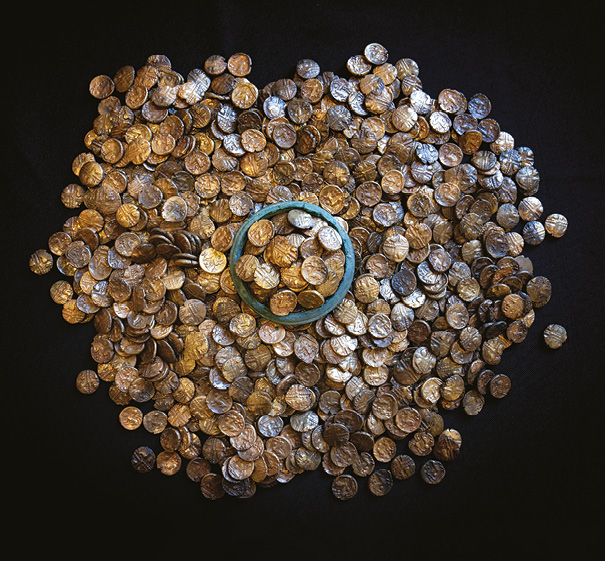
The largest Iron Age hoard of gold coins ever found in Britain is set to go on display at the Museum of Chelmsford in July – and it has just got even bigger, thanks to the discovery of two more coins that have been acquired just in time for the exhibition.
The Great Baddow Hoard was originally discovered near the eponymous Essex village in 2020. At that time, 933 gold staters dating to 60-20 BC were recovered, together with fragments of a possible pottery container, and (with National Lottery Heritage Fund support) these joined the collections of the Museum of Chelmsford in 2025.
A series of NLHF-funded projects followed, including a new excavation of the findspot by Archaeology South-East last autumn. This revealed two more Iron Age coins of the same ‘Whaddon Chase’ type of eastern British stater as 930 of the previous finds. The coins were reported to the Portable Antiquities Scheme, and the Museum of Chelmsford acquired them in April.
This summer, the coins will feature in a new exhibition exploring Chelmsford’s Iron Age history, changing concepts of ‘treasure’, and theories around why the hoard was buried. Timeless Treasures: unlocking the Great Baddow coin hoard will run from 18 July 2026 until 11 April 2027, after which the coins will go on permanent display in the museum’s Prehistory Gallery. See http://www.museumofchelmsford.co.uk/exhibitions/collections/the-great-baddow-hoard for more details.
UK’s first ancient DNA exhibition to open
A new exhibition exploring how ancient DNA (aDNA) is giving new insights into human evolution, migration, culture, and disease will open at the Francis Crick Institute in London in July.
We Go Way Back explores how this field has evolved, from early extraction of aDNA in the 1980s to game-changing advances in genetic sequencing in the 2010s, as well as highlighting its potential for future discoveries. Through displays drawing on research from the Crick’s Ancient Genomics Laboratory, visitors will encounter our Neanderthal and Denisovan cousins; explore how Britain’s population has changed through later prehistory and the Roman period; and learn about the bank of more than 1,000 ancient genomes from people who lived in Britain over the last 4,500 years that has been created by Dr Pontus Skoglund (the lab’s Senior Group Leader) and his team.
We Go Way Back runs from 16 July 2026 until 2 July 2027 (Wed-Sat); entry is free. See http://www.crick.ac.uk/way-back for more information.
Roman kiln reconstruction at Stanwick Lakes
An experimental project constructing a full-scale, working Roman pottery kiln has begun at Stanwick Lakes in Northamptonshire.
Led by archaeologist Derek Roberts through his community archaeology company Udig, in collaboration with Stanwick Lakes volunteers and supported by the National Lottery Heritage Fund, the initiative draws on excavated Roman pottery production sites in the Lower Nene Valley, particularly the kiln remains found at Stibbington, Cambridgeshire, in 1969.
The reconstruction is now in its active build phase, using locally sourced natural materials and archaeologically informed techniques. Once complete, the kiln will be a permanent feature at Stanwick Lakes, supporting workshops, school sessions, demonstrations, and ongoing experimental archaeology programmes. It will fire hand-made Roman-style pottery, testing construction methods, firing behaviour, fuel use, temperature control, and structural performance under real-world conditions.
See http://www.stanwicklakes.org.uk/from-iron-to-empire for more details of the kiln and the wider ‘From Iron to Empire’ heritage programme at Stanwick Lakes.
New exhibitions
BorderLands
Until 31 August 2026
Hay Castle, Hay-on-Wye
http://www.haycastletrust.org
Victorians
Until 2 November 2026
Littlehampton Museum
http://www.littlehamptonmuseum.co.uk/node/24
Capturing Old Shoreham
Until 25 July 2026
Marlipins Museum, Shoreham-by-Sea
http://www.shorehamsociety.org.uk/capturing-old-shoreham
Treasure: hidden, lost, found
Until 20 September 2026
Great North Museum: Hancock, Newcastle upon Tyne
http://www.northeastmuseums.org.uk/greatnorthmuseum/whats-on/treasure-hidden-lost-found
Archaeology and Empire
Until 20 July 2026
Stirling Castle
http://www.historicenvironment.scot/whats-on
Moving Objects: stories from behind the scenes at the museum
Until 20 December 2026
Museum of Archaeology and Anthropology, Cambridge
https://maa.cam.ac.uk/moving-objects-stories-behind-scenes-museum