
Subscribe now for full access and no adverts
‘Genghis Khan’ is a name that resonates through history. During the 13th century, the Mongol leader and his descendants built the largest continuous land empire ever known, at its peak stretching from Korea to eastern Europe. Today, the mounted warriors of the Mongol hordes remain a byword for unstoppable military force – but, as a new exhibition at the Royal Armouries Museum in Leeds eloquently demonstrates, their story is more nuanced and even more impressive than long-standing stereotypes suggest.
In Genghis Khan: How the Mongols Changed the World, almost 250 objects from Mongolia’s national collections – many of which have never left the country before – come together to illuminate a vast sweep of geography and time. Spanning the 1st to the 14th centuries, displays of arms and armour, artefacts, and artistry trace how nomadic steppe cultures rose to wield increasing political and economic power, culminating in a Temüjin managed to unite rival tribes and was proclaimed their Universal Ruler: Chinggis Khan. While the exhibition’s title uses the more-familiar Westernised version of this epithet, the traditional spelling appears throughout the displays themselves, and their contents, too, strive to give a more-authentic perspective on the Mongols and their enduring legacy.
Beside the Mongol Empire’s renowned military might, the exhibition argues, its true power lay in the fact that its rulers controlled not only lands and people, but trade connections crossing continents. This network brought once-remote populations into contact (and under a single system of rule) for the first time, facilitating the movement of scholars, traders, and artisans, and driving a vibrant exchange of goods, materials, and ideas. The course of Eurasian history would never be the same.
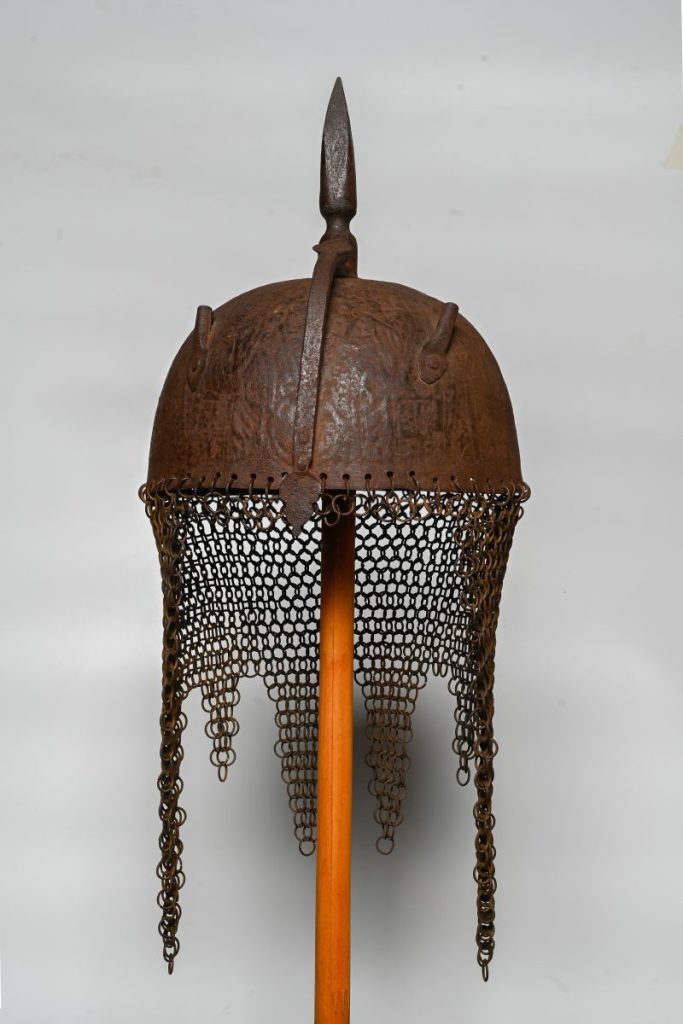
Although it cannot be denied that this empire was forged through violent conquest (and visitors keen to learn more about the Mongols’ famed skill at mounted combat will not be disappointed by the arrays of weaponry, chainmail armour, and even a complete composite bow), the exhibition is keen to highlight that its rulers were more than ruthless warlords: they were also patrons of the arts and sciences who were interested in astronomy and allowed considerable religious freedom among their subjects. Diverse displays in this section explore intellectual interests, artistic endeavours, and echoes of everyday life, including jewellery and pottery – this is not an exhibition focused solely on warriors. Visitors can delve more deeply into the distinctive details of steppe cultures as well, from shamanic religious beliefs to the Mongols’ practice of avoiding campaigning in the spring and summer, when their mares gave birth and produced milk.
Nor does the exhibition present a solely masculine view: throughout the displays are scattered snapshots of intrepid and accomplished women from the Mongol court, including Börte, Chinggis Khan’s first wife and trusted advisor; his daughter Alaqai Beki and daughter-in-law Sorqoqtani Beki, who became powerful rulers in their own right after their husbands’ death; and his fiercely independent great-great-granddaughter Khutulun, who swore she would only marry a man who could defeat her at wrestling
Atmospherically lit, complemented by eye-catching digital and interactive aspects, and accompanied by an effective but unobtrusive soundscape of birds, bells, whinnying horses, and clashing metal, this exhibition is an inspiring experience. Western imaginings of the Mongol Empire are often shaped by the views of contemporary outsiders like the Venetian merchant Marco Polo; here, artefacts created in the heart of this unique culture present the other side of the story – and it is a truly compelling tale.
Further information: Genghis Khan: How the Mongols Changed the World is at the Royal Armouries Museum in Leeds until 1 November 2026; see https://royalarmouries.org/leeds/whats-on/genghis-khan for more details.