
Subscribe now for full access and no adverts
Drink was, for agricultural and industrial labourers in 19th-century England, a cheap escape from the relentless misery of their working lives, as well as a source of companionship – the public house being a warm and sociable refuge from crowded and insanitary living conditions. At the same time, it was portrayed as the source of many social evils, some of which were graphically illustrated in William Hogarth’s 1751 engraving that depicts infanticide, starvation, madness, decay, and suicide among the miserably addicted inhabitants of Gin Lane.
In Beer Street, the companion piece to Gin Lane, Hogarth portrayed a healthy community, nourished by small beer and ale: ‘happy produce of our Isle… balmy juice… rival to the cup of Jove’. It was the destructive practice of drinking cheap spirits, rather than wine or beer, that was the initial target of the social reformers who, in 1826, set up the first Temperance Society in Boston, USA. Influenced by this rapidly growing American movement, similar societies were set up in Ireland and Scotland in 1829, and in England – specifically, in Warrington, Salford, Manchester, and Bradford – in 1830.
Initially, British efforts were uncoordinated, but a national movement began to take shape in 1831 when the London-based British and Foreign Temperance Society was formed with the Bishop of London as its President and several other bishops as Vice-Presidents. Its agents travelled all over England, calling meetings and encouraging the formation of new local societies, which were often sponsored by prominent industrialists. They would close their textile factories early so that their workers could attend evening meetings, at which speakers described the evils of intemperance in graphic and emotion-laden detail.
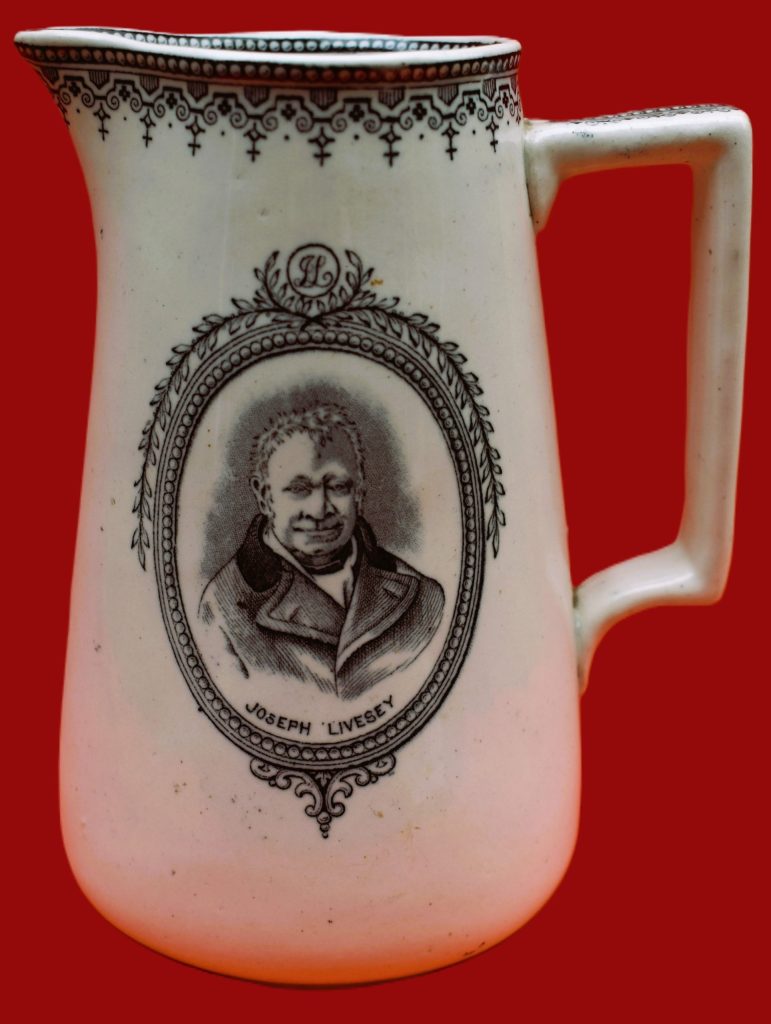
Splits in the movement appeared early, however, dividing those who only required members to abstain from drinking spirits from those who demanded total abstinence. Initially, for example, members of the Preston Temperance Society in Lancashire could subscribe to ‘the moderation principle’, but founder member Joseph Livesey introduced a newly written pledge in September 1832, inviting fellow members to abstain from all intoxicating liquors (‘except as medicine’).
That same year, the orator Richard Turner, another founder of the Preston society, declared that ‘nothing but tee-tee-total’ would do – echoing American and Irish English usage of the word ‘teetotally’ to mean ‘completely’ (or ‘total with a capital T’). The newly coined term gained rapid currency partly because of the association between teetotalism and tea drinking. Tea meetings were another initiative of the Preston society, with 1,200 people regularly buying tickets for events in the town’s largest public building, the Corn Exchange Assembly Rooms, for which a 200-gallon capacity boiler was required.

In 1835, the Preston society adopted teetotalism as the only pledge available to members. Subsequent campaigners were keen to promote the town as the ‘Bethlehem of Teetotalism’, and this resulted in some of the earliest surviving monuments to the movement in the form of Temperance gravestones and memorial tablets. Preston became the focus of teetotal tourism, with members of Temperance groups from around the country arriving by train to pay their respects at Richard Turner’s grave. Laid to rest in 1846 in the churchyard of St Peter’s (now the University of Lancashire’s Arts Centre), Turner lies beneath a slab whose inscription describes him as ‘the author of the word Teetotal, as applied to abstinence from intoxicating liquors’.
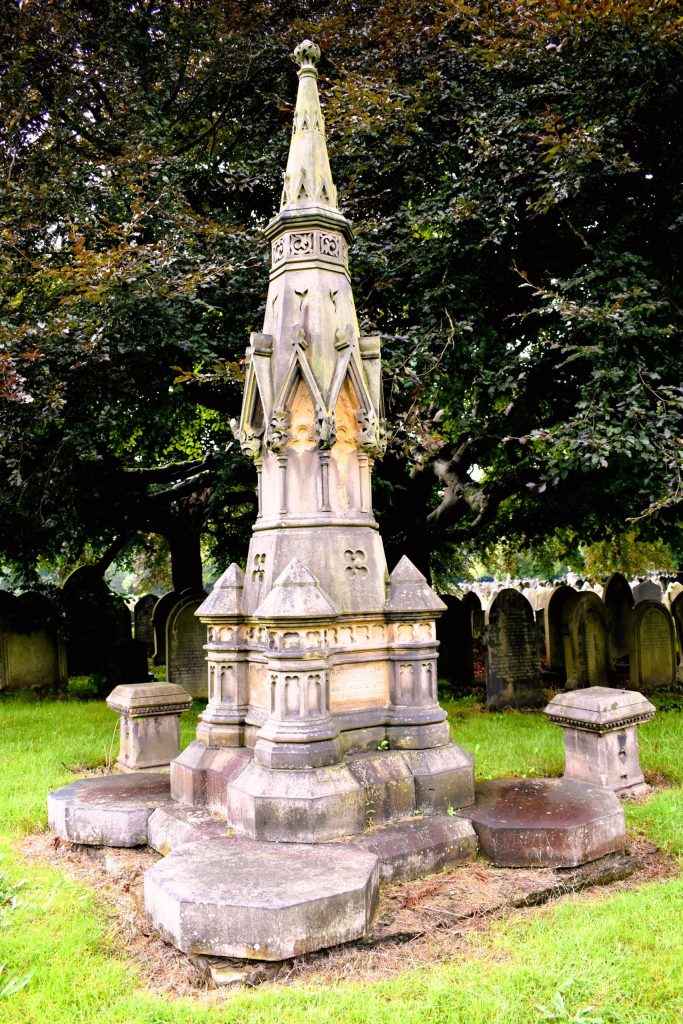
From there pilgrims went to see the neo-Gothic Teetotal Monument (erected in 1859) with its elaborately decorated spire rising 5m (16ft) into the air, located at the centre of a section of Preston Burial Ground devoted to the graves of early members and supporters of the movement. As recently as 1924, another site was added to the teetotal itinerary, when a memorial plaque was unveiled on the building (now a hairdresser’s salon) in Walton-le-Dale, on the outskirts of Preston, where Joseph Livesey was born in 1794.

A sober start
Being teetotal created daily challenges. Members of the movement were denied access to public buildings by local authorities where influential brewers, wine merchants, and those connected with the drinks trade served as councillors, officials, and magistrates. Alcohol-focused public spaces – inns, pubs, and alehouses – were, by definition, out of bounds. Open-air meetings were attacked by catcalling mobs, and indoor meetings were often disrupted by opponents shouting down the speakers, singing bawdy songs, or setting off fireworks.
In response to their exclusion, teetotal reformers set about creating a parallel infrastructure of buildings and social meeting spaces. Temperance Halls came in all shapes and sizes, from wooden huts and corrugated iron ‘tin tabernacles’ to impressive architect-designed buildings. Some were converted from existing structures: the Preston Temperance Society acquired a former cockpit owned by the Earl of Derby that had been made redundant by the banning of cockfighting in 1835 – a building with tiered seating and a central stage ideal for lectures and debates. No doubt, too, there was some satisfaction to be gained from converting a former drinking den (in Huddersfield, West Yorkshire), a pub (King’s Lynn, Norfolk), a maltings (Chesterfield, Derbyshire), a brewery (Cirencester, Gloucestershire), and a hop-sack manufactory (Alton, Hampshire) into Temperance Halls.
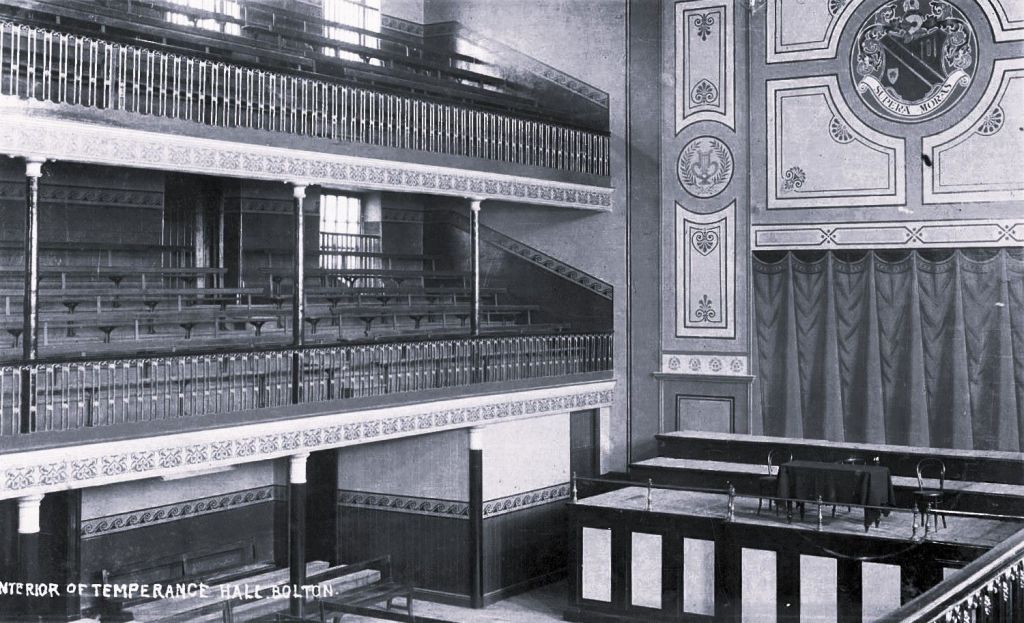
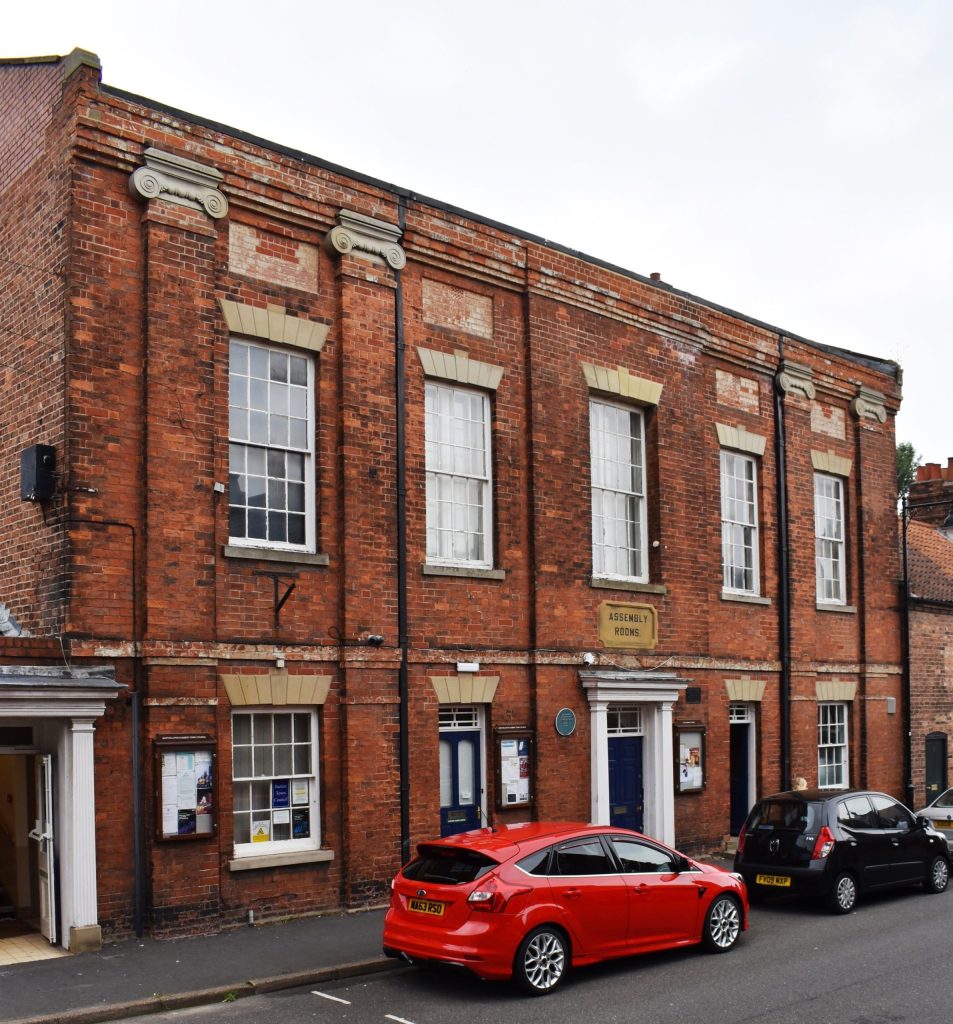
The first purpose-built Temperance Hall opened on 24 November 1834 in Garstang, Lancashire, paid for by funds raised by public appeals, street collections, subscriptions, tea parties, bazaars, concerts and soirées, lectures, recitations, and musical performances. The oldest of the purpose built halls to survive in England, though, is in Barton-upon-Humber, Lincolnshire. Built in 1843 in Classical style, it resembles a late-Georgian assembly room. Many other halls of the period show the influence of contemporary chapel architecture in their external appearance, and some of these combined the functions of chapel and Temperance Hall.
Early Temperance societies took every possible opportunity for public display as part of their recruitment effort, regularly staging processions through towns preceded by a band, with flags and banners flying and everyone dressed in their Sunday best to emphasise the financial benefits of not wasting money on drink. The establishment of a new Temperance Hall was an occasion marked by speeches (often lengthy) from leading members of the community, and the laying of a foundation stone recording the date of the event and the principal personalities involved. Some stones bore biblical quotations; others had slogans, like the ones at Newbury, Berkshire, declaring that ‘the Drunkard shall come to poverty’.
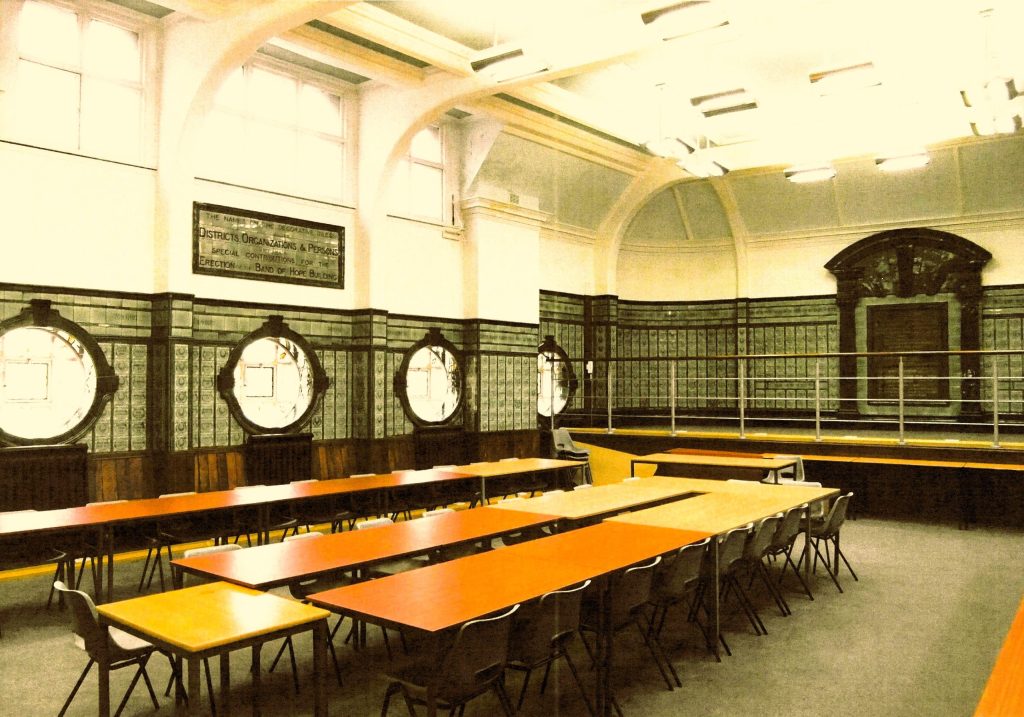

Opening ceremonies were even more ambitious. Railway companies laid on special trains and tents were erected for serving teas; bazaars sold ‘useful and fancy items’, including commemorative medals and prints of the new hall; while bands performed and choirs sang patriotic songs.
Inside, Temperance Halls combined a variety of functions: reading room, library, assembly room, schoolroom, and smoking room. Tea-drinking was an important ritual, requiring apparatus for boiling up to 50 gallons of water within 20 minutes, as well as tables, seating, tablecloths, and crockery. In Leicester, the ‘large and beautiful plated urn’ supplied a 70ft long tube, extending the length of the hall, with taps projecting from each side, so that tea could be supplied to hundreds of people simultaneously.
Large halls could accommodate 600 to 1,000 people, and some had galleries, orchestra pits, stages, and organs. As well as dances, concerts, and theatrical performances, lectures and readings were a staple of Temperance Hall activity. Charles Dickens often gave readings in Temperance Halls, while travel, exploration, geography, and science were popular subjects for lectures given by public figures and illustrated by lantern slides. Many Temperance Halls included classrooms, libraries, and newsrooms to support their members’ desire for self-improvement. The hall in Ulverston in Cumbria boasted ‘ice cold and shower baths’, while Ripley in Derbyshire included a swimming bath among its facilities.
The entertainment provided at Temperance Halls was in part intended to attract people away from music halls, which were seen as cesspits of prostitution and drunkenness, encouraged by ribald performances with songs and acts full of sexual innuendo. Neutralising the influence of music halls by providing ‘reformed’ performances, without ‘vulgarity, double entendres, or immoral ideas’ was one of the less successful ventures of the movement. While Robert Short, owner of the Alhambra in Shoreditch, claimed audiences of 10,000 nightly, other specially built music halls struggled. One of these is now the Old Vic – originally the Royal Victoria Palace – on the New Cut, near Waterloo Station. It lasted just seven months and led to the reluctant conclusion, according to the Western Morning News, that audiences were not keen on the bland entertainment on offer – smut and innuendo were what people went to the music hall to enjoy.

Abstinence architecture
Much more successful were those halls that incorporated rooms for overnight visitors, with stabling for their horses. The Temperance Hall in Street, Somerset, advertised ‘a commodious hotel for the accommodation of Teetotal travellers’. It was one of some 500 Temperance hotels built at the movement’s height. Preston was once again the pioneer, opening the first purpose-built Temperance hotel in 1832. Early examples were modest buildings, but by the 1850s they were becoming larger and more luxurious. Opened in late 1869, and designed by leading local architect Thomas Ambler, the Trevelyan Hotel in Boar Lane, Leeds, was one of the most stylish in the north, matching anything its licensed rivals could offer by way of comfort, service, and elegance.
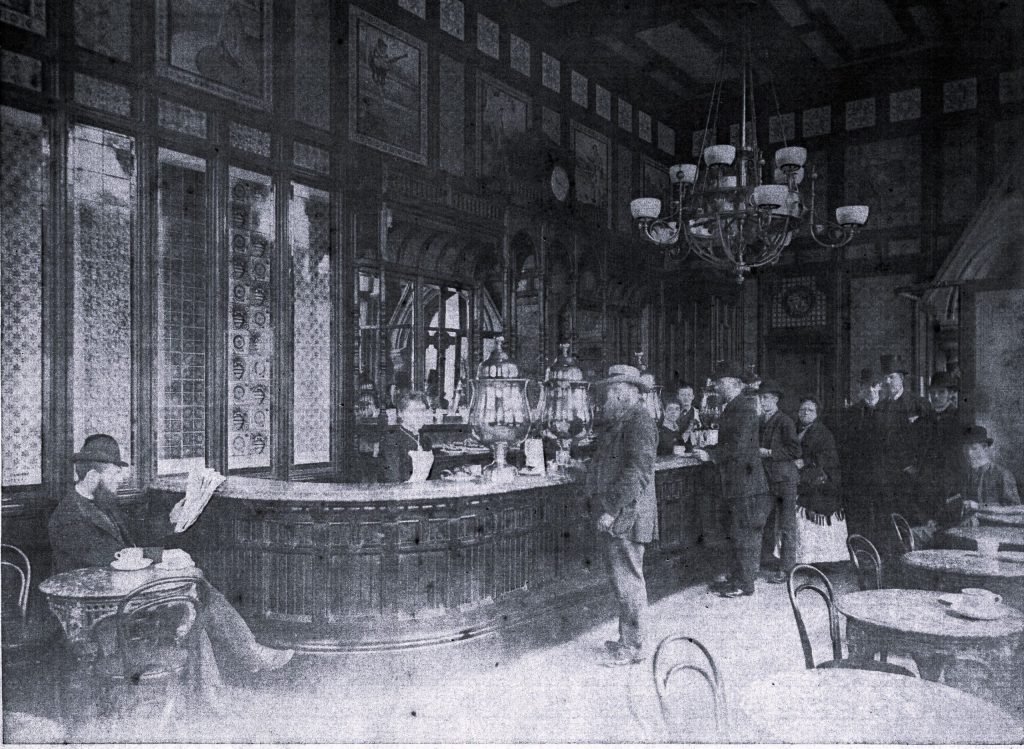
Some incorporated ‘taverns’, ‘bars’, and ‘public houses’, but not for the consumption of alcohol. Rather, these were places open to the public, where people could drop in and play billiards or bagatelle, while consuming coffee and other non-alcoholic drinks with snacks. In 1867, Temperance campaigner Rebekah Hind Smith persuaded her husband William to take over a notorious beer house in Fountain Street, Leeds, and turn it into a ‘public house without drink, where one can sit, talk, read, and think, and sober home return’ (so said the sign outside).
He called it the ‘British Workman’ after a popular and influential newspaper available in the pub’s reading room, and the name was subsequently adopted for a rapidly growing movement that took over pubs with a bad reputation in working-class areas. Most served hot and cold food, as well as non-alcoholic drinks, such as soda water, ginger beer, peppermint or orange-and-quinine flavoured tonic drinks, jargonelle (pear juice), and ‘Dantzick Black Beer’, made from molasses flavoured with pine resin. As well as reading rooms, they provided facilities for playing billiards, skittles, draughts, and chess.
The British Workman movement was just one of several Temperance initiatives that spread across the nation. According to the journal Coffee Public-House News, there were 1,500 coffee palaces and taverns in operation in the UK in 1884, with 120 in London. Additionally, there were some 260 companies dedicated to the building and operation of such institutions. Newly built coffee houses could be architecturally ambitious, making full use of decorative stone and exotic timber for the exterior, as well as tiles, mirrors and stained glass, brass and gas lamps, marble and copper for the interior fittings. Some were so superior to nearby licensed premises that pub owners had to upgrade their premises to compete.
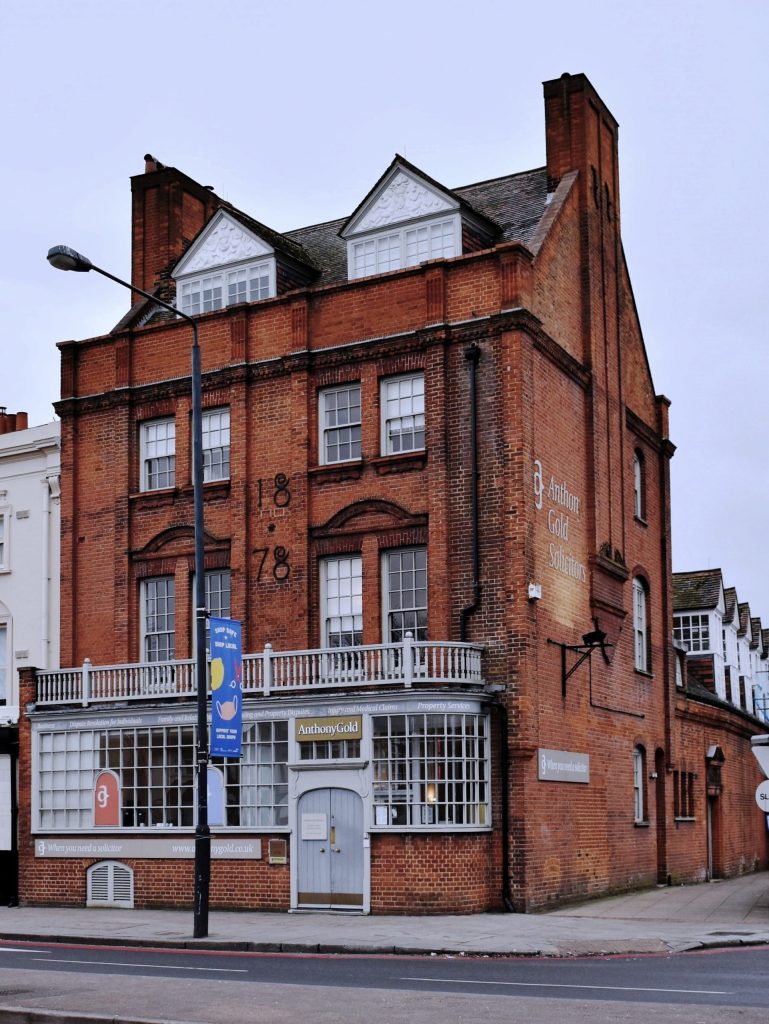
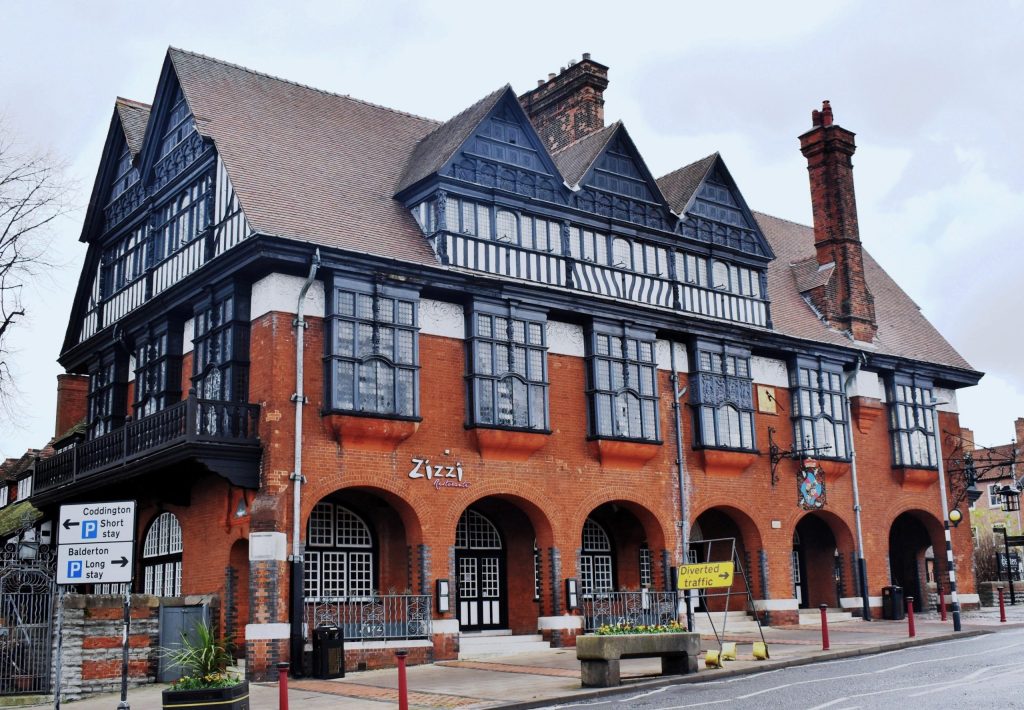
While all have since been converted to other uses, surviving examples show a desire on the part of the architects and sponsors to impart the idea of rootedness based on historic designs. The firm of Ernest George & Peto was one of the leading proponents of an ‘Old English’ style: in 1879, Building News described the firm’s coffee house at 496 Streatham High Road, London, as resembling a ‘quiet old red-brick tavern’ (today it is the office of a firm of solicitors).
The Ossington Coffee Palace (today a restaurant) at Newark-on- Trent, Nottinghamshire, is, according to a plaque on the building, ‘a perfect copy of a 17th-century inn’, featuring much oak-timber framing and ornamental pargetting. Edward Burgess designed several taverns for the Leicester Coffee and Cocoa House Company in eclectic styles, including the East Gates Coffee House (1885) in Church Gate (now a café and bakery), in ‘15th-century domestic style’, and, in French Renaissance style, the Victoria, in Granby Street.
Dry drinking fountains
By contrast with these palatial structures whose original purpose has now been forgotten, the humble drinking fountain is the most visible reminder on our streets of the heritage of the Temperance movement. The inspiration for the drinking fountain movement came from Switzerland, which wealthy Liverpool cotton merchant Charles P Melly visited in 1852. There he discovered that the water supply was owned by local authorities and distributed free via public conduits and drinking fountains, whereas water in England was supplied by private companies who charged for its use (see CA 421).
Returning home, Melly investigated water supply in more detail and discovered that dock workers, as well as the thousands of emigrants waiting for long periods for the ships that would take them to the USA, had no alternative but to visit the dozens of pubs that ringed the dock wall when they needed a drink. In 1853, he was reluctantly granted permission to install two standpipes in Prince’s Dock, and these were used so much that the taps wore out in a matter of months.

Melly persuaded the Docks Committee to let him install two more fountains, including a wall-mounted granite version. Monitoring showed that, on a warm summer’s day, it was used by 2,300 people. Within months, 40 polished red granite wall-mounted ‘Melly fountains’ were installed across Liverpool, with cast-bronze spouts in the shape of the heads of lions, tigers, and satyrs, as well as men, women, and children. Water was drunk from galvanised-iron cups or ladles secured by chains to the fountain. Melly is also credited with the design of a cast-iron drinking fountain (one survives at Bath Street, Liverpool), while a handsome red granite obelisk in Princes Park (also in Liverpool) was erected in memory of the Park’s promoter.
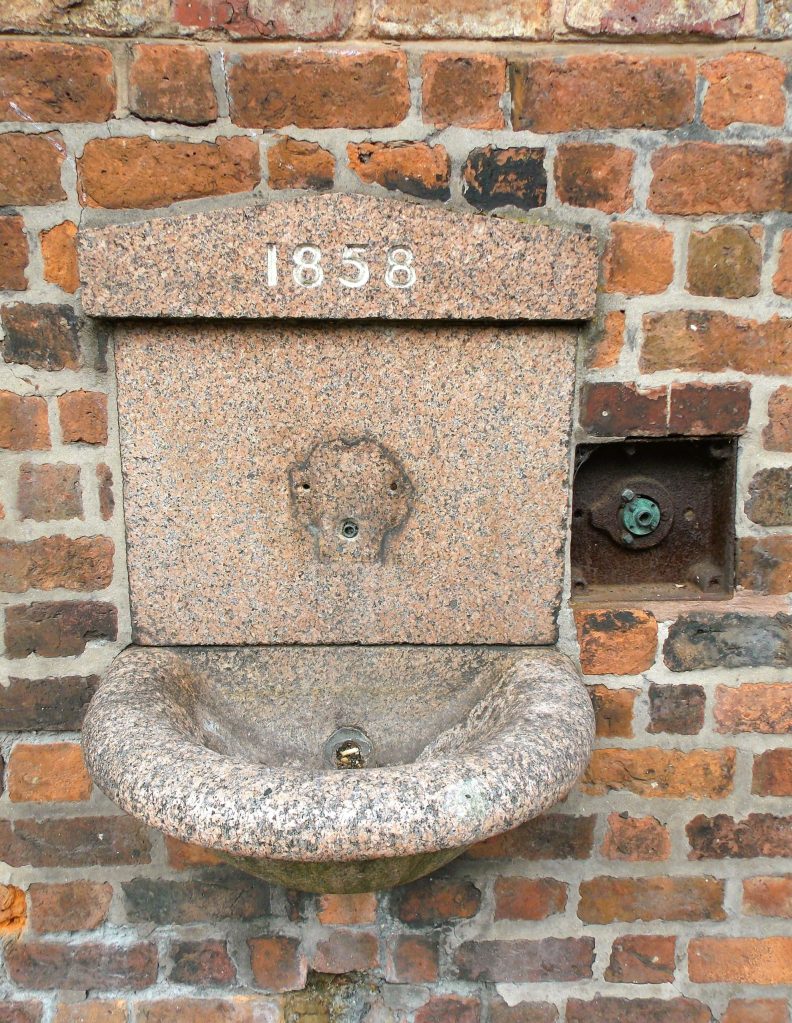
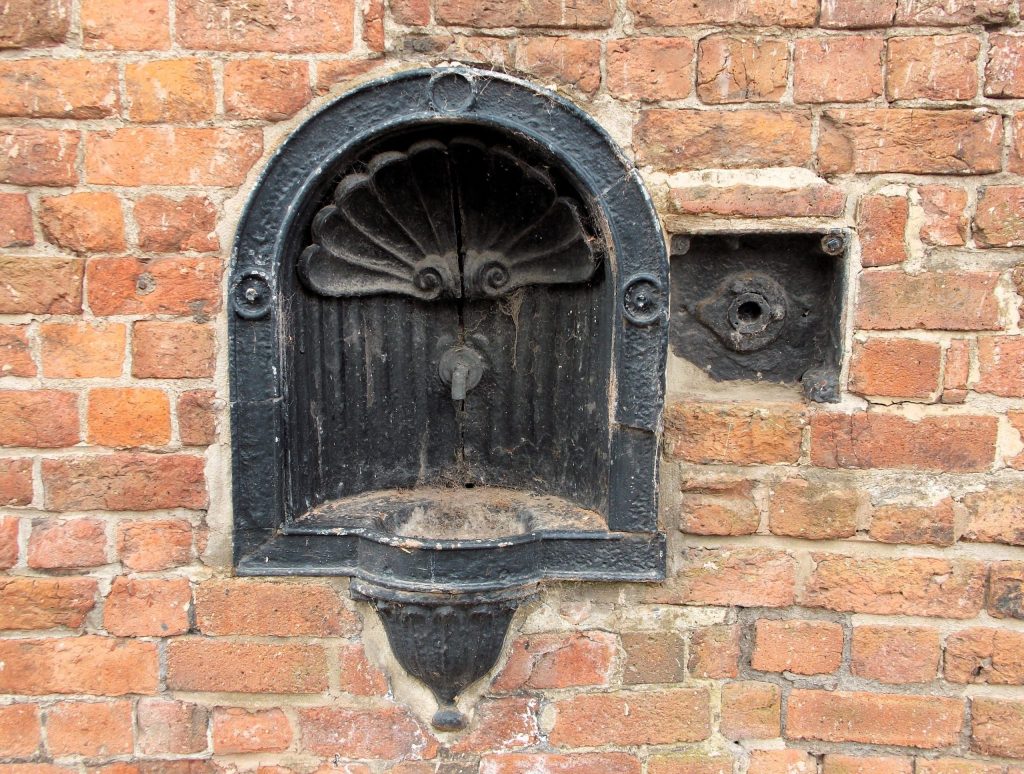
Melly was not primarily motivated by teetotal considerations, but the Temperance movement was quick to see the benefits of fountains, and they became an increasingly popular form of memorial to deceased philanthropists or to commemorate coronations, royal marriages, birthdays, or jubilees, as well as other special events. The splendid Temple Row fountain in Birmingham was erected to mark the visit of Queen Victoria to the city in 1858. It features an angel holding a book inscribed with the words from the Gospel of St John that became a standard phrase on the many thousands of drinking fountains that were subsequently constructed in the period leading up to the First World War: ‘whosoever drinketh of the water that I shall give him shall never thirst’.
In London, the rate payers who controlled local government in the city initially held out against the drinking fountain movement, ostensibly not wanting to add to the tax burden, but campaigners led by Samuel Gurney, MP for Falmouth, succeeded in gaining permission for London’s first fountain. Still fixed to the railings of St Sepulchre’s church, Holborn, today, it was inaugurated on 21 April 1859. A fortnight previously, Gurney had been joined by Charles Melly, Lord Shaftesbury, and the Earl of Carlisle at a crowded public meeting that set up the Metropolitan Free Drinking Fountain Association, which committed to installing 400 fountains to meet the needs of the capital.
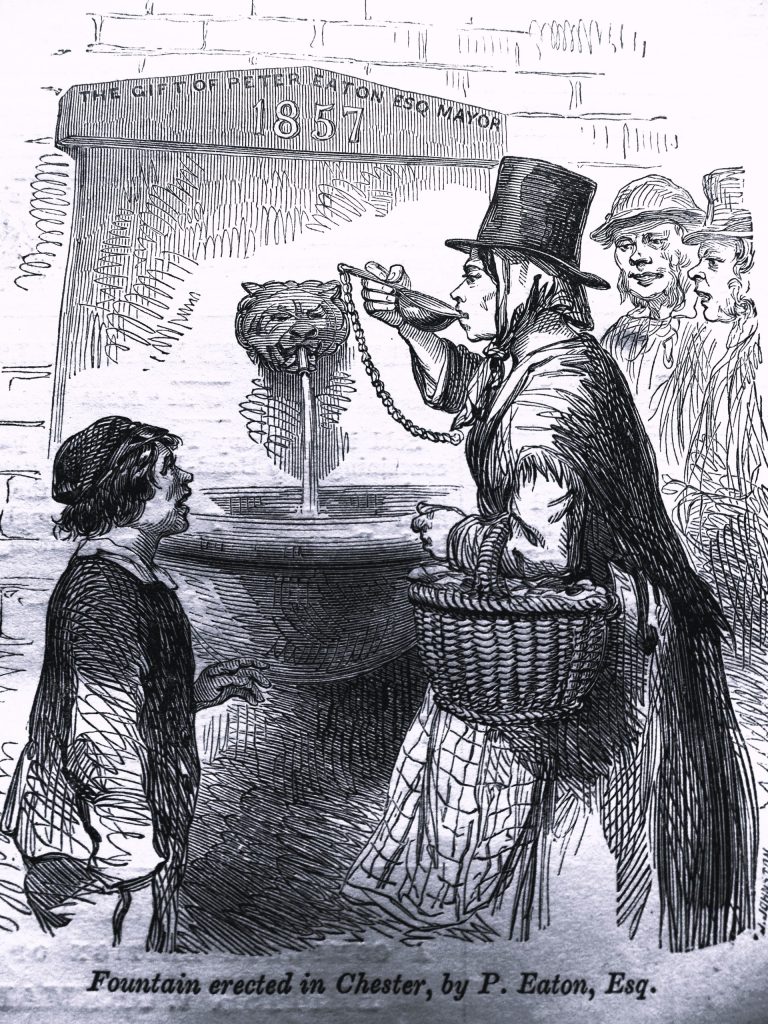
The history of drinking fountains deserves a dedicated study, but the chapter devoted to the subject in Andrew Davison’s comprehensive review of the built heritage of the Temperance movement (see ‘Further reading’ box opposite) indicates the diversity of forms, including those that incorporate impressive sculpture, such as St George slaying the Dragon of Intemperance in Aspatria, Cumberland; the figure of Temperance as a young woman pouring water from a jug located on the northern approach to Blackfriars Bridge, London; and a depiction of Rebecca at the well, alongside Bath Abbey, Somerset. Today, the Heritage of London Trust is doing sterling work in bringing some of the best of the capital’s fountains back into use, having restored 18 so far, with another six currently under restoration.
A lasting legacy
A movement that in the early years of the 20th century counted 3 million members in England – 10% of the population – began to decline even before the First World War, as better housing and an increasing range of leisure activities meant that recreational habits started to change. Cinemas, swimming baths, and growth in the popularity of sports, rambling, and cycling clubs offered alternatives to both the Temperance Hall and the pub. The appearance of the radio in the 1920s, moreover, meant that people enjoyed their music, talks, and theatrical performances at home.
Some Temperance Halls tried to compete by converting to cinemas. Around 100 are still in use today as community halls, churches, libraries, or theatres (including the well-known Little Angel puppet theatre in Dagmar Passage, Islington). Many, though, have lost their original interior fittings as a result of their transformation for other uses.

Coffee taverns and Temperance hotels submitted to the inevitable, and those that survive are nearly all now licensed to sell alcohol. The Temperance Institute, a prominent building on North Street in Keighley, West Yorkshire, is now a Wetherspoon’s pub called ‘The Livery Rooms’, and a pub converted from a Temperance billiard hall on Fulham High Street ironically calls itself ‘The Temperance’.
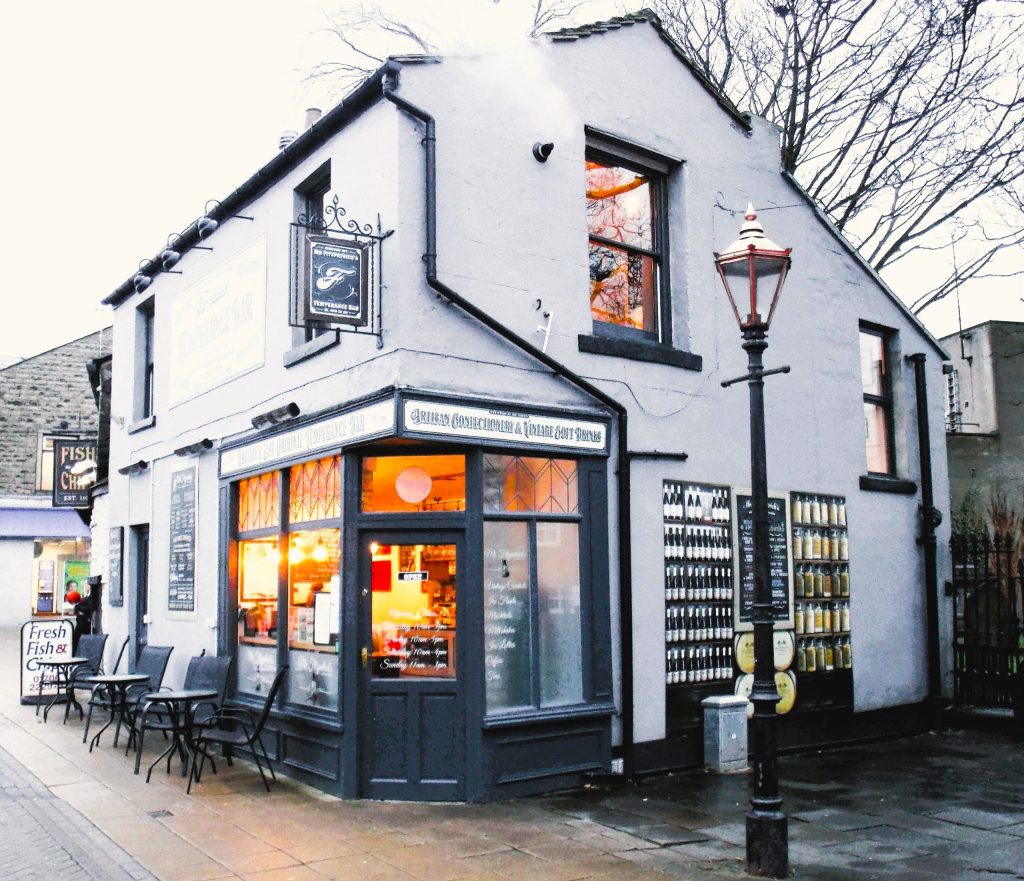
A rare exception to closure and repurposing is the Cross Keys, at Cautley in Cumbria, which was bequeathed to the National Trust in 1949 on condition that it never sell alcohol: it remains open selling tea, coffee, soft drinks, and meals to visitors. Another survival is Mr Fitzpatrick’s in Rawtenstall, Lancashire, which promotes itself as ‘Britain’s Last Temperance Bar’, selling a range of fruit- and flower-flavoured cordials.
Alcohol consumption in Britain declined after reaching a peak in the 1870s, and the fact that the ‘drink question’ is no longer the burning social issue that it was in the 19th century can be seen as a major legacy of the Temperance movement. For the remarkable physical legacy of the movement – its buildings, memorials, and fountains – though now heavily disguised by alternative uses, look no further than Andrew Davison’s eye-opening guide.
Further reading:
Andrew Davison (2026) The Built Heritage of the Temperance Movement (Historic England, ISBN 978-1836245834, £40).
All images: Andrew Davison