
Subscribe now for full access and no adverts
During the British Bronze Age, we can see a notable diversification of tool forms in the archaeological record, possibly reflecting an increase in craft specialisation by the Late Bronze Age (1300-800 BC). Despite this, tool-use associated with this period has been a neglected field, with object studies often focusing on other areas of Bronze Age life such as weaponry. Where Bronze Age tools have been examined in detail, they tend to be discussed as isolated artefacts rather than dynamic elements of larger toolkits. This approach is invaluable for building typologies, but it does not illuminate how such objects were used by – or what they meant to – Bronze Age people.
What can tools tell us about how craft practices changed during this period, and what in turn can surviving craft products say about tool-use? To address this knowledge gap, and as part of a collaborative doctoral project between National Museums Scotland and the University of Leicester focusing on northern Britain, I have been researching the varied ways in which multiple tools might work together in different stages of a project like building a roundhouse or creating a log boat. The many hundreds of tools currently residing within museum collections, together with the growing number that are being found through metal-detecting and archaeological investigations, provide a large source of data to explore tool-use in greater depth, and my own research focuses primarily on bronze cutting-edge implements with an emphasis on a specific woodworking tasks. I have also been examining associated items like sharpening stones and hafts, as they are so integral to the maintenance – and therefore to the continued use – of edged tools, making them an essential part of any Bronze Age ‘toolkit’. My project set out to shed light on the potential range of uses of specific tools, with a particular focus on whether it is possible to identify the varied purposes of an individual object.
Cutting-edge research
Marks on the tools themselves can shed light on their histories: previous use-wear studies of copper-alloy axeheads have focused on their efficiency, while there is also a growing interest in ‘use-intensity’, investigating the amount of work an individual tool carried out before deposition. In 2021, Miriam Andrews performed lab-based experiments using a drop-rig to test axehead bladelets for up to 3,000-4,000 impacts, assessing damage to the blades and comparing these against archaeological artefacts to suggest how heavily they may have been used. However, no other research to-date has attempted to subject similar axeheads to such a high number of impacts, nor over any great length of time, and record the results.

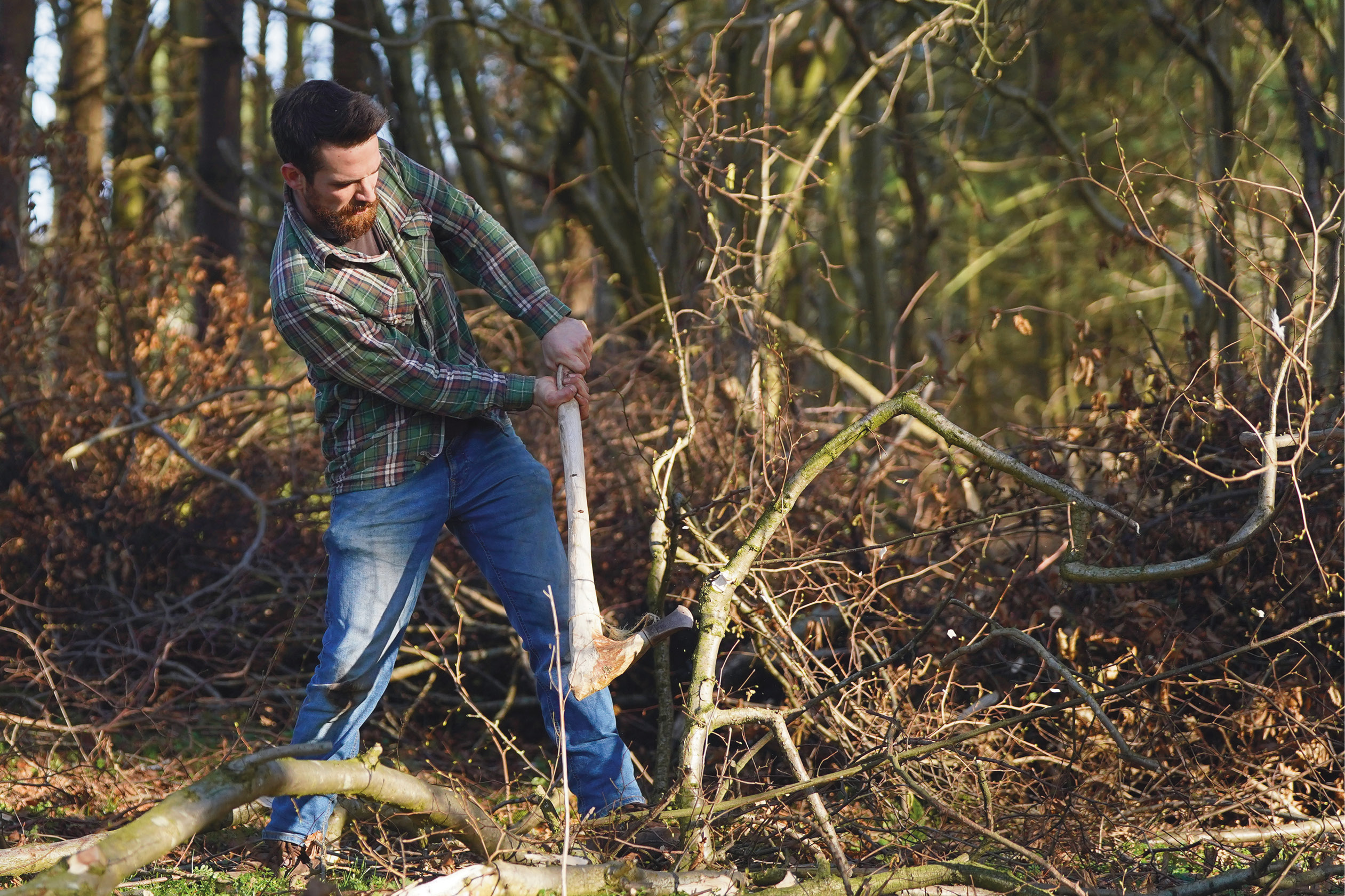
Given my background as a woodworker, it seemed a natural progression for my own project to test an axehead in a more ‘realistic’ or ‘actualistic’ setting, carrying out a whole course of tree-felling and -processing using a single replica axehead over multiple days. Previous use-wear studies of this type have been limited in the range of activities and scale of tasks that they have tried to replicate, and as such I hope that my own results can offer thought-provoking and useful analogies for interpreting artefactual evidence in museum collections.
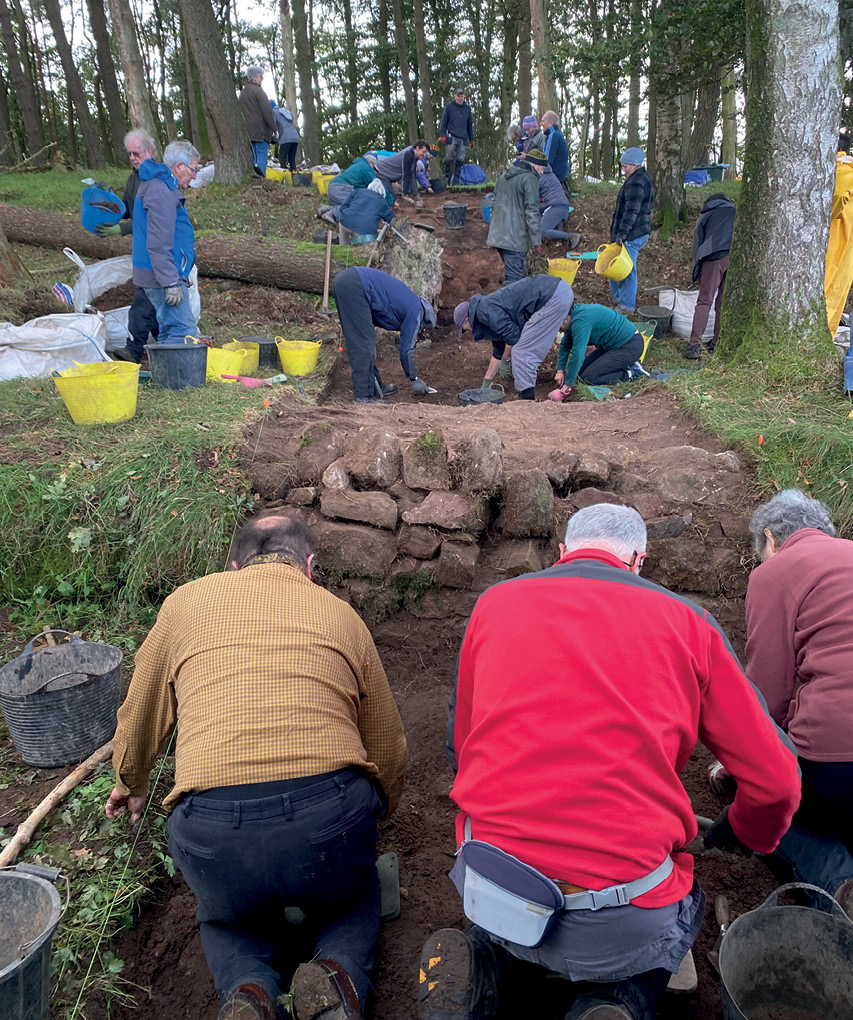
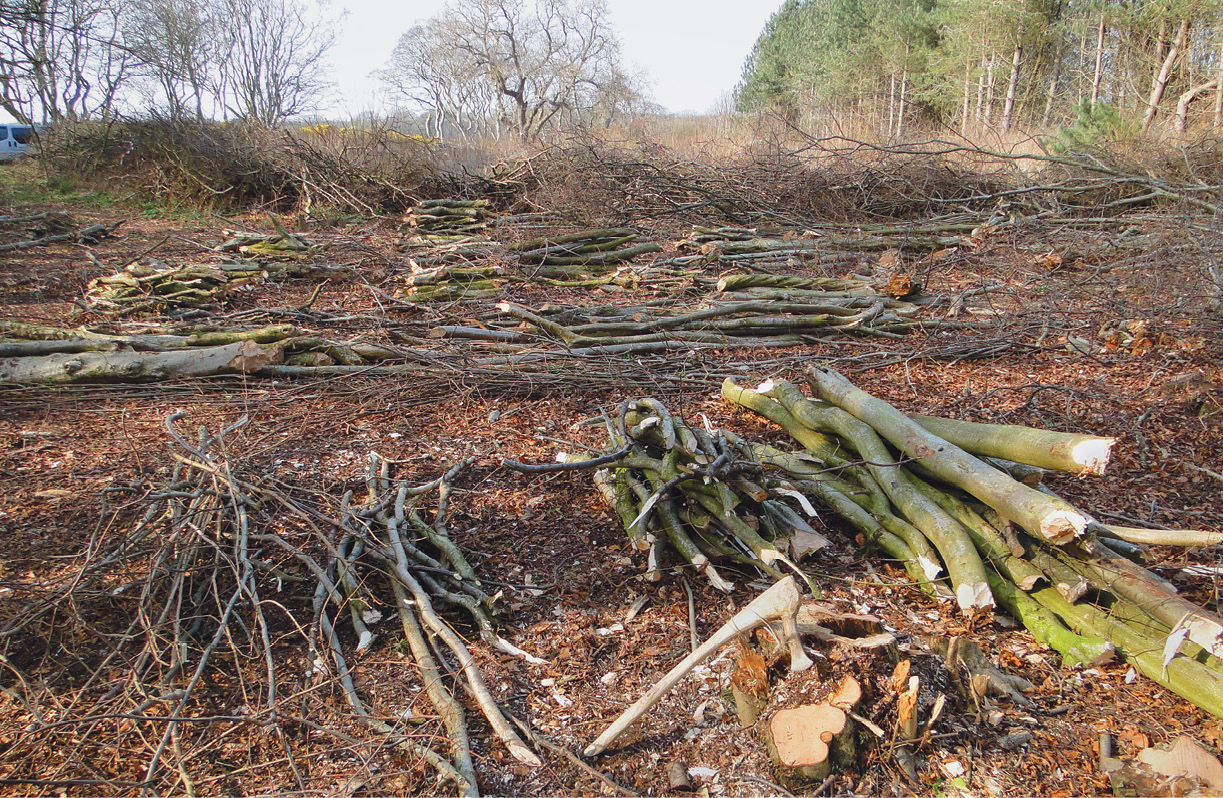
My initial phase of experimentation (a second is already under way) involved using a replica of a single-socketed Late Bronze Age axehead to complete a short season of hazel coppicing at Ravensheugh Copse, near Tyninghame, East Lothian. Coppicing – cutting deciduous trees down to near ground level to promote vigorous regrowth of new shoots from the stump (stool) – stretches far back into prehistory in Britain. The resulting long, straight stems can be used for a range of building and craft tasks, and some of the earliest evidence of this practice is found in the Neolithic Sweet Track of the Somerset Levels (see CA 38, CA 51, and CA 172).
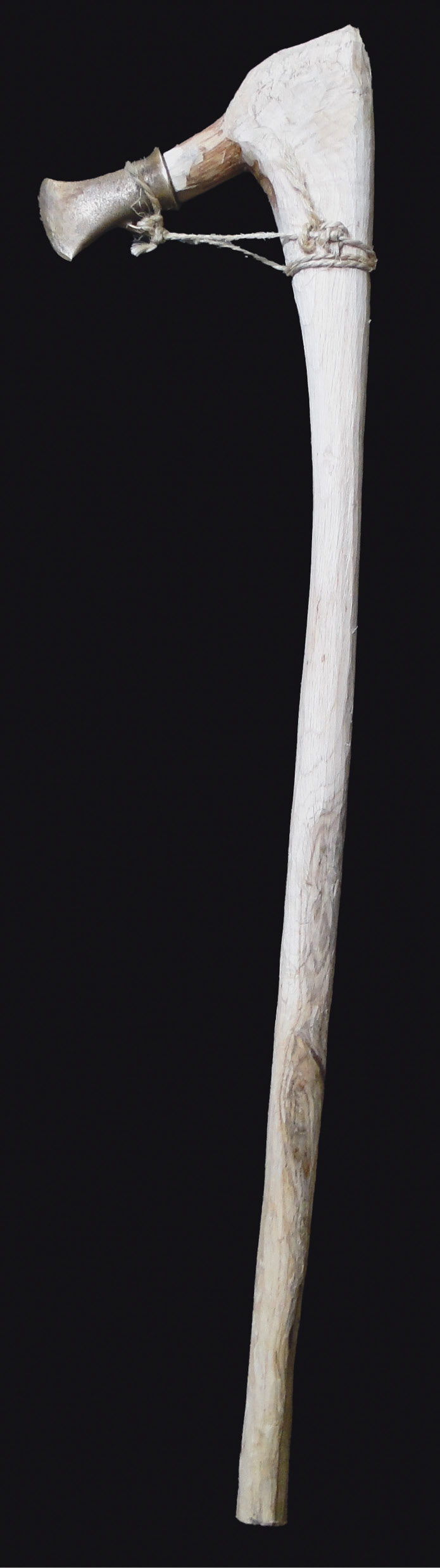
For my work, I used a replica based on a Type Portree axehead from the Kalemouth Hoard (a collection of 14 axeheads found in the Scottish Borders in 1932), which is a typical form found in northern Britain. The replica itself was made by expert bronze smith Neil Burridge, who cast it in a sand mould using 88% copper, 10% tin, and 2% lead, aligning with common metallurgical compositions of Late Bronze Age axes in the study area. Similarly, oak was chosen for the haft, based on apparent selection preferences of this period, and the angle of the foreshaft to haft was set at 75° to 80° based on archaeological evidence. The haft itself (measuring 90cm/35.4in long) was a branch ‘elbow’ type, incorporating the shapes and strength of tree forms, and sisal twine cordage was used for haft-to-loop binding to prevent the axehead from flying into the distance if it became dislodged.
During the experiment, the time expended and strikes made per task, sharpening frequency, and quantity of wood by timber classification and weight were all recorded daily, and I used a high-powered digital microscope at the National Museums Collection Centre in Edinburgh to track the progression of wear both to the axeheads and to the hafts over time.
Deliberate destruction or just an axey dent?
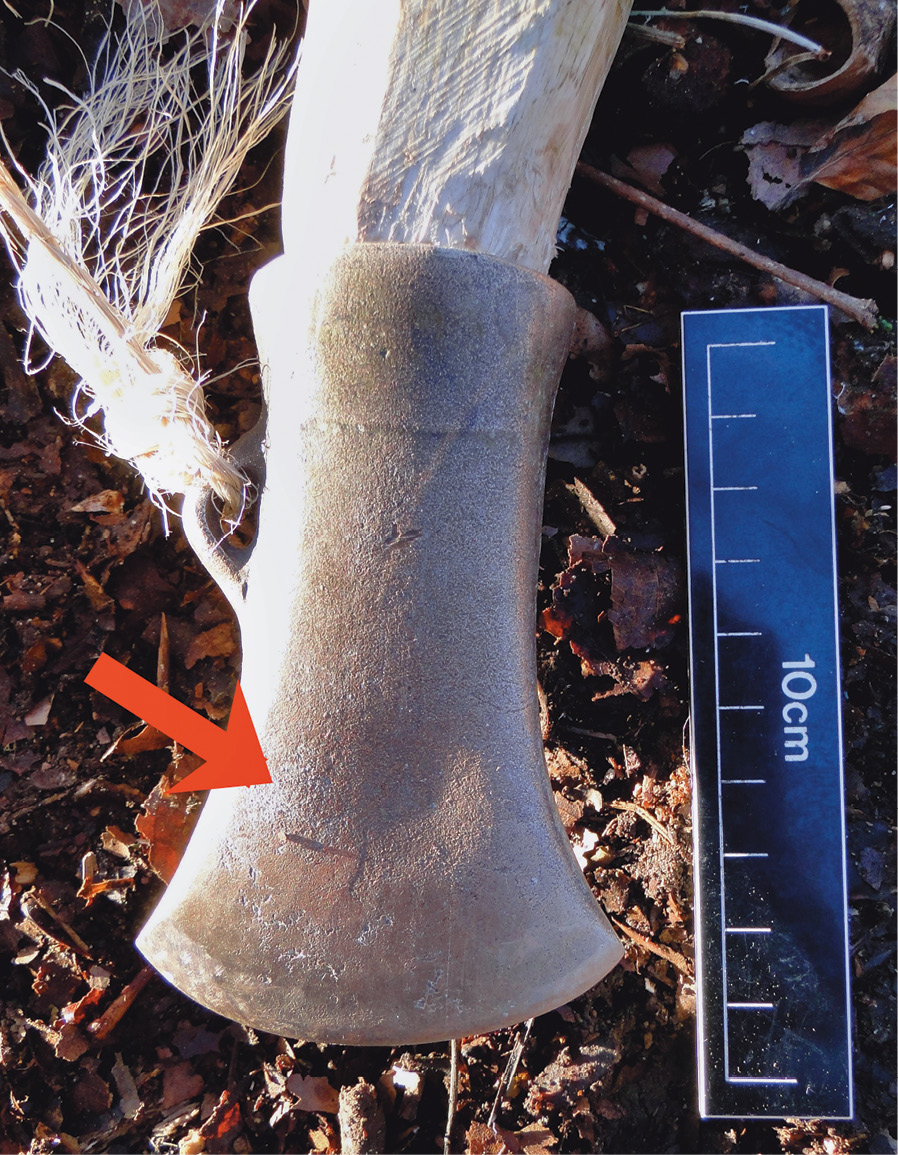
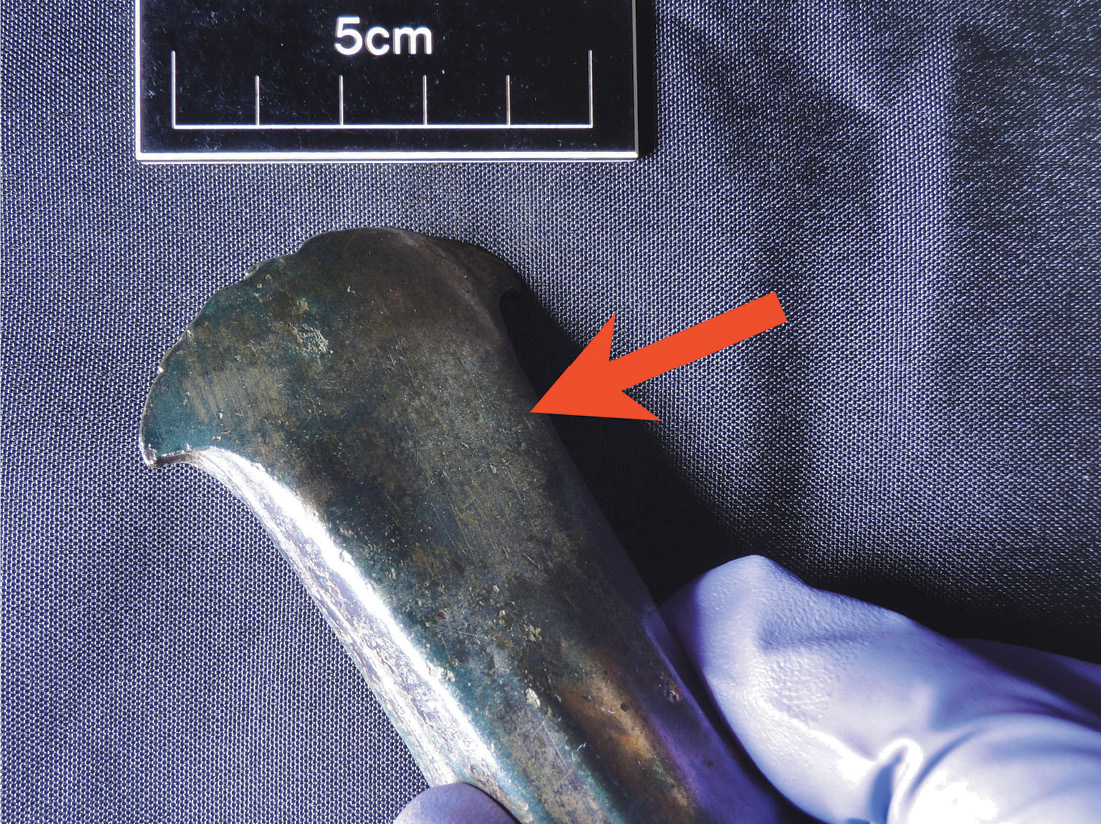
Damage on archaeological axes, such as dents and chips, has previously been interpreted as either use-related or intentional deformation. On the very first day of my experiment, though, I produced a dent that challenged previous assumptions about deliberate damage. Within the first 2 hours 10 minutes (after 3,534 strikes), a large, sub-circular dent appeared on one face of the axehead. Curiously this type of deformation has been recorded on many Late Bronze Age axeheads, and this modern equivalent suggests that such marks could result from side impacts from the felling and cross-cutting of timber rather than purposeful damage.
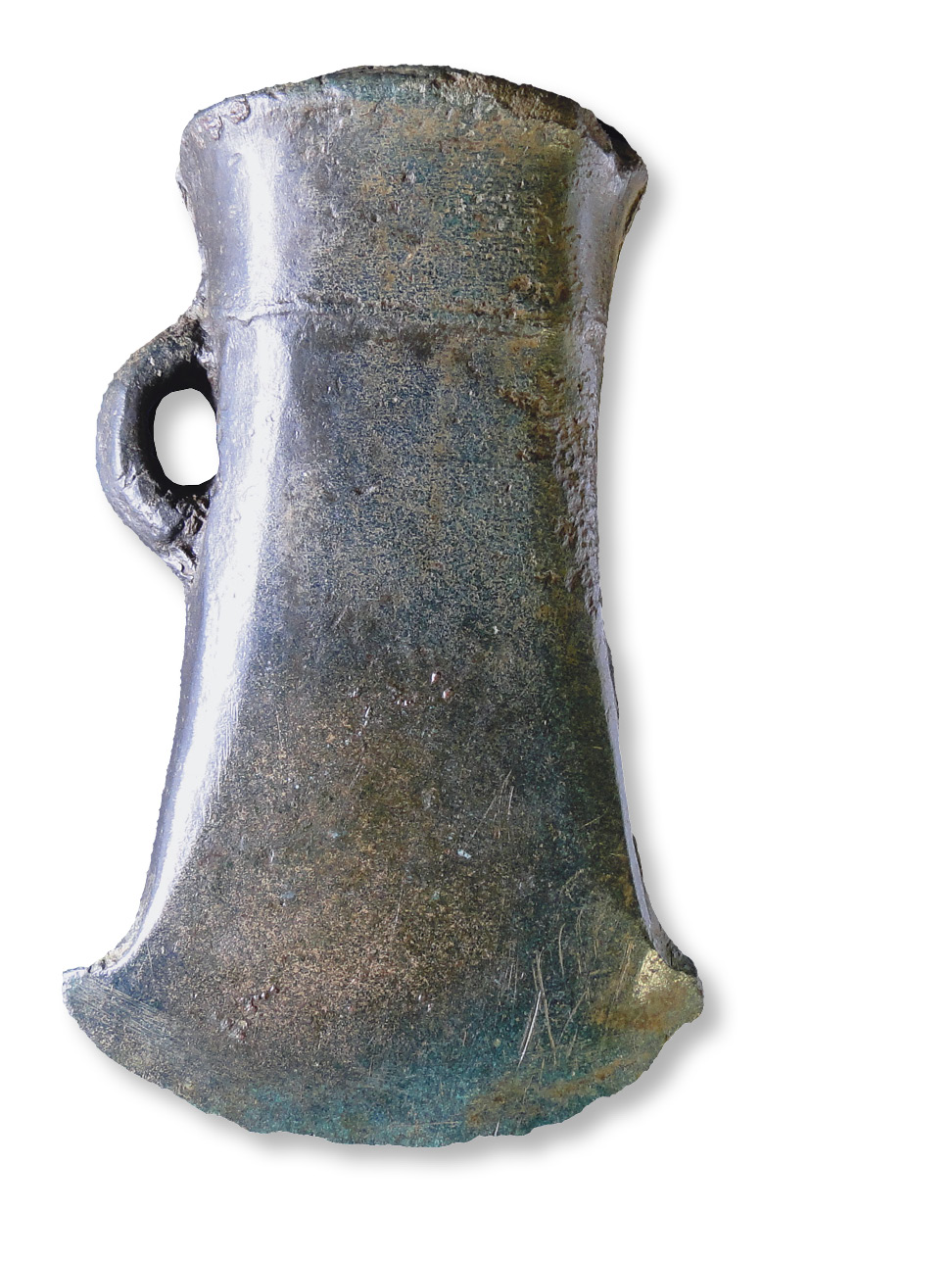
Assessing damage to ancient axeheads in the context of ‘use-intensity’, meanwhile, poses questions about the timeframe over which deformation occurred, how it developed, and in what sequence. For example, one of the other axeheads from the Kalemouth Hoard has a heavily chipped blade edge. If it had been used for tree-felling and -processing, how long might these chips persist throughout an object’s life? My experiment has revealed in detail how a single chip might occur, from its beginnings as a micro-fracture (after 2 hours 39 minutes, or 4,048 strikes) to a large chip which, after hundreds of successive phases of sharpening and usage across eight days, dramatically diminished over the course of 15 hours 3 minutes (28,293 strikes). By the end of the experiment, it had essentially disappeared. This raises important questions about the frequency at which Bronze Age axe-users were sharpening their tools in relation to the amount of timber-working they may have been doing, and the cultural practices of contemporary axe-use.
In all, I coppiced 22 individual hazel stools with the replica axehead, producing a range of structural timbers and firewood, with smaller numbers of stakes and withies, totalling 3,045kg (6,713lbs) in weight. The axehead itself had undergone 19 hours 31 minutes of work, completing 43,836 strikes, and over the course of this it lost 0.7g of bronze from its original weight of 251g (0.6lb), shrinking by 1mm at its maximum length. Interestingly, I saw minimal asymmetry developing to the blade edge, or rounding of the tip, something that has previously been identified as marker for greater use-intensity. Chips to the blade-edge were equally distributed to the lower and upper areas, with little damage to the mid-section, while I observed light striations emanating from the blade edge (from wood-processing) as well as occasional deeper, wavy ones (from rare ground strikes). There was some discoloration to the body of the axe’s upper surfaces, too, possibly in part due to tannic acid from the wood.
As for the impact of this work on the oak hafts, two broke over the course of the experiment, while a third snapped in half but remained usable as a shorter-handled axe. Serendipitously, this revealed that using two lengths of haft was beneficial for this type of work, with the long-hafted axe being well suited to felling and cross-cutting, and the shorter one being superior for sharpening stakes and trimming flexible, suspended branches and working material in more confined spaces. Indeed, we have circumstantial evidence from the Bronze Age settlement at Must Farm, Cambridgeshire (CA 312 and CA 319), that axes may have been used as pairs.

Versatile tools
An object’s biography can be complex and does not necessarily conform to a clear-cut narrative. An axehead could have a long, intensive life as a tool for processing timber, as an occasional weapon, as a splitting wedge, or even as a door stop, before finally being removed from circulation through burial or melting down. Axes can be used intensively for short periods or sporadically over one or many human lifetimes. There are far too many unknowns to be certain of the full biography of any axehead, as the overlapping use-wear traces form complex palimpsests. We can, however, identify specific processes and events that an axehead has experienced. My experiment offers insights into some of these, and will – I hope – provoke imaginings about whether an axe might last a season of work, a human lifetime, or multiple generations, and how it might fit into the rhythms of Bronze Age life. There are so many questions about how axes served the needs of Bronze Age society. How many axes were needed to harvest the material to build a roundhouse? How many tasks would have involved an axe at some stage? Was the axe, in fact, the multitool of its day?
• M G Andrews (2021) Modelling Tribological Processes to Examine the Lives of Bronze Age Palstave Axes (PhD thesis, University of Southampton).
• A Dolfini et al. (2023) ‘Testing the efficiency of Bronze Age axes: an interdisciplinary experiment’, Journal of Archaeological Science 152 (105741), https://doi.org/10.1016/j.jas.2023.105741.
• S Moyler (2007) Life on the Cutting Edge: interpreting patterns of wear on Scottish Early Bronze Age axes (PhD thesis, University of Southampton).
• B Roberts and B Ottaway (2003) ‘The use and significance of socketed axes during the Late Bronze Age’, European Journal of Archaeology 6(2): 119-140.
All images: Hamish Darrah, unless otherwise stated