

Subscribe now for full access and no adverts
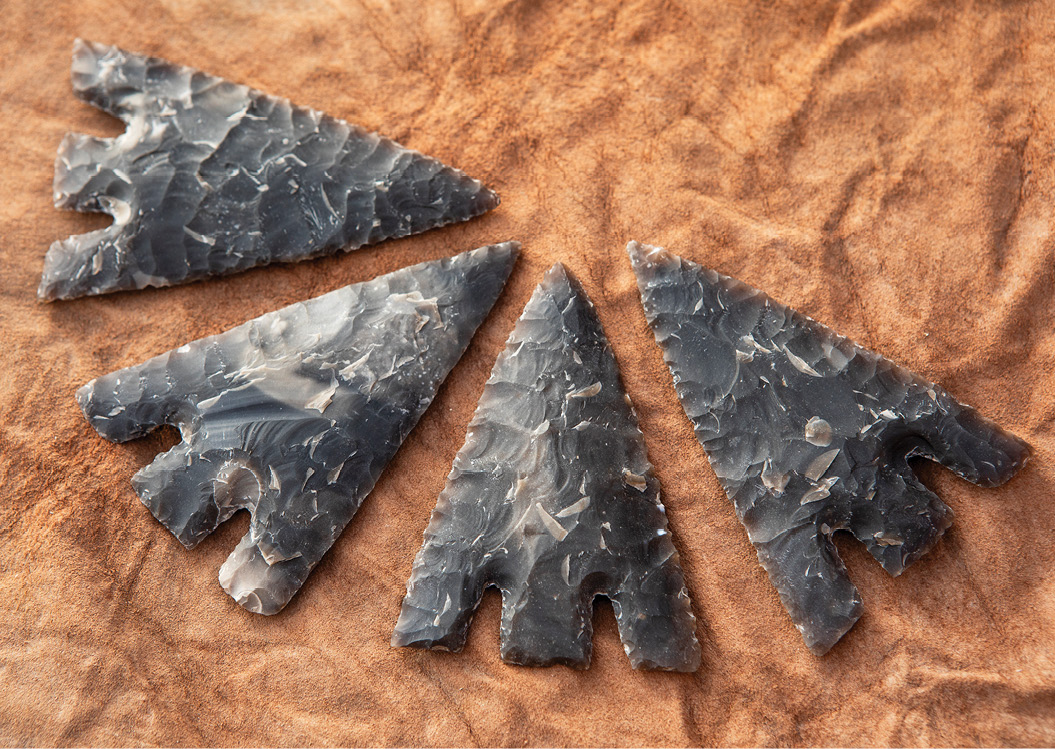
Whether following signs to a destination or moving the cursor on a computer, we encounter arrowheads throughout our daily life. The symbol is so familiar that it is surprising to learn that it has only been used to indicate direction for the last few hundred years. Its unmistakable outline – a design that we know in the UK as ‘barbed and tanged’ – has much earlier origins, however. The central stem directly below the projectile’s point, where the arrow shaft is attached, is known as the tang, while the two projections either side are the barbs. Such arrowheads appeared in Britain and continental Europe c.4,500 years ago, as one of the last types to be made in stone while the earliest metal objects and distinctive pots called beakers were beginning to circulate.
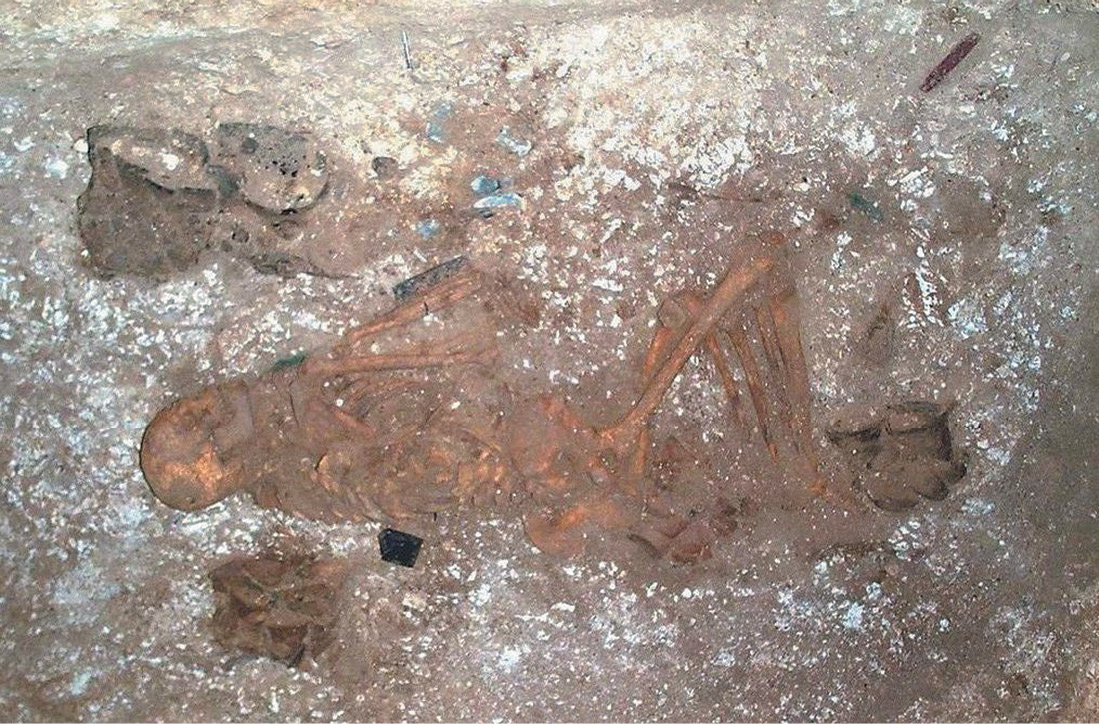
While metal items were hugely valued, archaeological evidence indicates that stone archery equipment remained an important sign of status in the early Bronze Age. One of the wealthiest graves from this period is that of the Amesbury Archer, a 35- to 45-year-old man whose burial was excavated by Wessex Archaeology around 5km (3 miles) from Stonehenge in 2002 (see CA 184, CA 251, and CA 265). This individual had travelled from the Continent c.2300 BC, and alongside generous grave goods including beakers, copper knives, and gold hair ornaments, he had been laid to rest with stone archers’ wristguards and 17 finely made barbed and tanged arrowheads. A year later, just 500m (0.3 miles) to the north, Wessex Archaeology encountered a broadly contemporary mass grave of seven individuals who had been buried with a record number of beaker vessels, as well as a number of similar projectiles that led to them being dubbed the ‘Boscombe Bowmen’ (CA 193).
Hundreds of arrowheads like these have been found across the UK. What were they for? From their frequency we might imagine that hunting was a common pursuit, but surviving animal remains speak of communities of pastoralists who kept cattle, pigs, and some sheep, consuming wild prey much more rarely. Perhaps the arrowheads placed in graves held a greater symbolic value. Martial prowess almost certainly played a role, and we know that at least some were fired in anger, as examples have been found still embedded in the bones of their victims – for example, a man who had been shot at close range with multiple arrows before being buried in a ditch at Stonehenge (CA 128 and CA 420). The ability to protect valuable livestock would also have been important to early Bronze Age people. The demand for finely made flint tools quickly dropped away, however, as copper was replaced by the harder alloy bronze, allowing the creation of longer knives/daggers and eventually swords and elongated spearheads as a new way to show status.
Caught knapping
Today, barbed and tanged arrowheads have gained one more symbolic meaning: recognising archaeological achievement. Each of the Current Archaeology Awards presented to people, projects, and publications at the recent CA Live! conference (see here) was topped with a scaled-up barbed and tanged arrowhead – and CA has invited me to describe how they were made.
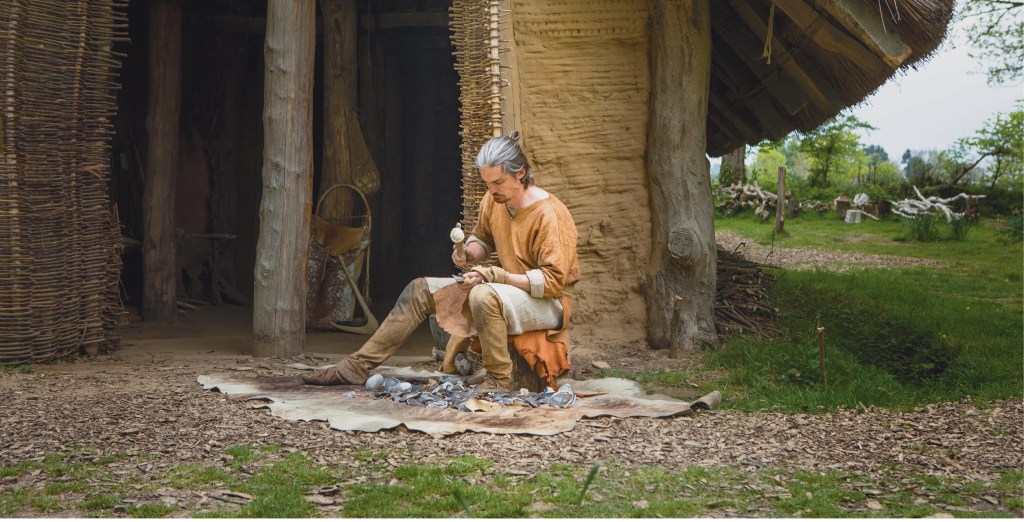
I have been flint-knapping since I was around 10 years old. Originally from Hertfordshire, I have long been familiar with flint and chalk, and after seeing John Lord, the grandfather of modern flint-knapping, expertly flake a flint axe (seemingly in a matter of moments) on television inspired me to try it for myself. Unsurprisingly, I found it very difficult – but I was fortunate to have easy access to more flint from nearby fields, and I kept practising after school and college. When I was 16, my non-archaeologist parents helped me to make a website, http://www.ancientcraft.co.uk, to show off my hobby. This sparked enquiries from museums and universities seeking demonstrations and replica tools. The hobby grew into a business and, on completing a PhD in Archaeology from the University of Southampton, a full-time job that has seen my work displayed at Stonehenge, the British Museum, and many other museums.

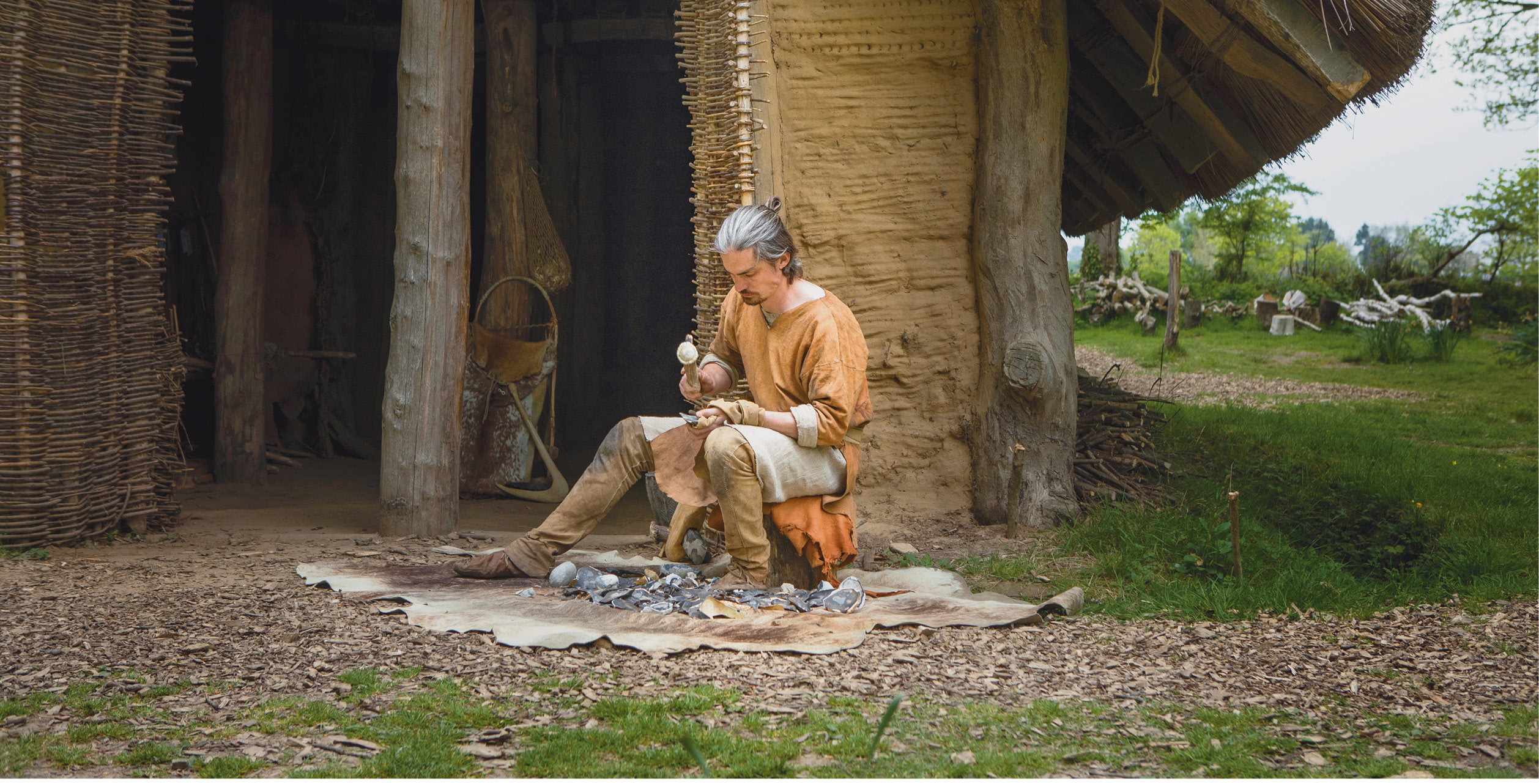
I was honoured to be asked to make the giant barbed and tanged arrowheads that feature on the CA Awards. I have made many normal-sized arrowheads in the past; these are around four times larger, but the technique is the same. I start by preparing a carefully selected flint flake. It has to be good-quality material, and I am lucky to have a small quantity of flint from Grimes Graves, a Neolithic mining complex in Norfolk (CA 327), left over from filming knapping sequences for the site visitor centre. The flake must have a flat area of around 10cm by 10cm (3.9in by 3.9in), and I use an antler hammer to thin it to around 1-2cm (0.4-0.8in), after which it needs shaping and thinning further through pressure-flaking. This involves a pointed antler or copper tool, which is pressed into the edge of the flint using the strength of my leg and abdomen muscles. It is more familiar to do this action using wrist and forearm power, but this can lead to injury. There is far greater muscle mass in our torso and legs which, with correct posture, can be harnessed to push off small flakes. In this way, I create a flint triangle, before I change my pointed pressure-flaker for one with a flattened end, which is used to form the notches that separate barbs from tang. This is the most challenging stage, fraught with the risk of accidentally snapping off a barb. With a normal-sized arrowhead, the whole process takes around 20-30 minutes; the giant versions took 40-50 minutes each.
Interestingly, while there are many examples of barbed and tanged arrow-heads in the archaeological record, very few flint-knapping tools like pressure-knappers have been identified. If we look to another type of early Bronze Age grave good, though, we might find them. Small, pointed, copper-alloy implements have been found in a number of graves. They have been interpreted as awls, tools for making holes in leather, but they look very similar to pressure-flakers – some even have a flatted tip.
It was very enjoyable making the unusual arrowheads for the Awards, thinking about the amazing projects and people they might be given to. I hope I will get the chance to see them with their new owners in the future.