Surveying Falerii Novi: Rethinking the development of a Roman town

Surveying an ancient town in Italy has presented fresh insights into a key moment for Roman urbanism. Matthew Symonds spoke to Martin Millett about what can be learnt from studying an entire townscape.
Start
This article is from World Archaeology issue 136


Subscribe now for full access and no adverts

The traditional story of the foundation of Falerii Novi is a dramatic one. This town lies in the Tiber valley, about 44km north of Rome, within the former territory of the Faliscans. Today, this group has been largely eclipsed in popular perceptions of Rome’s rise by their more famous neighbours, the Etruscans. Both groups, though, found themselves at the sharp end of Rome’s ambitions, as the burgeoning power in central Italy began to expand northwards. Conflict between the Faliscans and Rome is recorded as early as 438 BC, with intermittent fighting continuing until 351 BC, when a peace treaty was agreed. The relationship between the two groups soured again during the First Punic War, with the surviving summary of Cassius Dio’s Roman History recording a grave episode in 241 BC. Roman forces under the command of Manlius Torquatus are described ravaging Faliscan territory and fighting two battles. The second clash proved decisive, allowing Rome to seize ‘their arms, their cavalry, their goods, their slaves, and half their country’. An even worse fate befell the ‘original city’ of the Faliscans: ancient Falerii Veteres and modern Civita Castellana. The epitome of Dio’s text tells us that this, ‘which was set upon a steep mountain, was torn down and another one was built, easy of access.’ This new town was Falerii Novi.

A satellite image showing the site of Falerii Novi. A line of trees marks the location of the town walls, while the site of the amphitheatre can be made out towards the top right of the image. A town was first founded here after 241 BC, and it survived as an urban centre into late antiquity. Today it is mostly a greenfield site, with a medieval church presenting the most substantial structure standing within the former urban space. Image: Google Earth

It was long believed that this incident offers an example of Roman imperialism at its most brutal. Rather than suffer the Faliscans continuing to inhabit an easily defensible hilltop settlement, the population was forcibly relocated to a new home 6km away, which was positioned to ensure that Roman forces could take it with ease in the event of any further trouble. Sure enough, Falerii Novi is perched on a gentle plateau of volcanic tuff, beside both a key road, the via Amerina, and a stream, the rio del Purgatorio. This connection to the road network can be contrasted with the state of affairs at Falerii Veteres, which was bypassed by the via Flamina in 220 BC, fitting with the narrative that the site had been destroyed. What appeared to be a disaster for the Faliscans, though, also presents an opportunity for archaeologists seeking to understand the development of Roman urbanism. After all, the imposition of a new town should allow an insight into what were viewed as the essential elements of the urban fabric during this era. As is well known, towns later proved crucial to the success of the Roman Empire, providing an effective means of administering conquered territory. So successful was this model, that it went on to have a major influence on the development of Western urbanism more generally. While the Roman approach borrowed heavily from Hellenistic influences, its particular style seemingly developed in Italy, during the age of the Republic. More specifically, scholars believe that the 4th and 3rd centuries BC present the pivotal period.

Key roads and sites – including both Falerii Veteres and Falerii Novi – in the vicinity of Rome. Image: Tiber Valley Towns Project, Sophie Hay

Attempts to understand the processes in play during this crucial era have been hampered by limited knowledge of the contemporary nature of urban centres. This situation is in part because many of the towns in question went on to prosper in the imperial period and beyond. It is clear enough, for example, that urban life at Falerii Novi survived into late antiquity, leaving its earliest layers buried beneath the remains of centuries of urban development. Even more challengingly, the scale of Roman cities means that excavation can only provide snapshots of their original form. Previous digging at Falerii Novi has examined elements including its theatre and part of an insula, but even such comparatively large-scale endeavours cannot hope to offer a sense of an entire townscape. Geophysical survey, by contrast, enables a much more expansive look at what lies beneath the soil. Even so, large- scale surveys typically produce a single plan superimposing those structures that lie closest to the surface, making it challenging to identify the earliest phases of towns. Effective survey also requires large open spaces where readings can be taken. In this regard, Falerii Novi certainly presents a tempting target. Apart from a medieval church, the site is largely unencumbered by later buildings, with much of the town lying beneath an inviting patchwork of fields. This potential did not pass unnoticed.

Surveying the city

‘I was in Italy for a conference during the early 1990s’, remembers Martin Millett, Emeritus Laurence Professor of Classical Archaeology at the University of Cambridge and project director. ‘While there, I visited an old friend of mine, Helen Patterson, who lived near Siena. We were basically just travelling around looking at sites, and someone recommended Falerii. I remember walking on to it, and thinking, “if you’re going to do a survey, this would be a great place to get”. This was at about the same time that Mark Noel, who was at Durham University where I was then teaching, had just done the first big archaeological geophysics survey, which was at Lanchester, in Britain. That sparked the idea.’

The results of the magnetometry survey conducted in 1997-1998 (above), compared to a slice through Falerii Novi at a depth of c.0.75-0.8m, achieved using GPR (below). Images: Lieven Verdonck; aerial photograph: Google Earth

‘In 1997, we started doing magnetometry survey at Falerii Novi. That was the technique Mark used at Lanchester, and we wanted to see whether it worked in Italy. We had a small amount of money from Durham University, which enabled us to show that it did work. Thanks to that, we were able to get more funding from what was then the Humanities Research Board – and is now the Arts and Humanities Research Council (AHRC) – to examine a series of urban sites in Italy, alongside my colleague Simon Keay, who was at Southampton University. We successfully did that; then, about 15 years ago, I was talking with Frank Vermeulen and Lieven Verdonck, and it seemed that advances in Ground-Penetrating Radar (GPR) meant that it had perhaps reached the stage where we could do surveys on the same scale as magnetometry. Previously, people had been using GPR on 30m squares and so forth, but no one had really attempted it on a huge scale. We put together an AHRC bid to look at Falerii Novi and another ancient town in Italy: Interamna Lirenas, which my colleague Alessandro Launaro has been working on.’

 A comparison between (a) the GPR results and (b) magnetometer results from the theatre and its environs. Image: Lieven Verdonck

‘The essential pitch was that with magnetometry you can only see two dimensions, but with GPR, you get three of them. This means that you can distinguish buried features by depth, which is important if you are seeking the earliest phases of a town. Lieven, who was the key person working on this, was at the stage where he’d designed the kit and needed a site to use it on. Paradoxically, Frank, who had got the money to design the kit for Lieven, was working over in the Marche region of Italy. They tried it there, and it didn’t work, because the soils weren’t right; so the kit was there, the person was there, and it was just a case of finding the right site. And that’s what led to the work at Falerii.’

The original street-grid at Falerii Novi is shown in pink, with the increased urban area probably laid out in the 1st century BC coloured blue. Image:Alessandro Launaro

Falerii undergound

After a pilot GPR survey at Falerii Novi in 2014, full coverage of the available area within the city walls followed from 2015 to 2017, as part of the AHRC-funded ‘Beneath the surface of Roman Republican cities’ project. The results have fascinating implications for our understanding of the religious, political, social, and economic factors in play at a critical time for both the Faliscans and Rome. They also showcase the potential of GPR both to shed light on the development of ancient towns, and to refine the knowledge secured from survey work employing different methods.

‘As with all of these things, there are some real high points and there are some relatively low ones’, says Martin. ‘When you compare the magnetometry with the GPR, it should be remembered that the magnetometry – through luck rather than judgement – had produced one of the clearest pieces of large-scale magnetometry that I’ve ever been involved with. It allowed us to see the street grid, the main public monuments, a large number of houses, and so forth. That enabled us to hypothesise a development, which we were then able to test and refine with the GPR results. One of the ways that the GPR is valuable is in terms of its resolution. With magnetometry, you’re effectively collecting data every 50cm and interpolating between. The way that Lieven has developed the GPR means that the resolution is mostly either 12.5cm or 6.25cm between readings. The depth is also going down to something like 2m, so that means you can see something a bit larger than a dinner plate under 2m of soil.’

The plan of the forum, as revealed by GPR slices at depths of (a) 0.45-0.5m, (b) 0.75-0.8m, (c) 1.05-1.10m, and (d) 0.5-0.95m. Image: Lieven Verdonck.

‘There are some areas where the magnetometry didn’t pick up anything, which we now know contained buildings. Just inside the north gate, for example, there is some sort of monumental portico, which doesn’t show up in the magnetometry. In other cases, there were buildings that were visible but didn’t respond well, like the theatre. On the GPR, you can see its structure clearly enough to reconstruct it. So that’s a real strength. The weakness is that, for reasons that are not entirely clear, certain types of stone either don’t show up, or don’t always show up. This is a particular problem with some of the local volcanic stone used at the site. The current excavations that the Institute of Classical Studies, the British School at Rome, Toronto, and Harvard are doing at Falerii Novi have revealed major structures that don’t show up on the GPR either. I think this is the lesson of all geoscience: the more techniques you apply, the more likely you are to get things out in any detail. And the GPR still gives us an unprecedented view of the whole town, you just have to bear in mind that you can’t use the results to say that there’s nothing in a certain place; you have to argue from the positive rather than the negative.’

A monumental nymphaeum, complete with portico, may have been added to the townscape as an act of munificence by the emperor Gallienus. Here we see the results of the GPR at depths of (a) 0.55-0.6m, (b) 0.8-0.85m, (c) 1-1.05m, and (d) 0.45-0.9m. Image: Lieven Verdonck

Biography of a town

Bringing together the results of the surveys with the evidence from excavations and epigraphy allows a biography for Falerii Novi to be sketched out. While it seems natural enough to start with the foundation of the town after 241 BC, it is worth considering the likely nature of earlier activity at the site. Rural settlement seems to have been widespread in Faliscan territory, while the via Amerina appears to have formalised a much earlier route running through the region. It is plausible, then, that the plateau was already home to rural settlement before the town was built. Another tantalising prospect concerns the eventual site of the town capitolium: the temple to Jupiter, Juno, and Minerva that typically lay at the heart of Roman urban life. It has been noted that the example at Falerii Novi occupies a prominent hill that would have been well suited to an earlier Faliscan sanctuary. If so, it could be seen as a case of pre-existing religious space being symbolically incorporated within the settlement. Why the Romans would trouble to show such respect for earlier activity against the backdrop of forcing a vanquished foe into an indefensible new settlement is a different question. There are numerous signs, though, that the true intention outlined by the summary of Dio deviates from the traditional reading of it.

Ever since the magnetometry survey, it has been appreciated that the key elements of the town developed in phases. The original, regular street grid, for example, was later extended to the south, while the addition of town walls also occurred after the initial foundation. Examining the original four rows of insulae demonstrates that the street grid was laid out around the junction between the main east–west street and the via Amerina, emphasising the key importance of that road. The forum lay directly to the east of this intersection. Given the care with which the highway was incorporated into the settlement, is it possible that the importance of a site that was ‘easy of access’ – as the summary of Dio puts it – lay more in establishing improved communications than crushing a military threat? This would fit with the provision of town walls at Falerii Novi during the Republican period, which seems a curious choice if the aim was to keep the site as indefensible as possible. That the Faliscans had some say in the arrangements at their new centre is also indicated by the existence of a sacred way connecting Falerii Novi to Falerii Veteres. Work there has revealed that, contrary to the total destruction of Veteres implied by the literature, some religious sanctuaries remained in use.

The remains of the amphitheatre at Falerii Novi, after it was cleared in 2001. Image: Martin Millett

All of this brings greater nuance to our understanding of the relationship between Rome and the Faliscans following 241 BC. Perhaps that episode of fighting brought about the defeat of an anti-Roman faction in their elite, opening the way for more cordial relations with pro-Roman members of Faliscan society. If so, it was more an alliance than imperial brutality that was set in stone at Falerii Novi. Support for this view comes from the seemingly gradual increase of buildings in the city blocks, rather than the sudden influx of structures that would be needed to cater for a displaced population. On the strength of the GPR results, public buildings in the early town were restricted to a forum and religious buildings. There are growing signs that this slots neatly into a broader pattern in Roman Republican urbanism, with the temples often being the first elements to be monumentalised. The later expansion of the town street-grid can only be broadly dated, with the biggest clue coming from the 1st-century AD theatre overlying it. As such, a date in the 1st century BC for the increase in the urban area seems likely, emphasising that Falerii Novi remained a relatively small and unprepossessing town for much of the Republican period.

A more impressive range of public buildings was established in the town from the 1st century BC through to the 1st century AD, at the time when the Republic was transforming into the Empire. The forum seems to have reached its developed form during this period, while public baths were added too, and a compelling case can be made for a market, aqueduct, and extramural amphitheatre being constructed during this phase. Study of the surviving inscriptions shows that powerful local families played an important role in bankrolling civic architecture during the era of the emperor Augustus. In some ways, this arrangement mirrors events in Rome, where the imperial household enthusiastically embraced the role of urban benefactors.

Elite munificence slowed dramatically at Falerii Novi from the 2nd to 4th century AD, when only a handful of new public buildings were added, including another market and public baths, as well as a particularly impressive nymphaeum. It is possible that the town had an imperial connection to thank for the third of these monuments, as the emperor Gallienus (r. 253-268) made a play of his links to Falerii Novi. We can see from the surviving inscriptions that his mother’s family had been active members of its civic scene since at least the turn of the 1st centuries BC and AD, and it is possible that Gallienus himself was born there. Other than the grandiose nymphaeum, though, the picture seems to be of a town that maintained rather than significantly enhanced its prosperity during these centuries.

The picture from the geophysical surveys is less clear during late antiquity. A bishopric is known to have existed at Falerii Novi in AD 465, while current excavations suggest a long sequence of activity during this era. A curious feature of the GPR survey is that the area within the town walls appears to have been divided up into separate zones during the later phases of occupation, perhaps hinting that these urban segments came under the control of different powerful families. One potentially intriguing omission from the results is the absence of evidence for early churches at the site. Perhaps this was simply because pre-existing structures were adapted for use as places of worship, but it is worth noting that there is also a shortage of early Christian inscriptions from the site.

A plan of Falerii Novi, showing the interpretation of the features revealed in the surveys.  Image: Alessandro Launaro 
 A map of Falerii Novi, providing an estimate of population density per city block. Image: Alessandro Launaro.

Local places

Comparing these results with those from recent investigations of other Republican-era towns in central Italy, including Ocriculum, Forum Novum, and Interamna Lirenas, permits the development of Falerii Novi to be put into its local context. In particular, it allows us to ask whether these Republican centres were effectively generic sites that display the same essential characteristics – an accusation that is sometimes levelled at imperial-era towns.

‘Not at all’, says Martin. ‘Virtually all of the early sites – and indeed later towns – developed their own characteristics. At one level, Falerii looks like a classic – it has the regular street-grid that is often associated with Roman towns, whereas just down the road at Ocriculum, there’s no sign of a formal layout in this style. Instead, the arrangement of the settlement was topographically determined by the slopes and vistas. The new foundation at Forum Novum had a range of public buildings, but little in the way of a resident population, suggesting that the people it served largely lived in the countryside. Interamna Lirenas is also different in an interesting way, as there is very, very strong evidence for it being a significant local trading centre. That sort of economic activity seems to be less obvious at Falerii Novi. All told, then, Falerii Novi is unusual for the region, as it is the only one of these towns with a grid system, substantial defences, and a sizable resident population.’

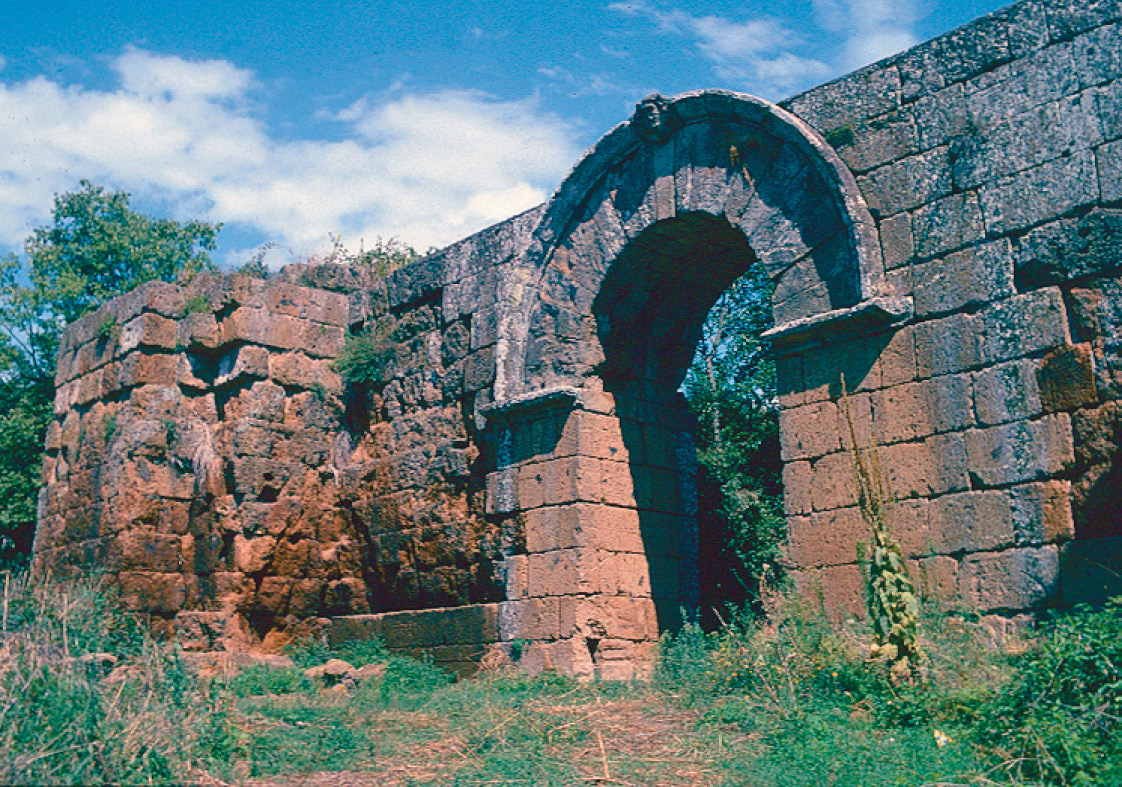
 Falerii Novi was equipped with an impressive set of defences during the Republican era, with the gateway known as the Porta di Giove seen here. Image: Martin Millett

‘I think that this variety reflects the responses of the people already living in these regions, who were being incorporated by Rome into new power structures. There were really two fundamental choices at that time: you can either rebel, in which case you don’t survive to show up in the archaeological evidence, or you can collaborate. That’s what we’re almost certainly seeing at Falerii Novi, when the new town was founded after the people who were in charge when the Faliscans rebelled were presumably no longer around. Instead, the faction who worked on the new town were responding to particular local circumstances – such as the existence of sanctuaries at Falerii Veteres – while also picking up on cultural ideas that were coming from Rome and the rest of the Mediterranean. In this way, they became a part of the competitive urban game of building and saying “I’m more Hellenistic than you are”.’


Further information:
• M Millett, A Launaro, L Verdonck, and F Vermeulen (2025) Falerii Novi: The Ground-Penetrating Radar Survey of the Roman Town (Cambridge: McDonald Institute Monographs).
• This open-access report is available here: http://www.repository.cam.ac.uk/collections/01e23c71-5c83-4e2c-a9eb-24718391f1b4.

By Country

Popular
UKItalyGreeceEgyptTurkeyFrance

Africa
BotswanaEgyptEthiopiaGhanaKenyaLibyaMadagascarMaliMoroccoNamibiaSomaliaSouth AfricaSudanTanzaniaTunisiaZimbabwe

Asia
IranIraqIsraelJapanJavaJordanKazakhstanKodiak IslandKoreaKyrgyzstan
LaosLebanonMalaysiaMongoliaOmanPakistanQatarRussiaPapua New GuineaSaudi ArabiaSingaporeSouth KoreaSumatraSyriaThailandTurkmenistanUAEUzbekistanVanuatuVietnamYemen

Australasia
AustraliaFijiMicronesiaPolynesiaTasmania

Europe
AlbaniaAndorraAustriaBulgariaCroatiaCyprusCzech RepublicDenmarkEnglandEstoniaFinlandFranceGermanyGibraltarGreeceHollandHungaryIcelandIrelandItalyMaltaNorwayPolandPortugalRomaniaScotlandSerbiaSlovakiaSloveniaSpainSwedenSwitzerlandTurkeySicilyUK

South America
ArgentinaBelizeBrazilChileColombiaEaster IslandMexicoPeru

North America
CanadaCaribbeanCarriacouDominican RepublicGreenlandGuatemalaHondurasUSA

Discover more from The Past

Subscribe now to keep reading and get access to the full archive.

Continue reading