Subscribe now for full access and no adverts
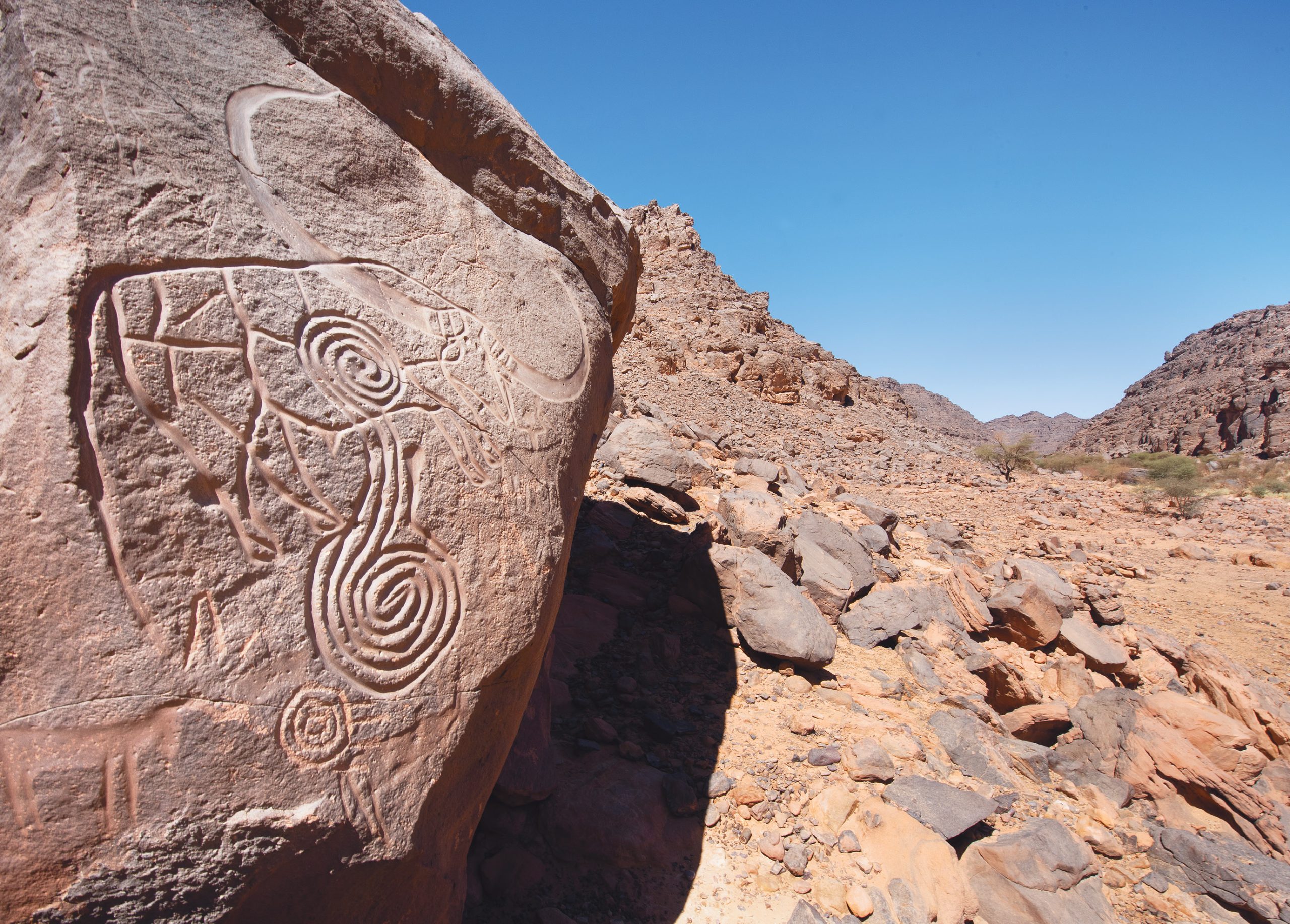
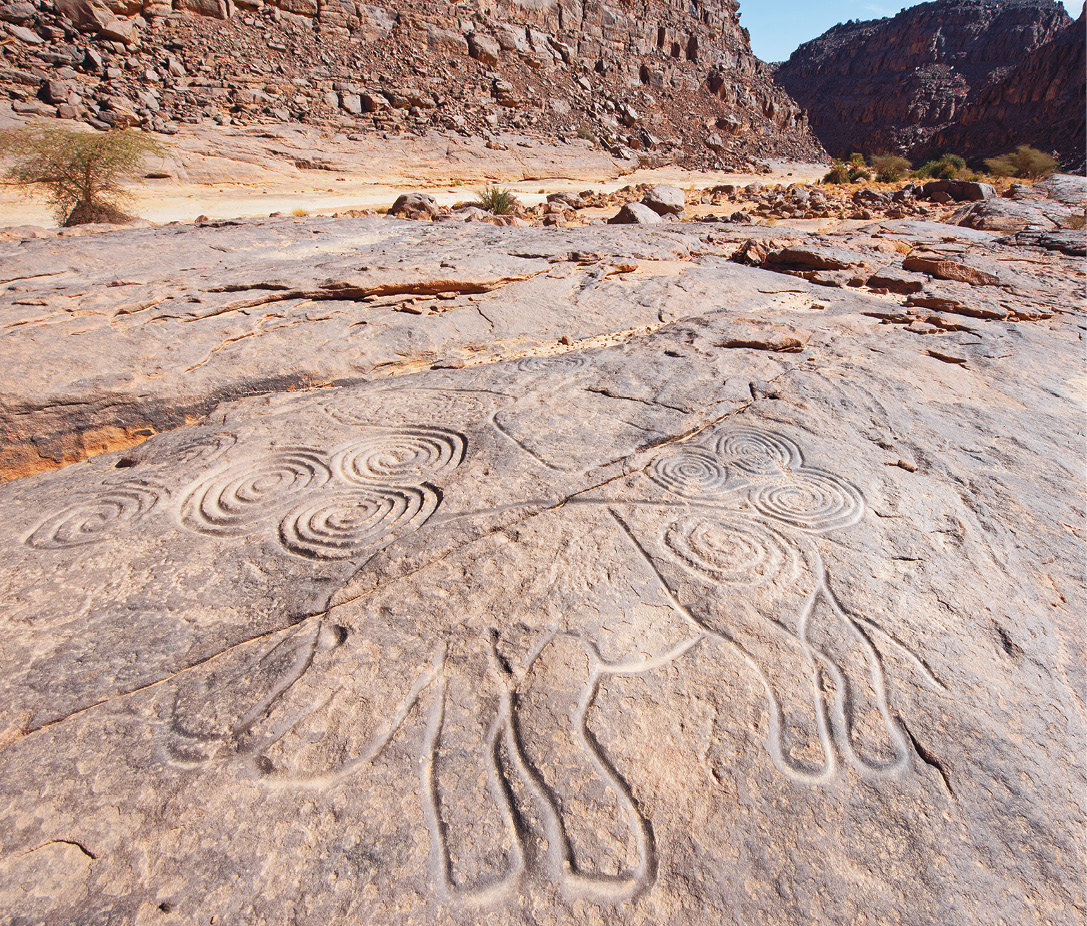
The Sahara has a surface of 9.2 million km², making it the largest hot desert in the world. About 20% of the Sahara is covered by sand, and 70% by stone plateaux and mountains that could in principle be sites for rock art. In contrast to Central Asia and Arabia, where rock carvings predominate and paintings appear relatively rarely, in the Sahara the proportions are reversed. Pictographs are widely spread, but petroglyphs are mainly concentrated in a couple of sandstone regions of the central Sahara. One of them is Wadi Djerat in the Tassili n’Ajjer, in today’s south-eastern Algeria. It is one of the world’s most extraordinary petroglyph sites, for in this deep, narrow valley – c.70 to 250m wide and in total more than 50km long – a rich variety of petroglyphs as well as paintings are found spread over a walking distance of some 35km.

Documenting Djerat
Research in Wadi Djerat is closely associated with the French explorer Henri Lhote (1903-1991), who was a pupil of the famous rock-art expert Abbé Henri Breuil. Lhote at first wanted to become an army pilot, but an accident ended his career and instead he travelled to North Africa to participate in a programme to fight locusts. In 1933, Lieutenant Charles Brenans of the French Camel Corps had rediscovered the petroglyphs of Wadi Djerat by chance during a patrol. One year later, Lhote undertook the first of several explorations of the Wadi. Starting at the oasis of Nafeg Supérieur, where the southernmost petroglyphs are recorded as Lhote’s site 1, the rock-art locations follow the flow of the seasonal river northwards as far as site L 75, where the wadi opens out into the vast desert. Today, more than 80 sites are recorded, totalling some 4,500 engravings. The petroglyphs were mostly incised on flat or gently sloping rock panels and blocks that had fallen from the cliffs or, more rarely, on vertical surfaces.
In March 2023, the present author, together with the rock-art expert Andras Zboray, the artist Therese Weber, three Tuaregs, and five camels, explored the wadi. Scouting the petroglyphs, one is struck by two observations: whereas one spontaneously associates camels with the Sahara, in Wadi Djerat there are very few engravings of dromedaries, which appear mainly in paintings of a comparatively late date. In petroglyphs, wild animals abound, above all the Bubalus antiquus (Syncerus antiquus) – which is an extinct species of buffalo characterised by powerful, curved horns – followed by rhinoceros, elephants, hippopotami, giraffes, fish, and crocodiles. None of these animals could survive in today’s prevailing climate. Indeed, the Sahara has had an eventful history in this regard, with its fauna thriving and disappearing to the rhythm of such climatic pulsation. The same observation applies to the human populations and their economies, which adapted to varying climatic conditions. And, as in Arabia and Central Asia, these changes in fauna and human activity were reflected in rock art.

While the Sahara had been an arid zone for tens of thousands of years, the warmer Bølling–Allerød Interstadial (14,700-12,900 BP) was a climatic game-changer. As the northern ice-sheets melted at the onset of the Holocene and global sea-levels rose, much humidity was released into the atmosphere and the climate of North Africa became moister. This development initiated the African Humid Period, which lasted until about 3500 BC. During this phase, the landscape of the Sahara featured rivers and lakes, while a mix of grass savannah, steppe, and bushes grew. The rapidly improving climatic conditions triggered the return of vegetation, soon followed by herbivores and their predators, which in turn drew hunter-gatherers. Occurring around 6200 BC, an episode known as the global 8.2-kiloyear event set off long-term climatic cooling, which, in the fundamentally fragile ecosystem of the Sahara, led to a shrinkage of lakes, a reduction in vegetation, and a growth in desert surface.

While agriculture never really took root in the Sahara, by around 6300 BC domesticated sheep and goats were spreading westwards from the Nile Delta, followed soon by cattle. It is conceivable that the earliest petroglyphs of bovines in the Tassili n’Ajjer and neighbouring Messak date to this period. The introduction of sheep, goats, and cattle into the Sahara changed its Neolithic economy from one of hunter-gatherers to pastoralism; nevertheless, hunting remained significant. This change represented a successful adaptation to fundamental environmental changes. However, when the African monsoon further retreated and aridification increased during the 3rd millennium BC, cattle pastoralists began to leave the central Sahara. Within centuries, major parts of the Sahara became inhospitable and uninhabited except by frugal semi-nomads practising small-stock husbandry, such as herding goats and sheep. Only oases like those in the Tassili n’Ajjer had enough resources to sustain sizable populations. By around 1000 BC, the climatic conditions of the Sahara were similar to those prevailing today. Soon after, three new technologies were introduced from what is now Egypt and Libya: first the horse and the chariot, and then later the dromedary. Just as images of big herbivores such as Bubalus, elephants, or hippopotami provide dates ante quem – that is, before they disappeared from the increasingly dry environment – so too the appearance of horses and camels in rock art provides reliable dates post quem.
A forbidding habitat
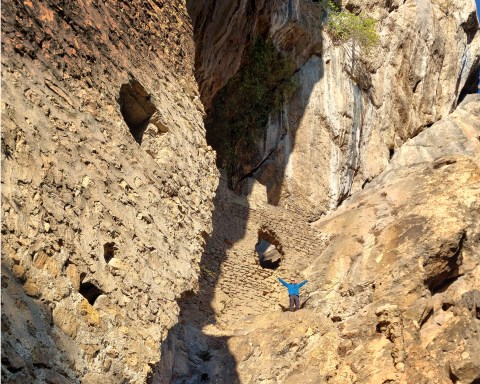
The second major peculiarity of Wadi Djerat is its topographical properties. It is narrow, with the mostly dry riverbed filling a considerable part of it, which limits the available habitat. Furthermore, the high cliffs of the wadi are so steep that only Barbary sheep can climb them. Although there are numerous petroglyphs of tropical megafauna, it is hard to imagine that these large herbivores could find enough food, let alone prosper, in such a confined space. Coexistence between humans and megafauna in such a setting seems even less conceivable. Furthermore, occasional torrential downpours must have caused flash floods that also inundated the narrow terraces flanking the riverbed, preventing a permanent presence by humans and large animals alike. Finally, the wadi could hardly have served as a natural passage on a migratory route, as it comes to a dead end at the base of steep cliffs, with a narrow path leading to the summit that can only be mastered by Barbary sheep, felines, humans, and pack animals like camels and donkeys. The contrast between the abundance of rock art and the relative dearth of archaeological finds confirms the assessment that, thousands of years ago, Wadi Djerat served not as an ordinary habitat for cattle-breeders, but rather as a kind of sanctuary for pastoralists who also practised hunting. In other words, in Wadi Djerat numerous wild animals are figuratively present, even though they would only have sporadically dwelt there.
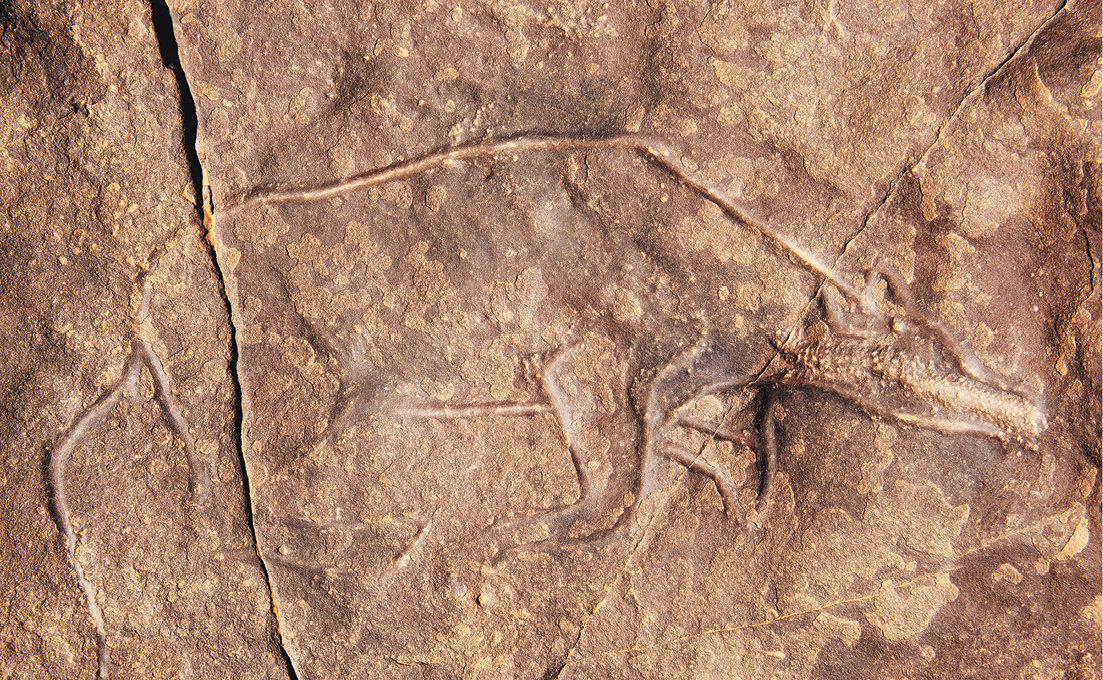
Based on ecological, stylistic, historical, and chemical criteria, a periodisation of rock art in the Tassili n’Ajjer can be proposed in the table below.
Concerning dating, it seems that there was no culture of petroglyphs among the hunter-gatherers active in Wadi Djerat, as no examples were made there before the introduction of domesticated cattle. Earlier rock art does seem to be known elsewhere, though. The so-called ‘Round Head’ rock paintings, which are concentrated in the Tassili n’Ajjer, are absent from Wadi Djerat. These images are characterised by anthropomorphic figures with a distinctly round head and no – or hardly any – facial features or sexual markers. Although these renderings are hard to date, they are occasionally associated with Barbary sheep and antelopes, which suggests that the makers of those paintings practised the corralling of such animals. This puts them among the oldest rock art in the central Sahara, meaning they may pre-date petroglyphs.

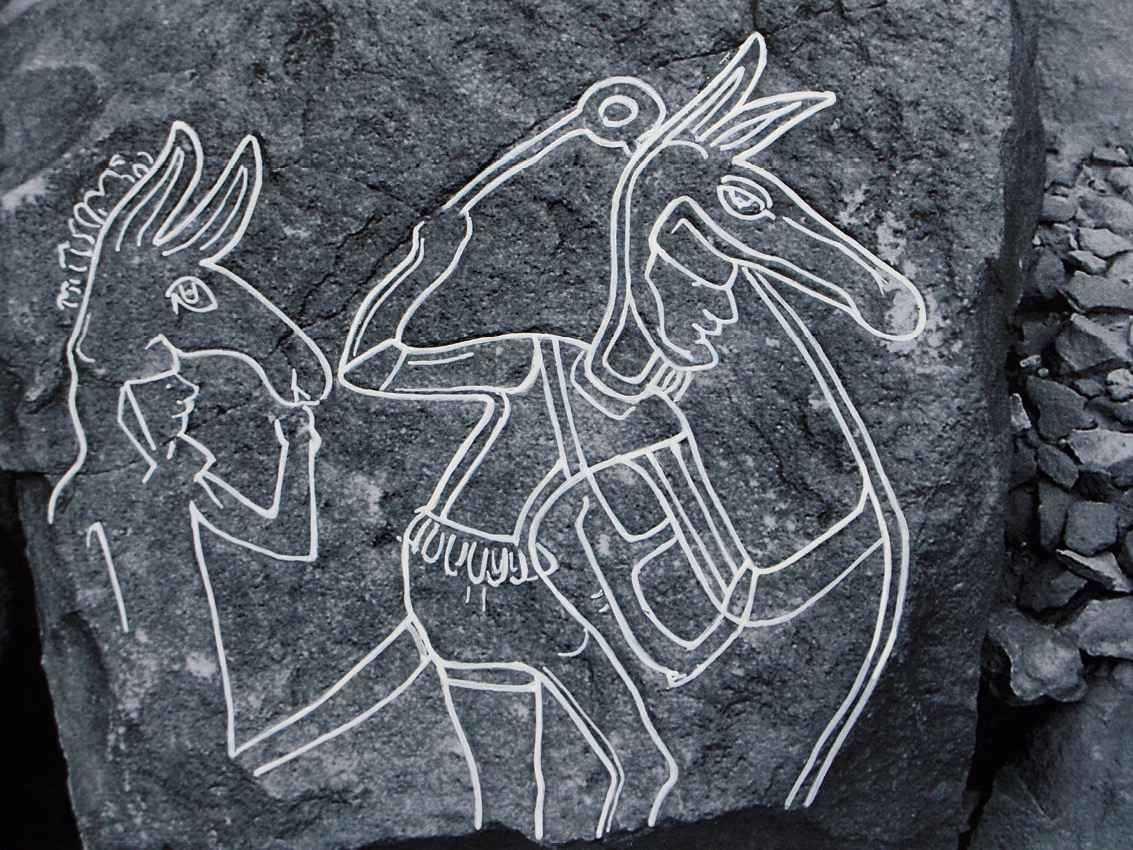
Before a paradigm shift from the dominance of animals to the dominance of humans took place in petroglyphs during the Middle Pastoral period, hybrid human and animal forms appeared in Messak and Wadi Djerat as an intermediate step, so to speak. They mostly consist of a human body and an animal head, usually of a canine such as a lycaon or a jackal. Other hybrids have the heads of buffaloes, elephants, hares, lions, cats, and even crocodiles and ibises, yet, while all these heads are without doubt those of animals, they display human facial features. Such therianthropes must be distinguished from human mask-wearers, as the latter can often be recognised as wearing an animal mask over their heads for either ritual or hunting purposes. Another aspect of these hybrids is sexuality, which is expressed in numerous scenes where canine-, leporine- (rabbit), and feline-headed hybrids copulate with humans. Indeed, it is noticeable that sexual scenes more generally gained in importance in Wadi Djerat during the Middle Pastoral Period.


Climate of change
When the aridification in the Central Sahara intensified, water-dependent animals like hippopotami and rhinoceroses disappeared, later followed by lions, elephants, and giraffes. Small crocodiles, for their part, survived in gueltas (ponds) of the Tassili until the 20th century AD. In the Later Pastoral Period, normal people take centre stage in the rock art, while cattle become less important. Bovines are no longer represented as powerful individual creatures, but as part of herds that are led by humans, who are rendered as proportionally larger than in reality, emphasising their mastery of the cattle. In rock art, idealised beings or concepts are no longer visualised, instead we see scenes from the everyday life of semi-settled pastoralists. At the same time, in Wadi Djerat rock paintings tend to become the preferred means of expression at the expense of petroglyphs. The accelerated aridification of the environment not only led to a gradual shift from cattle to sheep- and goat- herding, but also to stiffer competition for pastures and access to water. These changes are reflected in a few petroglyphs and numerous paintings featuring duels and battles. Taken as a whole, the petroglyphs and paintings indicate how the prevailing values in these societies changed over time, from the veneration of tropical megafauna to the depiction of human–animal hybrids and sexuality as the epitome of fertility, followed by the evocation of the everyday life of hunting, cattle-breeders, and finally of successful warriors.

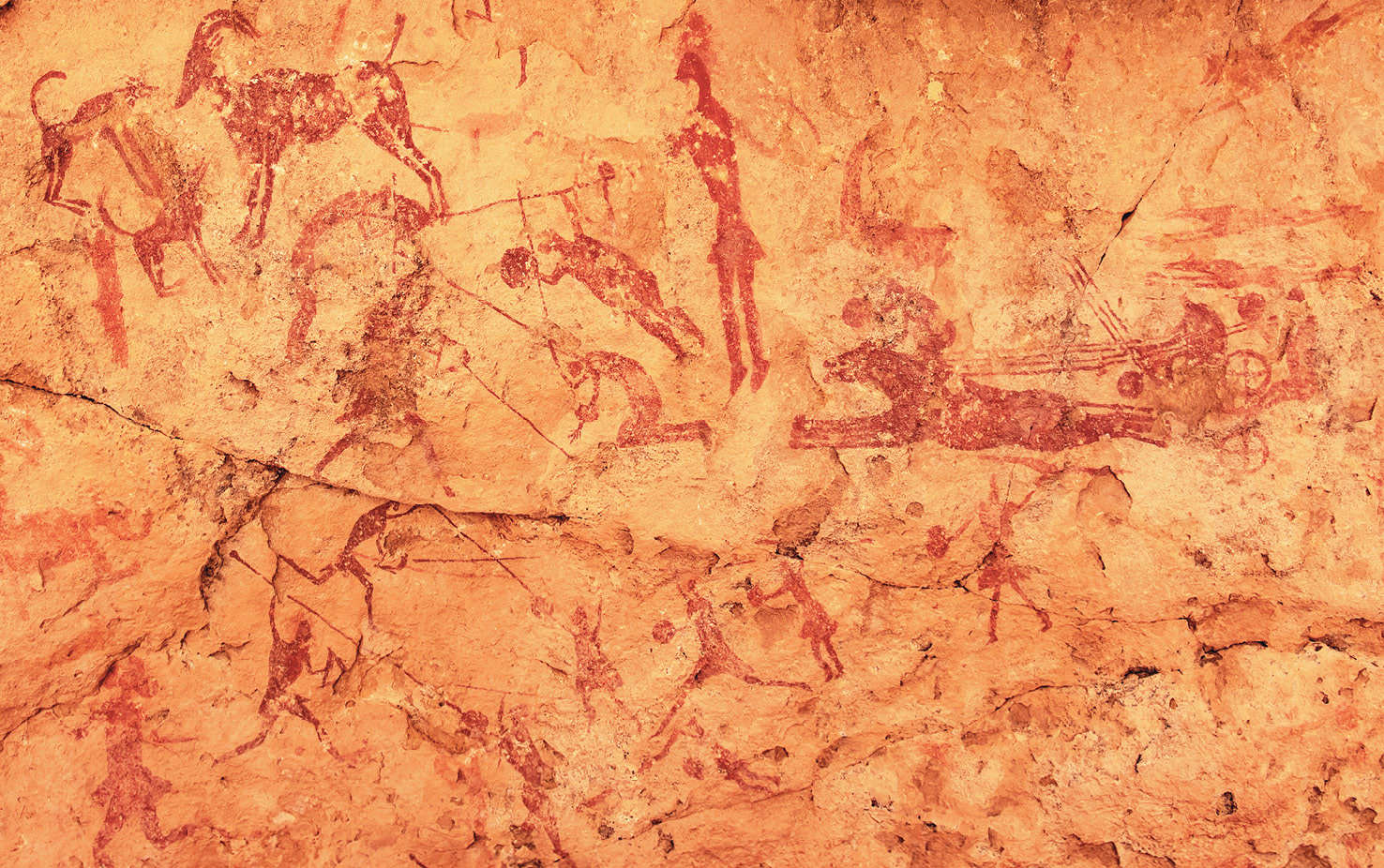
Over the course of the 1st millennium BC, horse- and chariot-use spread in the Sahara, where more than 1,500 painted and engraved images of chariots are known, the majority in the central Sahara. Depictions of single-axle chariots pulled by two horses seen from above, in which the animals and the driver are ‘folded out’, are widespread within the global universe of petroglyphs; sometimes the chariot and driver are seen from above while the horses are depicted from the side. Extremely rare in the world of rock art, though, are the hundred or so images of light, single- axle chariots pulled by two or four horses galloping at full speed and rendered from the side in proper perspective; most of these images are paintings. In Wadi Djerat, there are at least six well-preserved petroglyphs of light chariots and about two dozen paintings of light chariots travelling at a flying gallop. Whether these representations generally illustrate a myth or represent real scenes – for example, as pars pro toto of a hunt, a conflict, a sporting or ritual race – remains difficult to determine. Since chariots shown moving at high speed are often integrated in ‘canvases’ illustrating activities of daily life, such images had at least a partial reference to real events, although the stony ground of Wadi Djerat made driving there impossible. Finally, the last animal to appear in rock art is the one that dominates today: the dromedary.
Further reading:
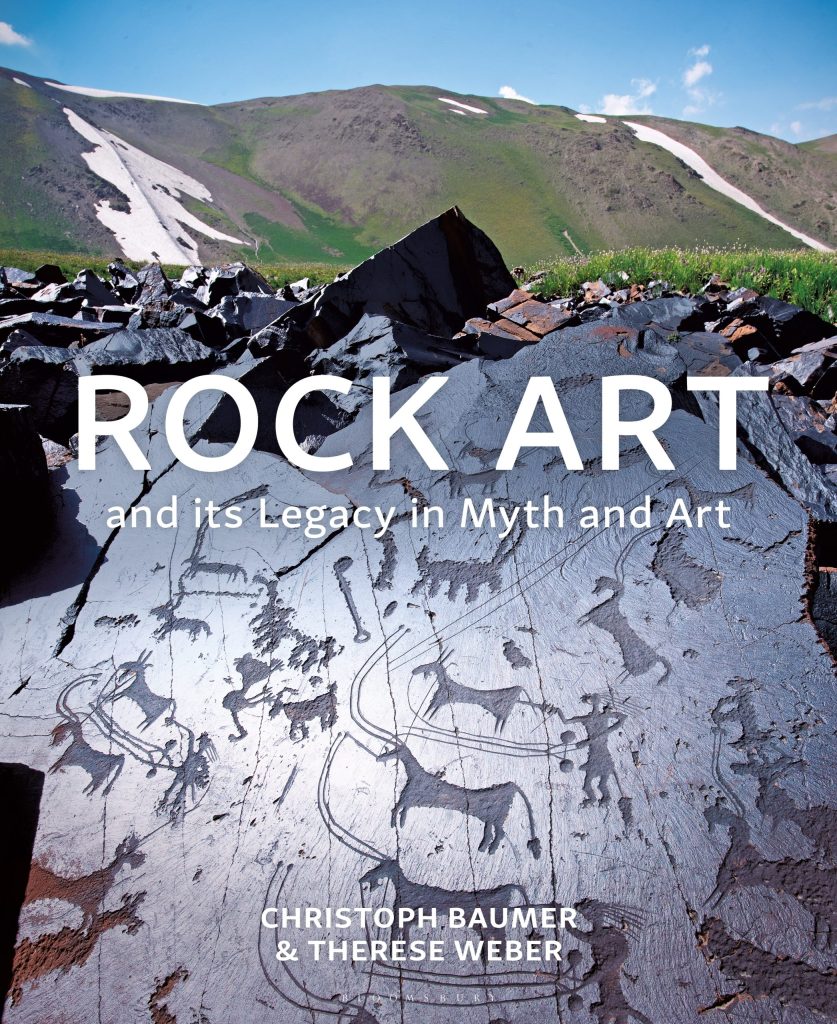
Christoph Baumer and Therese Weber (2025) Rock Art and Its Legacy in Myth and Art: Petroglyphs from Eurasia, Arabia and Northern Africa, published by Bloomsbury (ISBN 978-0755650446, 488pp, 340 colour photos and 10 maps, £30).
All images: © Christoph Baumer, unless otherwise stated