Subscribe now for full access and no adverts
This kind of trumpet is rare in Germany.
What is it?
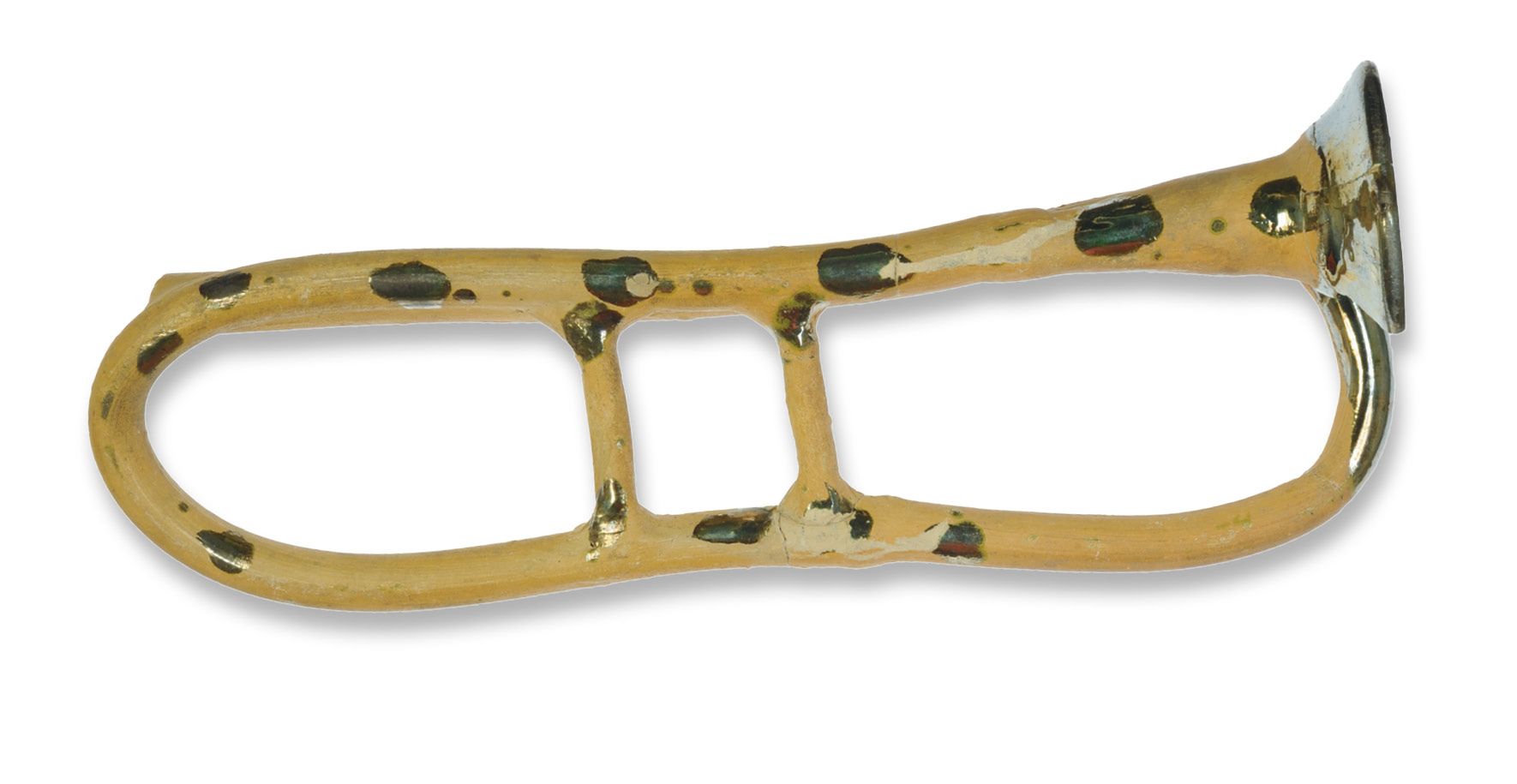
This ceramic trumpet, found in Bavaria, is more than 200 years old. Measuring 44cm long, the instrument comprises a coiled clay tube that was probably pressed using a ring-shaped template, while the clay bell was created on a potter’s wheel. Two vertical braces placed between the curved sections of the tube provide additional stability. The object’s shape is reminiscent of metal trumpets; however, it is a ‘natural trumpet’, meaning that it does not have valves or keys, so different tones are created solely by the tension of the player’s lips. The trumpet is noteworthy for its precise craftsmanship, as well as the silvery glaze that covers the instrument in some areas.
Where was it found, and when?
The trumpet was discovered in 2022 during excavations in Dorfen, in the Erding district of Upper Bavaria, Germany. It was found broken into eight pieces in the fill layer of the moat that once surrounded the inner town, in an area used by the tanning industry, not far from one of Dorfen’s town gates. Other artefacts discovered alongside the trumpet date it to the late 18th or early 19th century. Restoration work carried out by the Bavarian State Office for the Preservation of Monuments and Sites (BLfD) has made it possible to reassemble the object almost entirely; it is only missing the mouthpiece and part of the bell.
Why does it matter?
The trumpet is remarkable not just for its fine craftsmanship and exceptional degree of preservation, but for its discovery in the first place. Professor Mathias Pfeil, Director General of BLfD, commented that the find was ‘a stroke of luck’ for the organisation. Most other ceramic trumpets found in archaeological contexts date to the late Middle Ages or early modern period; the later date of the example from Dorfen stands out among this group, and its construction and glaze make it unique. Such a discovery can contribute significantly to our understanding of the manufacturing techniques and uses of such instruments, which are rare in Germany.
Unfortunately, without creating a replica, there is no way to know what the trumpet would have sounded like when it was played. However, it is unlikely to have produced the majestic sound we expect of a modern trumpet. In fact, archaeologist Ramona Baumgartner, who led the excavation and scientifically examined the trumpet, believes that it was probably not used as a conventional musical instrument at all. The section of moat in which it was found, used by the tanneries, was not located in a particularly salubrious part of town. The trumpet may, therefore, have served as a signalling instrument to warn the population of fire or other dangers.
FIND OUT MORE: The results of the scientific analysis of the trumpet will be published in a comprehensive article next year.
Text: Amy Brunskill / Photo: Bayerisches Landesamt für Denkmalpflege