Subscribe now for full access and no adverts
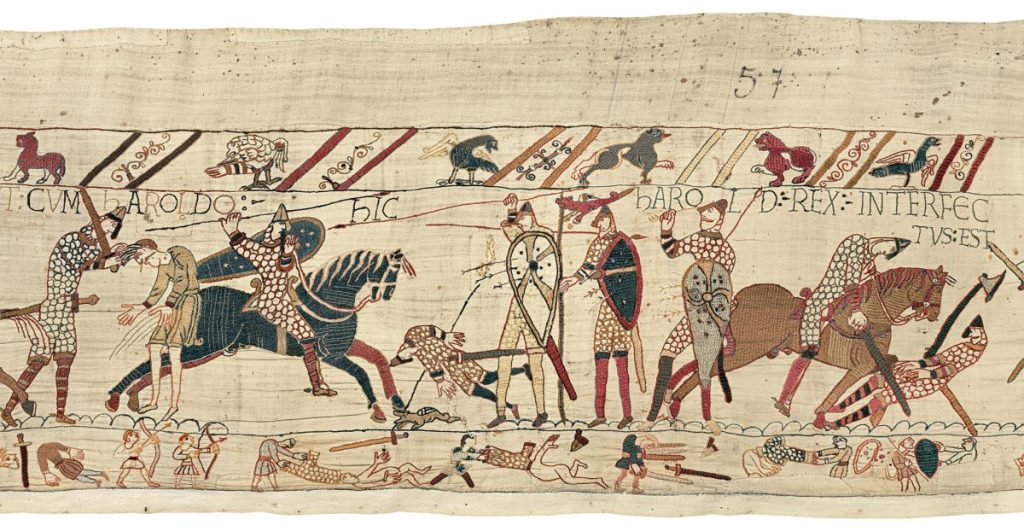
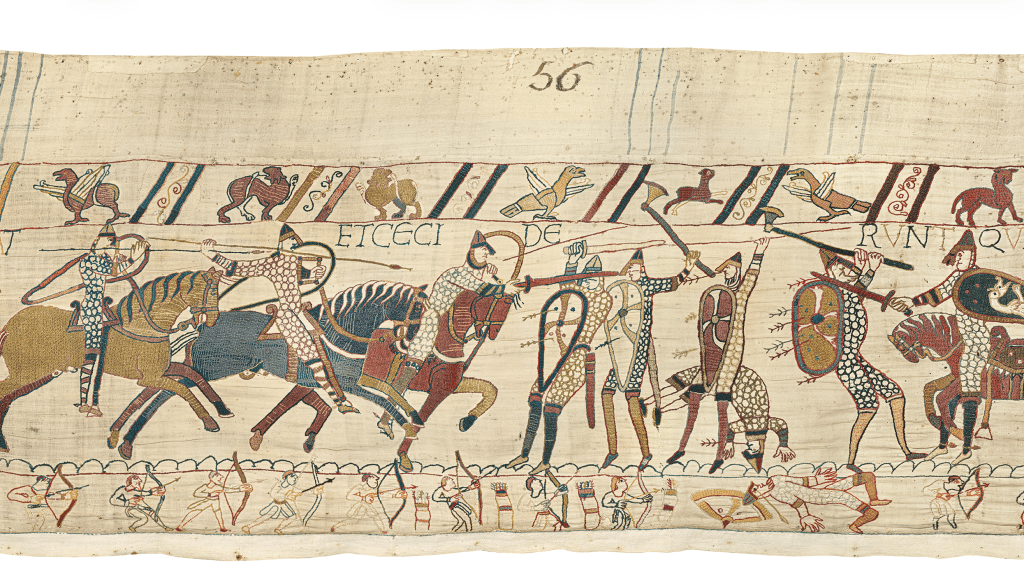
In September 1476, a brief but illuminating entry in the treasury inventory of Bayeux Cathedral, in Normandy, noted the presence of ‘a very long and narrow embroidered hanging with images and text’ stored in the vestry. The author added that the textile was displayed in the nave for a little over a week every year, and took for its subject matter the ‘Conquest of England’. Thanks to this information, we can be confident that these two and-a-half lines of text represent our earliest confirmed sighting of the Bayeux Tapestry. By 1476, this would already have been a venerable object, as most scholars place its creation in the years following 1072, meaning that production was probably in full swing less than a decade after the events that it depicts. These played out over 1065 and – of course – 1066, and revolve around the fortunes of two men: Earl Harold Godwinson of Wessex and Duke William of Normandy, known to history as ‘the Conqueror’. The Tapestry chronicles how they became locked on a collision course by their competing claims to the English throne. This rivalry reached its deadly denouement less than a year after the death of the previous monarch, Edward the Confessor. The armies of William and Harold clashed at Hastings on 14 October 1066, and the reverberations were felt throughout England. About a third of the Bayeux Tapestry is devoted to the brutal fighting, with the imagery pulling no punches when it comes to depicting the horrors of dismembered bodies and the looting of corpses. At the climax of the battle, Harold is slain and English resistance broken.
Taken as a whole, the embroidery is undoubtedly among the most celebrated artworks to survive from medieval Europe. Yet the Bayeux Tapestry remains every bit as enigmatic as it is famous. Many of the mysteries surrounding this textile concern events that are crucial to understanding the first 400 years of its existence. These include such fundamental questions as who commissioned it, where it was made, where it was first shown, and why. Exploring some of the options introduces us to a colourful cast of characters who lived through the events of 1066, and whose fates turned for better or worse when Godwinson fell at Hastings. Indeed, given the seismic impact of the Norman victory, it is hard to believe that many – perhaps any – of the countless hands that contributed to making the Bayeux Tapestry did not have their own opinions about the events it portrays. While this immediacy surely influenced the composition of the narrative, it is surprisingly difficult to pin down a consistent pro- or anti-Norman message.
It is difficult to pin down a consistent pro- or anti-Norman message in the Bayeux Tapestry.
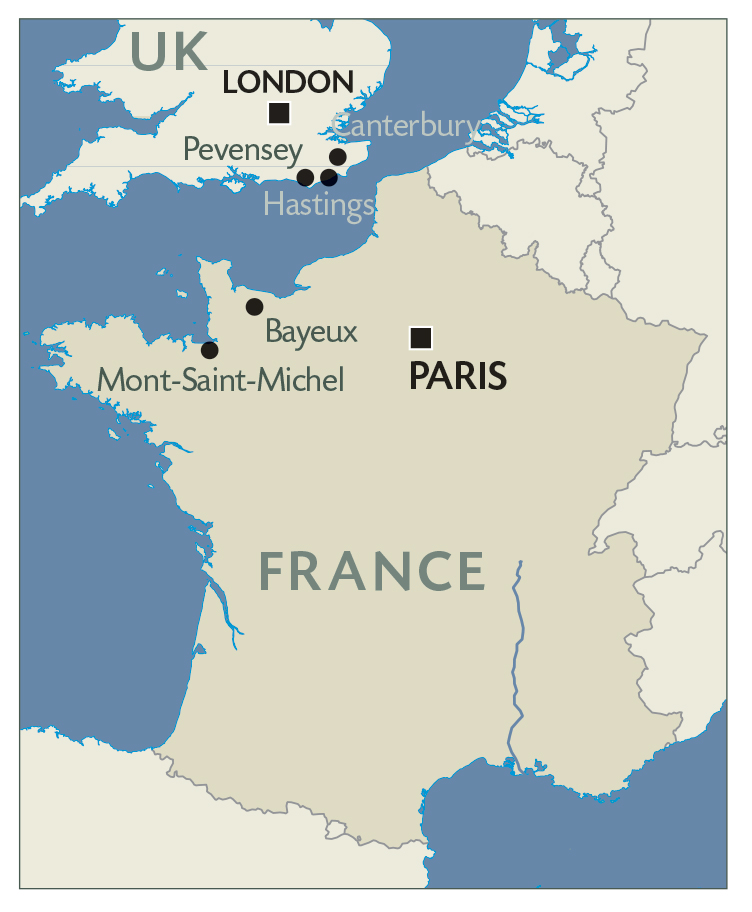
Knowing where the textile was intended to be seen would probably help to clarify the motive, and it is possible that Bayeux Cathedral was always the intended recipient. A poem penned around 1100 by Baudri of Bourgueil, who was based in the Loire Valley, appears to feature a fictionalised version of the Bayeux Tapestry, which would fit with it being on the Continent by then. Whether it was at Bayeux is a different matter, as an inventory of 1430 places a large tapestry depicting William’s conquest of England in the hands of Duke Philip the Good of Burgundy. Perhaps this simply reveals that there was more than one visualisation of the invasion in circulation. What is more certain is that after the 1476 inventory places the Tapestry in Bayeux, it is only known to have left the city a handful of times: once at the behest of Napoleon, once during the Second World War, and now for the highly anticipated British Museum exhibition The Bayeux Tapestry (see ‘Further information’ box below). This presents the textile lying flat and elegantly lit, allowing visitors a spellbinding encounter with a near contemporary take on a genuinely pivotal moment in English history.
Loose threads
As Sue Brunning and Michael Lewis observe in the fascinating volume that has been published to accompany the exhibition, strictly speaking the Bayeux Tapestry is not a tapestry at all. That would involve the images being woven into the textile, rather than stitched on, as is the case here. The confusion comes from the French term tapisserie, which is used more generally to refer to a textile hanging of either form. In English, the Bayeux Tapestry should technically be called an embroidery. However it is referred to, though, there can be no doubt that this tremendous textile was a magnificent accomplishment. Today, it is 68.3m in length, about 50cm in height, and formed of nine sheets of linen that were sewn together. As the narrative currently ends somewhat abruptly, with Harold’s routed troops fleeing the field at Hastings and the Normans in hot pursuit, there are grounds to suspect the textile was originally longer. Even so, the embroidery that we can see today is a product of immense labour by people skilled in numerous trades. Not all of them were working in the 11th century, though. Repairs made using wool steeped in synthetic dyes that were not available before the mid-19th century have been detected. Ironically, some of these additions have faded badly, because they do not hold their colour as well as the original 11th-century plant-based dyes. At an unknown date, a backing was attached to the Bayeux Tapestry, which now bears numbers that are still used to identify scenes in the narrative. Most of these may date to 1842, when the embroidery was first put on permanent public display. The last two numbers, though, were added during the Second World War by members of the SS, whose ‘ancestral heritage unit’ took a keen interest in the Bayeux Tapestry.
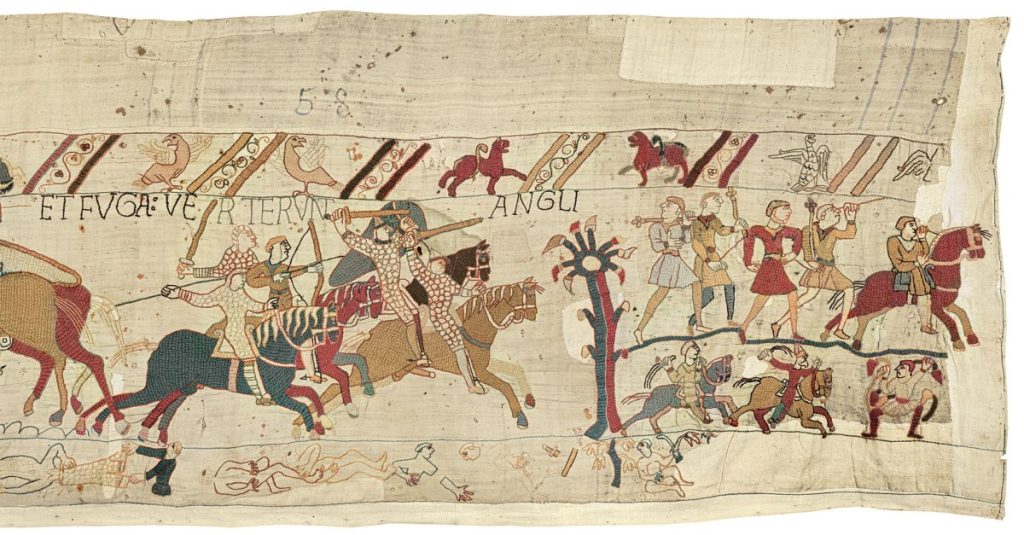
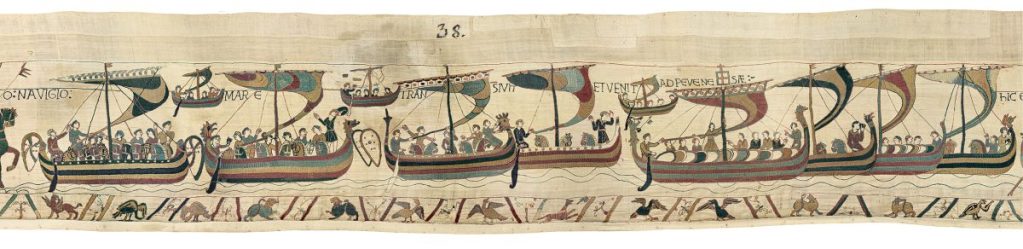
The decorative elements of the embroidery are divided into three sections, creating a central frieze that is set within upper and lower borders. This central frieze is where the action proper plays out, with the borders often populated by a menagerie of beasts both real and mythical. These elements sometimes seem to be influenced by events in the main narrative, such as when the animals become agitated as the fighting at Hastings intensifies. Could a swarm of wriggling eels underneath an earlier act of bravery by Harold Godwinson present a subtle dig about him being something of a slippery character? More certainly, a ‘star’ blazing through the upper border in Scene 32 attracts urgent gestures from onlookers in the central frieze. In reality, this speeding fireball is Halley’s Comet, which lanced through the sky in April 1066. Comets were often viewed as an ominous omen in the medieval world, and the Bayeux Tapestry takes full advantage of its dramatic appearance so soon after Harold Godwinson was crowned king of England. On other occasions, the events in the central frieze are so momentous that they swamp the upper or lower borders. As William’s army sails for Britain, the boats making up his vast fleet also invade the upper border of the embroidery. Later, as the fighting at Hastings grows ever more frenzied, combatants and corpses crowd the lower register. Throughout the narrative, a series of Latin captions were artfully arranged around the imagery, concisely identifying the events taking place.

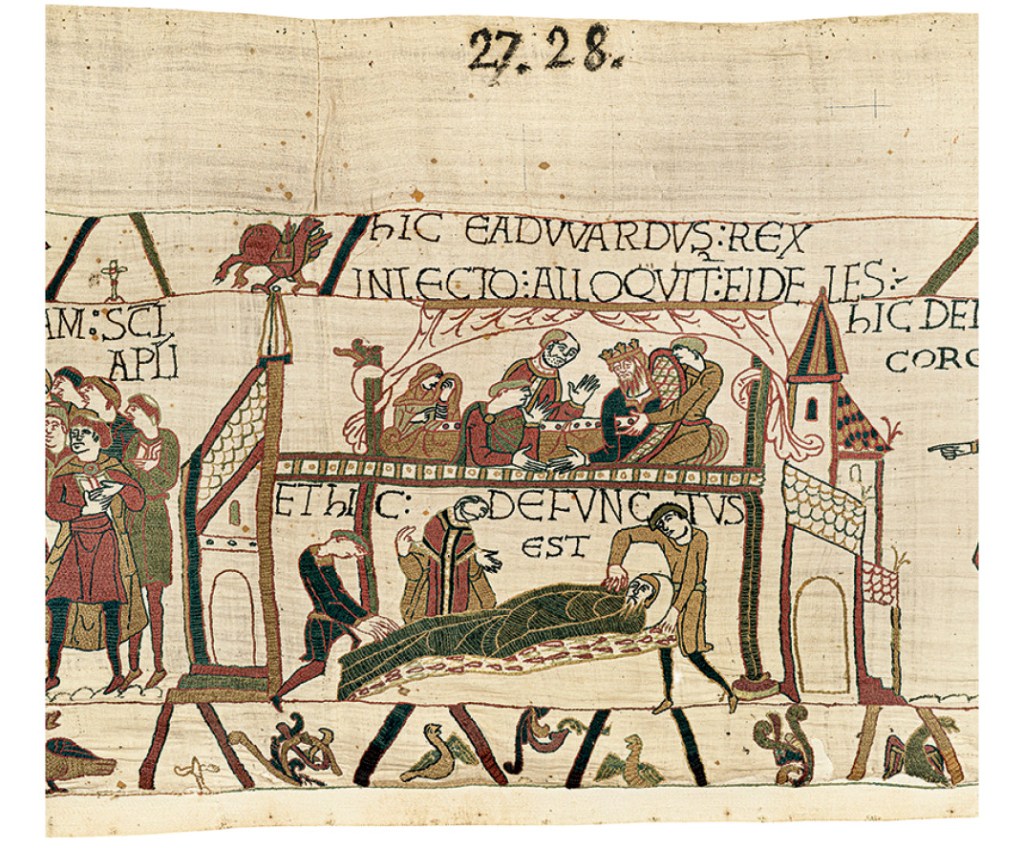
Engaging artists to draw these elements would have been one of the earliest steps in making the embroidery. The resulting layout would then have been sketched on to the linen sheets, probably by draughtsmen, prior to stitching commencing. These linen sheets also went through an involved production process. They were made from flax stems that had been rotted and then beaten to extract the long fibres within. The fibres were combed and hand spun, before being woven on a loom, and most likely bleached. Vibrant colours were needed for the stitched decoration, and four different types of plant dye were used: madder, weld, most likely woad, and a fourth that remains unknown but produced a brownish hue. These were used to dye threads made from combed wool, which had been sourced from farmed sheep. When work commenced on embroidering the designs sketched on the linen, it seems that the outlines were usually stitched first, and then filled in. The quality of the needlework is sufficiently high for the contributors to have been professional embroiderers. Not all of them were of the same calibre, though. Comparing the upper and lower parts of Edward the Confessor’s deathbed scenes indicates that the person responsible for the powerful evocation of the king’s final moments was rather more talented than the embroiderer who rendered his corpse. Figures become more simplified in the later stages of the embroidery, too, suggesting that the pace of work increased.
Establishment stitch-up?
As the exhibition publication discusses, numerous individuals have been identified as the possible patron who set this monumental project in motion. The first scholar to publish details of the Bayeux Tapestry, Bernard de Montfaucon in 1729, favoured its creation in Normandy. He noted a local tradition that the embroidery was produced under the auspices of Matilda, Queen of England from 1068, and wife of William the Conqueror. Another queen who has been linked to the genesis of the Bayeux Tapestry is Edith, the widow of Edward the Confessor, and sister of Harold Godwinson. Edith is one of only three women to appear in the central frieze of the textile, where she presents a portrait of grief beside her husband’s deathbed. Edith passes unnamed on the embroidery, which only refers to the king ‘addressing his faithful companions’. We can be confident that it is her, though, thanks to an account in a history of Edward’s reign, which was itself commissioned by Edith in around 1067. The very presence of this scene on the Bayeux Tapestry gives pause for thought, as it is not prominent in early Norman histories describing the events leading to the Battle of Hastings. Even more intriguingly, Edward the Confessor is shown reaching out to touch the hand of a figure who can be identified as Harold Godwinson. This gesture seems to legitimise the idea that Edward ultimately passed over his cousin William, and instead selected Harold as his heir, or at least as a regent. If this scene supports an English take on events, though, others very much toe the Norman line.
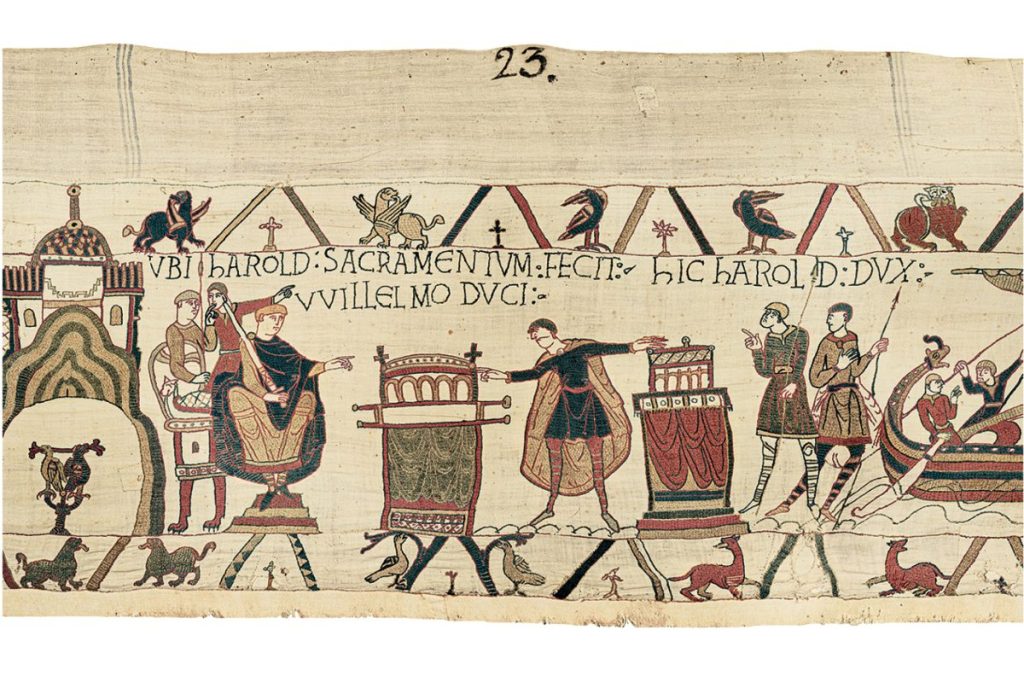
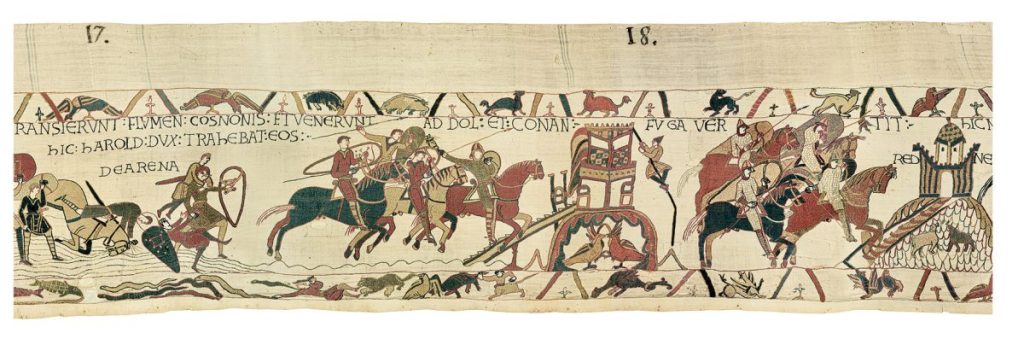
Even framing events as a two-horse race between William and Harold is to the former’s advantage, as it avoids muddying the waters by acknowledging that Edward the Confessor had a blood heir and potential successor at his court: Edgar ‘Ætheling’. William is also portrayed as an effective and decisive leader. Early on in the narrative, Harold Godwinson sails to the Continent, where he is ultimately delivered to William. When the two men first meet on the textile, William is shown clothed in a manner inspired by Roman emperors. The pair go on campaign together against William’s enemy Conan II of Brittany, with the fighting presented as a dramatic Norman victory. After the campaign is concluded, William presents Harold with arms, an act that places the latter in the former’s debt. Even more significantly, Harold is shown swearing an oath on holy relics under William’s watchful eye. By the Norman telling, this is the moment when Harold freely agrees to support William’s claim to the English throne. While the Bayeux Tapestry gives prominence to this scene as the culmination of Harold’s Continental sojourn, the Latin text remains studiously even-handed. We are told simply that this is ‘where Harold has taken an oath to Duke William’, but not what that oath might be. So it is that the Bayeux Tapestry includes scenes that appear to back up both English and Norman claims to being in the right, while steadfastly refusing to editorialise about who is the actual villain of the piece. Why?

The answer probably lies in the specific circumstances of the era when the embroidery was made. It would be fair to observe that the English were generally not enthusiastic converts to Norman rule. The change that followed defeat at Hastings must have been as disruptive as it was disorientating. The historian Chris Wickham has nominated it as perhaps the most comprehensive destruction of a European ruling class prior to the Russian Revolution in 1917. English resistance, though, was met with brutal suppression, and by 1072 it was clear enough that the game was up. The need now was to find a way for both conquerors and conquered to live together. By presenting elements of both Norman and English narratives, the Bayeux Tapestry seemingly strives to present a version of the past that both sides could agree on. If so, it appears well calibrated to act as an instrument of reconciliation. The embroidery probably also created a good deal of work for a range of English craftswomen and -men. Ever since Francis Wormald’s work in 1957, it has been appreciated that elements of both the overall artistic style and some of the specific motifs on the embroidery bear striking similarities to originals in medieval manuscripts from Canterbury, in Kent. The familiarity of the artists responsible for the Bayeux Tapestry with this imagery is most easily explained if they, too, were working in Canterbury. Within the city, various strands of evidence, including artistic style, make a connection between the project and St Augustine’s Abbey compelling.
Reap what you sew
The case for production of the embroidery in Canterbury presents a strong contender for the role of patron, too. William’s half-brother Odo received the earldom of Kent after the Conquest, but was also the Bishop of Bayeux. One man, then, connects the most likely place of manufacture of the embroidery with its ultimate destination. What is more, Odo would have been keenly aware of the sentiment in England, as he was left in charge when William returned to Normandy in 1067. Odo plays a prominent role on the textile, where his appearances include blessing a meal before the battle and urging on the soldiers during the fighting. Harold Godwinson is also shown swearing his fateful oath to William in Bayeux, which was Odo’s bishopric. Indeed, the dedication of the cathedral there in July 1077 presents exactly the sort of occasion that such a magnificent embroidery might have been commissioned for.

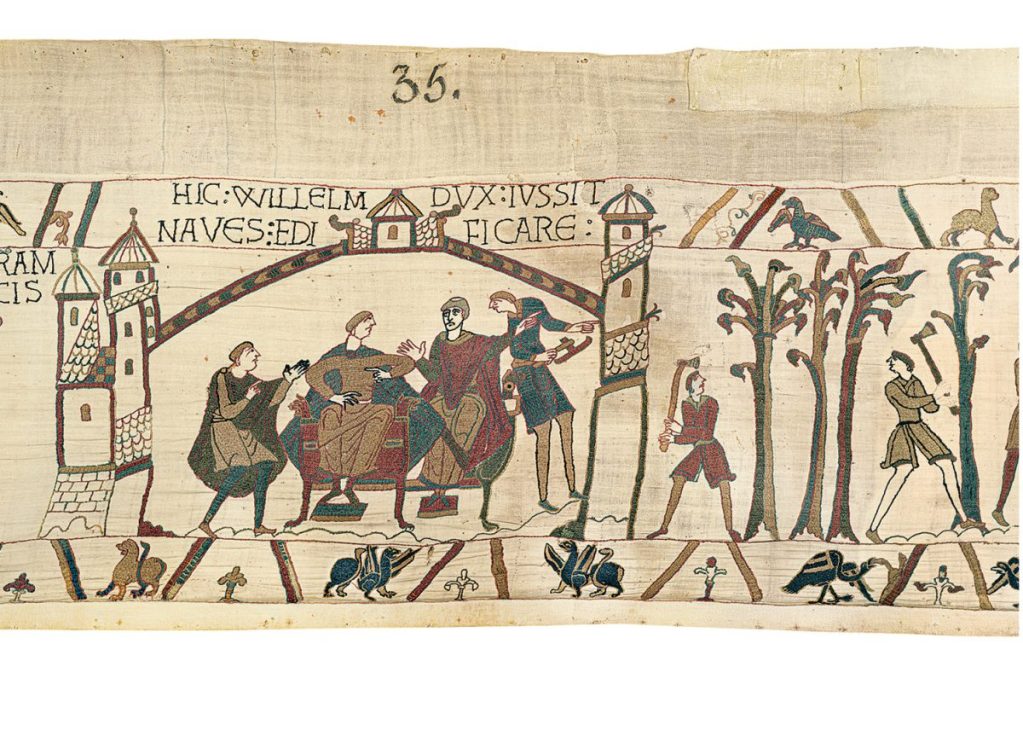
Whatever the truth, there are some subtle signs that, if the Bayeux Tapestry was intended to promote a version of the past that could unite both Normans and English, not everyone involved in its manufacture shared this vision. In a contribution to the exhibition publication, Alexandra Makin and Gale Owen-Crocker note that certain representations of William and his half-brothers Odo and Robert are eerily reminiscent of scenes in illuminated manuscripts that the designer of the Bayeux Tapestry was seemingly familiar with. One example, Scene 35 on the embroidery, seems to draw a connection between the Normans and the doomed inhabitants of Sodom, while another, Scene 44, has Robert mimic the pose of a man described as a ‘fool’. Such a subversive subtext would not be the only sign that feelings were still running high in the years after the Conquest. A late 11th-century document from St Augustine’s Abbey in Canterbury, which may well have played a leading role in producing the Bayeux Tapestry, shows that the brethren still prayed for the soul of Harold, whom they continued to call ‘king’. If these sentiments did inspire an artistic member of the monastic community to pepper the embroidery design with some hard-hitting allusions, then, as the exhibition publication puts it, ‘he was playing a dangerous game’. Any such act of dissent would also provide a fine illustration of how there has always been more than one way to read the Bayeux Tapestry.
Further information:
• The exhibition The Bayeux Tapestry will run until 11 July 2027. Although tickets for 2026 have already sold out, the first batch for 2027 will be released in October this year, with priority for British Museum members. For further details about the exhibition, including ticket prices, please see http://www.britishmuseum.org/exhibitions/bayeux-tapestry.
• A fascinating volume that accompanies the exhibition is also available. Beautiful photography shows the entirety of the Bayeux Tapestry, alongside contributions that shed light on many intriguing aspects of this extraordinary embroidery, including those introduced here: S Brunning, L de Beer, M Lewis, N Speakman, with M Horton-Insch (2026) The Bayeux Tapestry (British Museum Press; pbk: ISBN 978-0714123554, hbk: ISBN 978-0714123530).