
Embroidering history: Reconciliation and recrimination on the Bayeux Tapestry
As the Bayeux Tapestry goes on show at the British Museum, Matthew Symonds explores some of the enigmatic messages encoded in its exquisite needlework.

As the Bayeux Tapestry goes on show at the British Museum, Matthew Symonds explores some of the enigmatic messages encoded in its exquisite needlework.

Tiny traces of medieval wall-paintings have been discovered at Goodrich Castle in Herefordshire, transforming our understanding of how its chapel was decorated. Carly Hilts spoke to Sophie Stewart to learn more.

You would be forgiven for thinking that the beautiful architecture represented here had been carved from stone centuries ago. Instead, this is a mural, recently unveiled at St Drostan’s church in Markinch, Fife, that has been created as a faithful…
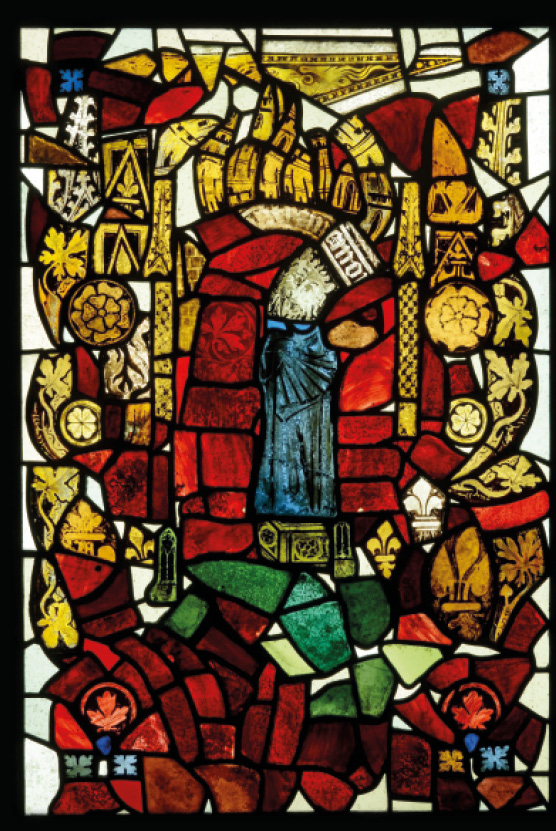
In 1946, 500 fragments of brightly coloured stained glass were removed from the window of St Andrew’s Church, Heckington, to make way for a modern replacement. This was not their first move – the fragments, which are mainly thought to…

MHM’s round-up of the latest military history titles.

Archaeologists working at Old Dongola in Sudan have stumbled across a set of unusual 13th-century Christian wall paintings.

Review by Nathalie Cohen This monograph, the result of a project started by David Neal and Warwick Rodwell in 2015 to examine the historic floors in the eastern arm of Canterbury Cathedral, is a stunning achievement. Over nearly 400 pages,…

While the chapel’s exact location remains unknown, it was probably situated on the south side of the 13th-century Lady Chapel, perhaps near St Mary’s garden.

Reconstruction of the collapsed stone vault in the north transept of the cathedral has now been completed.

The long-term project, which started in 2011, has seen the restoration of the ancient bathhouse to protect parts that were left open to the elements.

Throughout history, gold has captured the imagination – as a glittering symbol of money, sex, power, divine love, or whatever else our hearts desire. From the Greek myth of the Golden Fleece to Titian's Danae, and from the golden objects found in Ancient Egyptian tombs to the quest at the heart of JRR Tolkien's Lord of the Rings, the precious metal has been mined as subject matter for writers and artists across continents and down millennia.

Some of the most significant texts from around the world have been given very special treatment, with words of holiness and of diplomatic value written both in and on gold. Annabel Teh Gallop, Eleanor Jackson, and Kathleen Doyle investigate the indelible importance of the precious metal in luxury manuscripts.

The Friends organise a rota of more than 100 volunteer ‘watchers’ to keep the churches open. They put on lectures, tours, and special events, while encouraging others to make use of the buildings.

The figure of Nathan possibly dates to AD 1130-1160, making it perhaps the earliest surviving stained glass in England, and among the oldest in Europe.

Isabella (c.1427-1494) was the second daughter of James I of Scotland, and was given the manuscript by her husband, Duke Francis I of Brittany, on their marriage.

In a way, I began to feel slightly more sympathetic to Henry VIII; the church was extremely powerful and if you are to oppose it, I suppose you must be ruthless.

In 1170, Archbishop Thomas Becket was killed in his cathedral by knights linked to his former friend King Henry II. But how did Becket become a revered saint and protector of the king?

The British Museum reports that the snail-man mount could have been the medieval equivalent of a modern-day ‘meme’.

Over the past few years, the Ethiopian Heritage Fund has been scaling cliffs and mountains to study and conserve the remarkable rock-hewn painted churches of Ethiopia’s Tigray region, currently in the grips of conflict. Blair Priday, Stephen Rickerby, and Lisa Shekede guide us through their work.

‘The Lucas Psalter is of clear artistic and cultural significance, and tells a fascinating English story.'

Churches are what archaeologists call ‘persistent sites’, places used for the same purpose for centuries, even millennia. But that does not mean the churches themselves are static: they represent the accretion of various building interventions of many different kinds and dates. None are richer in art and architecture, though, than those from the period we call ‘Decorated’, as Nigel Saul’s new survey of 14th-century Herefordshire church buildings demonstrates. Current Archaeology's Chris Catling reports.

When flames ripped through the cathedral of Notre Dame de Paris in April 2019, the world feared for its survival. Now a small team of scientists is working towards its restoration and discovering secrets along the way. Christa Lesté-Lasserre spoke to some of them about their work and its challenges.

Jenny Davenport marvels at all the astoundingly intricate works of medieval English embroidery in Opus Anglicanum, a major exhibition currently on show at the Victoria and Albert Museum in London

One of the ways that the Fitzwilliam Museum is celebrating its 200th anniversary is by the staging of a splendid exhibition of illuminated manuscripts at the end of July – a very fitting tribute to its founder, reports Theresa Thompson