
Subscribe now for full access and no adverts
Recent renovations at Durham Castle have revealed new details of how the fortification was redecorated and altered over its almost 1,000-year history.
With the renovation of the castle presenting a rare opportunity to learn more about this World Heritage Site’s hidden history, the Durham Castle Research Group, supported by Durham University’s Heritage 360 network, carried out investigations ahead of the reinstatement works to explore the site’s early development and use.
One of the project’s star discoveries was a section of medieval wall painting, believed to date from the late 13th to early 14th centuries, which had been preserved beneath later 17th-century plasterwork and mid-20th-century panelling. Found within a part of the castle that has, since the 19th century, been known as the Senate Suite, it comprises an outlined masonry pattern with a central red flower and a green stem motif (below), and confirms that this was a high-status area of the building during the medieval period.
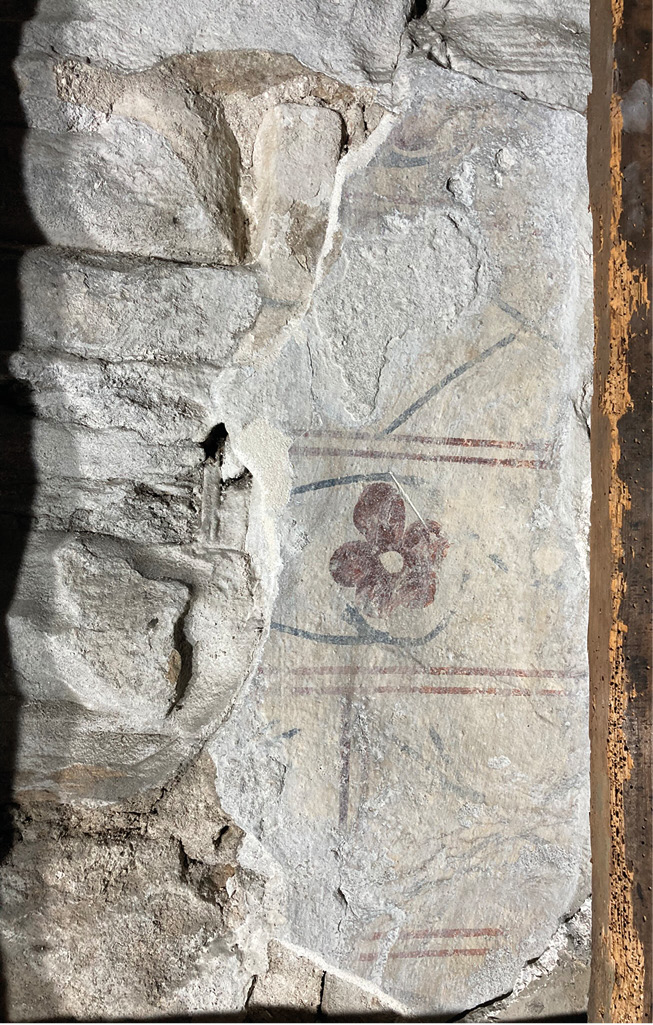
The painting has been conserved, and the whole of the space recorded, by members of Durham University’s Departments of Archaeology and History. Dr Andrew Ferrara, Project Lead and Career Development Fellow at Durham University’s Department of Archaeology, said: ‘The uncovering of this fragment of medieval wall painting is an absolutely sensational discovery. It’s an incredibly rare survival in such an important castle site and really underscores the power and status of the medieval bishops of Durham.’
Other previously unknown aspects revealed by the renovations included several blocked openings in the south wall, two of which – originally rectangular windows – are thought to have been infilled in the 1540s when Bishop Cuthbert Tunstall (1530-1559) turned the room on the other side of the wall in which they were found into a chapel. Elsewhere, the team identified evidence of a massive subsidence issue early in the castle’s history: a zigzag crack across some of the stonework appears to have been caused by the north wall pulling away from the overall structure and threatening to collapse down the slope towards Moatside Lane. The team think this may have manifested in the first centuries of the castle’s existence as an angled buttress was added to the external north wall in the 13th or 14th centuries.
Text: Kathryn Krakowka / Image: Dr Andrew Ferrara