Subscribe now for full access and no adverts
The Great Pyramid at Giza is nowadays recognised as the pre-eminent ancient structure in Egypt, but for 16 centuries it was rivalled by another of the Seven Wonders of antiquity: the Pharos lighthouse in Alexandria. According to the Greek writer Achilles Tatius (2nd century AD), it was not merely a lofty lantern, but a second sun that shone over the city, elevated on a pedestal that towered 120 metres above the waves. It completely collapsed after a succession of earthquakes seven centuries ago, so its structure and technology slipped beyond memory, to be superseded by supposition and fantasy. Only now, by combining clues from the few ancient images with eye-witness accounts, and by adopting a scientific perspective, can the Pharos be resurrected in all its ancient glory.

The architect
The Pharos is thought to have been erected between about 297 BC and 284 BC, during the reign of Ptolemy I Soter, although the Roman historian Ammianus Marcellinus (c.AD 330-400) assigned its construction to Cleopatra VII, who probably just repaired it.
However, an Arab writer, al-Masudi (c.AD 896-956), thought it most likely the work of Alexander the Great, and he has been partially vindicated by a marginal note in a manuscript of the satirist Lucian of Samosata (c.AD 125-180). This clearly attributes the plan for a lighthouse to Alexander, despite the fact that its foundations were not laid until a quarter of a century after his death. Neither does it seem that Ptolemy I either instigated or funded the construction of the Pharos. The ancient sources are unanimous in attributing the entire project, including its architecture and technological aspects of its design to Sostratus of Cnidus, a senior member of Ptolemy’s court.
Recent research has revealed Sostratus was a remarkably talented individual. He launched his career by damming the Nile to flood Memphis in order to facilitate Ptolemy’s takeover of Egypt after Alexander’s death. Afterwards, Sostratus appears as Ptolemy’s roving emissary in mainland Greece and its islands, even settling wars in the name of the Ptolemaic Empire. His emergence as an architect of prowess was confirmed by his construction of a magnificent causeway on arches in his hometown of Cnidus, but the Pharos was his masterpiece. According to Lucian, Sostratus added an inscription in soluble gypsum to the seaward face of the lighthouse which attributed the edifice to Ptolemy I, but it was quickly dissolved by the rain and sea spray to reveal, in durable metal letters 53cm tall: ‘Sostratus the son of Dexiphanes of Cnidus to the Divine Saviours on behalf of mariners’. Pliny the Elder (c.AD 23/24-79), however, more prosaically attributes this inscription to the magnanimity of Ptolemy in allowing the architect to take the credit.
The light
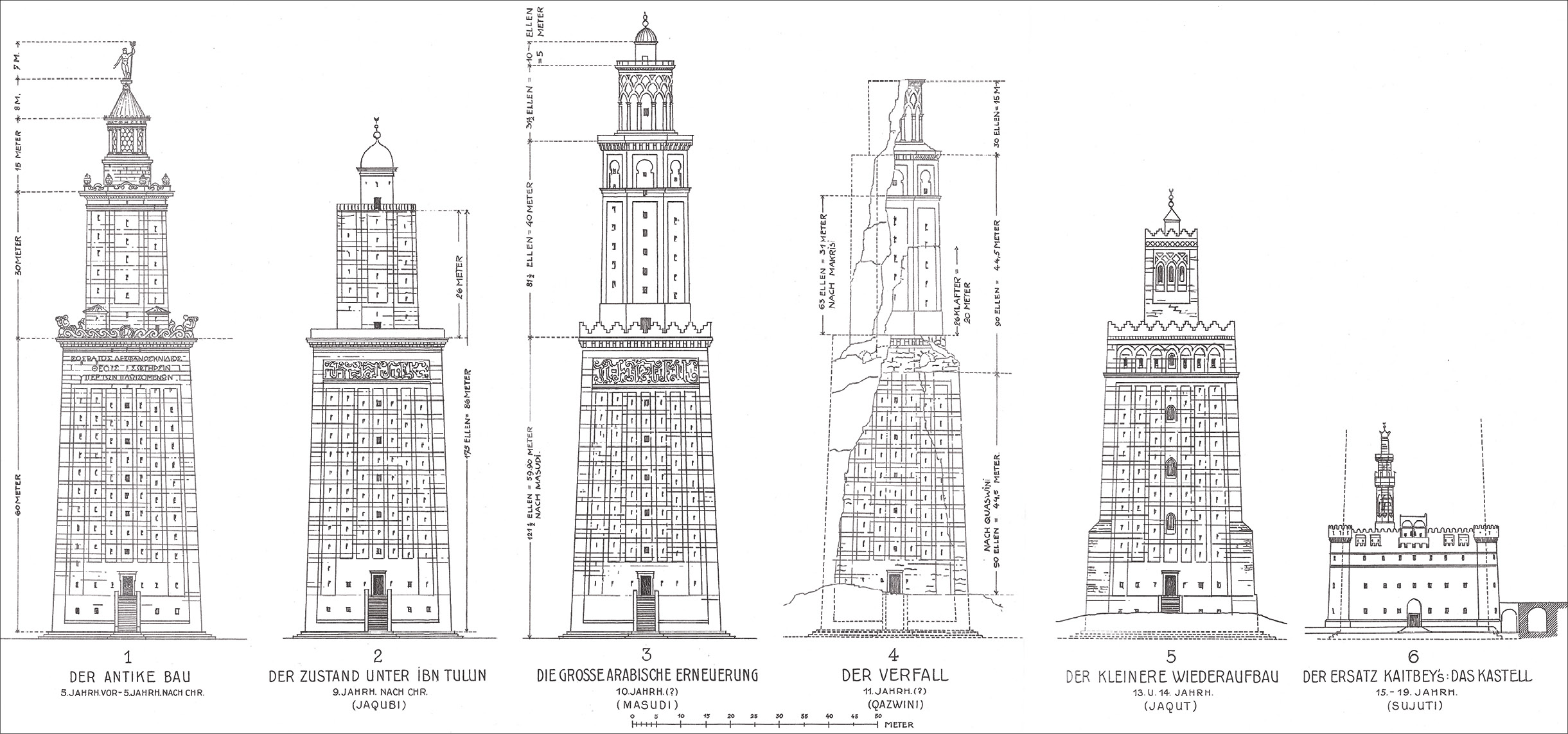
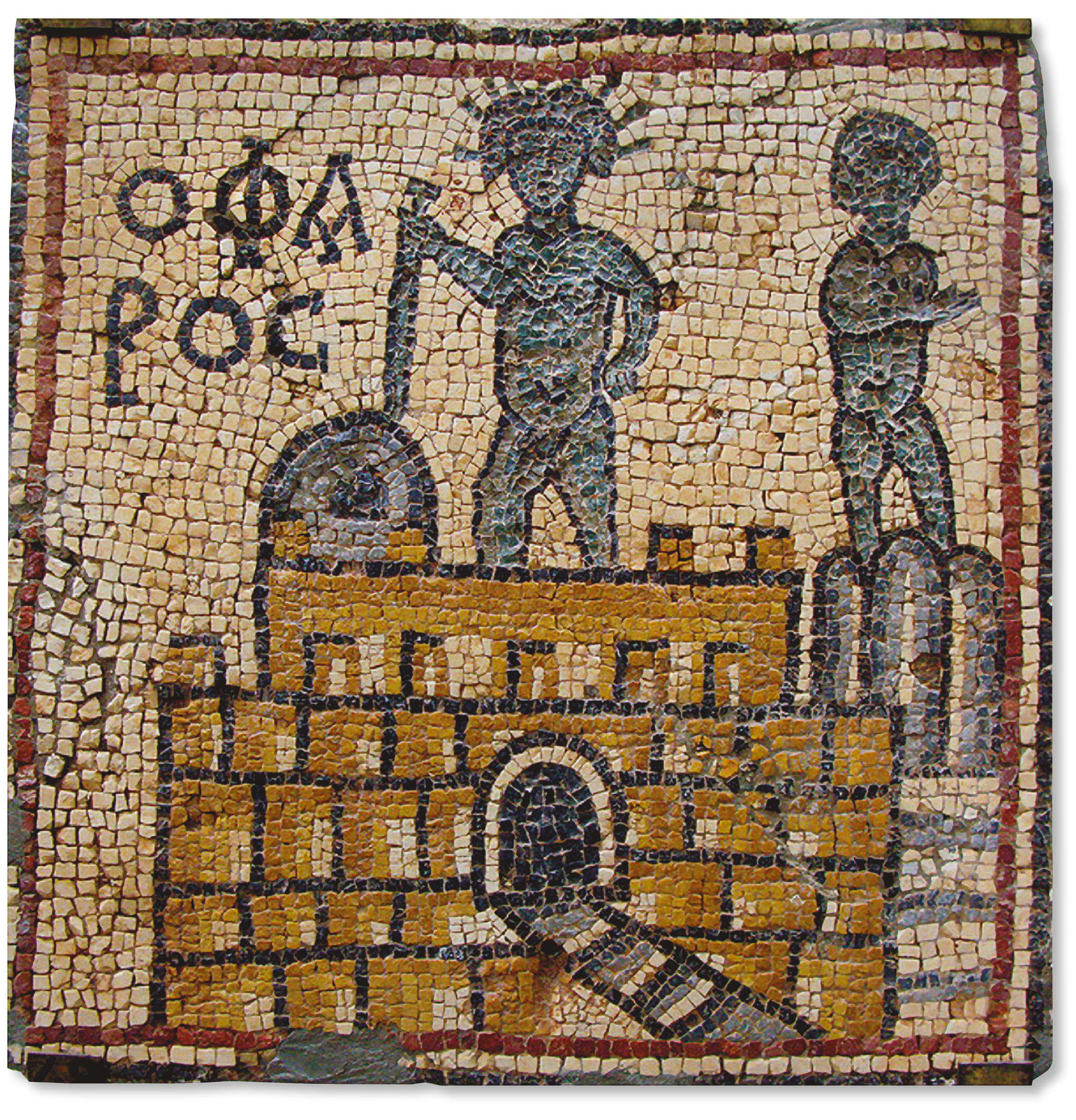
The modern conception of the Pharos is of a tower with a lantern in the form of a pillared cylindrical turret containing the light and surmounted by a statue. This form of the Pharos was defined in a famous book (Pharos, Antike, Islam und Occident: ein Beitrag zur Architekturgeschichte) published in Germany in 1909 by Hermann Thiersch, which contained splendid fold-out plates providing architectural drawings of the tower in various eras during its long existence. Thiersch had studied the available evidence intensively, so his reconstruction represented a great improvement in accuracy relative to its antecedents. However, on the matter of the lantern, there is no trace of such a structure in any ancient image, and there is an ancient mosaic of the Pharos in the Palazzo dei Conservatori in Rome that depicts a plain cylindrical turret supporting the crowning statue with no sign of any pillars. The earliest depiction of the Pharos with a lantern seems to be a drawing by Pirro Ligorio from the 1550s that he derived from Roman coin specimens from Alexandria. It looks as though Ligorio substituted a lantern for the crowning statue, which is missing from his reconstruction.
Thiersch imagined a basin of fire within the lantern as being the source of the light itself. However, the horizon of a 120m-tall tower can be calculated to lie at a distance of around 40km. To be seen that far away, a huge wood fire with a 2m-diameter flame would have been required. It would have released around 10 megawatts of power – enough heat to have crumbled the surrounding stonework within days, and would have consumed 50 tonnes of wood every night, and a whole forest in a year. Wood supplies on this scale would have been hard to source in ancient Egypt.
An efficient solution to the problem of fuelling the light would have been an oil lamp with a glass bulb which draws an airflow through the flame, feeding it with oxygen, and allowing it to burn much hotter and brighter. If that were the case, the flame would have needed to be only about 7cm in diameter to be visible at the horizon. The heat released would have been 1% of that from the wood fire, and about 130 litres of oil would have been consumed each night, which is merely a single barrel. Furthermore, we know that abundant oil supplies were available to ancient Egypt from the Nabataeans in nearby Arabia. However, this throws up a further problem, for a lantern, because the narrow flame from an oil lamp would be blocked from reaching huge swathes of the horizon by its pillars.
Positioning the lamp
Where, then, was the light located? The entire point of constructing such a tall tower was to enable the light to reach as distant an horizon as possible, so we should look for the light in the topmost reaches of the structure. The bulb of the oil lamp needs only to have been a metre or two in diameter, and it would have protected the flame from the elements, so a very high and exposed location is perfectly feasible. Furthermore, an exposed location was actually necessary, so that the light had an unimpeded path to the horizon in all seaward directions.
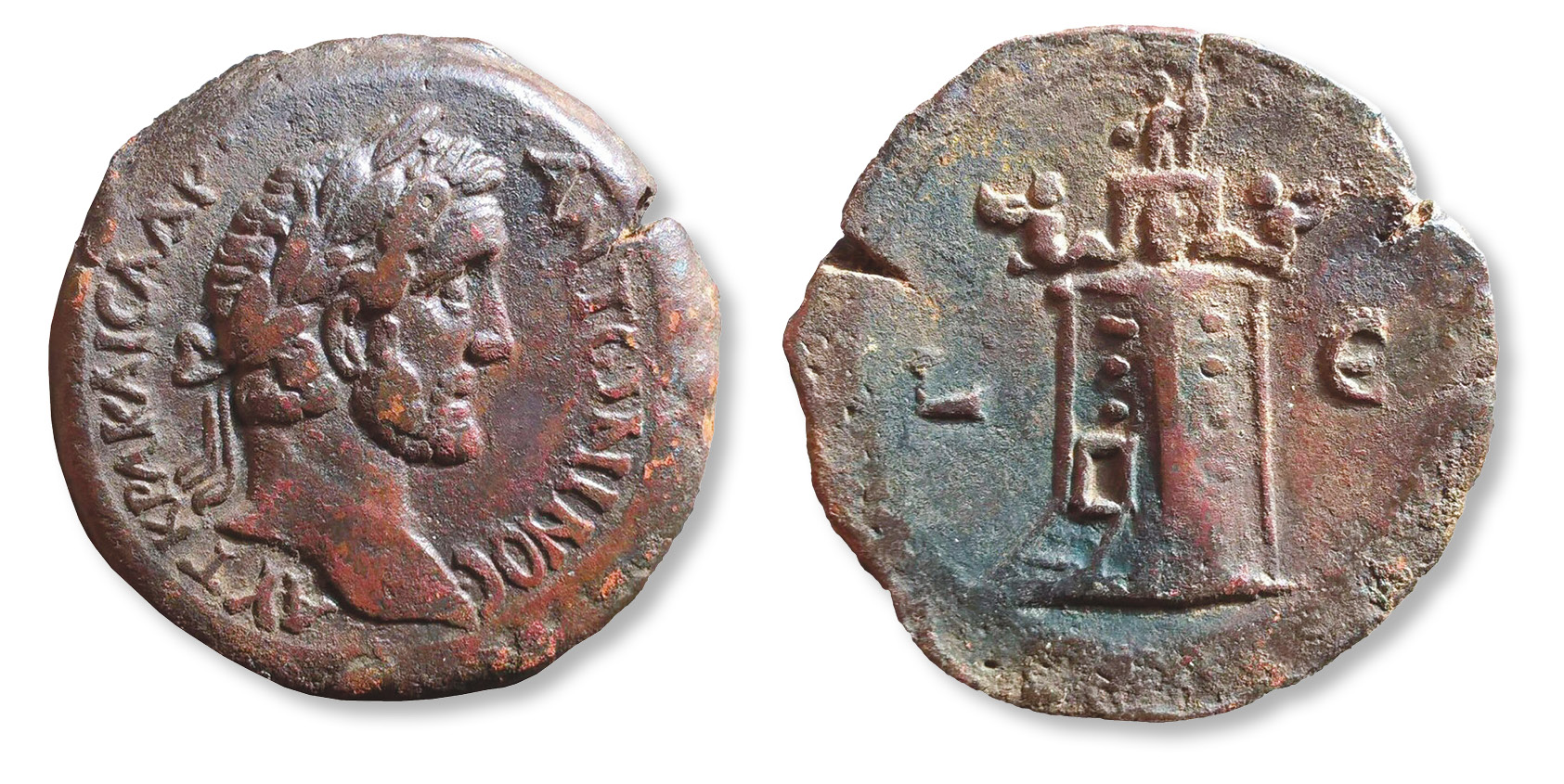
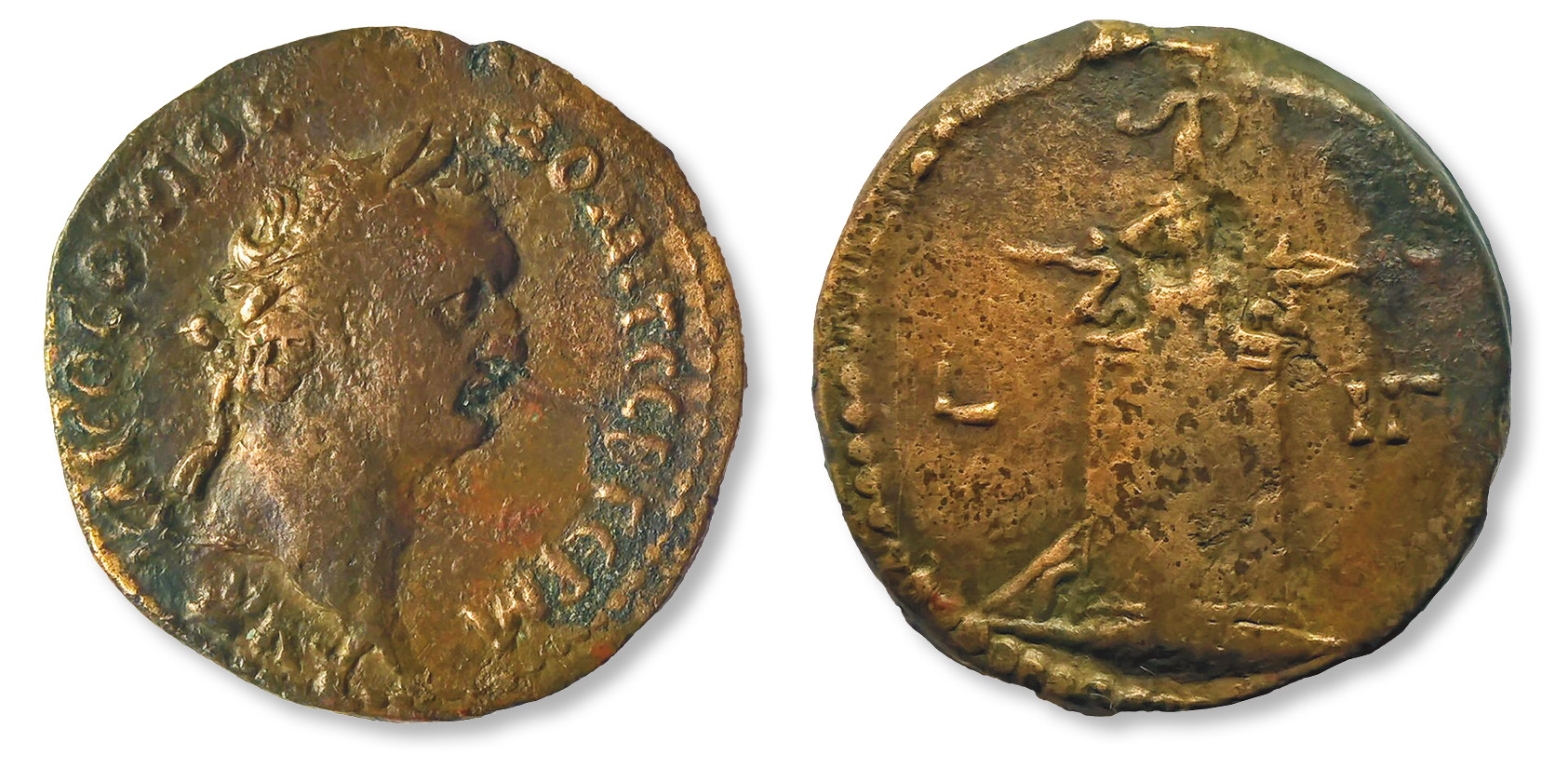
Examining specimens of the Roman coins (hemidrachms) that depict the Pharos, there is an obvious candidate for such an oil lamp in the form of a sphere being held out in the hand of the crowning statue. This statue is believed to have stood at least 7m tall, so the sphere in its hand could easily have been over a metre in diameter, with a clear view of virtually the entire horizon.

In some other engravings and coin images, the crowning statue appears to be empty-handed. There is also another crude mosaic representation of the Pharos from Qasr el-Libya in which the crowning statue is a nude male bronze with a reflective spherical object at his feet. He has a projection above his right hand, which might be an oil lamp wick, and a strut beneath the same hand, which might have been used to remove the spherical bulb and deposit it at his feet for cleaning. Therefore, essential maintenance in the form of washing off soot deposits provides an explanation for the bulb having regularly been removed from the light.
The statue in the Qasr el-Libya mosaic has rays emerging from his head. In Greek iconography, this is only normally seen on a nude, beardless, male figure when he is a representation of the sun god, Helios. Furthermore, another standard attribute of Helios is a celestial sphere held out in his hand.

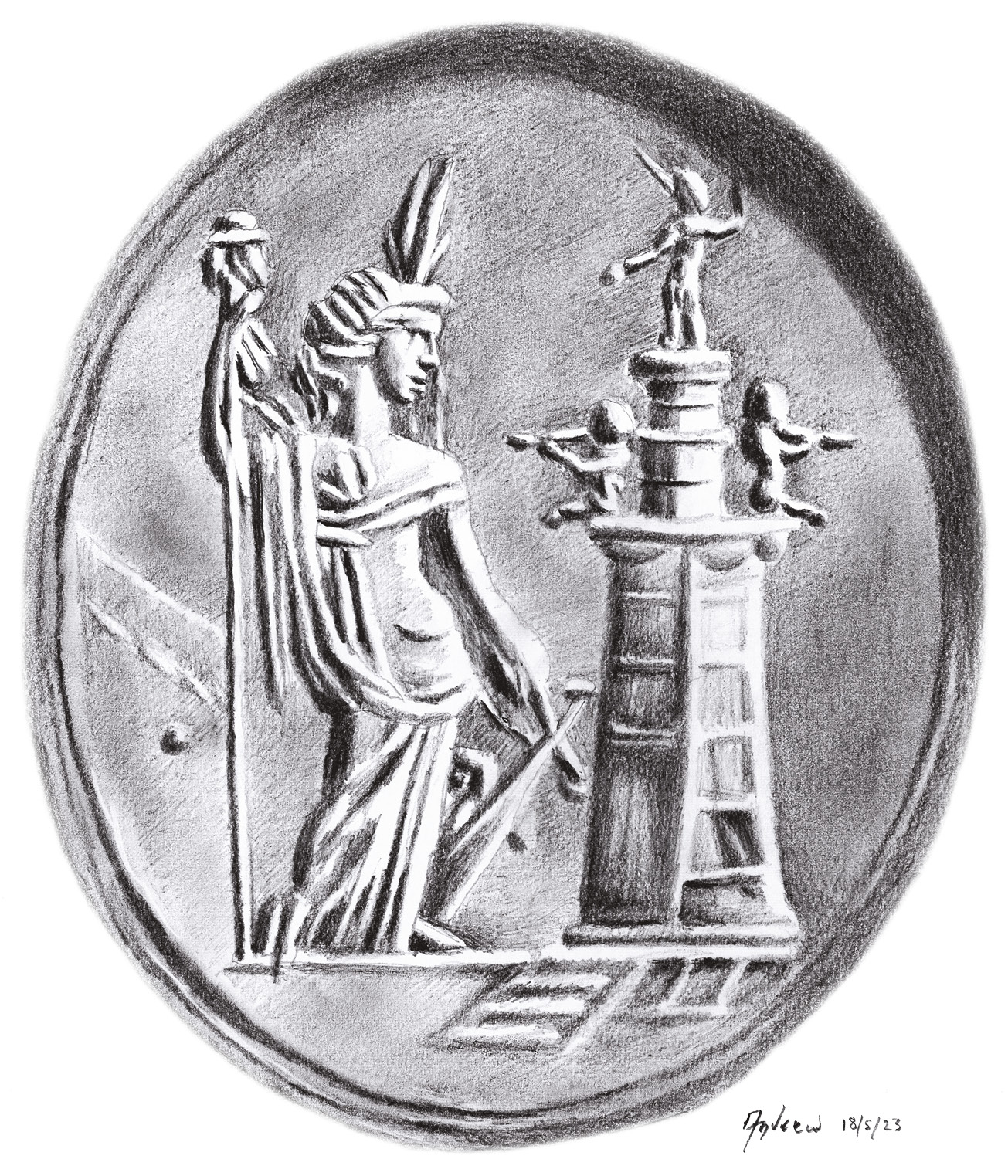
Most surviving ancient representations of the crowning statue are too small and indistinct to confirm his identity as Helios, but there is a Byzantine carved-gem seal in the British Museum that has a harbour scene, with a three-stage tower surmounted by a nude male figure holding out a sphere, and with rays emerging from his head. This provides confirmation that the crowning statue at the top of the Pharos was a representation of the sun god, leading us to appreciate that Achilles Tatius was being literal as well as figurative when he described the light of the Pharos as a second sun.
The Tritons and their trumpets
As well as Helios at the peak of the Pharos, there was a set of four statues of Tritons at the upper corners of the first stage of the tower which are given comparable eminence in the ancient images. Tritons were Greek mermen with fish-tails, sons of the sea god Poseidon, depicted blowing seashell trumpets. An intriguing detail is that about 10% of the Roman hemidrachm coins, and also an ancient carved blue-glass seal now in the Vienna Kunsthistorisches Museum, show the Tritons with a prominent phallus. This means they should be viewed as mascots symbolising the virility of the city of Alexandria as the nexus of a seafaring empire.
There is evidence as well to suggest that the trumpets of the Tritons were not just for show, but actually issued fog-horn sounds on demand. The mathematician and engineer Hero of Alexandria wrote a treatise on pneumatics in the city c.AD 60. In Section 75, he outlined the design of a steam engine with the specific purpose of making Tritons ‘honk’. It would seem quite likely this was a mechanism that had been installed in the Pharos, given that its Tritons would have been visible across the Great Harbour at the time that he wrote. So, the Pharos was not just an architectural wonder, but a spectacular sound and light show, too, utilising what was cutting-edge technology in the era of its construction.

The tower as a plinth for its statues
The Rhodians, who were allies of Ptolemy I, set up another of the Seven Wonders on their island almost in parallel with the construction of the Pharos in Alexandria. This was the Colossus of Rhodes. Various ancient pieces of evidence reveal that the Colossus was also a representation of the sun god Helios, and that it was given the features of Alexander the Great.
For example, the head of Alexander in the Capitoline Museums in Rome is connected with the Colossus by the Roman writer Pliny, and has holes spaced around the head to accommodate the gilded bronze rays of the radiate crown of Helios. Several coins from the later Ptolemaic era also show the kings wearing the radiate crown of the sun god.


Above & below: A drachm struck in Alexandria during the reign of Hadrian (AD 117-138) bearing the profile of the emperor on the obverse, and Alexander-Helios on the reverse (from the author’s collection).
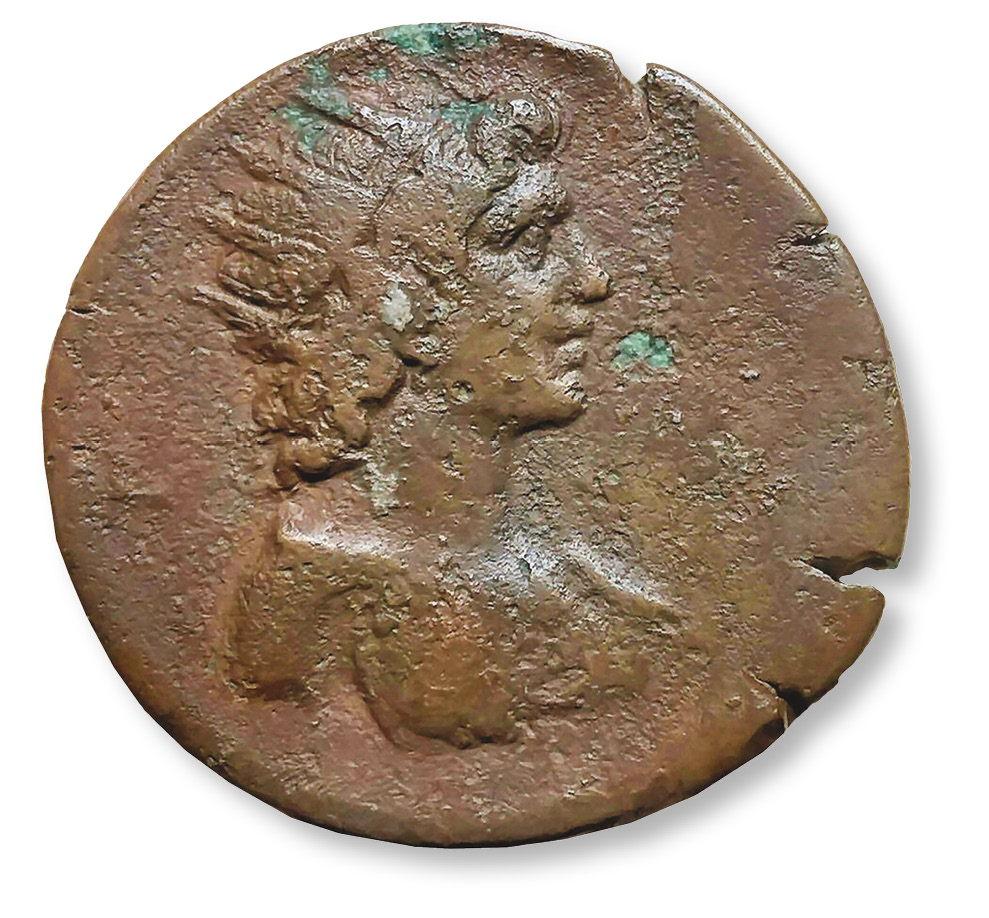
There is a portrait, too, of Helios wearing his radiate crown on multiple Roman coin types from Alexandria. These Alexandrian profiles of Helios are likely to be modelled on the head of the statue of Helios atop the Pharos, but they bear a striking resemblance to the head of the Colossus of Rhodes as well. It can therefore be inferred that the statue on the Pharos was Alexander-Helios.

So, the crowning statue not only bore the light, but also commemorated the founder of the city of Alexandria, Alexander the Great, and welcomed visitors to his city. Similarly, the Tritons served the dual purpose of providing foghorn sounds to guide or greet ships, and as mascots epitomising the virility of Alexandria as a seafaring power. From the point of view of the ancient Alexandrians, these functions of the statuary were the most important features of their lighthouse, and the tower itself was merely a suitably lofty pedestal on which to display them. This is why the surviving ancient depictions of the Pharos make the statues so prominent, considerably exaggerating their size relative to the tower.
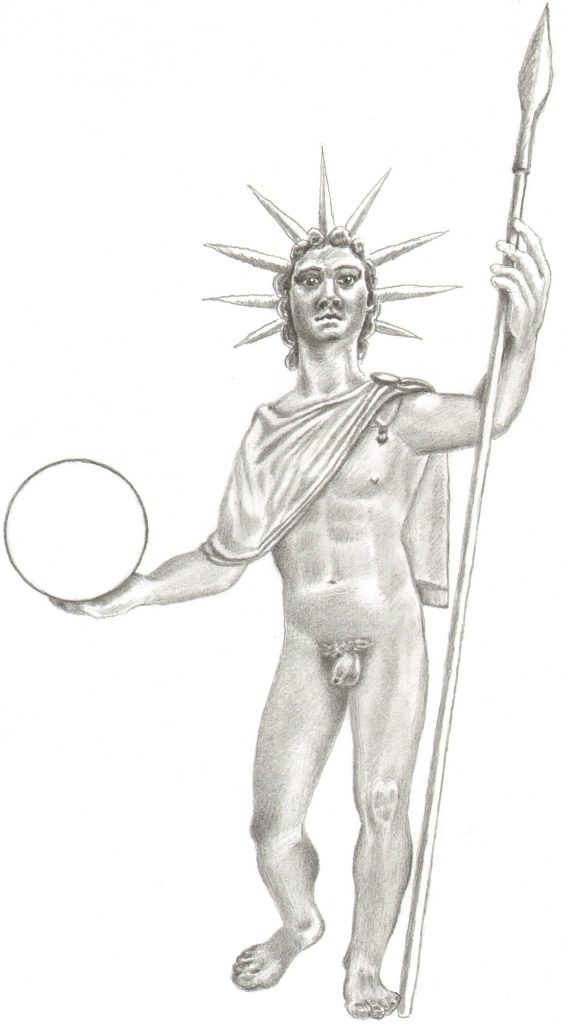
A close-up of the Alexander-Helios statue, as drawn by the author.
An inspiration to Eratosthenes
Sostratus appears to have fixed the height of the Pharos light such that it could be seen by vessels up to a day’s sailing away from Alexandria. In order to devise that arrangement, he needed to have measured and quantified the relationship between a light’s height above sea-level and the distance to its horizon: specifically, to double the distance to the horizon, the light needs to be four times higher. Greeks understood geometry, so it is likely that they realised that this relationship meant the surface of the sea is part of the surface of a sphere. Just a few decades later, the polymath Eratosthenes (c.276-194 BC), head of the Library of Alexandria, made an accurate measurement of the circumference of the Earth. The circumstances suggest that he was inspired in this endeavour by the understanding of the curvature of the sea’s surface from the work of Sostratus, and perhaps also by actual observations from the windows of the Pharos. Eratosthenes went on to make measurements of the distances to the moon and the sun by applying similar geometrical principles. Therefore, there is a close connection between the construction of the Pharos and some of the most spectacular feats of Alexandrian science later in the Ptolemaic era.
Reconstruction
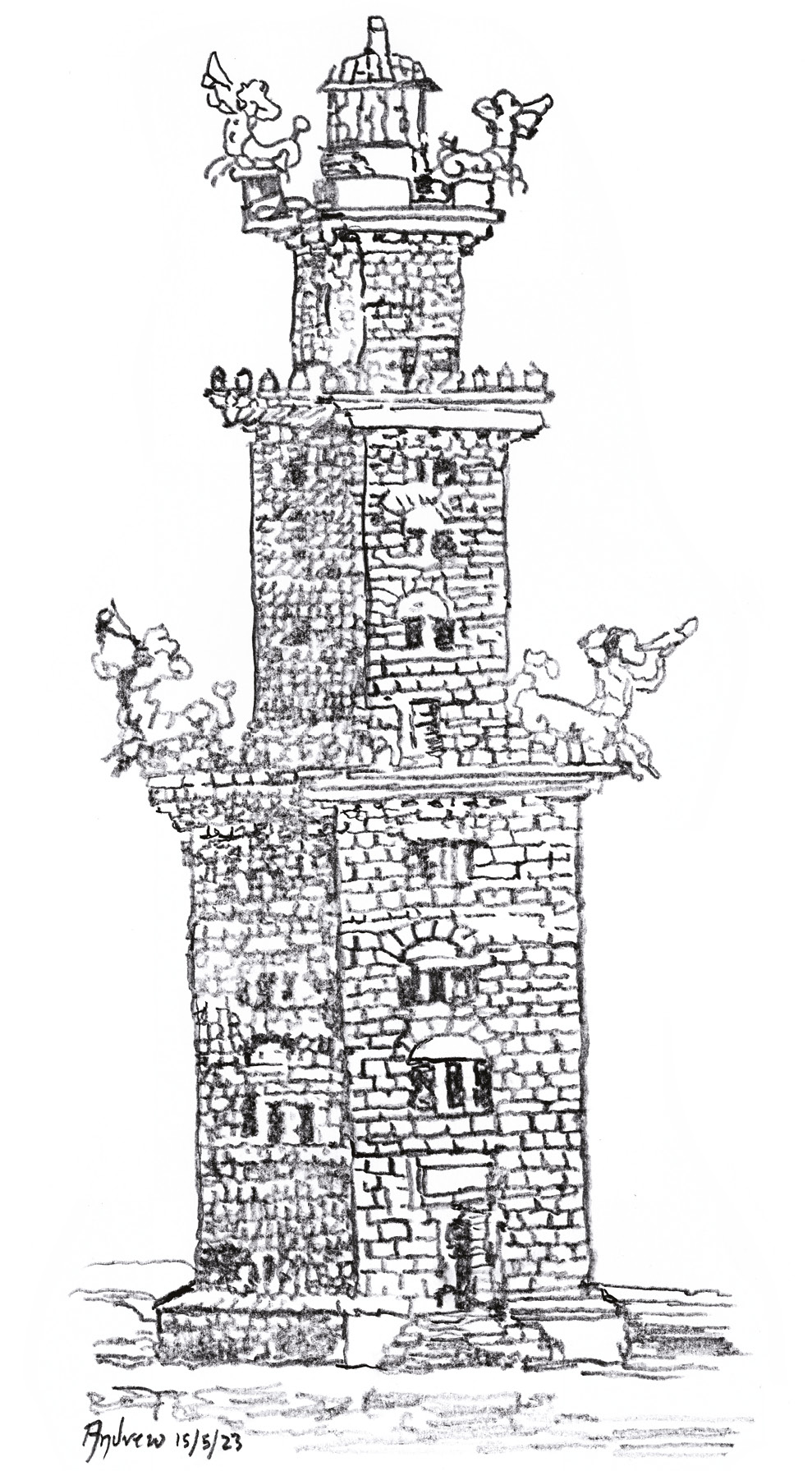
A fresh reconstruction of the Pharos by the author incorporates new research on the light and the statuary. The lantern adopted by Thiersch is gone and the light is now an oil lamp in a spherical glass bulb, held out in the hand of the crowning statue of Alexander-Helios, as is dictated by science and the ancient images. The white glow of the hot flame in the oil lamp in the half-light just before dawn can be imagined on a typical day in Alexandria in the 3rd century BC, accompanied by the sudden blaring of the trumpets of the Tritons, welcoming a state galley into the Great Harbour.
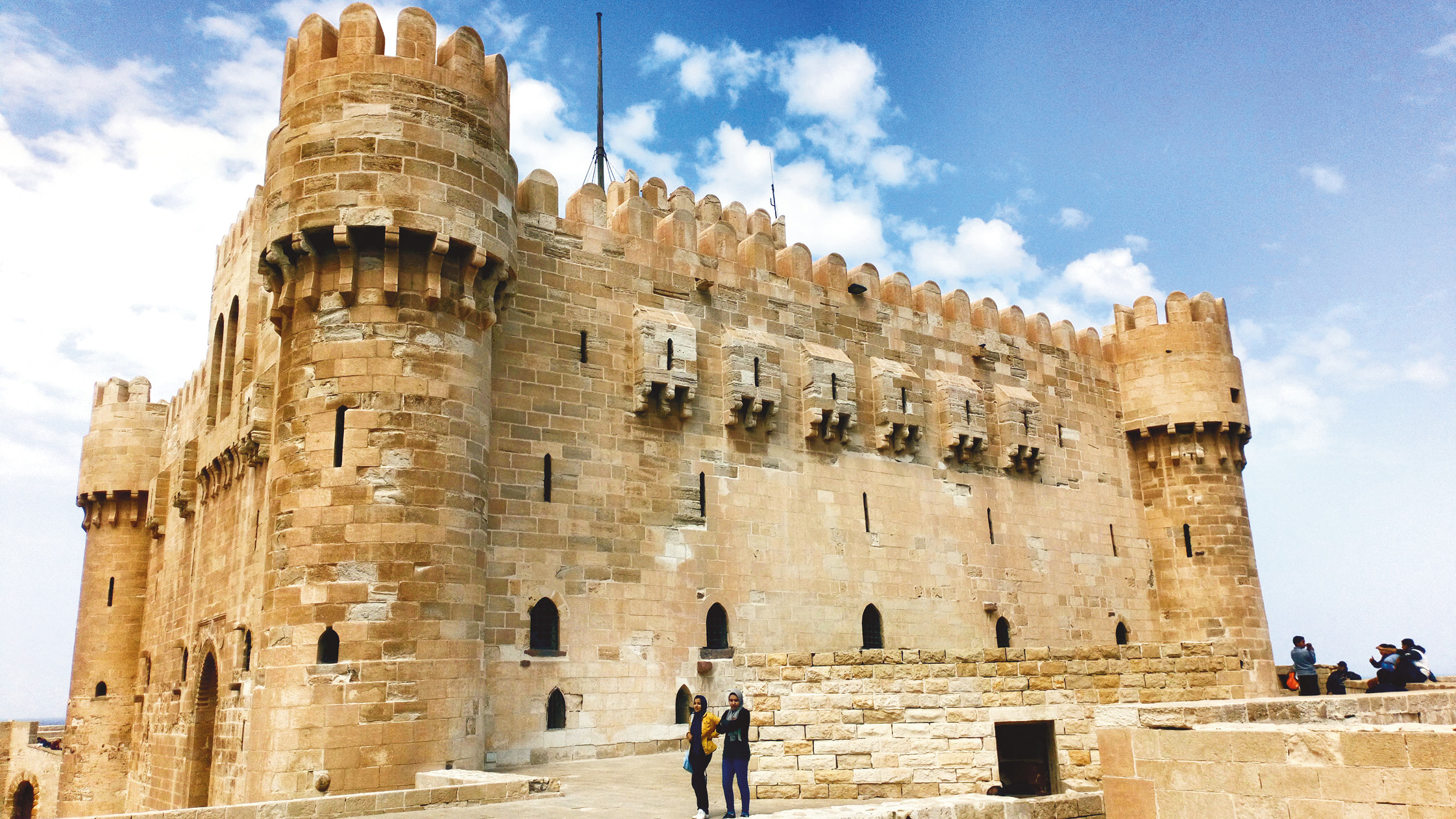
It is currently impractical to consider the physical reconstruction of the Pharos on its original site on the western side of the entrance to the Great Harbour, since it is occupied by the 15th-century Qait Bey fortress. However, a detailed and accurate virtual reconstruction is increasingly feasible as understanding of its features improves, so this may be the best way to preserve the memory of one of the most important and influential buildings in the history of the world.
Andrew Michael Chuggis a Natural Sciences graduate of the University of Cambridge, and the author of The Pharos Lighthouse in Alexandria, Second Sun and Seventh Wonder of Antiquity (Routledge, March 2024 – reviewed in AE 145). He has also written a number of papers and books about Alexander the Great, and appeared as an expert contributor on various radio and television documentaries. You can find out more about the search for Alexander’s tomb (with videos) on Andrew’s website at http://www.alexanderstomb.com.
All images: the author, unless otherwise stated