
More finds from Magna Roman Fort
The latest season of digging at Magna Roman Fort is currently uncovering further details of how the site was used both during and after the Roman period. One of the star finds for 2026 so far is a die which…

The latest season of digging at Magna Roman Fort is currently uncovering further details of how the site was used both during and after the Roman period. One of the star finds for 2026 so far is a die which…

A metal-detectorist has discovered a hoard of Roman bronze objects in the Chilterns, Buckinghamshire, including a rare rattle that may have been used in religious ceremonies (below centre). Adam McClelland was detecting with the permission of the landowner when he…

Several recent reports have suggested that participation in cultural activities is good for one’s well-being. Under the headline ‘Daily dose of art as important to health as 5-a-day’, The Telegraph reported that cultural engagement not only slows down ageing, but is a ‘human necessity’.

Castlehill Wood, located south-west of Stirling, has historically been labelled a ‘dun’ – a poorly defined term that is usually used to describe an unroofed enclosure that is smaller than a hillfort but more fortified than a farmstead. Situated within…

This slim volume is the latest addition to the ‘50 Finds’ series produced by the Portable Antiquities Scheme in England and Wales (PAS). While most finds recorded by PAS are metal artefacts recovered by detectorists, more than 100,000 struck flints…

This volume by Helena Hamerow and her team is the interpretive companion to their digital database () for the recently finished five-year FeedSax project. It explores the profound changes in farming and environment across the period, with new insights on…

This site report details excavations carried out by Oxford Archaeology ahead of the replacement of the gas transmission pipeline that crosses the Humber between Goxhill in North Lincolnshire and Paull in East Yorkshire. Palaeoenvironmental evidence sheds light on how this…

This is the latest in the ‘…in 20 Digs’ series. Gavin Speed has been involved in Leicester’s archaeology for more than 20 years, and he has produced a well-illustrated account of 20 key sites in Leicester (with a bonus 21st…

‘There’s no time like the present’, as the adage goes – and those who specialise in Contemporary Archaeology certainly agree. John Schofield explores how applying archaeological techniques to the material remains of our own times can illuminate current issues, as well as improving our understanding of the past.

Mining is rooted in Cornish heritage and woven into the fabric of Cornwall’s historic landscape, and so it seems fitting, as we mark the 20th anniversary year of the Cornwall and West Devon Mining Landscape becoming a UNESCO World Heritage…

While this summer’s drought conditions have had a dramatic effect on many aspects of our environment, one upside of the recent hot and dry conditions has been the discovery of long-forgotten or completely unknown archaeological sites. This was the case…

Tiny traces of medieval wall-paintings have been discovered at Goodrich Castle in Herefordshire, transforming our understanding of how its chapel was decorated. Carly Hilts spoke to Sophie Stewart to learn more.

Scottish Archaeology Month, Archaeology Scotland’s flagship festival, returns this September to showcase the best of the country’s archaeology, history, and heritage in a month-long programme of events for all ages. Tessa Till shares some highlights; full listings are at www.archaeologyscotland.org.uk/events.

On 9 February 1538, Abbot Thomas Rowland signed a Deed of Surrender, formally handing over his monastery to Henry VIII, and the 1,000-year history of Abingdon Abbey came to an end. As a reward for giving up their property voluntarily,…

CA recently visited exhibitions at three sites in the care of North East Museums, with displays exploring Roman military life and ideas of ‘treasure’.

Recently published research suggests that the bones found around Brading Roman Villa could reflect violent events linked to 4th-century political upheaval. Kathryn Krakowka reports.
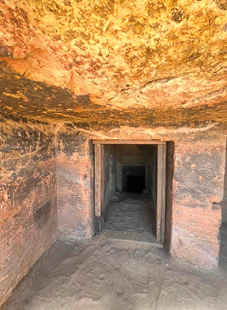
Three rock-cut tombs belonging to high officials of the early New Kingdom have been discovered by an Egyptian team in the Bubasteion necropolis at Saqqara. The tombs are inscribed with their biographies, and provide important evidence of Egypt’s foreign relations…
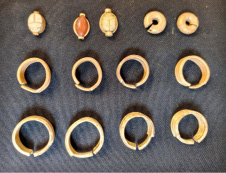
Archaeologists working at ancient Heliopolis (Matariya, Cairo) have uncovered an almost complete funerary assemblage beneath a mud-brick burial structure. The discovery includes a collection of personal and ritual objects, including a copper mirror, alabaster kohl vessels containing traces of cosmetics,…
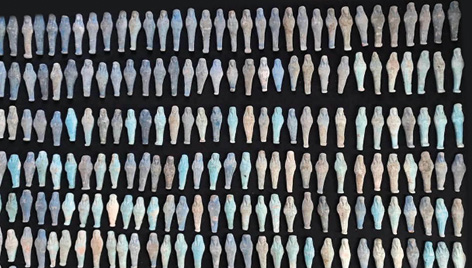
An Egyptian mission has documented an unusual funerary practice in a newly discovered tomb at the Tell Quesna necropolis (Menoufia Governorate), in the central Delta. The team discovered several burials with pottery dishes placed beneath the arms and between the…
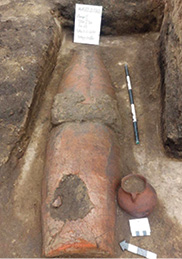
An Egyptian team excavating the multi-period cemetery at Tell Kom Aziza (Beheira) in the Delta has uncovered a section dating to the Graeco-Roman Period with diverse human funerary practices. Burials ranged from simple pits and mud-brick-lined tombs, to decorated gypsum…
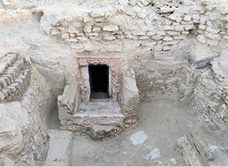
A Dutch team from Leiden University has discovered a previously unknown Ramesside tomb in Sheikh Abd el-Qurna. Wall inscriptions name the owner as an official called Paser. The tomb has a typical Theban layout, with an open courtyard containing a…

A large multi-functional complex dating to the Fifteenth Dynasty (the Hyksos era) has been uncovered by an Egyptian mission at Tell el-Ku’a in Wadi Tumilat (Ismailia Governorate) in the eastern Nile Delta. The team discovered a walled residential compound, measuring…

Geoffrey Lenox-Smith pays a return visit to the Grand Egyptian Museum to view the new galleries.

Robert R Frost explores the life and legacy of the antiquary, traveller, and pioneer of British Egyptology.

The Osirion is one of the most intriguing New Kingdom monuments. It is located behind the Sety I temple at Abydos, the burial place of Osiris. Now open to the sky, this unique structure was originally subterranean, built to resemble…

Pioneering research in the Francis Crick Institute’s Ancient Genomics Lab is boosting our understanding of past populations, people, and pathogens. Carly Hilts spoke to Tom Booth and Kat Nilsson and explored a new exhibition sharing some of these findings.

In my previous two columns I explored some of the great religious buildings of Britain; these are primarily known for their medieval and later histories, and for their towering urban architecture. This month, I will move back in time to explore some of the great sites associated with the early church that have been visited by Current Archaeology over the decades.

My recent ‘Odd Socs’ column on the Ancient Tree Forum (CA 436) proved to be unexpectedly topical when, on 18 June, it was announced that Sherwood Forest’s 1,200-year-old Major Oak had died. The expressions of sadness that followed showed that many people loved this tree and considered it an important part of our national heritage.

Archaeology has been ‘solved’! (or, how we shed some light on dark earth…) It was great to see Cotswold Archaeology’s research into the function of burnt mounds included in ‘Sherds’ (CA 435). Chris Catling suggested that we should now turn…

Norwich today has more medieval churches than any other city north of the Alps. The Brooke Commission concluded in 1970 that only six were required for parish worship and that either alternative uses should be found for the rest or they should be demolished. Fortunately, 31 remain, with half a dozen continuing to be used as churches and 18 in the care of the Norwich Historic Churches Trust. A newly published and sumptuously illustrated interdisciplinary study shows us what these churches can tell us about the city’s past and its people, as Chris Catling reports.

There are lots of great ways to get involved with history and archaeology over the next few months, including exhibitions, lectures, and conferences exploring a wide range of subjects. If you would prefer to get your heritage fix from the comfort of your sofa, though, there is a variety of resources on offer online, too, from virtual site tours and digital offerings by museums to podcasts, TV shows, and more. Kathryn Krakowka has put together a selection of some of the options available.

In mid-May, the day before CA 437’s print deadline, we joined a press conference to hear about an exciting discovery associated with Stonehenge. Keen to keep to our commitment to bringing you ‘current’ archaeology, we included a brief summary of the key findings in last month’s issue – here is a fuller account of the research that was described by Phil Harding, Matt Leivers, and Fabio Silva.

A new exhibition at the Royal Armouries Museum in Leeds explores the history and legacy of the Mongol Empire. Carly Hilts visited to learn more.

New insights into the Plain of Jars in Laos Xieng Khouang Plateau in northern Laos is dotted with hundreds of ancient stone jars. While they have been the subject of archaeological investigations for over a century, their full use and…

Another prehistoric circle was recently uncovered during a community archaeology project, this time near the Giant’s Ring, just outside Belfast. The investigation, led by archaeologists from Queen’s University Belfast, was sparked by a re-examination of aerial photographs taken in the…

A small glass bottle excavated at Tanner Row in York 40 years ago has been identified as a kohl bottle – a type of eye make-up container that was very common in Roman Egypt, but is extremely rare outside this…