
Subscribe now for full access and no adverts
Animals have held many roles throughout human history, from the helpers of hunter-gatherers and beasts of burden to guards, moral exemplars, and entertainers. They capture our imaginations as fictional characters, advertising icons, political emblems, and satirical symbols. Above all, though, many are much-loved members of our households. How did this complex relationship evolve? Pets & their People, a recently opened exhibition at the Weston Library (part of the Bodleian Libraries in Oxford), explores why we invite animals into our homes, and what this bond reveals about us.
It is a story whose origins are ancient: among the colourful displays of posters, photographs, illustrations, and advertisements, it is easy to overlook a pale piece of bone, but this find – a 14,300-year-old dog mandible from Gough’s Cave in Somerset – has an intriguing tale to tell. Isotope analysis reveals that this dog ate the same diet as the humans whose remains were also discovered in the cave – and that is not all that they shared. A large hole was drilled through the mandible after the dog died, and similar treatment had been accorded to some of the human bones. Were they being given the same funerary rites, and might this suggest that they were seen as part of the same group, even the same family?
Alongside such enigmatic evidence, some ancient attachments are more obviously sentimental. A 3rd- or 4th-century AD papyrus from Antinoopolis in Egypt preserves a letter, written in Greek, suggesting that the recipient should ‘send Soteris the puppy since she now spends her time by herself’. A 5th-century BC account by the Classical historian Herodotus, meanwhile, attests that contemporary Egyptians would run into blazing buildings to rescue their cats – though the nearby display of a mummified feline, one of thousands known to have been farmed specifically for sacrifice, highlights that human–animal relationships have never been straightforward.
Today, keeping pets is not cheap – from vet bills, insurance, and food, to the innumerable toys, treats, and accessories that advertisers pressure us to buy for them – and visitors to the exhibition may raise a wry smile to see that animal-related outlay and admin is nothing new. The displays include a 3rd-century papyrus whose account of daily expenses lists ‘bowls for the dogs’, as well as a 2nd-century receipt for registering camels, shown alongside more recent Blackpool tram tickets for dogs.
As well as enjoying these heart-warming insights, visitors are encouraged to consider darker aspects of animal ownership, from the disabling effects of some selective breeding to commercial exploitation in the name of entertainment (including an array of 19th-century flyers trumpeting the skills of ‘learned cats’, ‘scientific sparrows’, dancing dogs, and performing fish). The depth of human–pet relationships, however, is most powerfully reflected by objects and images examining how we mourn and mark their short lives – complemented, more light-heartedly, by a display of ‘animal substitutes’ that show how keenly many desire to have something to care for, from Tamagotchi to the mid-1970s marketing miracle of ‘pet rocks’.
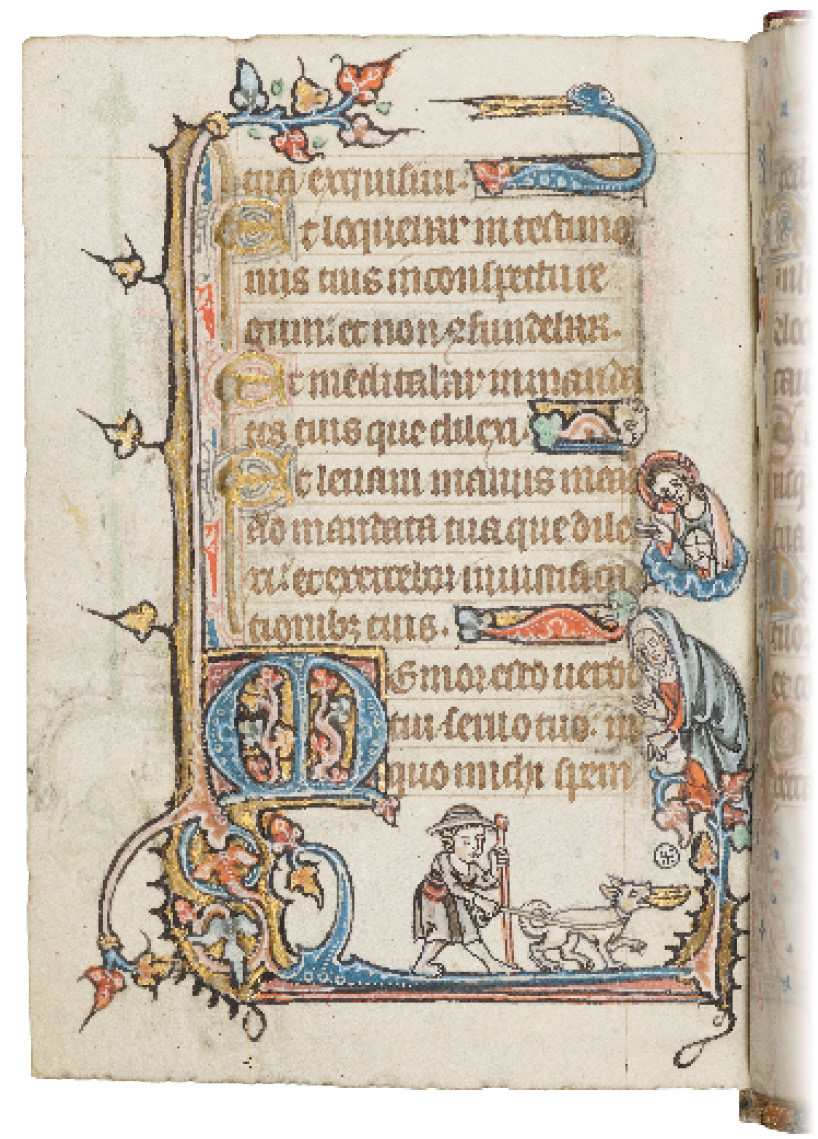
Perhaps one of the most visually striking images of our long coexistence and cooperation, however, is an illustration from a 14th-century Flemish psalter. It shows a dog leading a blind man (who grips its leash in one hand and a staff in the other) while carrying his alms bowl in its mouth: one of the earliest known depictions of a guide dog.
Further information: Pets & their People is at the Weston Library, Oxford, until 27 September 2026. See https://visit.bodleian.ox.ac.uk/event/pets-and-their-people for more details. There is an accompanying book of the same name, reviewed here.
Image: © Bodleian Libraries, University of Oxford