Subscribe now for full access and no adverts
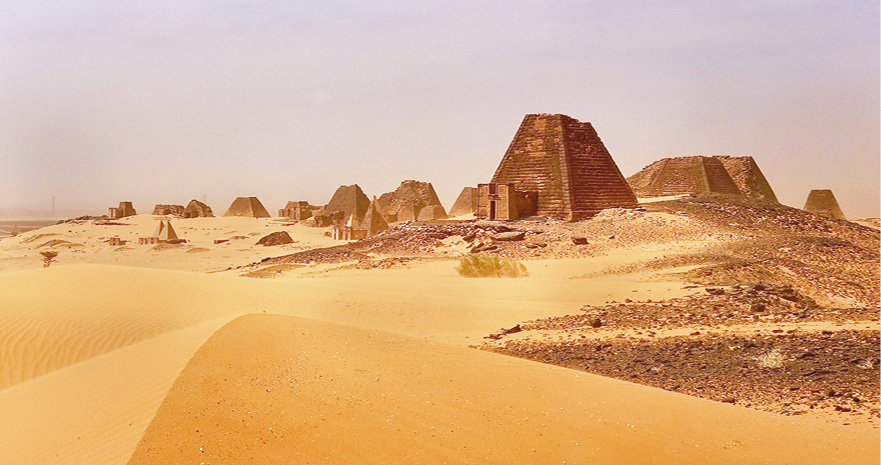
Having visited the far north of Sudan during a trip made earlier this year with my travel companion Paul (see AE 139), it was time for us to sweep down through Upper Nubia, back towards Khartoum. Our mission was to explore some of the archaeological sites in an area commonly known as the ‘Island of Meroë’.
KERMA
Our first stop on this journey was the Kerma Museum and the exquisitely carved statues of the Napatan kings, replicas of which had inspired my trip to Sudan. Outside the museum the imposing 18-metre-high mud-brick structure known as the Western Deffufa dominates the royal settlement that was at the heart of the Kerma kingdom, and we were able to climb the various mud-brick staircases and ramps that took us to the top.
Dukki Gel
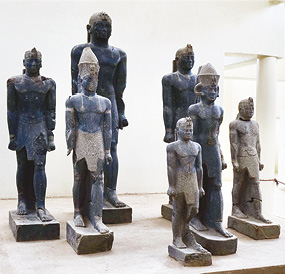
The cache of black granite statues of Napatan kings found at Dukki Gel.
The cache of statues was not found at Kerma, however, but at another settlement, now known as Dukki Gel, a few kilometres away. Dukki Gel (a Nubian term meaning ‘red mound’) is commonly believed to be the site of the ancient city of Pnubs. There had been a temple of Amun at Pnubs, which experienced much the same fate as the Temple of Amun at Gebel Barkal. It was founded by Thutmose III, and converted to a temple of Aten worship by Akhenaten (it is one of the most southerly versions of an Aten temple), before being rededicated to Amun during the Nineteenth Dynasty. We saw several examples of talatat blocks in the museum that were found in situ at the site. Having been largely abandoned during the Ramesside era, the temple was restored by the Nubian rulers of the Twenty-fifth Dynasty.
The settlement of Pnubs continued to be inhabited by later Napatan rulers until an invasion of Kush by the Twenty-sixth Dynasty king Psamtek II (documented on his ‘Victory Stela’ at Kalabsha) forced the Kushite king Aspelta to move the focus of his kingdom further south towards the relative safety of the city of Meroë. It was possibly during this invasion that the many statues of various Napatan kings were mutilated and carefully buried at both Dukki Gel and Gebel Barkal. When they were first analysed, it became apparent that they had been intentionally damaged using a bronze chisel. The almost perfect state of conservation of the stone surfaces also indicated that very little time elapsed between the destruction of the statues and their burial. It was most probably Aspelta – who reigned for a further 20 years after the invasion of Psamtek II – who ordered their careful burial on hallowed ground.
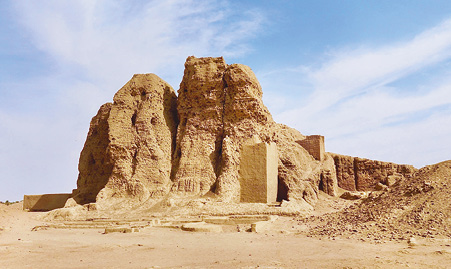

Before we set off from Kerma, our Sudanese guide Ibrahim asked for the security gates of Dukki Gel to be opened, and a police escort was arranged so that I could briefly visit the find-site of the statues. The statues were discovered by the Swiss archaeologist Charles Bonnet and his team in 2003.
The Royal Route to Meroë

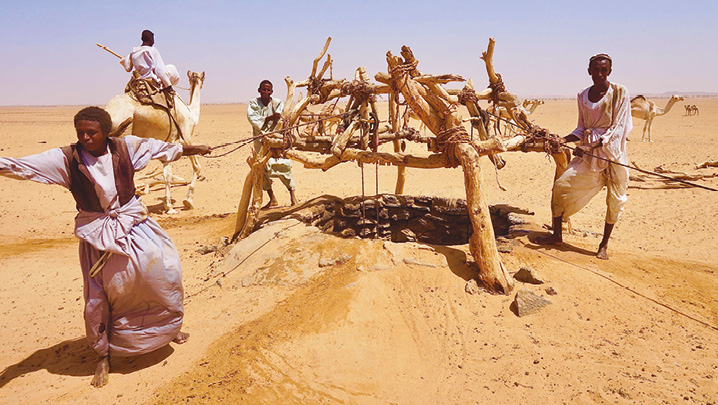
It was time to make our onward journey to the ‘Island of Meroë’ – an area of land bordered by the Nile to the west, the Atbara to the north-east, and the Blue Nile to the south. From Karima, it was an incredibly thrilling four-hour drive across the pale-yellow sands of the Bayuda Desert. This was the same overland route that the Meroitic rulers of Kush had taken when travelling from their palaces at Kerma and Napata to the new royal city of Meroë. It was also an important source of gold for the pharaohs of the New Kingdom. Today it is a vast expanse of scorching hot desert in the giant ‘hook’ formed by the Great Bend in the Nile between the Fourth and Sixth Cataracts. First, we drove for two hours on a simple but isolated tar road, and then for another two hours directly across the coarse desert sands, stopping at one of the ancient wells that still provide fresh water for nomadic pastoralists such as the Bisharin tribe, and other travellers in the area.
MEROË
After a final passage across the Nile on a very rusty pontoon ferry, to the region now known as Butana, it was not long before the World Heritage Site of Meroë was in sight. We were soon settled into our campsite, and from my tent I could see, on the near horizon, the sun setting over the distinctive silhouette of the steeply pointed peaks of the Meroitic pyramids.
Our first day in Meroë was possibly the hottest that I have ever experienced. Temperatures rose to the low 50s centigrade and, to make things even more inhospitable, there was a hot wind savagely sweeping across the dry desert landscape. As we headed out to the first cluster of royal pyramids – the Southern Cemetery – I quickly realised why so many of the artefacts from Meroë that we see in museum collections around the world are heavily eroded. The wind was picking up small rocks and clumps of gritty sand and swirling it around the atmosphere. I can best describe the feeling of being outside in this combination of wind and heat as like being inside a giant hairdryer while having hot grit thrown at you.
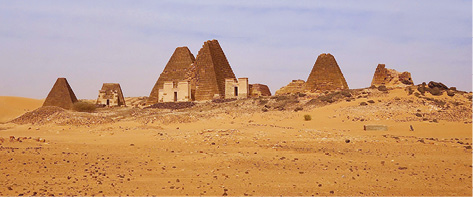
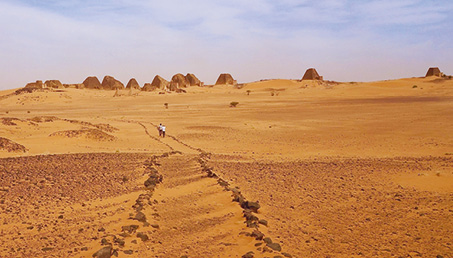
The dramatic red-orange desert landscape around Meroë hosted a large necropolis for the final Kingdom of Kush from around 300 BC to AD 400. The elite burials were divided by location into what are now called the Northern Cemetery, the Southern Cemetery, and the Western Cemetery.
Southern Cemetery
The earliest burials are in the Southern Cemetery, which was in use up to the first half of the 3rd century BC and contains more than 200 tombs. Among its pyramids are the royal graves of the first two Meroitic kings – Arakamani and Amanislo – and several non-ruling queens. During the Meroitic era, strong female rulers were of equal status to male rulers and a central part of government. The role of a kandake (or candace) was a crucial element in the often-confusing world of Kushite succession. A kandake was the sister of a ruling king, and would bear the next heir, making her the queen mother. Some kandakes were rulers in their own right.
Northern Cemetery
The Northern Cemetery was established in the second half of the 3rd century BC by King Amantekha. The pyramids of the two best-attested Meroitic rulers – Kandake Amanitore and her co-regent son King Natakamani – flank the ends of a sweeping curve of tombs. It was the necropolis for around 40 kings and queens, plus several crown princes, leading up to the end of the kingdom in the 4th century AD. The Western Cemetery, located near to the royal city, was largely used for the burial of the non-royal elites.
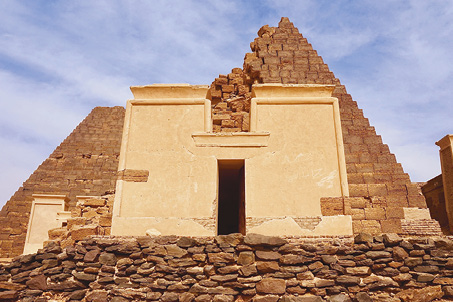
The Meroë pyramids consist of burial chambers cut into bedrock. Each has a staircase leading down to the burial chamber, and a superstructure made of local sandstone. The superstructure consists of a small, steep pyramid (around 30 metres in height, with inclinations between 60° and 70°), and a single-room chapel to the east. Cladding stones are either laid smooth or stepped, and the core of the pyramid is filled with rubble. At the chapel entrance is a small pylon, and some of the pyramids have evidence of further exterior courtyards and temenos walls. Many of these chapels are now reconstructed. The interior walls of the chapels are decorated with familiar reliefs, although most were severely weathered, and it took us some time to decipher the depictions. Scenes include various mortuary rituals; food offerings; a false door for the deceased to enter and exit the tomb; a procession of priests; demons with knives guarding the entrances; and depictions of Egyptian gods and goddesses such as Isis, Osiris, Anubis, Horus, Geb, Thoth, and Nephthys.
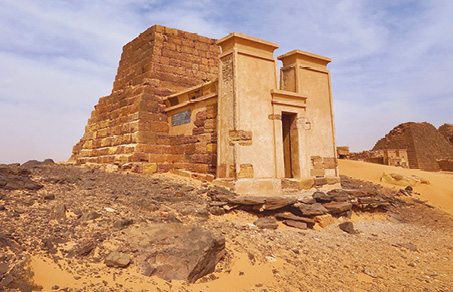
Western Cemetery
Disappointingly, the site of the walled royal city of Meroë, the political and religious heart of the Meroitic empire, was closed due to bad flooding that had occurred in 2020. We could, however, visit the Western Cemetery, the heavily eroded ruins of a sun temple (of unknown dedication) to the east of the city walls, and a cult temple dedicated to the Meroitic lion-god Apedemak.
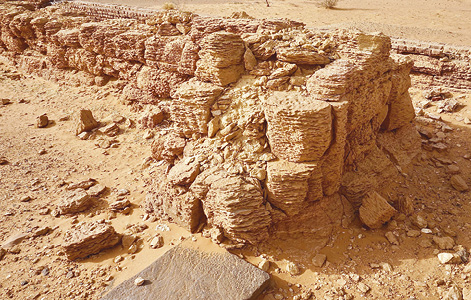
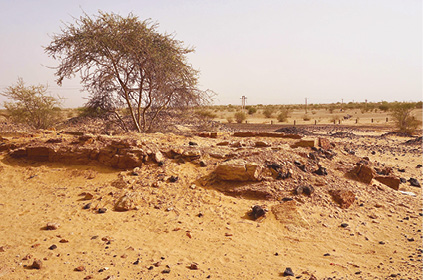
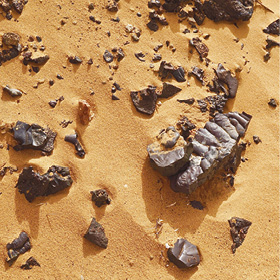
For centuries the major temples of Kush had been built for gods of the Egyptian pantheon, such as Amun, but with the shift of the Kushite kingdom’s political centre to the south, the cults of more local gods gained prominence. The most-attested of these was Apedemak, whose name is a combination of the Meroitic words meaning ‘creator’ and ‘god’. The ruins of the lion temple (as described by Liverpool archaeologist John Garstang, who excavated at the site between 1909 and 1914) are found on a landscape littered with lumps of iron slag, the leftover impurities from the iron-smelting process. Iron production took place on a large scale at Meroë and contributed significantly towards the success of the kingdom. Weapons, agricultural tools, and ornamental items such as jewellery were produced in large numbers. The smelters of Meroë made iron using the bloomery method, which resulted in an iron ‘bloom’ that was then heated and hammered to make a finished object.
BEYOND THE NILE VALLEY
To discover more about this uniquely Meroitic god Apedemak, we travelled away from the Nile, into the dry hinterland savannah of our two final destinations: Musawwarat es-Sufra and Naqa. The Kushites built large basins or reservoirs, called hafirs, to capture and store water during the rainy season in these locations.
Musawwarat es-Sufra
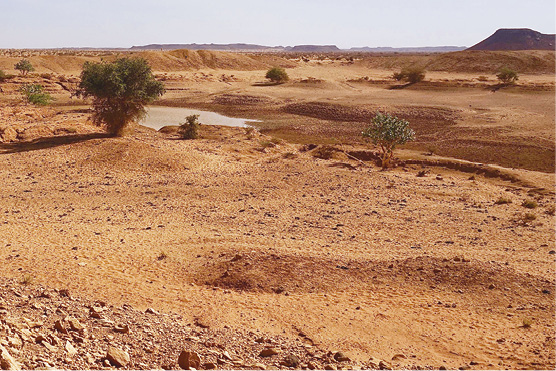
An Apedemak temple at Musawwarat es-Sufra was built by King Arnekhamani, who is portrayed in various poses with Apedemak on the temple walls. It is the earliest known evidence of the local lion-headed god, who is referred to on the walls as ‘Lord of Naqa and Lord of Musawwarat’. There are images of other animals and mythical beasts depicted on the walls, including griffins, cows, and elephants.


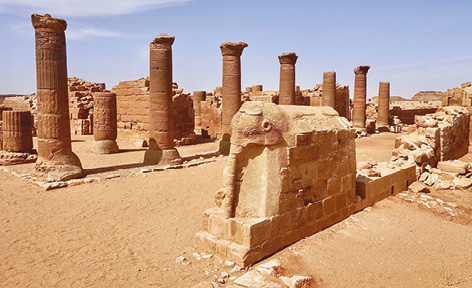
A large statue of an elephant is a striking feature of another building at Musawwarat known as the Great Enclosure. The purpose of the Great Enclosure is largely unknown (there is no other version of this type of building in existence), with theories ranging from a temporary royal coronation residence or a hospital to an animal training ground. There are the ruins of at least three temples, kitchens, workshops, and numerous storerooms, all located within the complex. The large open spaces, extra-wide hallways with ramps, and various water basins strongly suggested to me that it was an area where animals, such as elephants, were housed and possibly worshipped.
Naqa

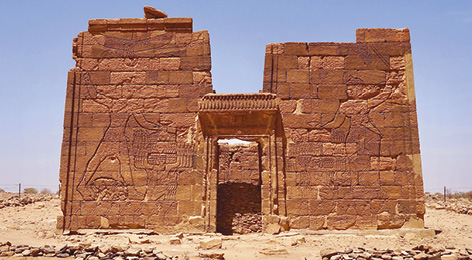
About 15 km south of Musawwarat es-Sufra lay the final site of our trip: Naqa. Here we saw three well-preserved buildings: Lion Temple 300; a Roman Kiosk possibly dedicated to Hathor; and a temple to Amun. The two temples were both constructed in the 1st century AD during the co-regency of Amanitore and Natakamani. Both rulers can be seen posed in equal status on the walls, pillars, doorway jambs, and lintels. The front of the Lion Temple has a particularly vivid image of both rulers smiting enemies in a style similar to those seen on many Ptolemaic temples in Egypt. On the left (southern) side are images of the king and queen, along with a crown prince who predeceased them called Arikhankharer, and male deities. On the right (northern) side are images of the same royal triad with female deities. Apedemak features on the southern side, along with others including Horus and Khonsu, and he can also be seen in a beautiful representation on the pylon, emerging from a lotus flower with the body of a snake. In another unique depiction on the rear (western) exterior wall, he appears bizarrely with three heads and four arms. This union of stylistic elements of Kushite and different external cultures – pharaonic Egyptian, Graeco-Roman, indigenous African – coexisting beside one another made a fitting end to an epic adventure.

Karl Harris is a freelance consultant to the heritage education sector, and makes frequent visits to Egypt as an independent traveller. You can read the first part of his Sudan journey in AE 139, and his explorations of Elkab and el-Hawawish in AE 135 and AE 137.
All images: by the author, unless otherwise stated