Subscribe now for full access and no adverts
On 26 January 1788, a group of 11 ships sailed into the sheltered waters of Sydney Cove, and the destiny of Australia was changed forever. This was the (in)famous First Fleet, and its aim was to establish a new penal colony for Great Britain after the recent American War of Independence had cut off their previously preferred destination for transported convicts. As well as sailors, marines, officers, and their families, the vessels were carrying more than 700 prisoners: men and women who had originally been condemned to hang for their crimes, but whose sentences had instead been commuted to years of labour on the other side of the world.
Once ashore, the convicts were set to (literally) carving out their new home from a sandstone headland located away from where the new government buildings and military settlement were to be established. Lines of flimsy huts and tents soon clustered along narrow tracks (called ‘laneways’) that snaked up and over the steep ground. As more waves of convicts arrived, the settlement swiftly expanded, and within a decade it had wider roads and more established houses, as well as shops, pubs, and other businesses. By the 1830s, Sydney had developed into a bustling port town, whose population was swelled further by the arrival of merchants and free settlers from such diverse embarcation points as Britain and Ireland, France, Germany, Scandinavia, North America, Māori New Zealand, and China.
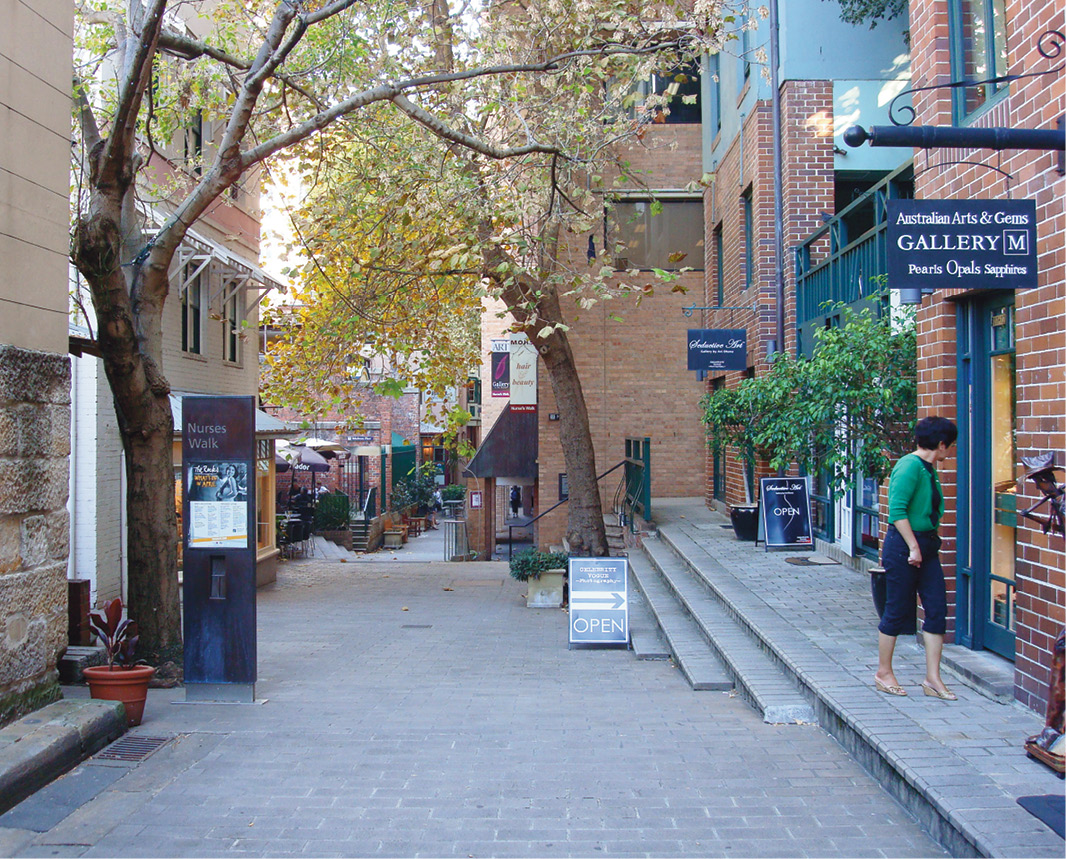
Above & below: Today, The Rocks is a popular tourist area full of artisan shops and boutique restaurants, but the district began as a late 18th-century settlement for transported convicts. Images: Kay Adams CC BY 2.0/Emma Thomas

The new colony had not been founded on empty land, however. When Captain Cook had claimed New South Wales for the Crown in 1770, he argued that the territory did not legally belong to anyone (a concept later called terra nullius), despite having encountered many First Nations people during his travels. Sydney Cove, too, had been the home of an established community for thousands of years. These were the traditional lands of the Gadigal (also spelled Cadigal) people, one of 29 coastal clans belonging to the Eora Nation, and to them the bay (which they called Warrane) was the location of many culturally significant hunting, fishing, and camping sites. The headland where the convicts had settled was known as Tallawoladah; to the newcomers, however, the exposed outcrop was simply ‘The Rocks’, a name that the district has retained to this day.
First contacts between the Gadigal and the European settlers were complex, variously combative and cooperative, but they would ultimately prove disastrous for the bay’s indigenous inhabitants, who were increasingly displaced from their lands and lost 80% of their population to smallpox in a single year. Colonial occupation of the area continued to increase, and by the dawn of the 20th century The Rocks district was decried as an overcrowded slum. After further outbreaks of disease, many of its buildings were demolished in the interests of urban improvement.
Subsequent redevelopments brought even more dramatic changes, with entire streets swept away by the construction of the Sydney Harbour Bridge in the 1920s, and ongoing expansion in later years. Until the ‘Green Bans’ of the 1970s, hard-won through popular protests, there was no legislation to protect historic areas of the city from urban growth, and many colonial traces were destroyed as high-rises soared skywards and their basements bit into underlying archaeological remains.
The Big Dig
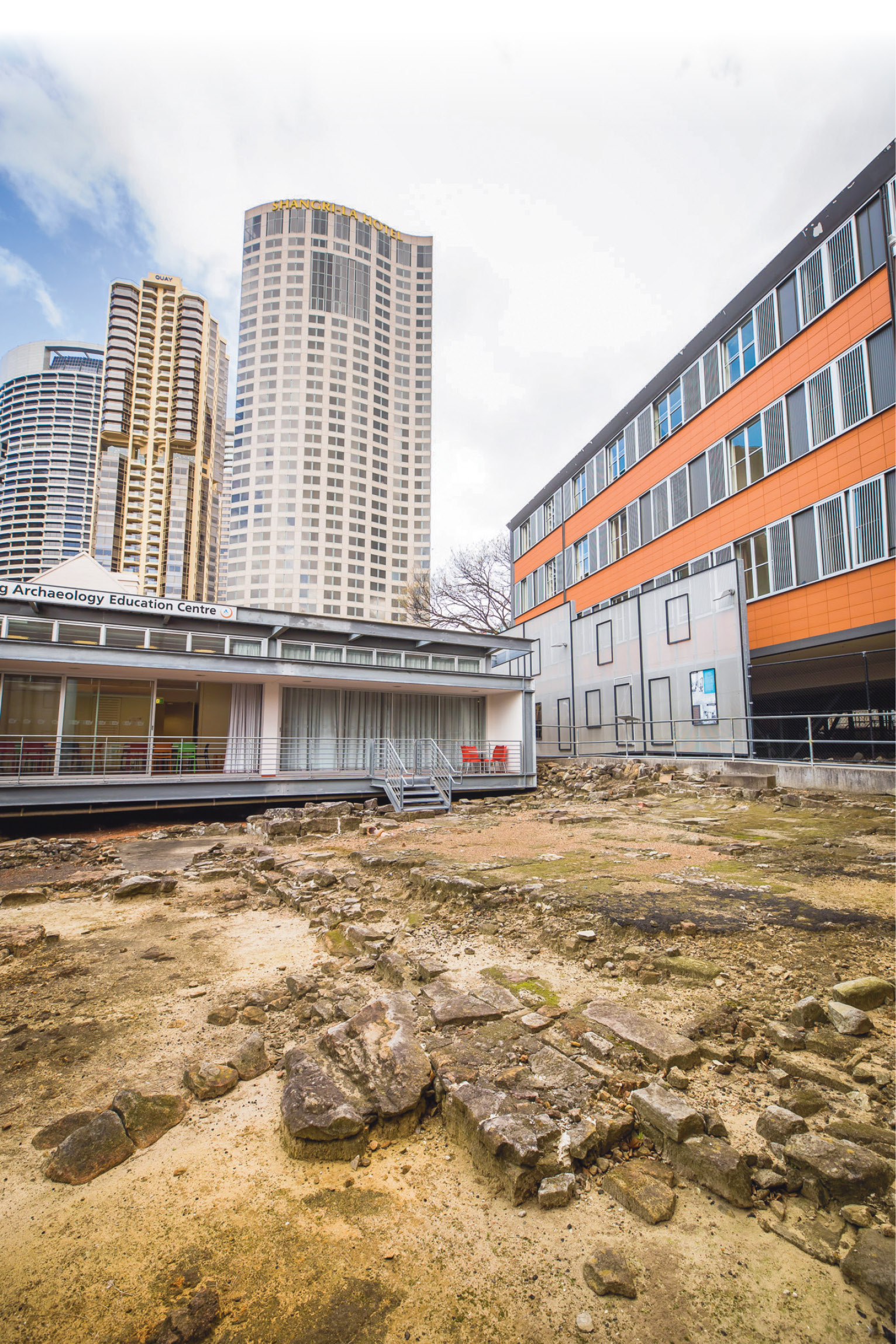
Today, The Rocks is a popular tourist area, full of artisan shops, pubs, and restaurants, gentrified beyond the wildest dreams of its convict founders. Its networks of alleyways and side streets still preserve echoes of its earlier incarnation, though, and visitors strolling can still find surviving examples of 19th-century buildings – among them The Rocks Discovery Museum, whose displays trace the district’s colourful past with a diverse range of artefacts excavated in the area (see box opposite). Just a five-minute walk uphill from the museum, there are further archaeological treasures to explore in the form of in situ foundations, floor surfaces, and fireplaces dating back to the colony’s earliest days, which have been preserved on a site called the Sydney Big Dig.
Sandwiched between Cumberland Street and Gloucester Street, this was once a densely occupied area and, like many nearby plots, its buildings were swept away in the first decade of the 20th century. Unlike its neighbours, however, it was not built over in subsequent years, instead remaining open as a bus depot and then a car park, sealing and safeguarding the underlying remains until they were brought to light once more in 1994. The land had finally been scheduled for redevelopment, but heritage legislation was by then vastly different, and before construction could start a team of 20 archaeologists and more than 400 volunteers began the ‘Big Dig’, one of the largest urban excavations ever undertaken in Australia.
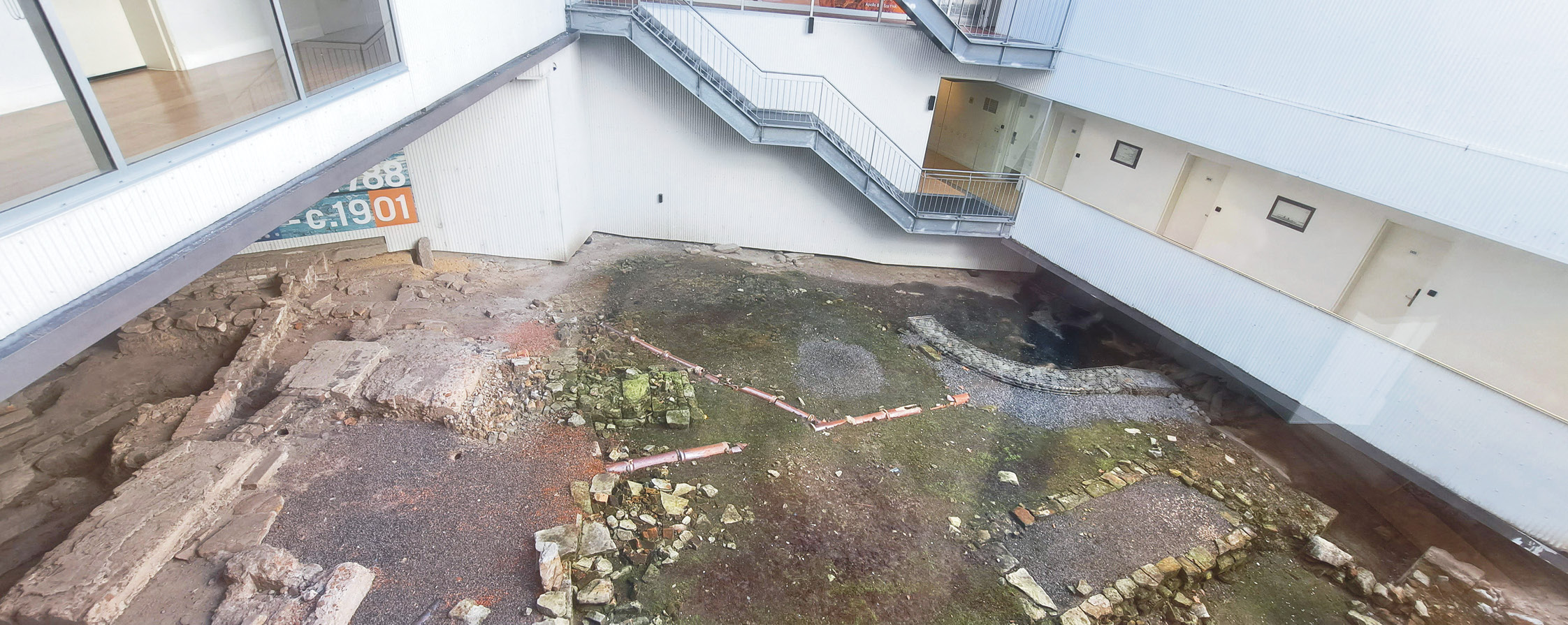
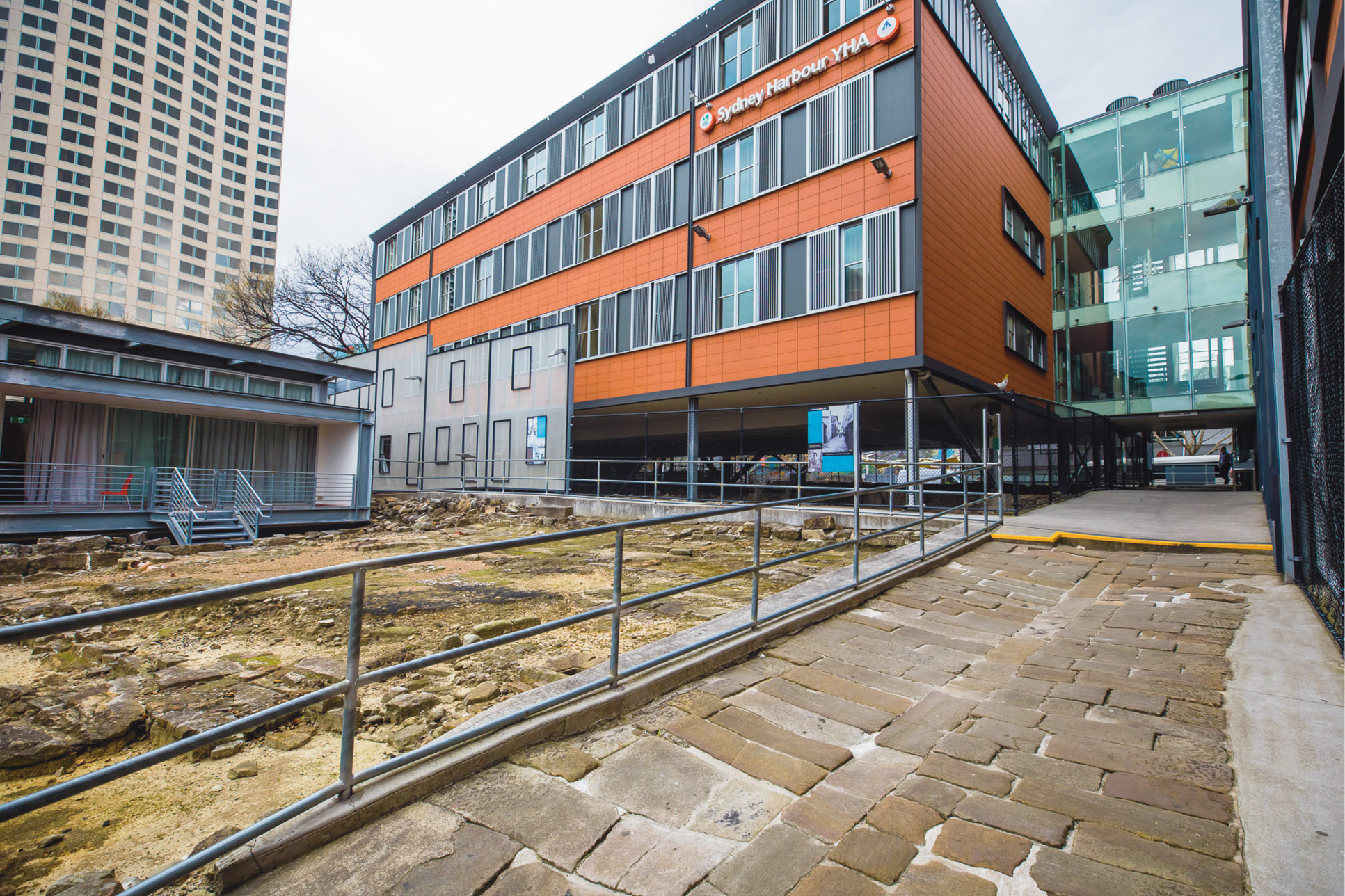
This investigation, together with subsequent work on the site in 2005, 2006, and 2008, uncovered a large area of the old colonial settlement, revealing the footprints of 46 buildings and recovering tens of thousands of artefacts. When the Sydney Harbour Youth Hostel was built on the site in 2008, a key driver behind its design was the need to preserve these finds in situ, so the hostel stands on stilts, raised above historic remains that the public can view within its grounds and inside the building’s foyer in daylight hours.
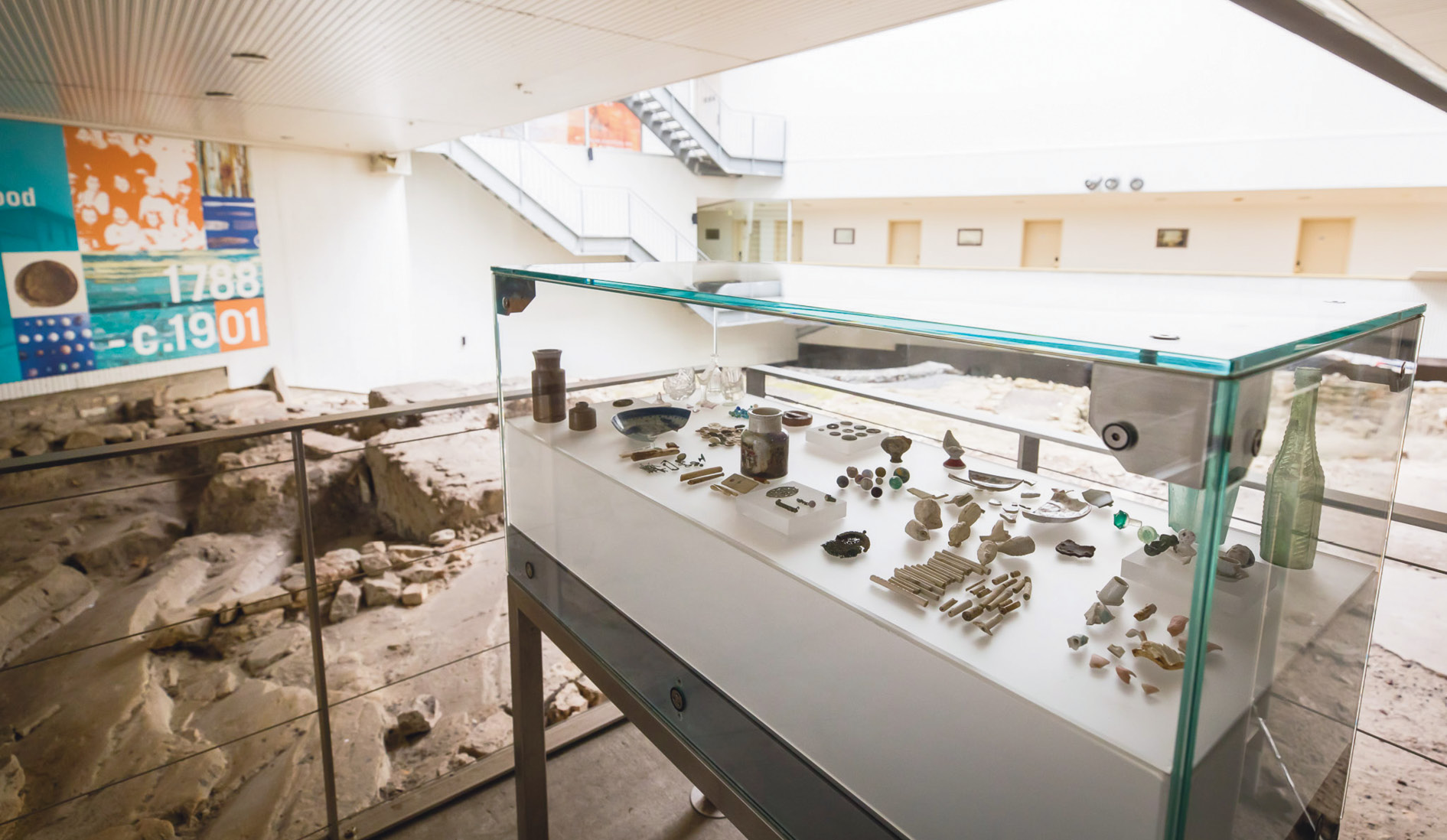
Walkways, glass panels, and grilles allow visitors to explore the exposed structures, and colourful information boards and cases displaying a selection of artefacts (many more are on show in The Rocks Discovery Museum) help to bring the people who once called this area home vividly back to life. No evidence of Gadigal activity was found during the Big Dig (although, in 1989, an excavation a short distance along Cumberland Street – on the site of what is now the Shangri-La hotel – revealed the remains of a campfire and midden pre-dating the colonists by more than 300 years), but the site holds compelling stories of transported convicts and free settlers. Thanks to historical records, it is even possible to link named individuals to specific structures.

If walls could talk
One of the earliest stories from the site is that of Ann Armsden, a woman from Kent who was transported for highway robbery. She not only found a new life in Australia, but also two new husbands, the first being George Legge, a Dorset shoemaker convicted of theft. The remains of a small building dating to c.1795 – the oldest structure found during the Big Dig – are thought to represent the home that Ann and George built together, based in part on the fact that the building underlies another house, where Ann is known to have lived with her second husband, George Talbot, whom she married in 1810. The newer dwelling was a simple, single-storey structure, with weatherboard walls and a wooden shingle roof containing just two rooms. A large fireplace to the rear may reflect how the couple supported themselves financially: although George Talbot had been transported for theft, he was a baker by trade, and if convicts had a skill that could be useful to the colony they were allowed to continue in that job.
The colony also housed political prisoners, among them Richard Byrne, an Irish rebel transported after an uprising in 1798. He and his wife Margaret (a domestic servant convicted of stealing from her employer) set up home on the Big Dig site, raising seven children in a house that, originally, had only one room. Richard was a stonemason, and the robustly built remains of his house testify to his skill. Two additional rooms were later added to the rear of the building, and over time a wealth of objects was lost beneath the floorboards, offering glimpses into the lives of their occupants. Pins and needles evoke images of quiet evenings spent making or mending clothes, while the Byrne children played with marbles and tobacco-smoke filled the air, curling from the clay pipes that were popular with male and female convicts alike.
Other historic buildings to explore
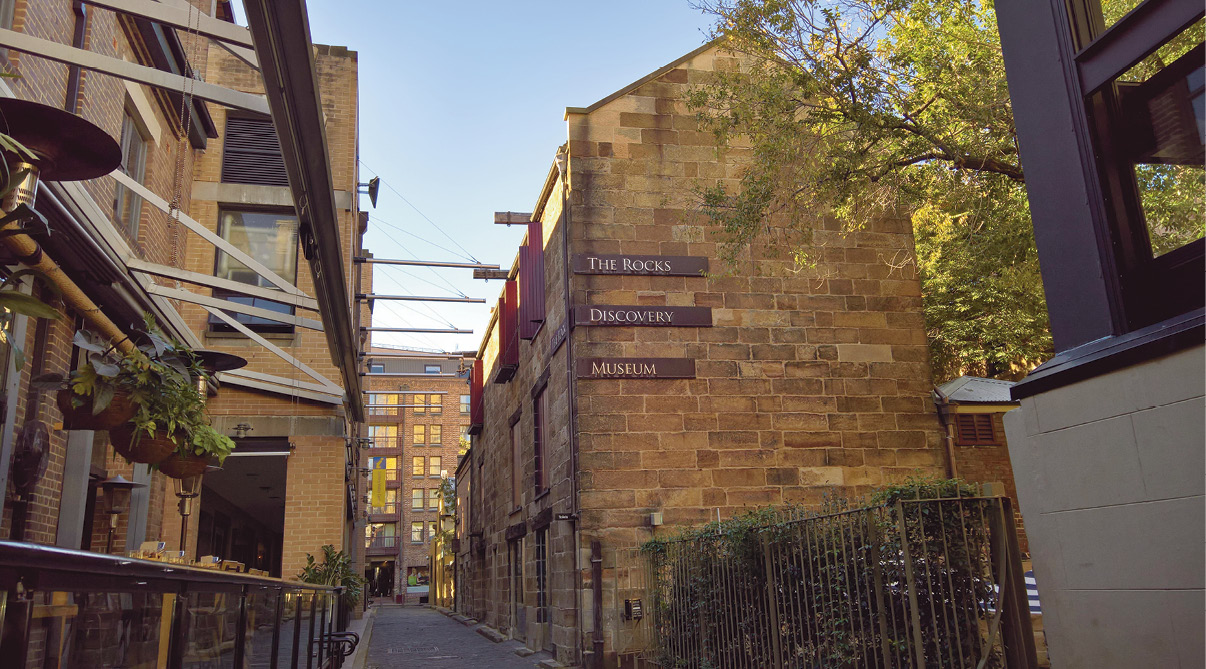
The Rocks Discovery Museum is housed in mid-19th-century buildings that talk eloquently of the historical diversity of the area: one was a warehouse built by a prominent member of the local Jewish community, and all three were later used by Chinese merchants. The museum’s displays explore different periods of Sydney’s history, spanning 60,000 years and reflecting Gadigal culture, the impact of colonialisation, and how Sydney evolved to the present day. Entry is free; for more information, see https://rocksdiscoverymuseum.com.
A hidden Rocks gem is tucked just off Gloucester Walk. Foundation Park is home to the lower courses of eight terraced houses, built in the 1870s and demolished in the 1940s, which visitors can explore inside.
Also within The Rocks, on the opposite side of Gloucester Street to the Big Dig site, is a terrace of four small houses built in 1844, which today form Susannah Place, a museum with recreated interiors. Visits are by pre-booked guided tours; see http://www.mhnsw.au/visit-us/susannah-place.
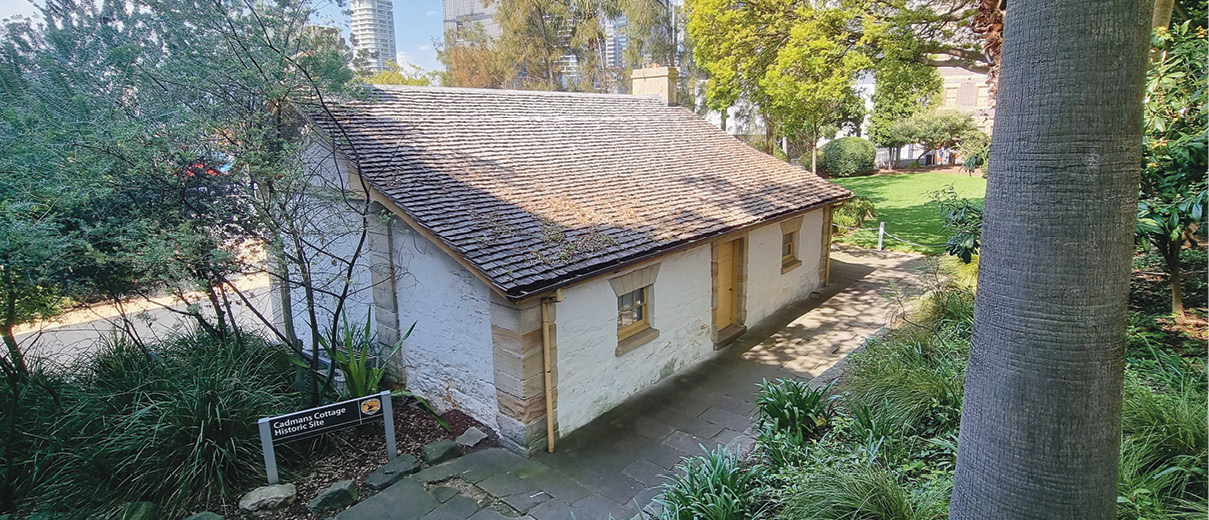
Down by the waterfront, Cadman’s Cottage is the oldest surviving residence in Sydney. Built in 1816, the four-room dwelling was originally an office used by government coxswains, and later home to the ex-convict (and horse thief) John Cadman. Subsequent uses were (from 1845) the headquarters of the local water police and a Home for Sailors; today it is a protected heritage site, although its interior is currently closed to the public.
Rocky relationships
One of the most dominant presences on the Big Dig site is George Cribb, who took up residence in 1809. He had been convicted of possessing forged banknotes, but once in Australia he set up a highly profitable business as a butcher. The remains of his slaughterhouse take up much of the southern end of the excavated site, and for over a decade he made a living killing and butchering animals, and selling the meat. Surviving features paint a visceral picture of this work; the abattoir’s flagstone floor is marked with stray chop marks and crazed from the weight of the animals that George was processing, while close-by are two indentations that would have held half-barrels angled to collect run-off blood.
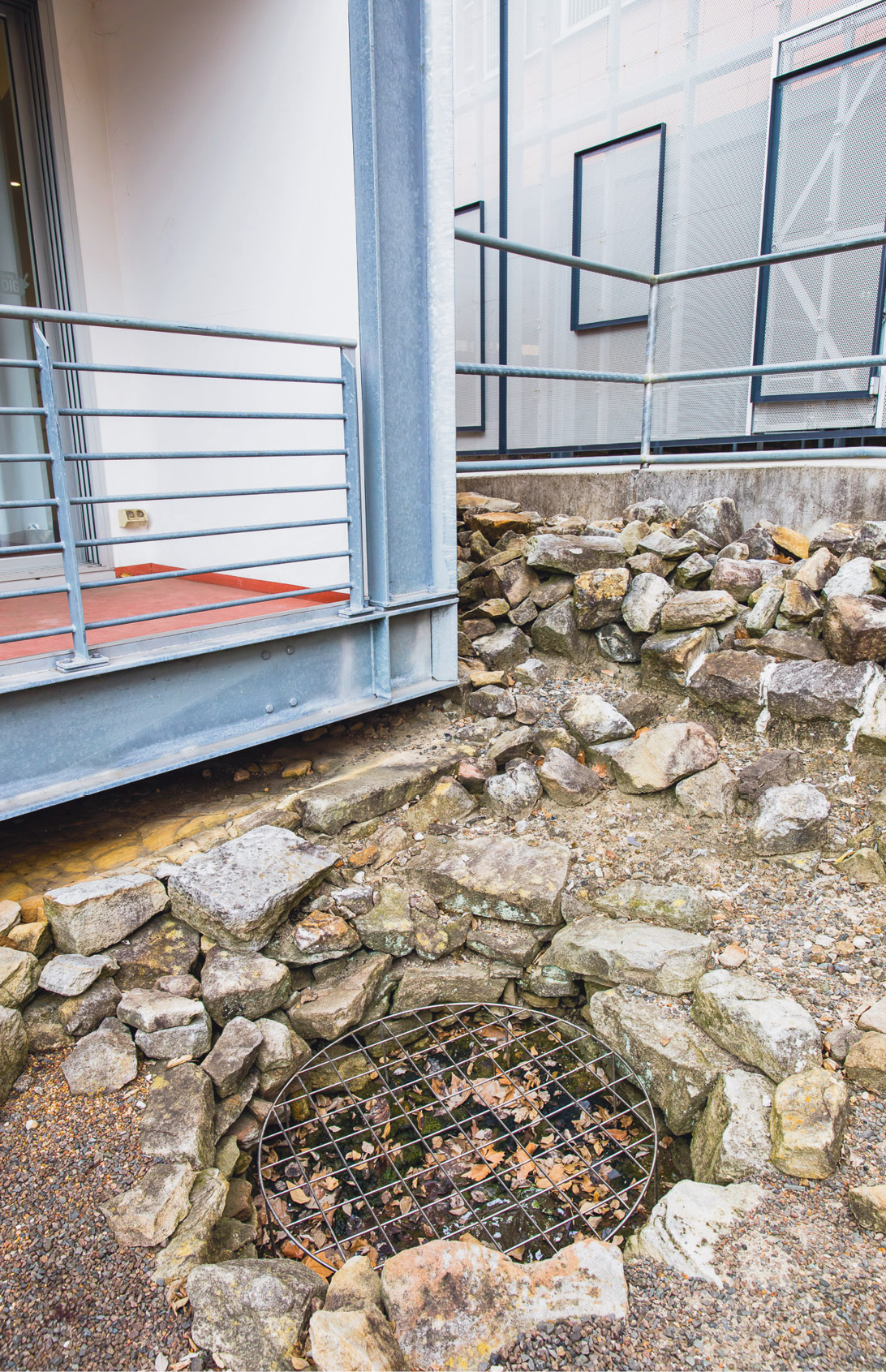
We know that George was butchering cows, pigs, and sheep, as he buried their discarded skulls, bones, horns, and tusks in pits across the site – and, in doing so, appears to have poisoned his well, as this water source was swiftly abandoned and instead used to discard household rubbish. Visitors to The Rocks Discovery Museum can explore its contents using an interactive touchscreen, and see some of the recovered finds; this was not just everyday refuse, but also included costly items including a hand-painted Chinese porcelain bowl and a steel filleting knife that was still sharp when it was recovered by archaeologists. Such items testify to the opportunities that the new colony offered to convicts – particularly if they were willing to continue to bend the law: George’s well yielded evidence, too, of an illegal (and possibly hastily hidden) alcohol still.
As he prospered, George built himself a two-storey house, and by 1813 historical records attest that he owned half of the Big Dig site, including a row of tenements that he rented out. In 1815, George was even joined by his wife Martha, who had been left behind in England, but this was not a happy reunion as he had been living in a bigamous marriage with Fanny Barnett since 1811. George managed to pay Fanny off, but his troubles were not at an end: by the 1820s, he was bankrupt and his properties were sold, subdivided, and transformed into other businesses, including a stable and a hotel. A rather different slice of colonial life is presented by the remains of the Berry/Share residence. They were free settlers, a military family, and in the 1830s they built a bakery on the Big Dig site. Today, its storage cellars can still be seen, complete with a brick ramp to help them roll barrels of supplies in and out.
End of an era
By 1900, the Big Dig site was crammed with more than 40 buildings – sheds, workshops, businesses, and tiny two-up two-down terraced dwellings, many of which housed large families. Such densely packed accommodation was becoming increasingly undesirable, not least as advances in public transport allowed those with the means to do so to move to ‘healthier’ suburbs, and areas like The Rocks were condemned as decrepit slums. Most of our written insights into the district at this time come from outsiders who paint a picture of abject destitution – but the excavated evidence tells another story.
Finds from the Big Dig attest that the site’s inhabitants had enjoyed a varied diet, and some of these meals were eaten off decorated china. Residents were able to decorate their homes with figurines, vases, cowry shells, and coral, and they and their children had enough leisure time to make use of clay pipes, dolls, marbles, miniature tea sets, dominoes, and toy soldiers. It is undeniable, however, that overcrowding made the spread of disease much easier. A smallpox epidemic swept through the area in 1881, and in 1900 bubonic plague arrived in Sydney. Panic spread faster than the disease, and within a year the New South Wales government had taken over the area of the Big Dig site, demolishing all of its buildings between 1902 and 1912. Despite stereotypes of The Rocks as insanitary, however, only three of New South Wales’ 100 plague deaths were within this area. One, though, was on the Big Dig site.
It is not known how 15-year-old James Foy contracted the plague – possibly during his work as a newsboy down by the wharves – but in 1902 he died from the disease. His family had only moved to the area the year before. Their home, like those of their neighbours, was promptly demolished, but its excavated footings can still be seen today, picking out a small front room with a fireplace, a kitchen to the rear, and the base of a narrow staircase leading to long-vanished bedrooms. While the presence of a disease more commonly associated with the medieval period seems incongruous in a rapidly industrialising city, the Foy house also produced a tiny, tangible trace of the modern attitudes that were emerging at this time. James’ father was a coal-lumper, and he may have been part of the newly unionised workforce that was rapidly growing in Sydney. In an underfloor space within his house, archaeologists found a wharf labourers’ union token dated 1902-1903, presumably lost through the floorboards at around the time that tragedy struck the Foys and the family left The Rocks forever.
Further information:
To learn more about the Big Dig excavation, and to watch a documentary about its finds, see www.thebigdig.com.au/education/documentary.