Subscribe now for full access and no adverts
In the 1880s, locals digging for peat in Hjortspring Mose on the island of Als, off the east coast of the Jutland peninsula, made a remarkable discovery: the remains of an ancient wooden boat, preserved for thousands of years by the boggy conditions. However, the find was kept secret until after the First World War, when Als and the surrounding area – which had recently been annexed into the German Empire at the time of the initial discovery – was returned to Denmark.
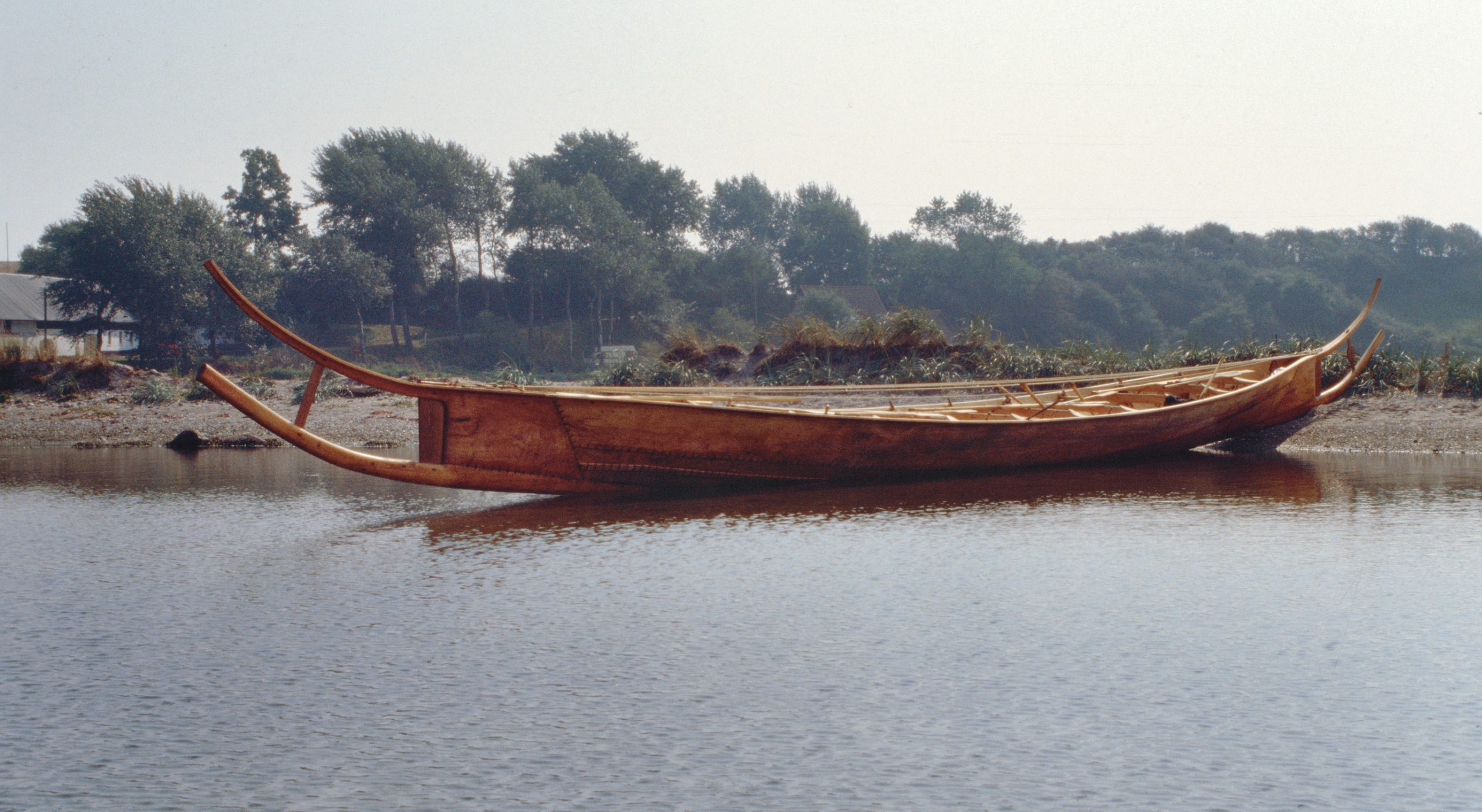
When formal excavations were conducted in 1920-1921, archaeologists were thrilled to be able to recover c.40% of the boat, enough to reconstruct its original form in its entirety. It was established to be a sewn plank vessel, over 19m long and 2m wide, made of lime-wood planks lashed together with cordage, rather than fastened with nails. The discovery was – and remains – the most intact example of a prehistoric plank boat ever found in Scandinavia. What is more, it was filled with military objects including shields, spearheads, swords, and mail armour, as well as other artefacts and everyday goods. The assemblage contained enough weapons and armour for 80-100 warriors, several times the number that could have been carried in this boat. It is therefore believed that the Hjortspring boat was part of an armada of four or five such vessels that launched an attack on the island of Als. It seems that the offensive was unsuccessful, though. The locals defeated these invaders, filled one of the captured boats with their enemies’ weapons, and deliberately sunk it in a bog as a thanks offering for the victory.
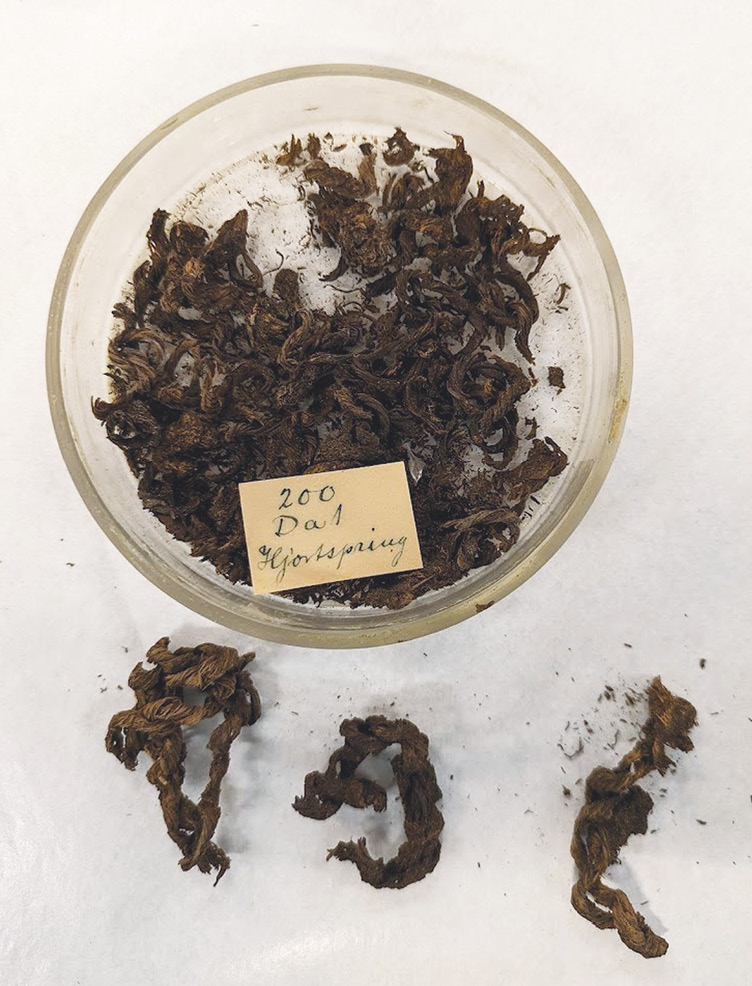
Following excavation, the material recovered was taken to the National Museum of Denmark in Copenhagen for conservation. Unfortunately, the techniques used at the time involved the application of chemicals that today make it impossible to conduct radiocarbon dating and many other types of analysis. However, Mikael Fauvelle, a researcher at Lund University, was not dissuaded. Looking through old museum records, he was able to locate several boxes of material from the original excavations that had been put aside. These contained unconserved fragments of the rope used to bind the boat’s planks together and the caulking material used to waterproof the vessel, both of which could be studied using modern scientific methods.
Ancient hands
First, the newly rediscovered rope was subjected to radiocarbon dating. This produced a date in the 4th century BC, placing the Hjortspring boat firmly in Scandinavia’s pre-Roman Iron Age, thus providing solid support for existing hypotheses. Earlier attempts at dating had been carried out on wood fragments recovered by archaeologists who revisited the find location in the late 1980s-early 1990s, but this cordage, which was part of the original excavation material, provides the first carbon dates from the boat itself. Additionally, rope has a relatively short lifespan and consequently offers a more accurate date window for the boat’s construction than wood dating, which can reveal only when the tree was felled, potentially many years before it was used.

Remarkably, the fragments of rope were so well preserved that researchers were able to work with modern rope makers to create reconstructions, in the process learning more about what the cordage would have looked like, how it was made, and even the knots that were used in the boat’s construction. This research provides insights into the skill of the craftspeople who made the original rope, demonstrating that they were well versed in what must have been a long-standing boat-building tradition.
Another unexpected discovery was made during inspection of the fragments of caulking tar: a partial human fingerprint. The size reveals that it belonged to an adult, but not much more can be stated about the individual at present. Regardless, such a discovery is exceptionally rare in Scandinavian prehistory, and provides a powerful connection to either the ancient people who built the boat or the member of the crew who repaired it.
Distant shores
Perhaps the most important revelation, though, is a new clue about the seafarers’ origins. It was previously speculated that the boat came from somewhere in the vicinity of Als, or perhaps nearby northern Germany. The caulking material covering the boat was therefore assumed to be linseed oil, which would have been readily available locally. However, gas chromatography and mass spectrometry analysis of the tar’s chemical composition has revealed that it was, in fact, made with pine pitch. This is intriguing, as Denmark and northern Germany were completely devoid of large forests of pine at the time. Looking at pollen from soil cores and other records around Scandinavia and northern Europe, it seems that the large pine forests of the 1st millennium BC were located in areas further east along the Baltic coast, such as Blekinge, Bornholm, Gotland, and northern Poland.

If the boat was made in one of these locations, as seems likely, the journey to Als would have involved voyaging over hundreds of miles of sea – no small undertaking in an open, paddle-powered wooden boat. It also would have taken the seafarers past the larger islands of Zealand, Falster, and Lolland. This suggests that the attack on Als was organised and intentional, indicating that some kind of connection already existed between the regions. Perhaps the armada was sent to avenge a trade relationship gone wrong, or as part of a cross-regional political or military dispute. If true, this has potential implications for our wider understanding of the political landscape in Iron Age northern Europe. Although long-distance connections are known to have been important for Scandinavia in the Bronze Age, it has been suggested that some of these networks had contracted by the Iron Age. The potentially distant origin of the Hjortspring boat is a sign that some long-distance connections across the Baltic Sea did endure into the Iron Age.

The recent findings have been published in PLOS One (https://doi.org/10.1371/journal.pone.0336965). Meanwhile, it is hoped that future research, including DNA analysis of samples of caulking material, which is currently under way, will tell us more about this remarkable piece of maritime history.