Subscribe now for full access and no adverts
Fifty years ago, I received a life-changing letter. David Peacock, my tutor at Southampton University, offered me a doctoral scholarship to study the imported Frankish pottery from Hamwic, the 7th- to 9th-century emporium at Southampton. The newly formed Southampton Archaeological Research Committee (SARC) had released the funds in order to make sense of these enigmatic potsherds. David, one of life’s great gentlemen (and a fine scholar), memorably told me: ‘with pots you travel’. Roman amphorae had taken him all over Europe and North Africa. He was spot on: studying these sherds was to lead me to France and Spain; then, the Low Countries, West Germany (as it was then), Denmark, Sweden, and Norway. I motored from each museum or archaeological project to the next in a 1962 green- and cream-liveried Austin A40. Along the way, I camped in a small blue single-pole tent and rustled up dinner on a single gas burner. I broke down on the Spanish plain, in the Rhineland, and Frisia. Always, the Automobile Association came to my rescue. Most of all, along my travels I met a galaxy of archaeologists and curators, every one of them as kind to me as David had been. It was an odyssey at a time when medieval archaeology in much of western Europe was far behind the swinging digging days of the ’60s and early ’70s in England.

Hamwic and its issues were relatively new to me. It was a world away from the city’s university in the leafy Highfield suburb. Bombed-out sites still existed in the St Mary’s district of Southampton; the city had taken the full brunt of the Luftwaffe’s ire in 1941-1944. The only upside was the unexpected discovery in post-war excavations of one of Anglo-Saxon England’s earliest towns. The post-built houses and rubbish pits of Hamwic lay largely undisturbed 2 or 3ft (60-90cm) below the ground, left to posterity when the town – which covered 40ha – was abandoned in the Viking age and superseded by medieval Southampton to the west. To be quite honest, digging in Hamwic was thankless in comparison to the blissful places I had experienced in my teens. The brickearth natural was bare and as unforgiving as the desolate rows of post-war housing. On the positive side, when I excavated at Melbourne Street with the effervescent David Hill and his thoughtful deputy, the kindly Jane Hassall (Carr), the camaraderie was as magical as the piles of objects and bones in the deep Middle Saxon cess pits. In the 19th century, Southampton’s starving poor had mined these very pits to boil up the bones, a millennium old. I have no recollection of finding anything exceptional, but I instinctively knew that Hamwic was a premier-division place, and its story told properly would change Anglo-Saxon and early-medieval history.
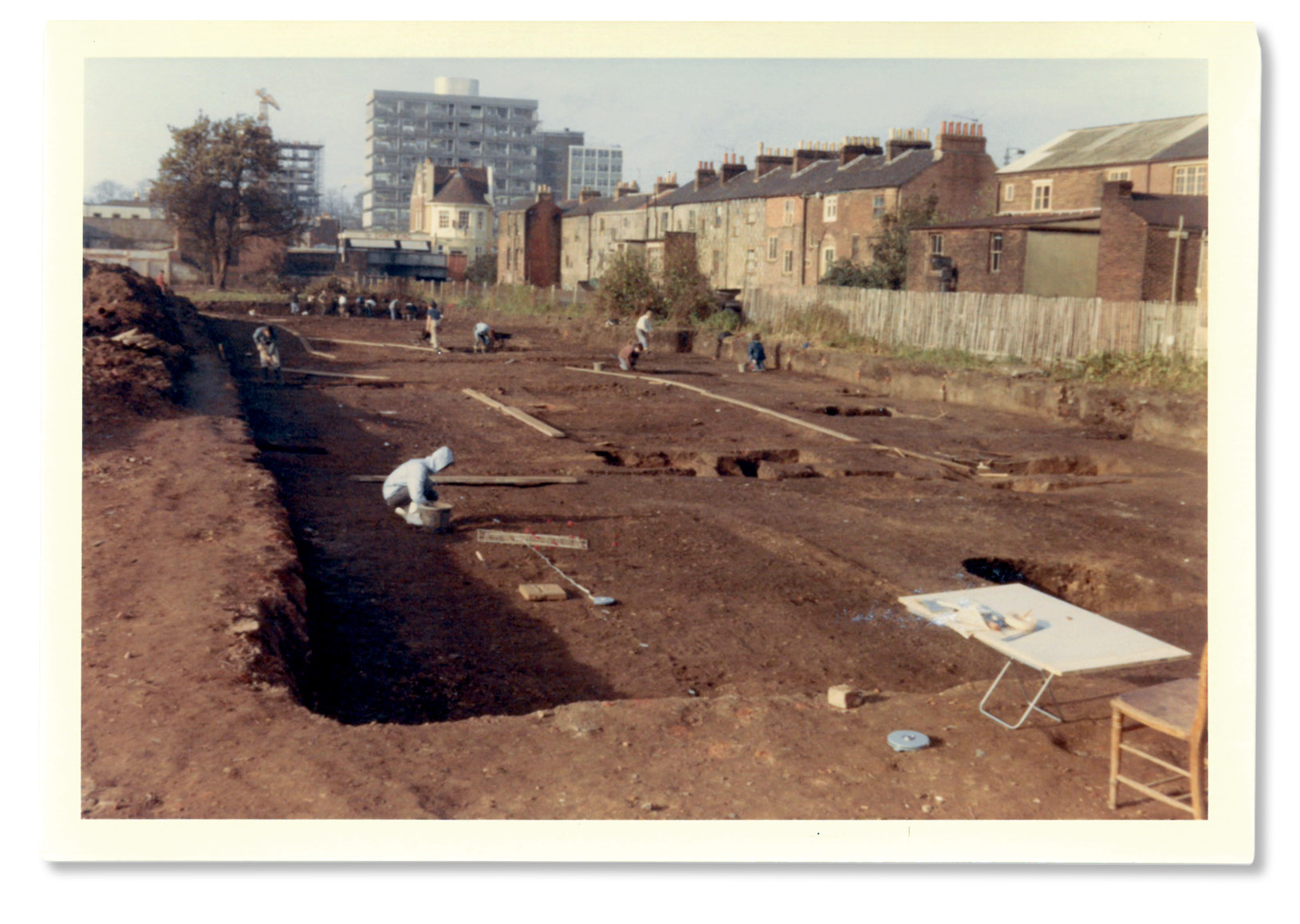
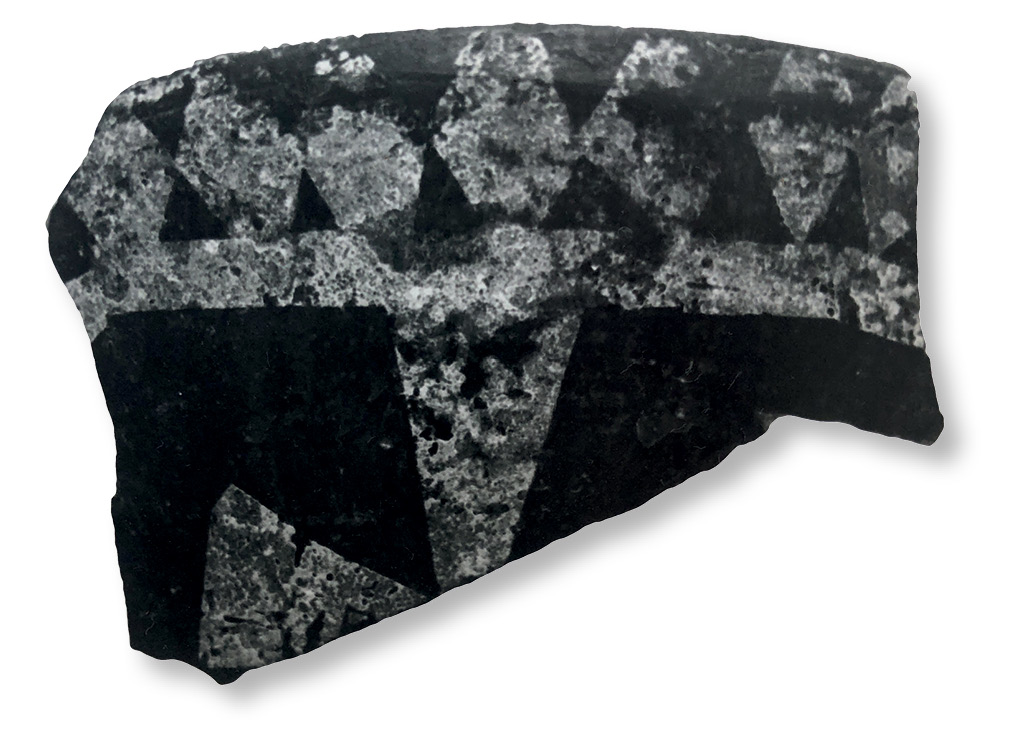
Above: Excavations under way of Hamwic in Clifford Street during the early 1970s. The results of such work revolutionised knowledge of early medieval Southampton. Sherds of Tating Ware were among the finds, including the fragment shown here (below).
From Frisian Ware to Tating Ware and back
David Peacock, a glint in his eye, urged me to focus as I embarked on my research. ‘Cherry-pick,’ he advised. ‘Start with Tating Ware. Look at those volcanic inclusions,’ he said with a winning smile. My eye was not adjusted to his, trained in geology. Instead, I saw the bleached traces of an adhesive on the fine black sherd. Tin lozenges and an apotropaic cross had once been affixed to its burnished black surface and then been lost. Applied after firing, these tight rows of triangles and strips cut out of tin foil had once been polished to reflect light like a mirror. It was quite unlike anything else found at Hamwic. Picking up his magnifying glass, David added, ‘My bet is it was made in the Rhineland.’
Tating Ware was named after a village in northern Frisia by the legendary German archaeologist, Herbert Jankuhn. It had been first identified half a century earlier by a Swedish archaeologist, T J Arne, when complete examples were excavated in the sprawling Viking cemetery accompanying the island emporium of Birka in central Sweden. Until Jankuhn intervened, these pitchers were described as Frisian Ware. They were given this name because, as I shall describe below, they were associated with the Frisians, the fabled argonauts of the early Middle Ages, who operated out of Dorestad at the Dutch mouth of the Rhine. As it happens, Tating Ware is an iconic object of the Viking era, but in fact it is the quintessential ceramic of Charlemagne’s Carolingian renaissance. Appealing to the visual senses, this glittering pottery aimed to dazzle. Unlike the great books and jewellery associated with this, the first renaissance, Tating Ware has an extraordinary distribution. Examples have been found from Orléans, on the Loire, to Staraja Ladoga, the emporium at the mouth of the Volchov, close to St Petersburg. Chasing down these vessels and making sense of their production was very much in David Peacock’s mind as he squinted at the Hamwic sherd through his eye-glass.
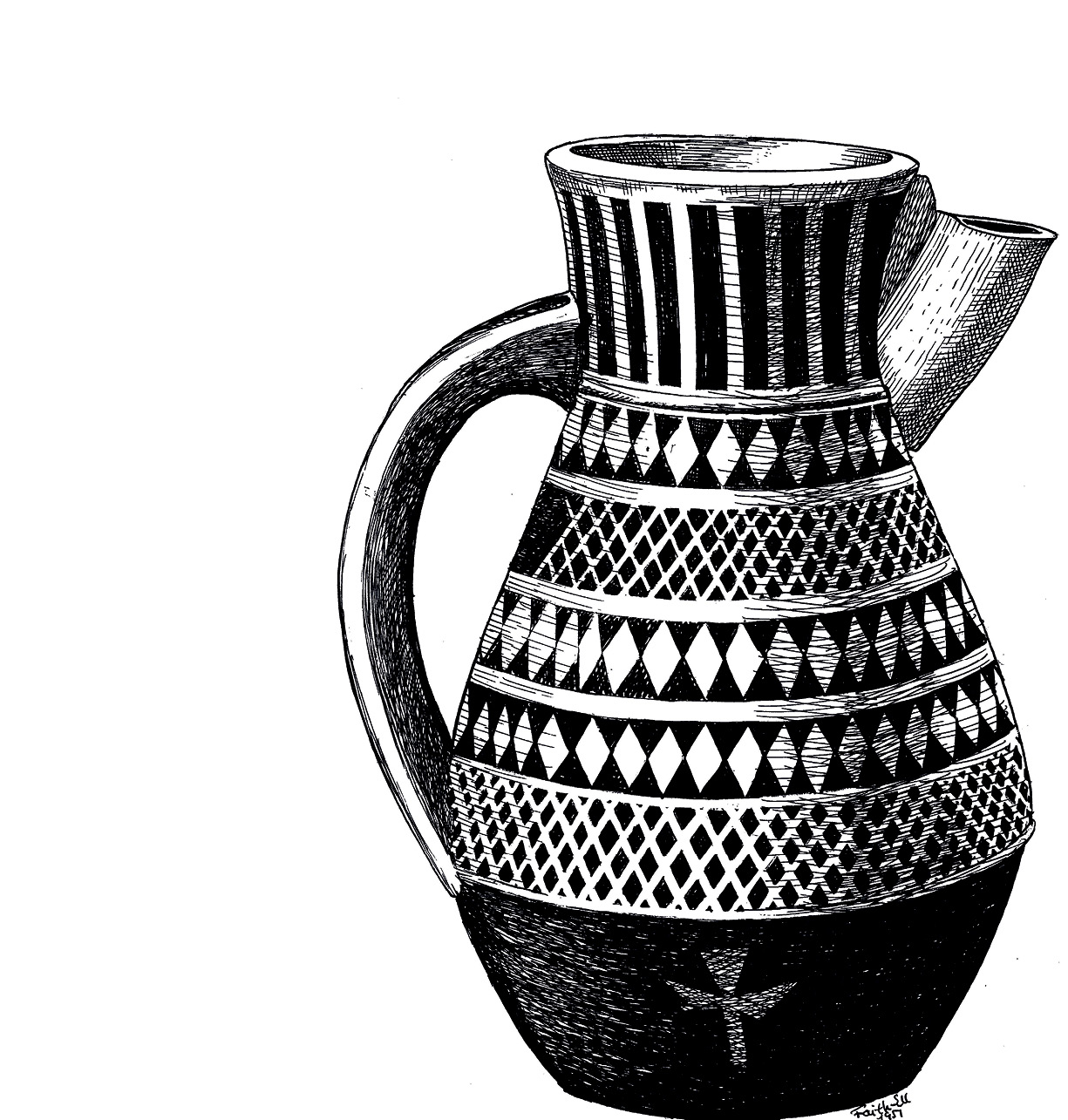
A late 19th-century drawing of a Tating Ware pitcher from Birka, in Sweden. Such vessels from this site were originally described as Frisian Ware.
As it happened, Tating Ware was already in the news as I started my research. The prominent tin-foil crosses affixed to the bodies of many of the pitchers had led a German and concurrently a Swedish scholar – Wilhelm Winkelmann and Agneta Lundström – to interpret the vessels as liturgical pots associated with the earliest Christian missionaries to the Baltic sea region. My travels took me to meet Winkelmann in Münster in 1974 and Lundström at Helgö near Birka in central Sweden in 1977. Both scholars could not have been kinder. Both were mystified by the pottery and just as mystified by my quest made in my A40 (with its English [right-hand] steering wheel)! Winkelmann, a badly wounded survivor of the Second World War, had undertaken great excavations at the Carolingian palace of Paderborn. The Tating Ware sherds came from levels he interpreted as pre-dating a major rebuilding campaign of AD 778. His view – one that reigned for 50 years, until signal discoveries in the Danish emporium of Ribe – was that Tating Ware dated to the third quarter of the 8th century, and was in circulation at the apogee of Charlemagne’s reign (774-814). Winkelmann’s interpretation of these pots as liturgical instruments made sense when he published his article, especially as the best-known exemplars came from the Viking world, where the intrepid Frankish missionary Ansgar had been active. But, as we shall see, times have changed, and new finds speak to a very different story. I am just sorry that Wilhelm Winkelmann and Agneta Lundström are no longer with us to appreciate how Tating Ware studies have advanced.

What did I discover?
Under David’s supervision, I made thin-sections of the Tating Ware sherds from Hamwic, as well as sherds from other English excavations and the great North Sea emporia at Dorestad, Ribe, and Kaupang. Mineralogy was not my thing. My fingers were burnt and uncomfortably coated in the affixing glue that held the wafers of potsherd in place. But the results took David and I by surprise. Eight different fabrics emerged under the microscope. In one sample, the volcanic inclusions – including plagioclase and sanidine feldspar, brown hornblende, and lava fragments – were as large as life. David bet his boots on a source in the Eifel Mountains close to or at Mayen, the major Roman pottery-producing centre in the Rhineland, not far from Cologne. Other samples, notably from the trading towns of Dorestad, Kaupang, and Ribe, had minute traces of feldspar consistent with a source somewhere in the Rhineland. Five rather different variants of a distinctive potting alchemy, on this evidence, were made in Charlemagne’s heartlands. But three differing fabrics in thin-section had no such talismanic inclusions. Quite the contrary. If the tin-foil had not been present, these looked like black burnished wares, quotidian tablewares that I reckoned to have been made in northern France, in either the Pas-de-Calais or the Meuse valley.
The upshot of this was to complicate mightily the manufacturing sources of these tin-foil decorated pots. Potters from at least two different centres – and possibly many more – were involved. One was likely as not copying another. Then, to confound matters further, the German-produced pots were shipped through Dorestad and handled by Frisian merchants. Meanwhile, those pots from the Meuse/northern France were likely as not being handled by Frankish traders operating out of ports like the long-lost emporium of Quentovic, close to Boulogne-sur-Mer. Competing commercial networks were involved in marketing these iconic items.
As 50 years have elapsed, not surprisingly other scholars and scientists have scrutinized the fabrics of these wares, trying to squeeze out of them more information. Alan Vince and Lyn Blackmore thin-sectioned some sherds found in excavations of Lundenwic: Hamwic’s great peer situated in the West End of modern London. These produced a ‘fingerprint’ not unlike the Rhenish pots made north of Mayen in the Vorgebirge Hills, so-called Badorf Ware. They had been prompted to act by three German scholars – Henning Stilke, Anno Hein, and Hans Mommsen – who used neutron-activation analysis to examine the chemistry of a group of Tating Ware samples. Their work pointed to all of their samples coming from the same source. Then, a decade ago, Marianna Kulkova and Alexey Plokhov, analysed the sherds found at Staraja Ladoga, the Viking gateway to the maze of riverine routes aimed at the Abbasid caliphate. This Russian team also thin-sectioned two sherds from excavations at the great Carolingian abbey of St Denis, north of Paris. Their detailed findings show that there were at least six different Tating Ware fabrics, and those from France may well have come from a source outside the Rhineland. Decades after my research was published, the Russians confirmed my discoveries.
Several kilns, it now seems, were producing these distinctive pots. Wasters from misfired vessels have been reportedly found in excavations at a royal stronghold at Karlburg, beside the river Main. Meanwhile, an exhaustive study of Roman Mayen Ware made in factories in this Eifel-mountain town on the eastern side of the Rhine valley has led Lutz Grunwald to propose, as David Peacock long since believed, that some Tating Ware vessels were successor products of the burnished and reduced-fired variant of Mayen Ware that is known as type MB. This was in the tradition of Roman Terra Nigra wares made since the 5th century AD. Grunwald contends that Tating Ware is an initiative of the later 8th-century Mayen potters that was produced in these Rhenish kilns until at least the late 9th century.
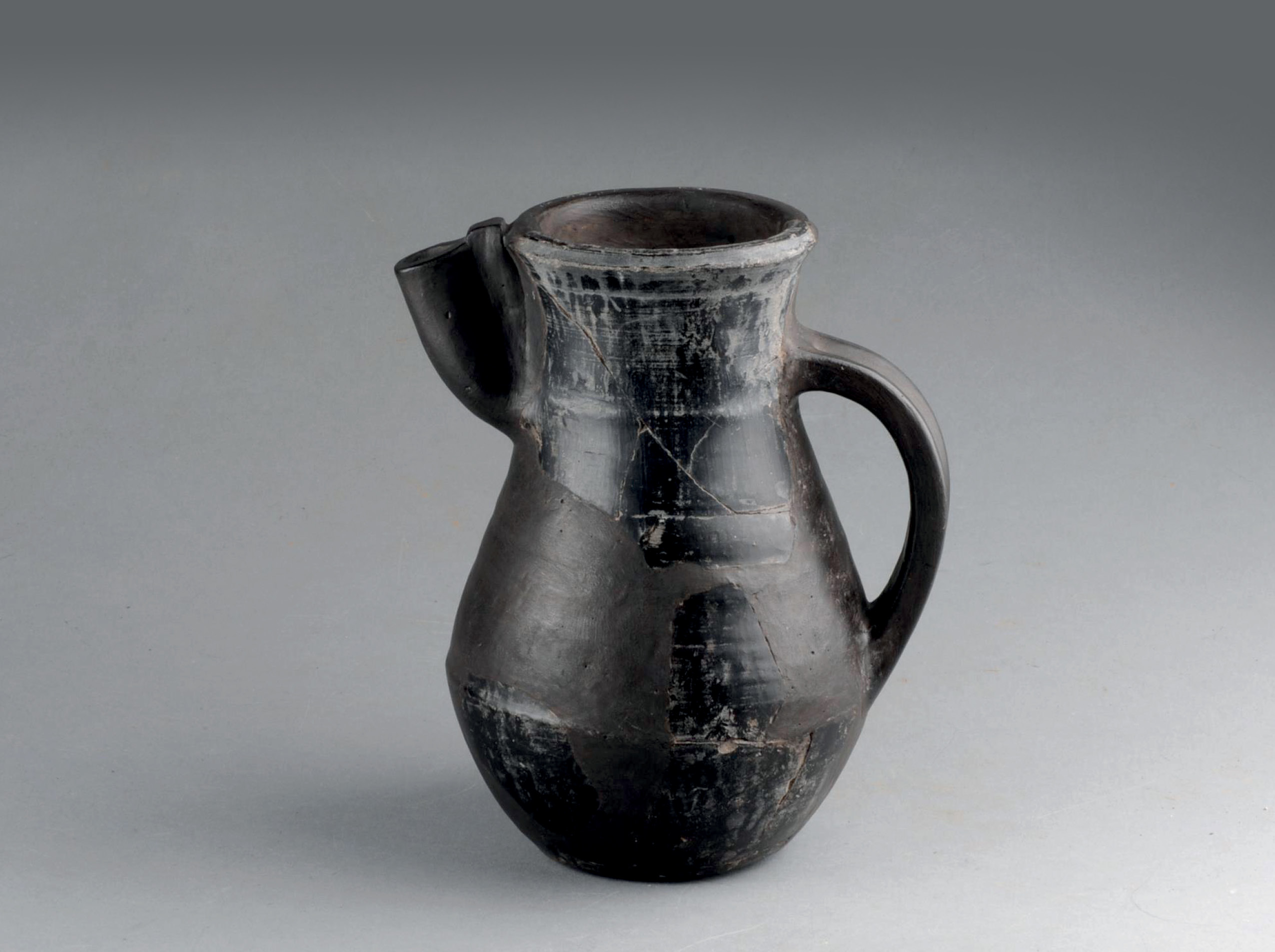
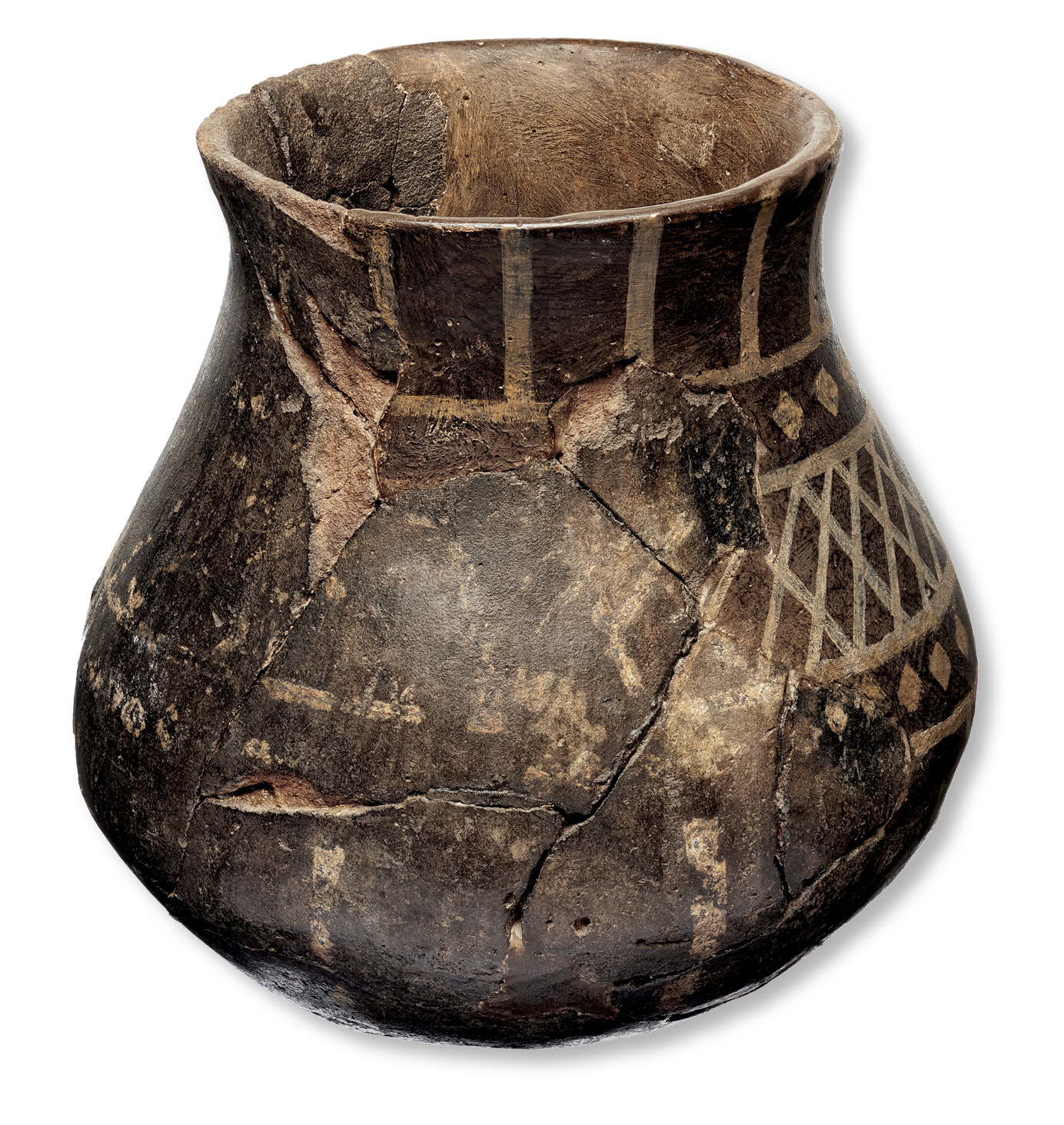
If the multiplicity of Tating Ware fabrics has complicated matters, the typology of differing vessel forms has thrown another spanner into the conventional view of these vessels. Most modern copies of Tating Ware pots in museums such as Birka (Sweden), Hedeby (Germany), and Ribe (Denmark) are canonical pitchers with tin-foil decoration, including a cross applied to a burnished carinated pot. In form, these vessels stood out as much for their shape as their ornamentation. Numerous though this style is, other variations have now been identified, complicating the unfolding biography of this particular pot. Minority forms include the classic biconical pitcher form with horizontal zigzag incisions and no apparent applied decoration, which has been found at Hedeby, Karlsberg, and Trier. Another variant is a tall, more globular pitcher with zigzag and applied tinfoil decoration, as well as an archetypal black ware flanged lip for a lid found at the minster site of Brandon, Suffolk. No less unusual are a biconical pitcher with roller-stamped chevron decoration on its upper half from Dover, Kent, a chalice-like cup from grave 457 at Birka, and a shallow bowl imitating a Roman sigillata dish from Ipswich. This typological diversity is unique within the Carolingian-era potting tradition. Imitation of glassware (with zigzag decorative lines made with glass reticella rods to resemble marble veining) and metal dishes may explain this otherwise bizarre potting fad, as though Tating Ware was a cheaper item in a range of serving vessels.
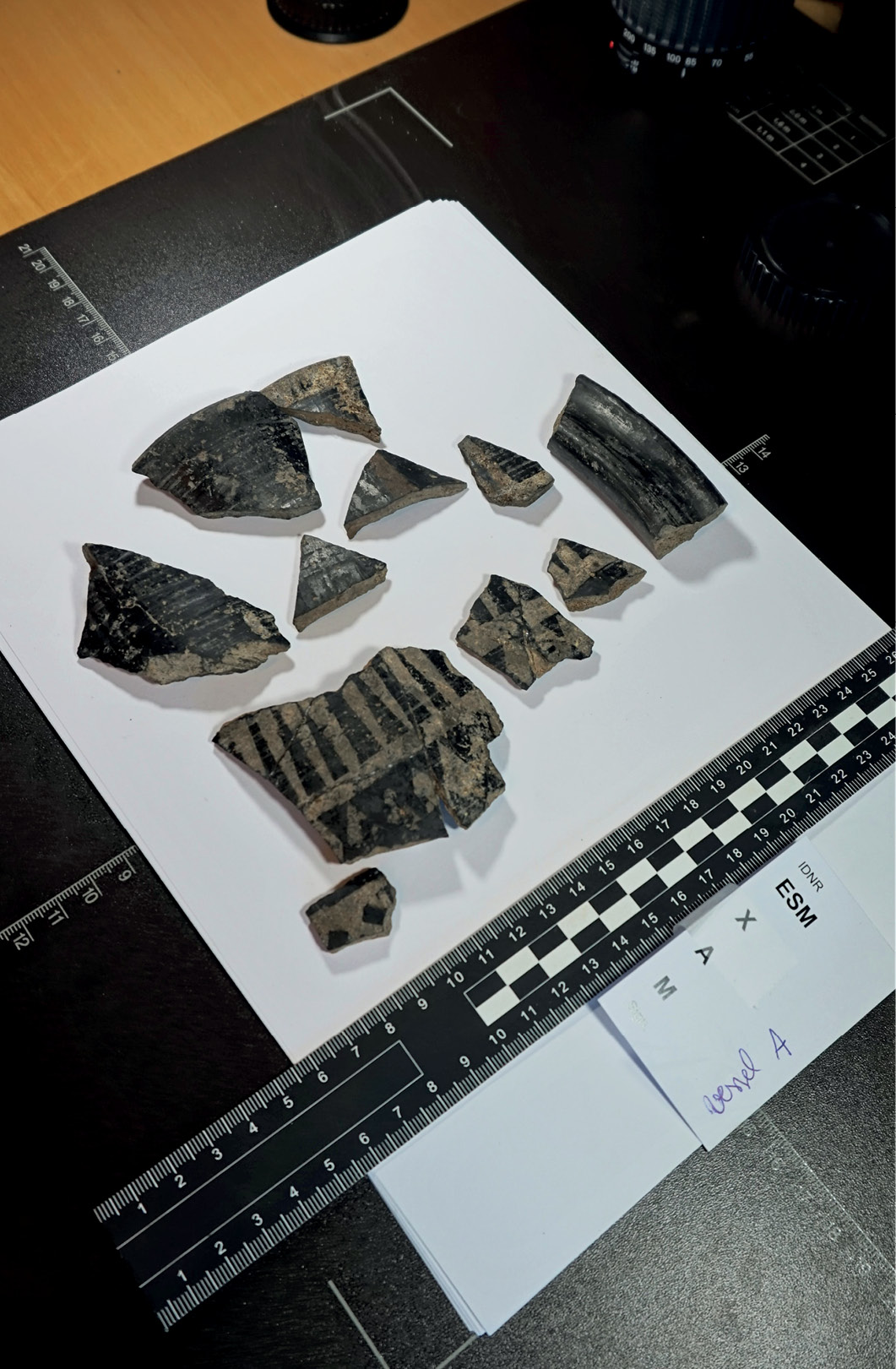
Elaborating upon this theme, Pieterjan Deckers – in a new assessment of the 159 sherds representing a minimum of 11 vessels found recently in the excavations of a jewellery workshop at Posthustorvet, Ribe – has revealed an obvious yet extraordinary discovery. Each of the 11 or possibly 12 pitchers from this workshop is different. Careful scrutiny of the decoration and fabric reveals a diversity that has been staring us in the face for decades. The seeming mass production of these pots, flying in the face of increasing standardisation of early-medieval pottery production, is an illusion. Further emphasising this point, Deckers draws attention to Ludwig Wamsers’ seductive argument that the large number of undecorated Tating vessels from the immense excavations of the Rhine-mouth emporium at Dorestad show that the tin-foil was applied here over the surface of roller-stamping and other decoration. This was almost certainly not the work of the potters, but by artisans once the barge-loads of pots and tin mined in Bohemia arrived in the Frisian port. In a sense, a century on it gives real meaning to the original name of these distinctive pots as Frisian Ware. This observation becomes all the more intriguing as we look at the numbers involved. Heiko Steuer, the distinguished German medieval archaeologist, proposed in 1987 that the then 50-known vessels equaled production of some 50,000 pots. Thirty-five years on, and 125 vessels have now been found in the emporium of Dorestad. The 11 or 12 from the Posthustorvet excavations in Ribe, let alone those found in earlier excavations in the town, show just how common these pots were. Almost each of these Dark Ages trophy items had its own manufacturing story.


Doubts about the date
Winklemann dated Tating Ware to the decades before the rebuilding of Charlemagne’s grand palace at Paderborn in 778. The sherds from Hamwic, like those from Dorestad, were associated with Anglo-Saxon and Carolingian coins of Charlemagne’s reign, coinciding with the foundation of the Danish emporium at Hedeby (close to modern Schleswig) and the explosion of Viking trade in the Baltic Sea. Some scholars after Winkelmann tried to push Hedeby’s foundation back to the 770s, following the discovery of an early nucleus known as the south settlement. With the discovery of the dendrochronologically dated jettied harbour works at Hedeby, pinpointed to 815 and after, it now seems safe to interpret this port as the product of King Godfred’s mad gamble to corral Frankish traders at this sheltered bay off the Baltic, rather than permit them the freedom of trading at nearby Reric, close to modern Wismar. Godfred paid the ultimate price as Charlemagne, according to the Royal Frankish Annals, was mightily irked by this audacity. The Emperor set out to deal with the Dane, outraged at what had happened at Reric. Godfred perished, the Danes sued for peace, and for a generation Viking loot acquired through attacks on the British Isles passed through Hedeby, along with Carolingian staples. Tating Ware, it seems, was part of this merchandise from the outset. Along with Christian slaves taken from Ireland and Scotland, came a mission led by Bishop Ansgar of Hamburg to introduce Christianity at Hedeby, then soon afterwards to the northern terminus of its trans-Baltic route on the island trading town at Birka, west of Stockholm. Tating Ware, it now appears, belongs to the overlapping ideologies of Charlemagne’s fervent advocacy of the church and the warrior world of the Viking Sea Kings; ‘hydrarchs’, as they’ve come to be known.
Ribe once again helps to frame this era. The high-definition excavations – as Søren Sindbæk has correctly described his unearthing of a jewellery workshop at Posthustorvet – provide indisputable dates based on a mixture of radiocarbon and other means. The result is as good as a written annal from this age. The 157 sherds representing at least 11 Tating Ware vessels were closely dated to AD 820-860. Sherds of Tating Ware from earlier levels in the workshop are interpreted as intrusive. Other Rhenish imports occur in the workshop before 820, though not in great numbers. Ribe had good connections thanks to Frisian traders with the Rhineland since about 700, when King Ongendus ruled Denmark. In sum, Winklemann’s dates – seen through the prism of a modern excavation of the highest calibre – seem doubtful at best. Tating Ware principally belongs to the era of Charlemagne’s son, the hapless Louis the Pious and his divisive sons. More to the point, it belongs to the decades when Viking fleets were the scourge of the British Isles and the North Sea, before the Sea Kings turned to colonising Ireland, then England, then Francia.
The Ribe evidence has also seriously undermined Winklemann’s belief that these were precious liturgical vessels. Pieterjan Deckers, in a diligent analysis of the Tating Ware sherds in the thin working layers of the workshop, concludes that these, like the handmade local pottery, were treated as household utensils. Unlike other Rhenish imports, Tating Ware was found consistently with other domestic items. It leads Deckers to a compelling conclusion. Rather than a liturgical function, given the prolific numbers found in Ribe and emporia such as Dorestad and Viking-period Hedeby and Birka, it was surely associated with the ritual of drinking (sweet) Rhenish wine and belonged to the package of Frankish cultural practices that included dress styles and swords adopted beyond frontier areas of the Carolingian realm. Emulation of Charlemagne’s renaissance evidently took many strange turns. The adoption of a visually striking new pitcher type by pagan, northern aristocrats, then, was a response to a merchant and urban culture in the same way as has been proposed for late-medieval German beer-drinking stoneware exported (in much larger quantities) by Hanseatic League traders throughout the Baltic. In the age of the Sea Kings, no less, parvenu urban mercantile communities played a great part in setting standards of taste. Bizarrely, in those troubled times, as the Vikings created merry hell, their tableware of choice was Tating Ware, with its apotropaic crosses and shiny allusions to Christian rituals.
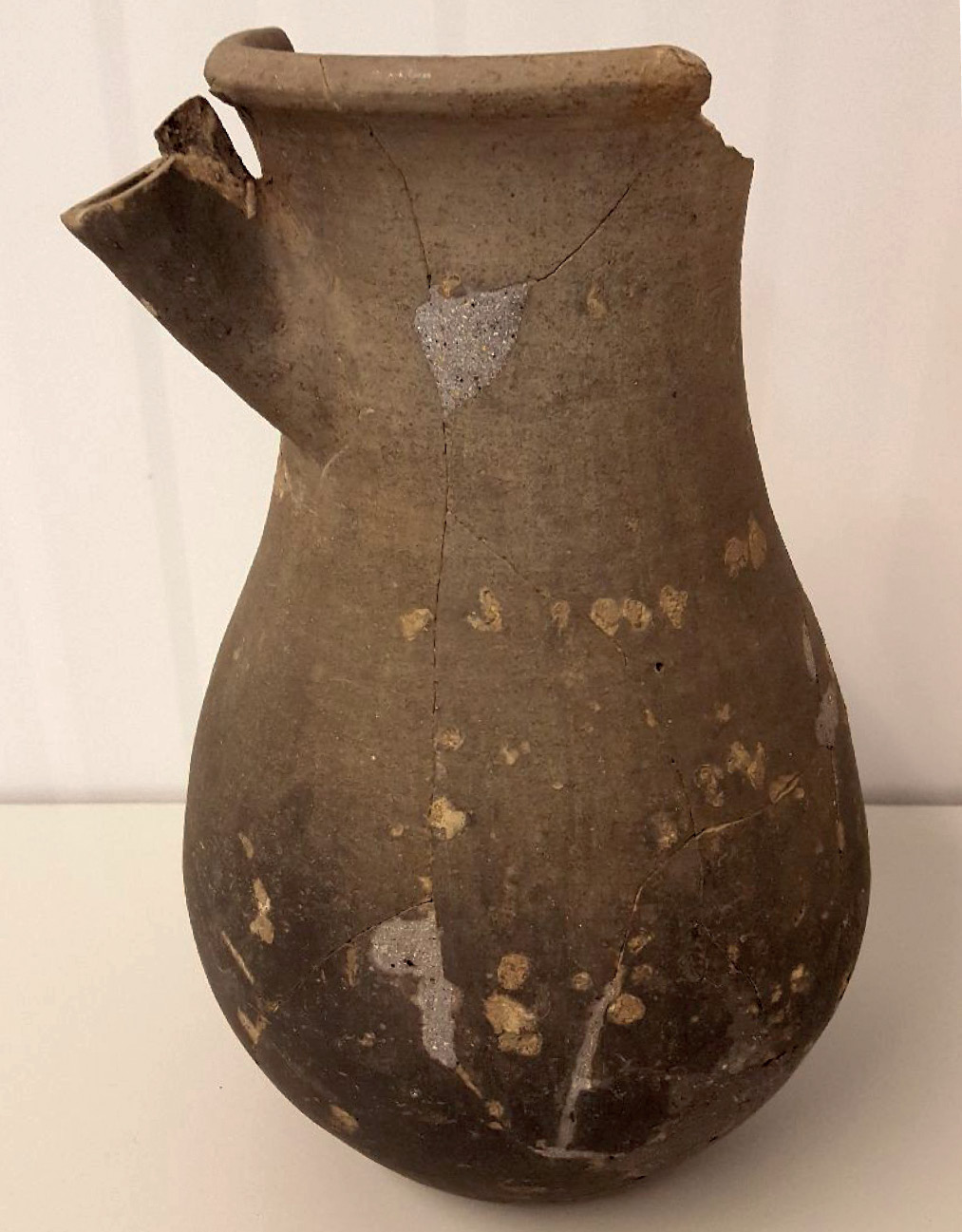
Emblematic of great change
Tating Ware is a paradox. It was first found in richly furnished pagan burials at Birka, before it was identified in the domestic refuse of the trading towns of the era ranging from Hamwic to Hedeby. Naturally, given its range of forms and above all its glittering ornament, it was assumed to be associated with the church. Finds from Brandon, Suffolk, Lorsch in the Rhineland, and St Denis show that the clergy were susceptible to the visual blandishments of the unusual ornament. But the real story is one of competition between the great potteries of the age to treat it as a special staple barged upstream along the Rhine to emporia like Dorestad, which has the biggest concentration of Tating Ware. Then it was shipped to the exploding new Viking towns of the Baltic Sea, where loot and slaves taken from Christian communities in the west were traded on as far as Russia, garnering Abbasid treasure by return. Tating Ware is a flashy Carolingian renaissance trophy – at the cheap end of a scale that included great ivories and illustrated manuscripts – that, courtesy of the hearts and minds of Frisian merchantmen, for a generation won a place in Viking households.
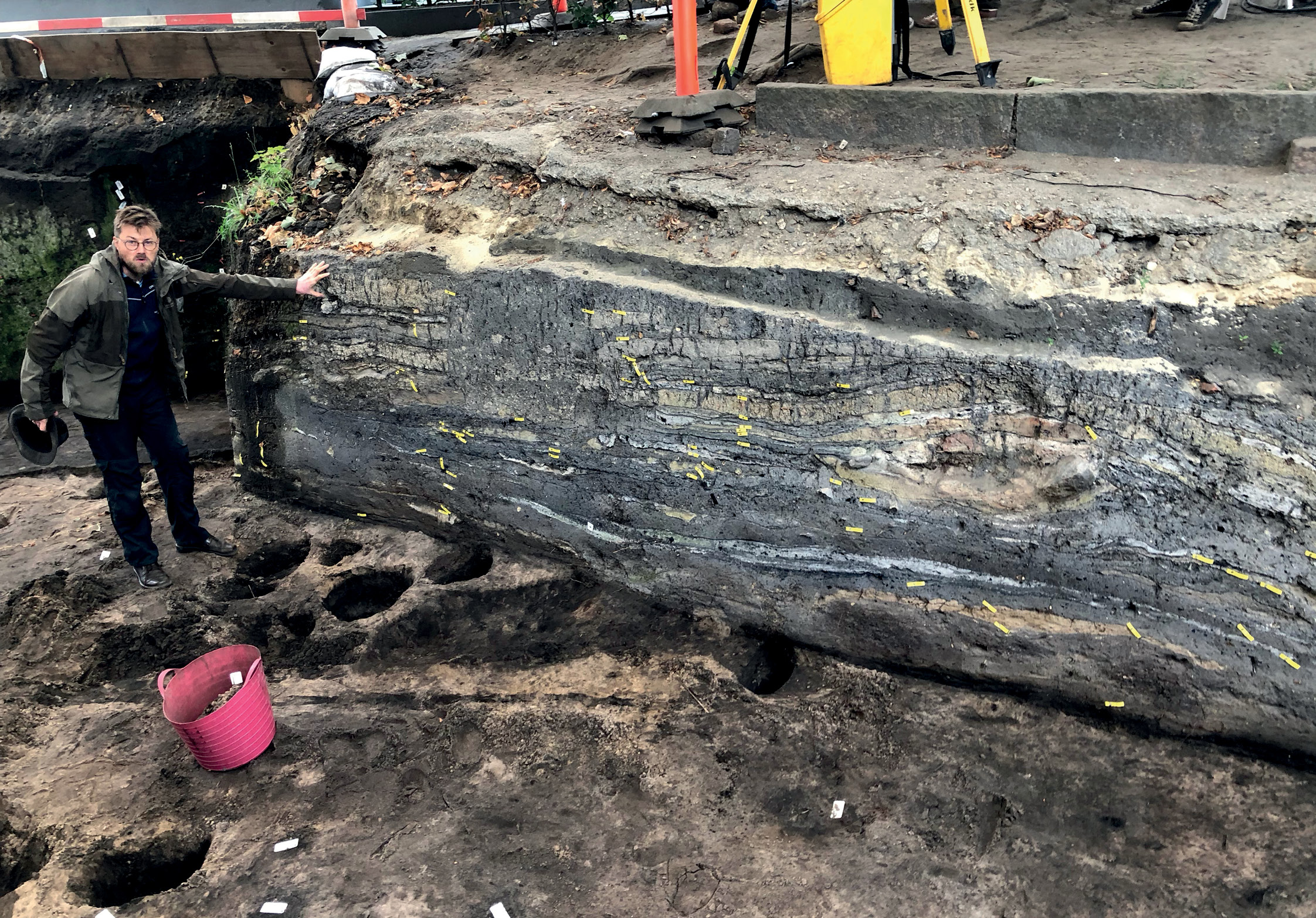
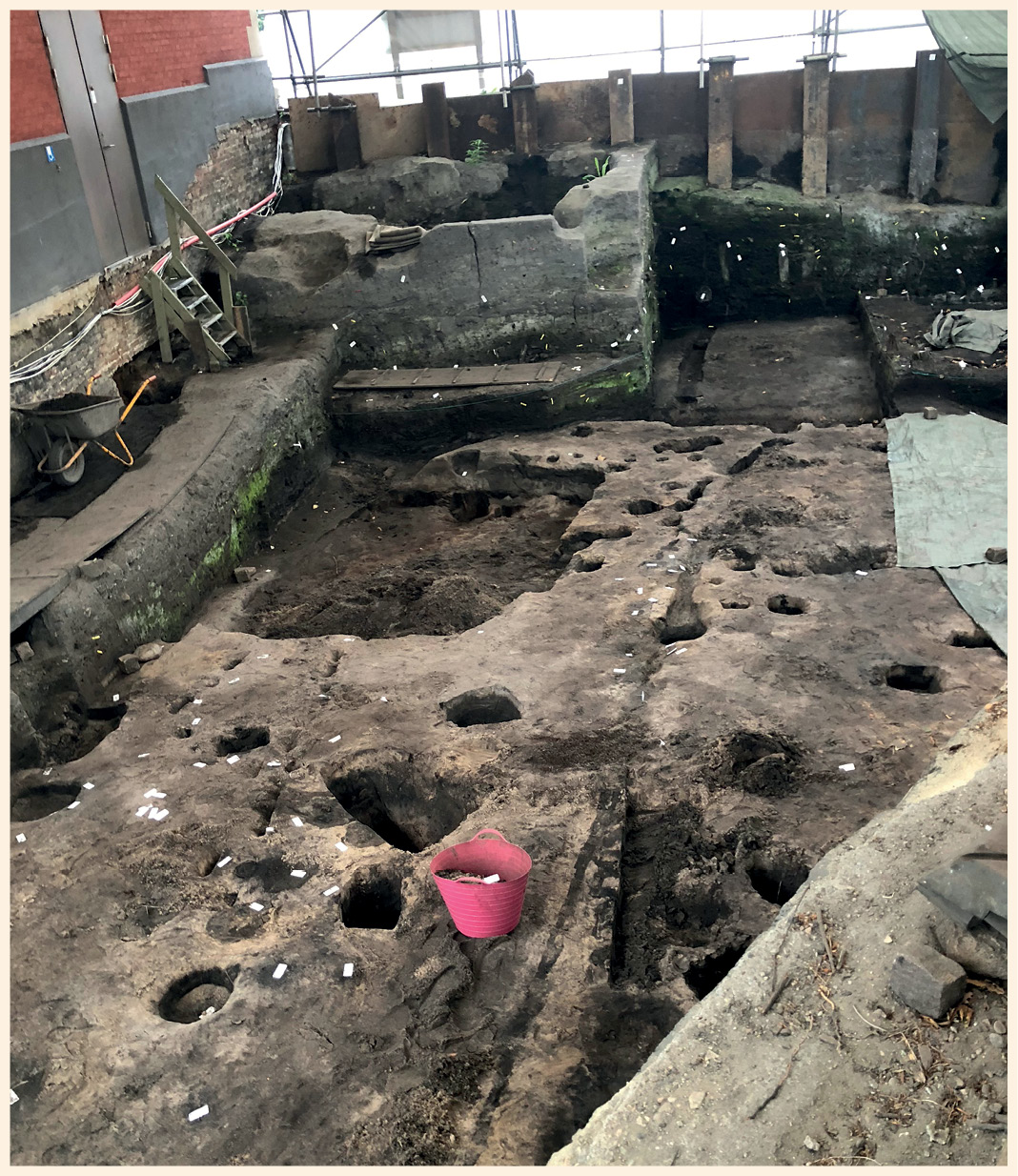
Excavations underway at Ribe. Here we see Søren Sindbæk showing the impressive and worm-free stratigraphy at the site (above), and the remains of 8th-century buildings cut into the sand (below).
Fifty years have sped by, enriched by the teaching and scholarship of many archaeologists such as David Peacock. I can only imagine the twinkle in his eye as he might have balanced the high-definition archaeology from Ribe with the tell-tale minerals in the thin-sections of these much-traveled Viking-age wares.
Acknowledgements:
My thanks to Pieterjan Deckers, Thomas Kind, and Søren Sindbæk for wise counsel as well as help with tracking down recent Tating Ware studies.
For more on Viking-age Ribe, see Søren Sindbæk’s Northern Emporium vol 1 & 2, published for the Jutland Archaeological Society in 2022 and 2023.
All images: courtesy of Richard Hodges, unless otherwise stated.