Subscribe now for full access and no adverts

I was in Greece, rolling off a ferry at Kyllini, about to visit its mighty castle, when I received the text message accusing me of being a Greek spy. Almost at once, I got an avalanche of emails from angry Albanians asking me to explain myself. It continued thus for a week. The virulence was, to say the least, discombobulating. After all, I have been a staunch champion of Albania and Albanians over the past three decades. Of course, I am not a Greek spy, but a nemesis had dubbed (into Albanian) and widely distributed a filmed lecture I had given 15 years ago, and made me state that Albanians had no part in creating their republic. My lecture about Butrint had explained how political serendipity led to the archaeological site being located in Albania. In 1913, after the Second Balkan War, the conquering Greeks wanted northern Epirus to be part of Greece. The Great Powers meeting in London were at first sympathetic, and then Italy objected. The Italians did not want both sides of the Straits of Corfu to be in Greek hands. Cape Stillo, immediately south of Butrint, on the Balkan side of the Straits, was at the centre of the dispute. For six months in London the diplomats wrangled about this. Then, thanks to the British Foreign Secretary Lord Grey’s skilful machinations, the new boundary was accepted, and Stillo became the southernmost cape of Albania. At first, the Greeks were outraged. Even ten years later, their lingering ire took the form of assassinating an Italian boundary commissioner. In essence, in the dubbed filmette that went viral, my nemesis ventriloquised me supporting the Greek cause.
There was more to this false accusation, with its resonant echo of Enver Hoxha’s communist regime. Hoxha – the post-war Albanian dictator – in deliberating on the origins of the Albanians once enigmatically declared: ‘what is Illyrian is Illyrian and what is Greek must be considered Greek’. This was turned into a metal sign and prominently mounted at Butrint to reinforce Hoxha’s conviction that the Albanians were descendants of the independently minded Illyrians. Butrint, in other words, owed nothing to Greeks. Its Hellenistic theatre, 200 Greek inscriptions, and its Byzantine heritage all belonged to Illyria and Hoxha’s fantastical ‘paradise on earth’. Post-communist Albania has come to recognise the terror and inhumanity of Hoxha’s mad era. Yet, as wave after wave of emails and text messages to me showed, many have staunchly held on to his fable about the Illyrians. Hence to propose that Butrint had any Greek heritage is heresy.
Why was I personally being attacked? What was behind this virulent outburst?
The answer, of course, was not about any interpretation of history or archaeology. Very simply, the social-media assault was designed to remove me from the trusteeship of a new foundation that has been set up to manage Butrint. This nationalist outcry about historical footnotes was intended to unnerve the Prime Minister’s resolution to deliver a more effective approach to running the Butrint National Park. As I know much about the archaeological site and am the only foreigner to serve as a trustee of this new foundation, my nemesis armed the leader of Albania’s opposition party to ask questions about my national allegiance in parliament. Needless to say, as anyone who knows Prime Minister Edi Rama will tell you, he responded in my defence with verbal fireworks.
This storm in a teacup made me nervous about returning to Butrint. But I did.

Excavating Butrint’s western defences
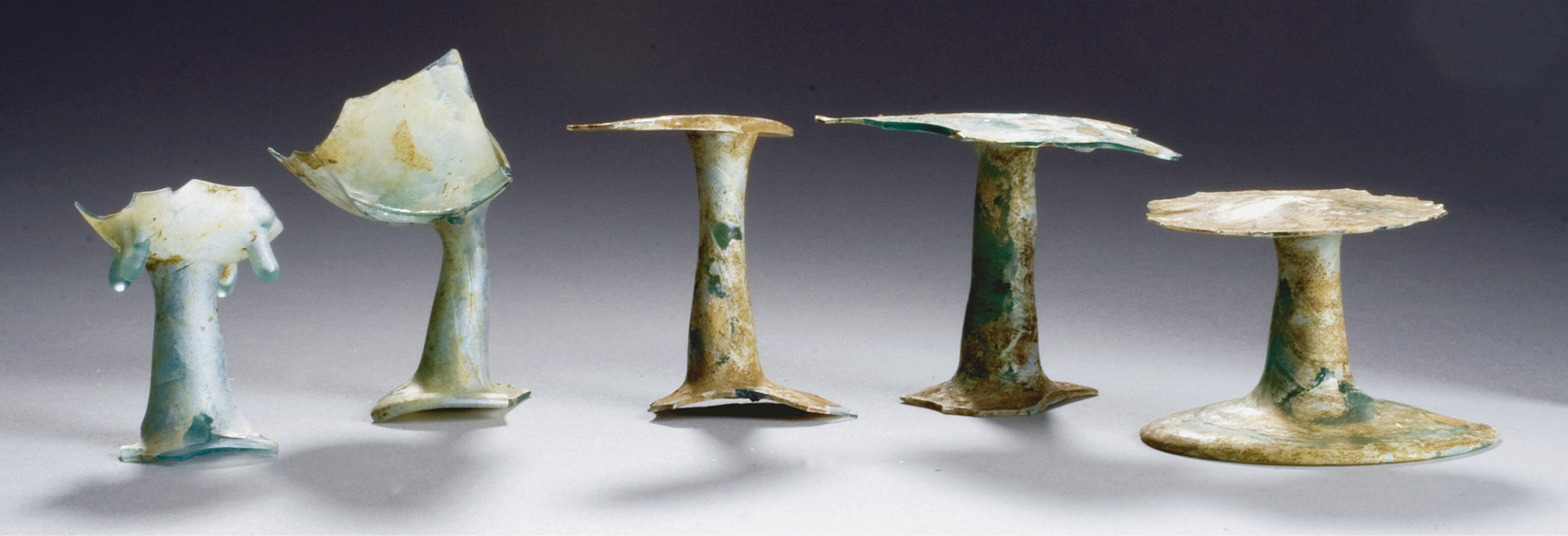
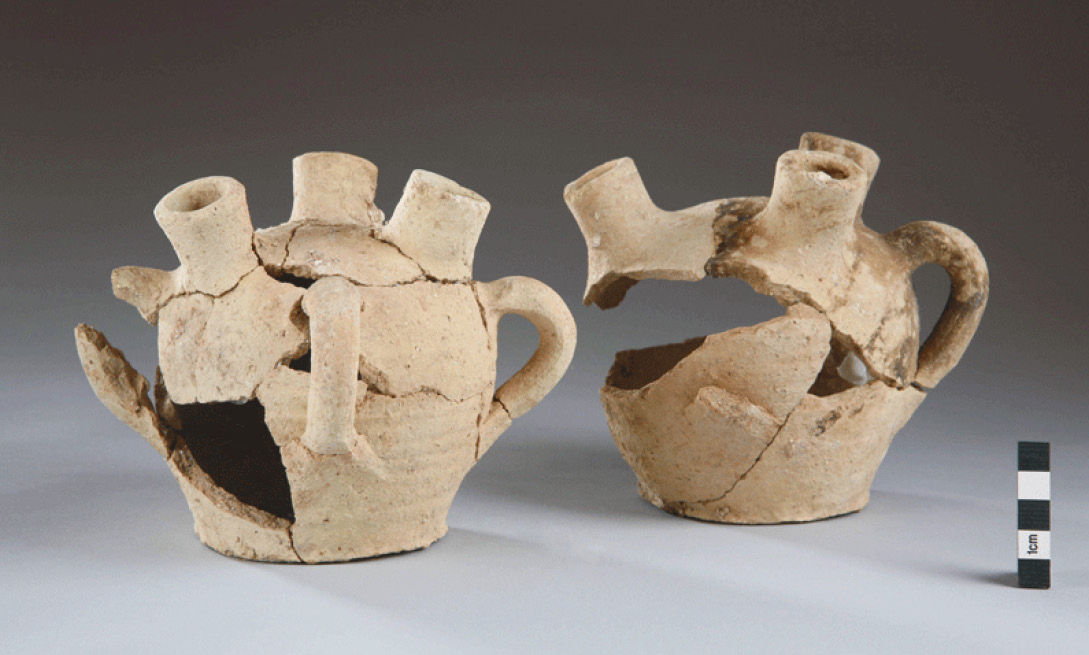
In 2004-2009, the Butrint Foundation carried out several small excavations in two of the three towers in Butrint’s seaward defences. These were our only forays into the western part of the site. Our discoveries were little short of sensational. The defences with their three towers were erected around AD 520-530, judging from the many coins and ceramics we found. But it was the contents of the towers that astonished us. Tower 1 was burnt down around AD 800, we believed 15 years ago, in a cataclysm that Pompeii-like sealed a marvellous assemblage of pots and a crate of glass waste. We excavated only half of Tower 2, deliberately leaving the northern half, and found extensive evidence of a fire here as well. Here, though, we also discovered ten strange pots with two or mostly three spouts, as well as a couple of finer vessels including a chafing dish: a portable ceramic oven.
Now, the fine dating of this calamity has had an impact on the economic history of the Ionian Sea region and beyond. It also seemed to dovetail neatly into the desertion of Butrint in the mid to later 9th century, in favour of an extra-mural nucleus outside the town, located in the old Roman suburb.
Fifteen years on, though, outstanding new studies of the port of Comacchio (Venice’s diminutive twin at the mouth of the Po), sites in Apulia’s heel – the Salento – and, above all, in Sicily gave me pause for thought as far as my interpretation of Butrint’s 9th-century history was concerned. If ever I was a Greek spy, it was in pinpointing the Byzantine story about its mercantile reach to its rich western domains.

Getting the band back together
The Butrint Foundation generously encouraged me to excavate the remaining half of Tower 2. So, following my lifelong adage that archaeology is as much about people as places, I got the band back together. Only when I went through the passport details of my colleagues to arrange insurance did I realise how we had all aged. But for our three Albanian students, the average age of the band was in their late 50s, and one or two of us were near contemporaries of Mick Jagger and Keith Richards.
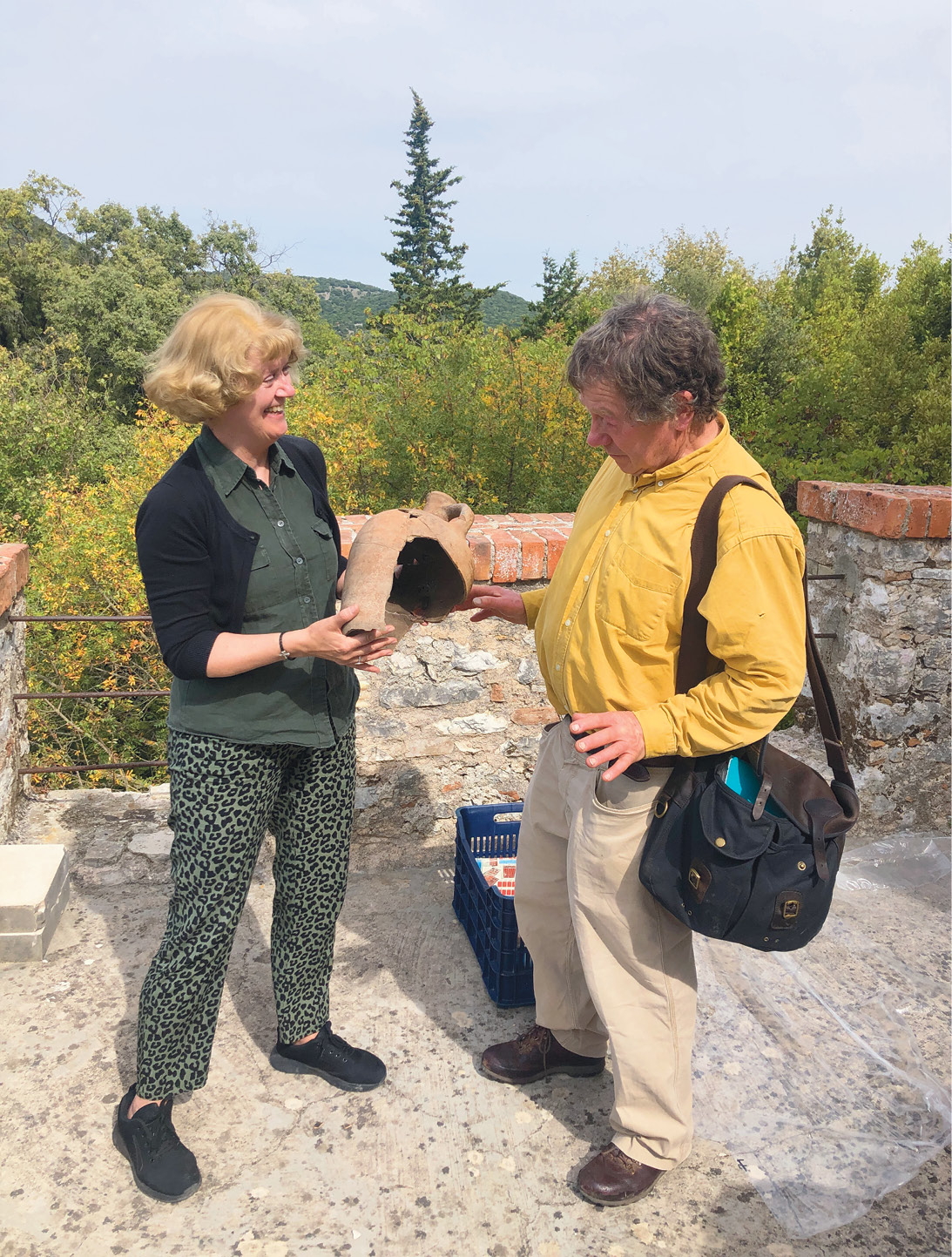
Nevila, my co-director from the Institute of Archaeology, had been collaborating with me for more than two decades. How was it possible that the years have passed so quickly? So too the evergreen excavators, Sarah and Simon, wonderful archaeological journeymen whose skills unearth interpretations I find simply beguiling. Joanita joined us from Leiden, where she is chair of archaeology, having studied Mediterranean ceramics since I first met her at Butrint in 1999. Sam, our numismatist, does a wonderful impression of an aging George Orwell with a cut-glass accent, a droll humour, and a commanding knowledge of all corroded small late Roman coins. Then there is Ollie – Albania is his second home – who has returned to help us navigate the stores. His presence draws every Albanian from far and wide to pay homage to his lifelong generosity towards a country that at times has struggled.
Many more join us, but the band is fully back together when John, my ‘professor of knick-knacks’ arrives. I first went to Albania with him 30 years ago, when we took a haversack of Spam in case we starved. He has brought his irrepressible excitement and his peerless art historian’s eye to the many small finds we have turned up. Each evening’s dinner with this aging band in Papi’s hotel in the nearby village of Ksamili, once no more than a wishful anticipation of a hostelry, was as rewarding as the dig.

Digging days
More than a dozen years have passed since I last excavated in Butrint. My first decade of digging here (1994-2004), I now freely admit, was a nightmare. The constant conflict – some of it down to my single-mindedness, some of it due to corruption – scarred me. From those conflicts, though, I have learnt much. I failed to comprehend the full depths of the terrifying vacuum left by the fall of communism. What I got right, thanks to the counsel of some wise heads, was the protection and presentation of Butrint that saved it for many global tourist bucket-lists. I also assembled a stellar team of archaeologists who gave their hearts and souls to both Butrint and supporting the legion of young Albanian archaeologists to whom we taught modern field techniques.
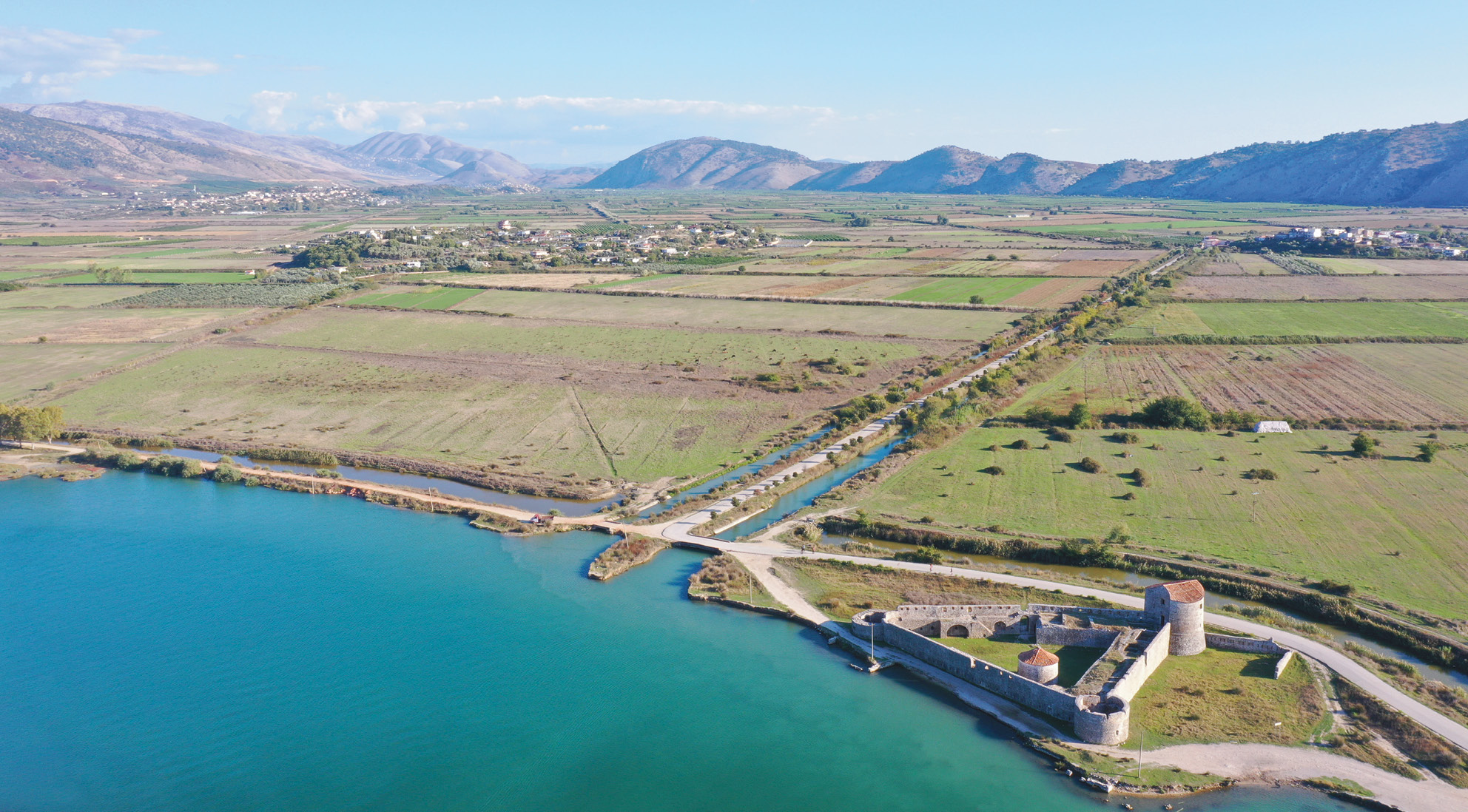
But Butrint and Albania have well and truly changed. Gone are the grinding poverty and the anarchy of construction. Today, to my astonishment, tourism has brought vast wealth to the country, and with it an appetite for a contemporary European ideal. Papi’s is a case in point. In the shabby little square next to the post office in Ksamili, the village nearest to Butrint, this was once a dark, ill-fit place; refurbished, it is now a three-star place on Booking.com. The affable bear-like Papi began in this or that nefarious activity in the 1990s and has made a peaceful haven for his family and us. But he is not alone. In 1993, when I first passed through Ksamili, it had just a few crumbling tower blocks and a solitary hotel, the Sea Eagle, overlooking this bijou bay with its crystalline waters opposite Corfu. The British travel-writer Eric Newby had paused here a decade earlier, to despair at the sight of the communist apparatchiks cavorting on the beach in their minimalist Western beachwear while the country starved. Today, Ksamili boasts 108 hotels. Polyglot tourists now descend on the town in all shapes and sizes. Being profiled on the Dutch version of I’m a Celebrity… Get Me Out of Here! has enticed flocks of Low Country sun-seekers. The changes are almost too overwhelming.
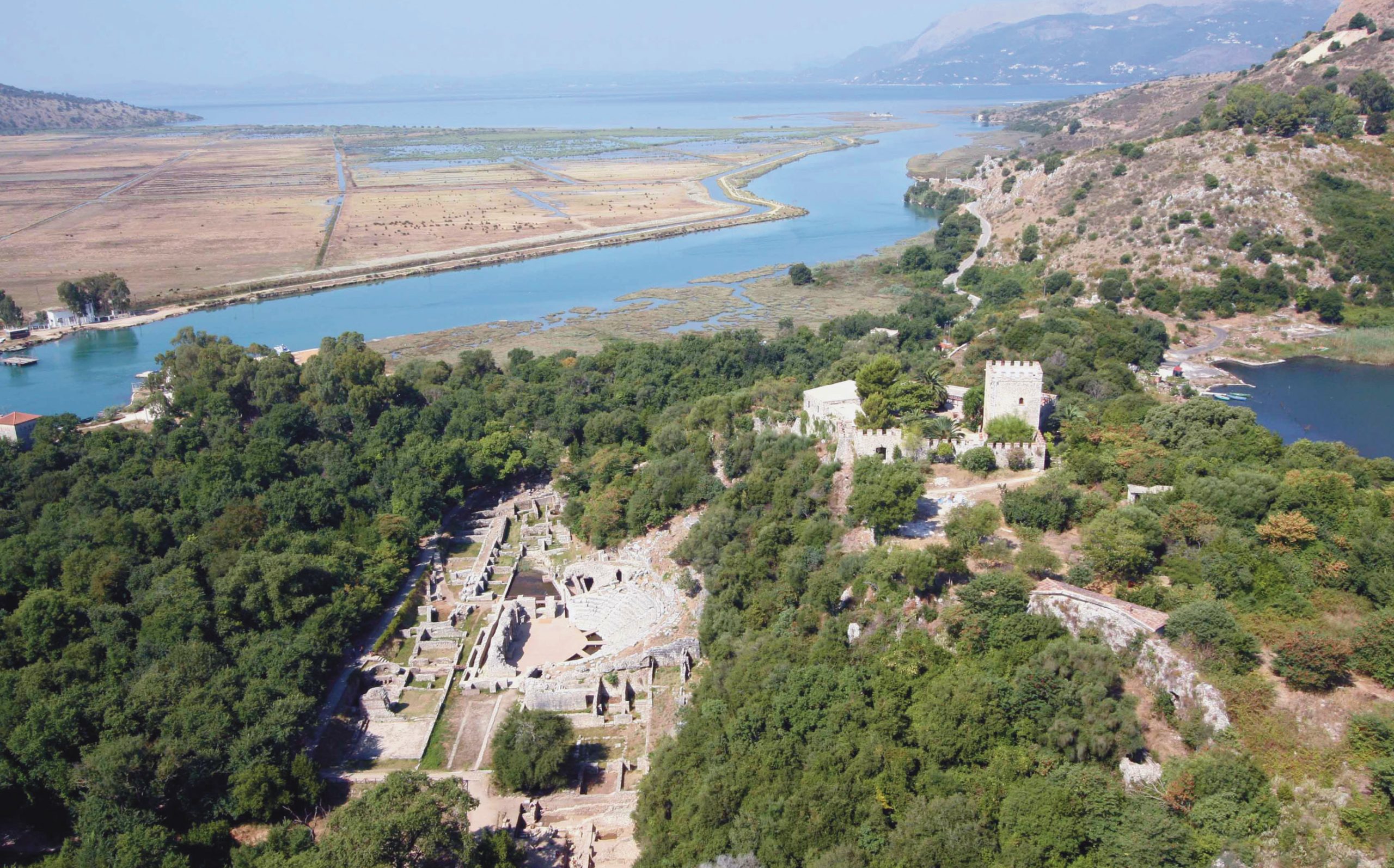
As an archaeological site, Butrint has barely changed since I first came here. Each day it is a joy to wind down the road to the Vivari Channel and enter the blissful canopy of woodland that covers the ancient and medieval town. Out beyond, with Cape Stillo forming the southern horizon, little has changed. This is a Homeric landscape.
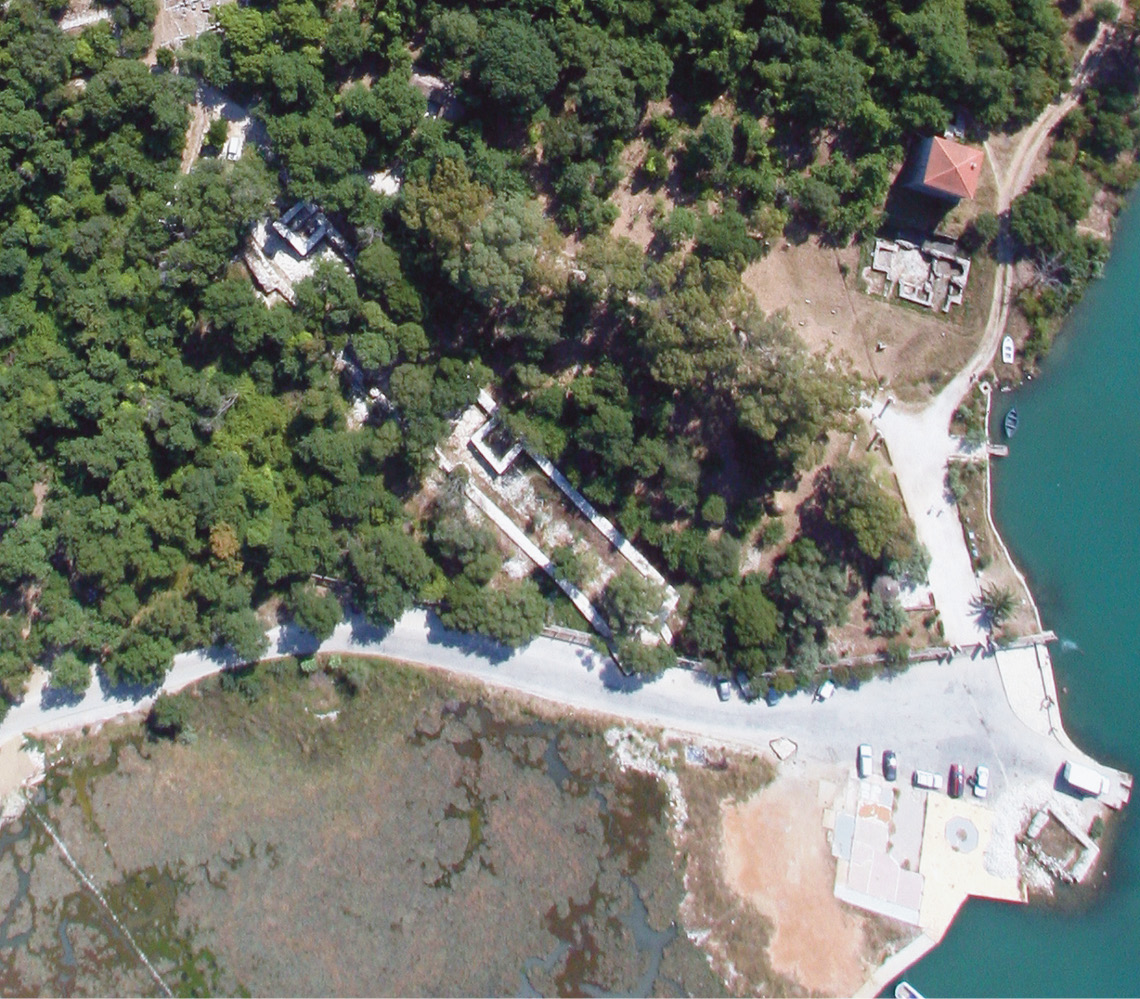
But Butrint has changed in one important respect. In 1993, we walked alone around the UNESCO World Heritage Site on a September Friday. Now Butrint attracts 300,000 tourists a year, or more. They come because it is Albania’s premier destination, the price-point is still enticing, and possibly because of its advertised association with Virgil and the Aeneid. Coach parties, camper-van families, and bold cyclists all relish one aspect above all others: Butrint is escapism from the modern. It is a gentle foray into a past made quite dreamlike by glistening views of Lake Butrint and the trees and the shadows they cast over the ruins, including a Hellenistic theatre, a 6th-century baptistery, and a roofless basilica. This is what it was like to be a Grand Tourist in the age of Lord Byron or the painter Edward Lear. This magical effect that first struck me 30 years ago has in no way diminished. It brings young Albanians to have wedding photographs taken here. The magic is what sticks in the minds of the countless visitors who stop to ask us what we are digging, then offer rapturous observations.
Butrint’s fame brings challenges. To keep it as it is while we confront climate change necessitates real investment in far-reaching studies to protect the place. The tsunami of visitors brings transport problems galore. These are just two of the many reasons behind the new foundation. You may well wonder why on earth ‘being a Greek spy’ has anything to do with planning the future. The fact is, of course, it doesn’t. It’s Orwellian doublethink to undermine the government – pure politics. Nevertheless, as soon as I arrive with my trusty band, I am asked by bemused locals about my Greek associations! Worse, on the first day ‘the piranhas’ (as they call themselves) arrive. These three men are uniformly dressed in black, and carry a large camera and boom-mike. Of course, mixing with tourists in sandals, they stand out like sore thumbs in the dappling autumn sunshine. Knowing I am on site, they intend to surprise me. Their political humour involves quizzing me on being a Graecophile and then editing the film to superimpose a quacking cartoon duck on my shoulder in order to ridicule whatever I say. Fortunately, these practised urban-based predators have no sense of an archaeological site. My Albanian friends ensure that I avoid them, until they lose patience and seek other prey for their early evening show.
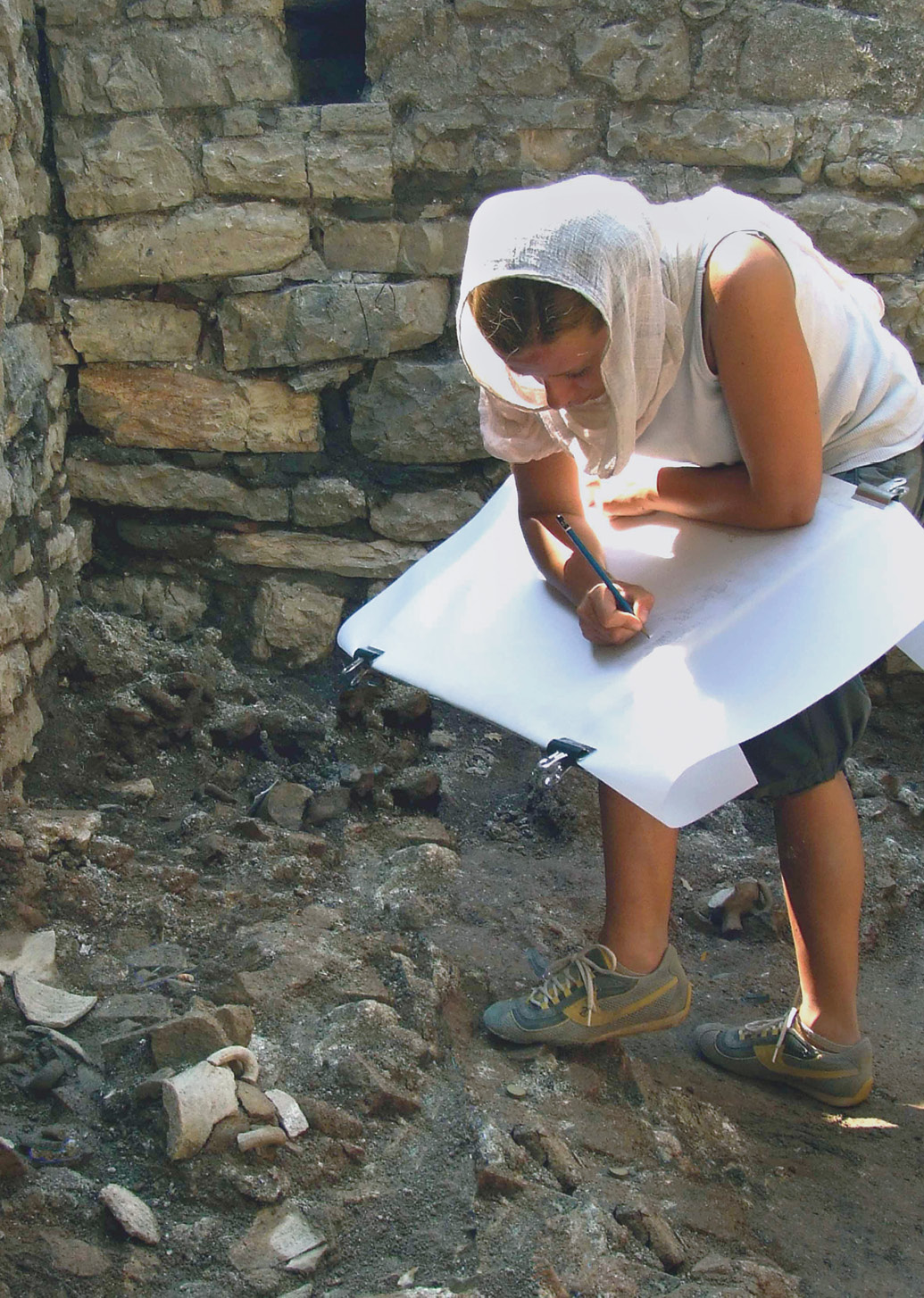
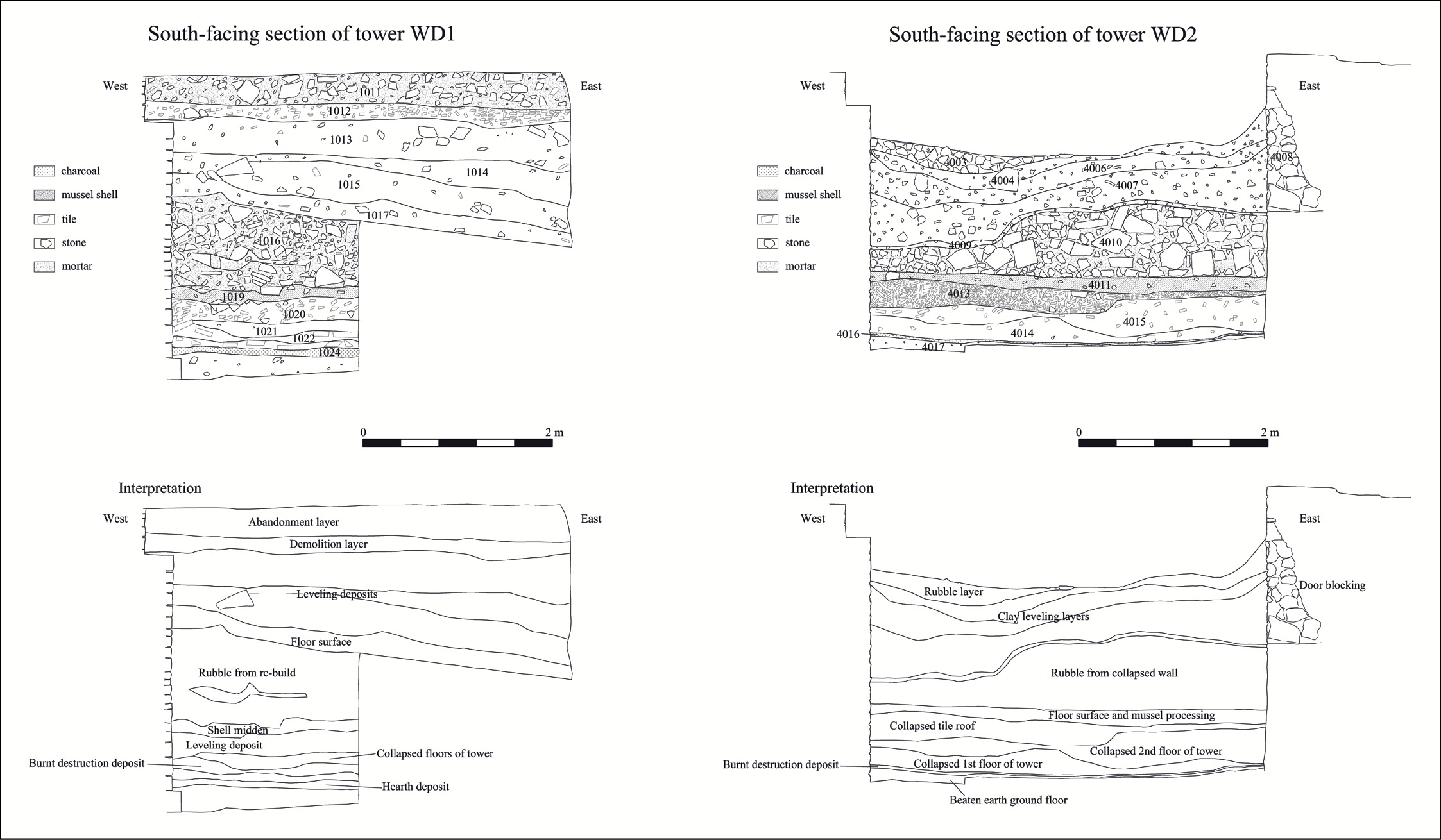
This momentary nuisance is soon eclipsed by the simple thrills of the archaeology. Sarah and Simon with their team slog away through a deep layer of 12th-century collapsed stone, the aftermath of an earthquake almost certainly in AD 1153. Underneath is a layer of crushed mussel shells similar to those found elsewhere in Butrint. From it came two 10th-century Byzantine folles, everyday coins that John triumphantly identifies, and Sam promptly confirms. Before this dig, I believed the midden and the thick demolition layer of smashed roofing tiles and rubble below it to be traces of a roof collapse, followed by use of the ground floor of the 10th-century tower as a point where mussels from Lake Butrint were processed. But the mussel layer extends out through the tower’s ground-floor door as far as a levelled 5th-century wall to the east of the tower. The penny – or perhaps the follis – drops: these two very different layers are a kind of hardcore followed by a waterproofing of expendable midden material almost certainly brought in from outside Butrint. (Similar waterproofing occurs in almost all our excavations, pointing to the industrial scale on which shellfish was processed at this time.) Here, as in other parts of Butrint, around AD 1000 the well-organised aim was to build up the living surfaces above the water table. This, as I shall explain below, became more than obvious a week later.
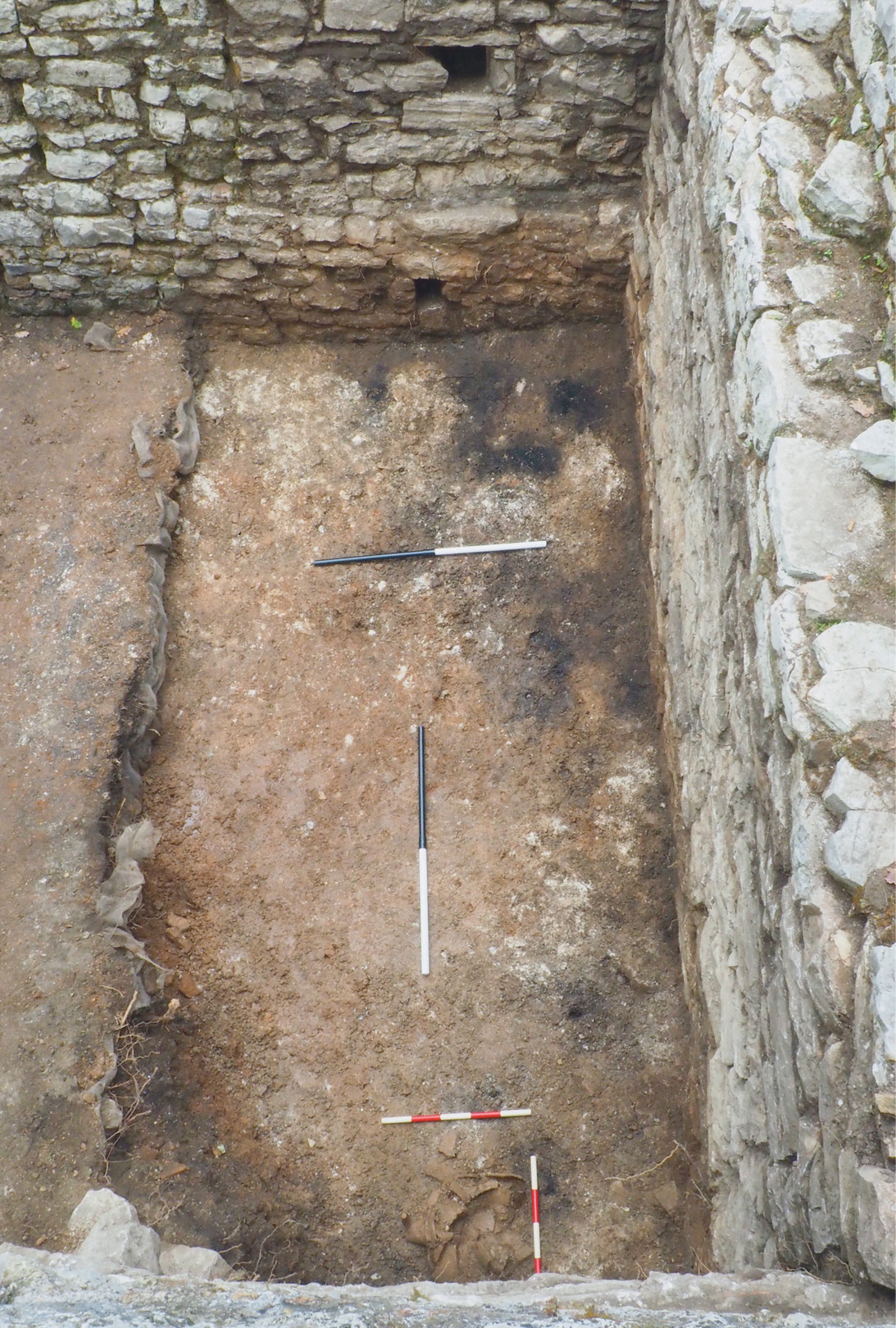
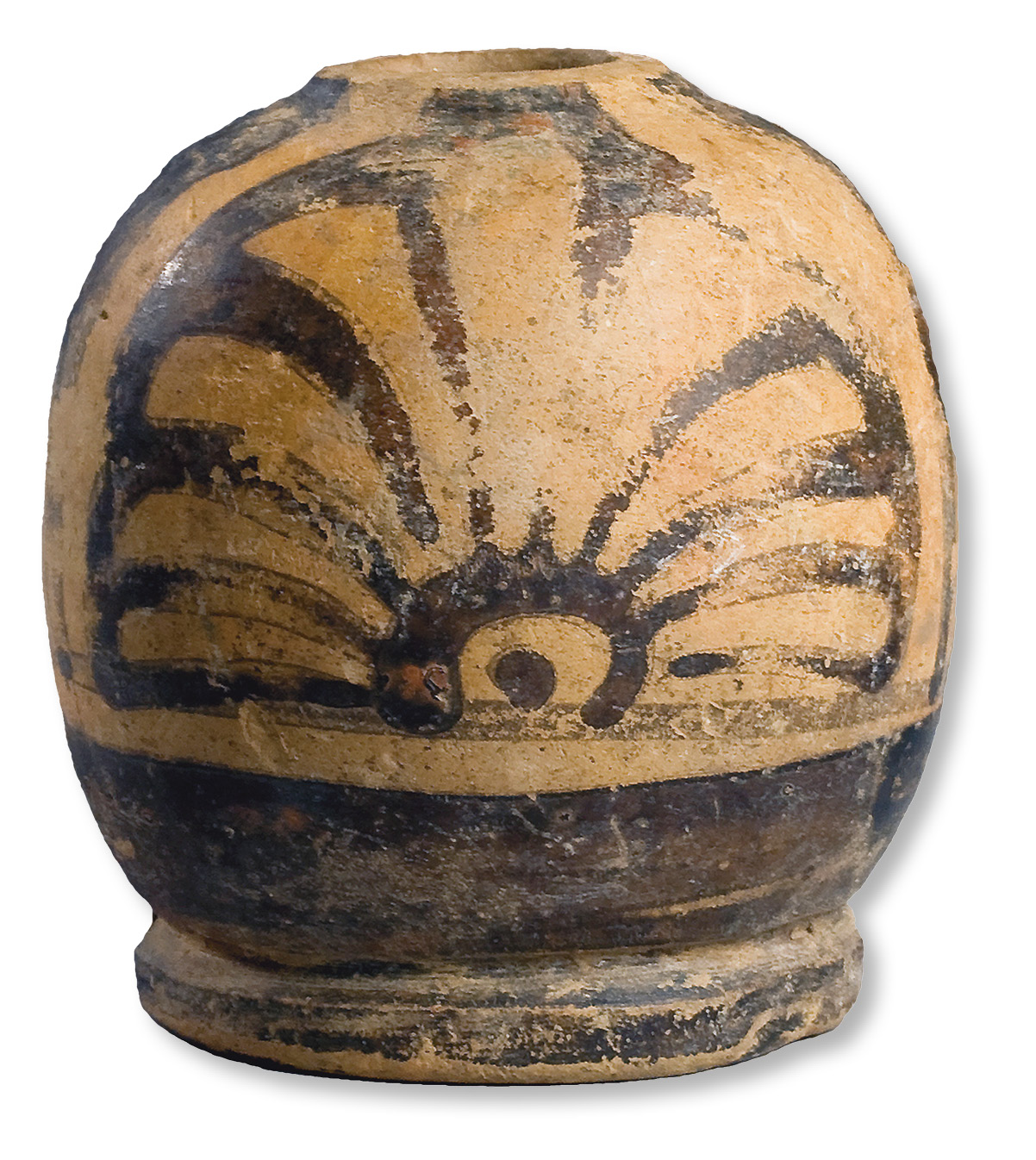
Now, what would we find below the hardcore? In 2008, we believed the 9th-century floor showed signs of a fire, like Tower 1. In 2008, associated with this surface in the southern half of the tower deposits were a galaxy of enigmatic pots. Sarah and Simon have a knack of upturning the archaeological apple-cart. Careful to focus on my problem, forensically they discovered that the burning was both ephemeral and patchy. Rather than a roof collapse (the later hardcore demolition level), it looks as though two or three hearths had been made on the final beaten-earth floor. A near complete amphora, almost certainly of 9th-century Sicilian origin according to Joanita, lay on the surface. It showed no signs of burning, unlike the scorched amphorae found in Tower 1. Rather, it had the hallmark of a storeroom that was simply abandoned. Only one other multi-spouted vessel was found to add to the ten discovered in the earlier excavation. Of all the small treasures from this ephemeral layer, one thrilled us. A dark round metal object, identified thanks to Sarah’s eagle eye, turned out to be a Byzantine follis of the Emperors Basil I and Constantine (869-879). The tower was never burnt down, it now seems, but instead it was abandoned in the 870s.

Beneath this unprepossessing 9th-century floor were others reaching down to the 6th century, when Tower 2 was constructed. This new take on the history forced us to rethink the interpretation of the western defences. Three conclusions became evident.
First, the erection of the defences in the 520s involved demolishing at least one and perhaps as many as three large later Roman townhouses extending westwards to a likely harbour area, sealed underneath the present parking lot. Second, it is now crystal clear that the wide, powerful wall with Towers 1, 2, and 3 lay immediately behind an outer, seaward-facing wall. These two parallel walls erected in the 520s were what is known as a proteichisma, an uncommon emulation of the great landward Theodosian Walls of Constantinople. These walls were intended for display. Their purpose was to impress visitors – traders and others – approaching Butrint from the Straits of Corfu and up the Vivari Channel, or pursuing a landward track running south from the village of Ksamili, much as the modern road does (originally built for Nikita Khrushchev’s visit in May 1959).
Third, the archaeology now suggests a new 9th-century narrative. Tower 1 perished in a fire, early in the 9th century, perhaps prompted by an attack or a domestic catastrophe. Its ground-floor store was rich with ceramics from an arc stretching from Constantinople to Sicily. These finds have the hallmark of someone with significant portable possessions. In contemporary Byzantine terms, it was probably home to the archon – an administrator of Butrint and its territory, which was then known as Vagnetia. Tower 2, by contrast, looks to have been abandoned rather than destroyed at this time. One reason for this became crystal clear to us. A thunderstorm lasting many hours led to our trench filling with 50cm of water as the water table rose, terminating the dig. This perhaps explains why a new Butrint was made outside the old town on the slight rise in the ruins of the old suburb. More to the point, we now have a date for the likely shift provided by the well-placed coin of Basil I and Constantine. Rather than on the occasion of the calamity around 800, the shift occurred after the 870s. Numerous Byzantine coins and seals from our large Butrint Foundation excavations of extra-mural Butrint bear this out (published by Oxbow Books in 2019). As it happens, the coin sequence here begins in the third quarter of the 9th century and lasted for little more than a century. It was then abandoned in turn, and the new town of Butrint was reconfigured on raised terracing, much of it made from middens of processed mussels.
Greek spy?
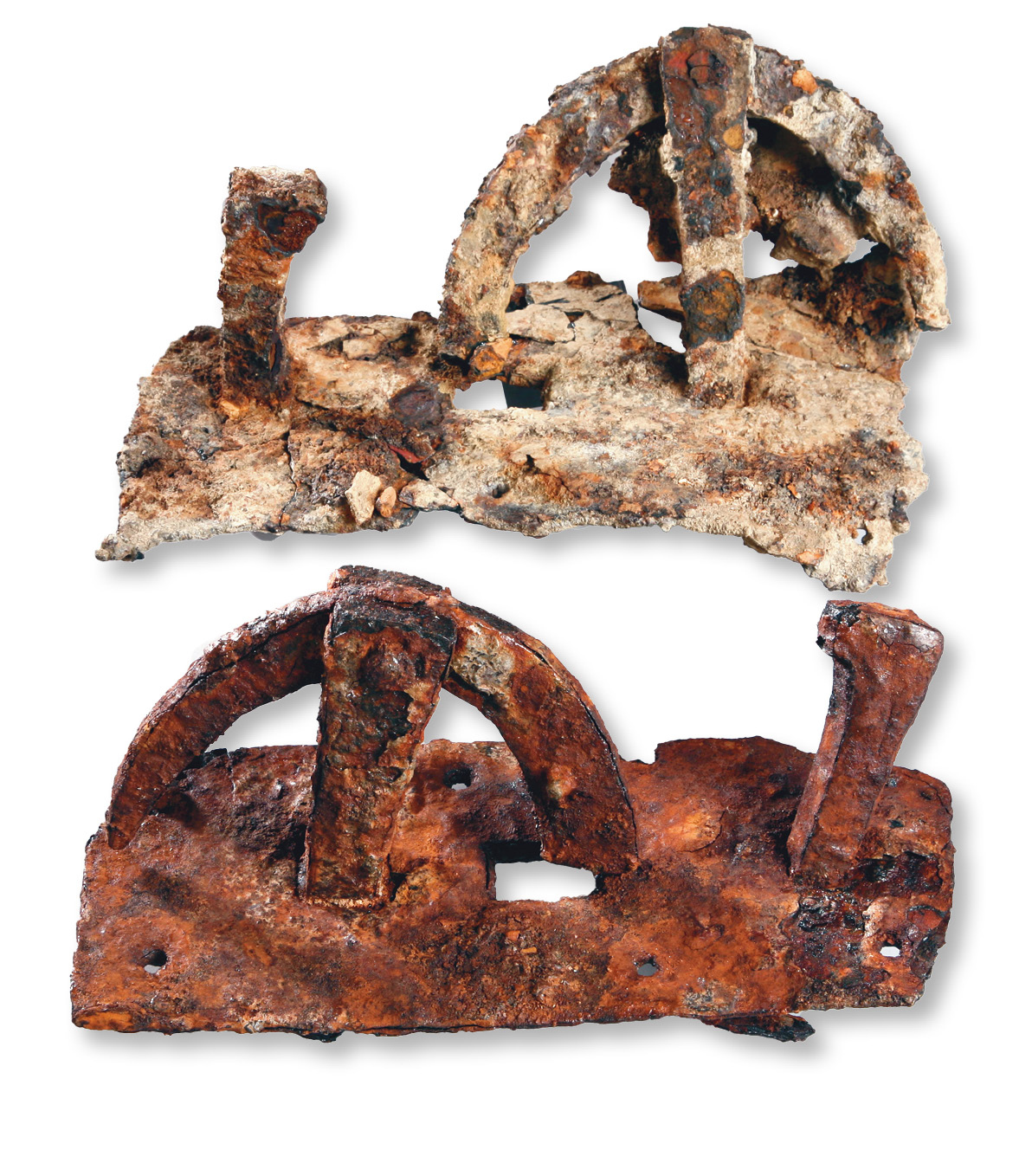
During this short season, we reassessed all the exceptional finds from the excavations in Towers 1 and 2. Some objects make plenty of sense: the array of pots from Tower 1 as well as an extraordinary crate of glass waste, possibly destined for making windows in Carolingian Italy, or beads in Viking Denmark, hold no real mysteries. Making a good catalogue of these, as well as the coins and small metal finds, was achieved despite the pipistrelle bats and cat-sized rats in Butrint’s storerooms in the castle. These have given rise to two lively debates between John and Joanita. The first concerns an odd iron armature from each tower. Are they part of artillery pieces known as ballistas stationed in each, as John likes to believe, or some hinge for a moveable ladder to reach the first floor as Joanita proposes? Equally contentious is the purpose of the 11 multi-spouted pots from Tower 2. John, with his irrepressible imagination, favoured them being grenades for Greek fire. Joanita disputes this colourful interpretation and proposes that they were a type of friendship cup for sharing drinks at banquets – a convivium. The idea is that you drink from your spout, then pass it to another person, who drinks from a different spout. In north Italy today, friendship cups are used to sip wine, or more commonly hot coffee alla Valdostana with grappa, sugar, and spices. John’s theory would explain why there are so many, but may be just a little far-fetched. Joanita’s would be plausible if there were two or three examples, but why were 11 left here when the tower was abandoned in the later 9th century, and why have none been found in the extra-mural suburb? What unalloyed fun we had debating these and other imponderables over dinner, and rewriting history. That is the real joy of archaeology. New discoveries constantly prompt new theories and interpretations.

As for being a Greek spy, there is little doubt that Butrint in the Dark Ages – as in earlier times – fell under a larger Hellenic hegemony. Greek graffiti incised on some of the pots from Tower 1, as well as the minted folles, strongly affirm this. But then many places at this time fell under a Grecian spell – in Montenegro and Croatia, as well as in Apulia. Even Venice for a period was Byzantine – that is, Greek. Manipulating this history, just as manipulating the history of the creation of Albania’s southern frontier between 1913-1923 to somehow show that Cape Stillo was Albanian/Illyrian all along, is to create an arrant falsehood for present purposes. Yet Albania, in a period of great transition from communism to a modern European republic, is no different from many other countries, where nationalism and identity issues that came to a head in the later 19th and earlier 20th centuries have bred conflicts with echoes that endure into the 2020s. Thankfully, today a minority in Albania subscribe to this doublethink. For Butrint, as it gains an ever-greater grip on the central narratives of its history, thanks to excavations like ours, the priority is not identity issues, but the urgent need to protect the place for the future as climate change (namely, the rising water table we confronted) and swarms of visitors call for strategic management appropriate to its Homeric spirit.
Richard Hodges is President Emeritus of the American University of Rome.
All images: courtesy of Richard Hodges