Subscribe now for full access and no adverts
Another advance has been made in the efforts to decipher a collection of ancient papyrus scrolls from Herculaneum that were burnt during the eruption of Mount Vesuvius in AD 79.
Remarkable progress has been made in recent years thanks to the development of an innovative process through which the carbonised scrolls can be virtually unrolled and lost text identified, as part of the Vesuvius Challenge (see CWA 129). Now a new scroll is under investigation. In 2024, Scroll P.Herc. 172, which is housed in the Bodleian Libraries in Oxford, UK, became the fifth scroll from Herculaneum to be scanned at the Diamond Light Source synchrotron facility. These X-ray CT scans revealed that the ink in this scroll was much clearer than any of the others investigated to date, in some places even visible to the naked eye. This could be due to higher-density ink, a difference in the papyrus, or the carbonisation process itself; investigations are currently under way.
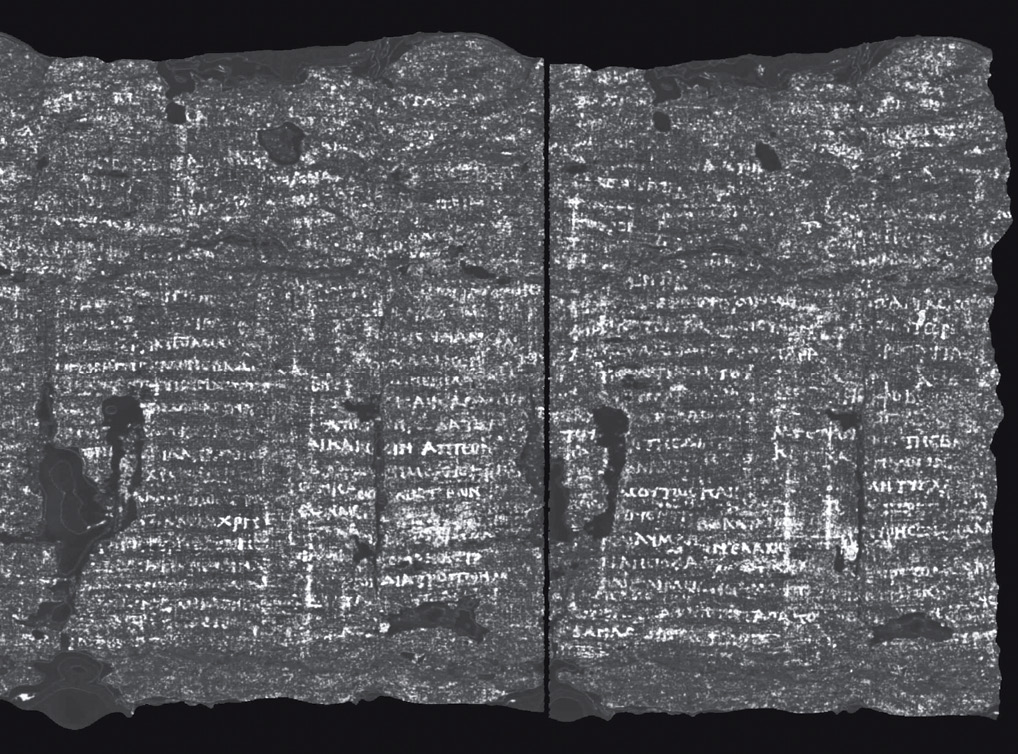
Over the following months, researchers worked with machine learning tools to create the clearest possible images of the inside of Scroll P.Herc. 172 and enhance the legibility of the writing on the surface of the papyrus. These images were then handed over to human scholars to transcribe and translate the text. Already, a number of words in ancient Greek have been deciphered, including Διατροπή, meaning ‘disgust’, ἀδιάληπτος (‘foolish’), φοβ (‘fear’), and βίου (‘life’). The handwriting, along with several other clues, suggests that the scroll may be a work by the philosopher Philodemus, who was responsible for most of the other books identified in the Villa dei Papiri’s library so far.
There is still more work to do, but already P.Herc. 172 contains more potentially readable text than ever before seen in a scanned Herculaneum scroll, representing a significant step towards recovering these valuable ancient writings.
Text: Amy Brunskill / Image: © Vesuvius Challenge