
Subscribe now for full access and no adverts
Archaeologists have confirmed ‘beyond all reasonable doubt’ the site of the long-lost home of Harold Godwinson, the last Anglo-Saxon king of England – thanks in part to a medieval toilet.
Harold ruled as the English monarch for only nine months before he was killed at the Battle of Hastings, during the Norman invasion of Britain, in 1066.
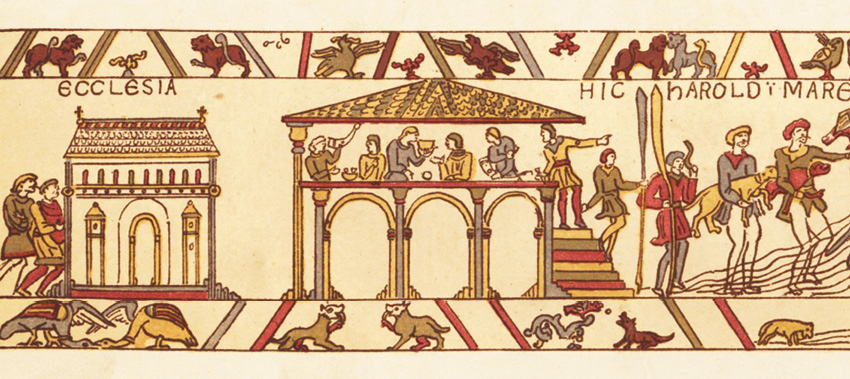
The story of the invasion is told in the Bayeux Tapestry – which, among its many details, twice features Harold at the village of Bosham on the coast of West Sussex.
It has long been suggested that a manor house in the village – now a private residence – stands on the site of the former royal residence depicted in the tapestry.
Through recent research, teams from Newcastle and Exeter universities confirmed the existence of two previously unidentified medieval buildings at the site: one which forms part of the current house and another in the garden.
The archaeologists also re-examined evidence from excavations carried out by West Sussex Archaeology in 2006, which identified a latrine within a large timber structure.
Over recent years, archaeologists have begun to recognise a trend in England, beginning during the 10th century, for high-status households to have integrated toilets.
The timber structure therefore almost certainly formed part of Harold’s royal residence – the exact location of which remained a mystery for almost a millennium.
As Dr Duncan Wright of Newcastle University explained: ‘The realisation that, in 2006, excavations had found, in effect, an Anglo-Saxon en suite confirmed to us that this house sits on the site of an elite residence pre dating the Norman Conquest.’
‘It is beyond all reasonable doubt that we have here the location of Harold Godwinson’s private power centre,’ he added.
The research, which was published in The Antiquaries Journal, is part of a wider project, Where Power Lies, exploring historic centres of aristocratic rule in England.