Subscribe now for full access and no adverts
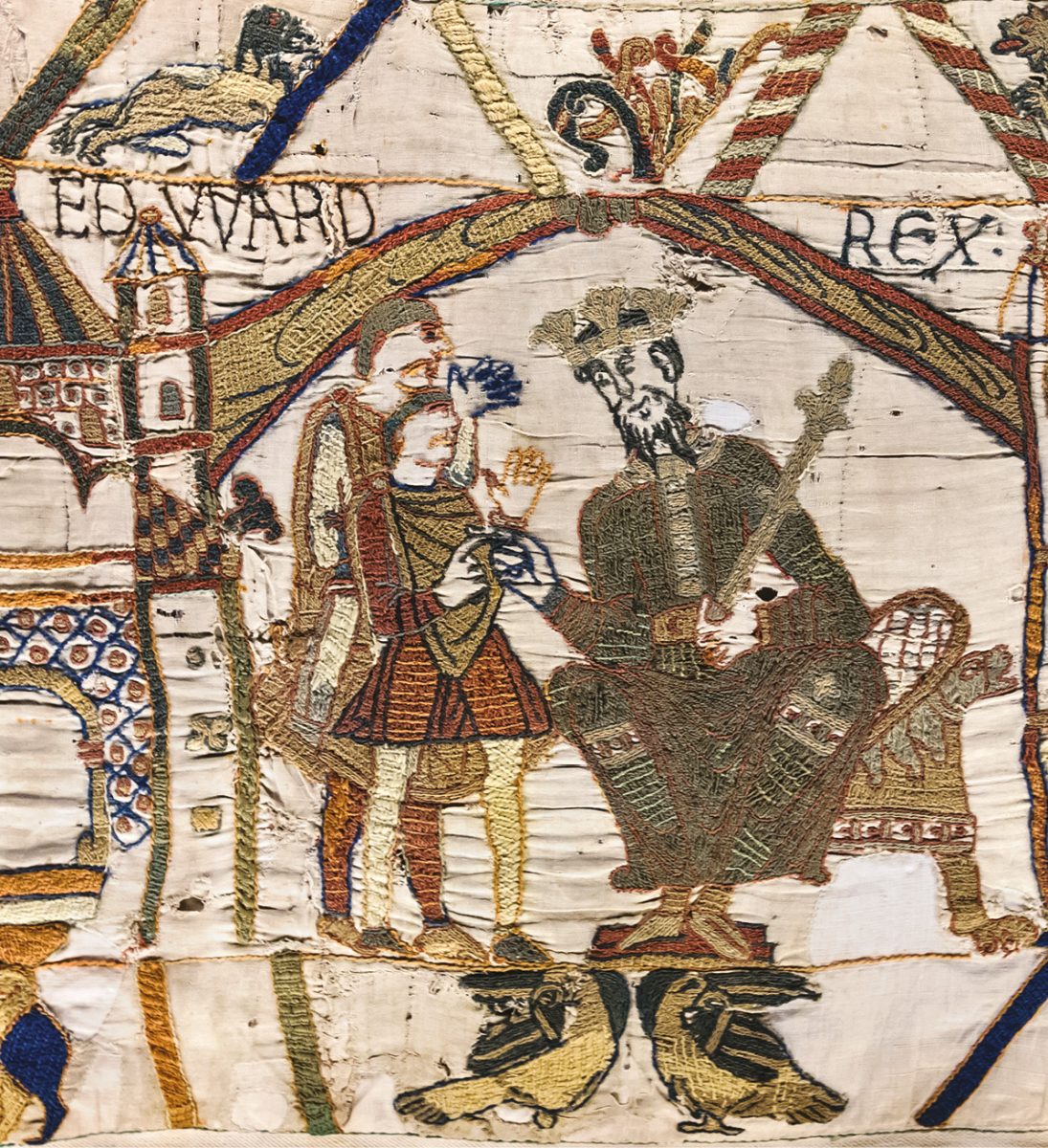
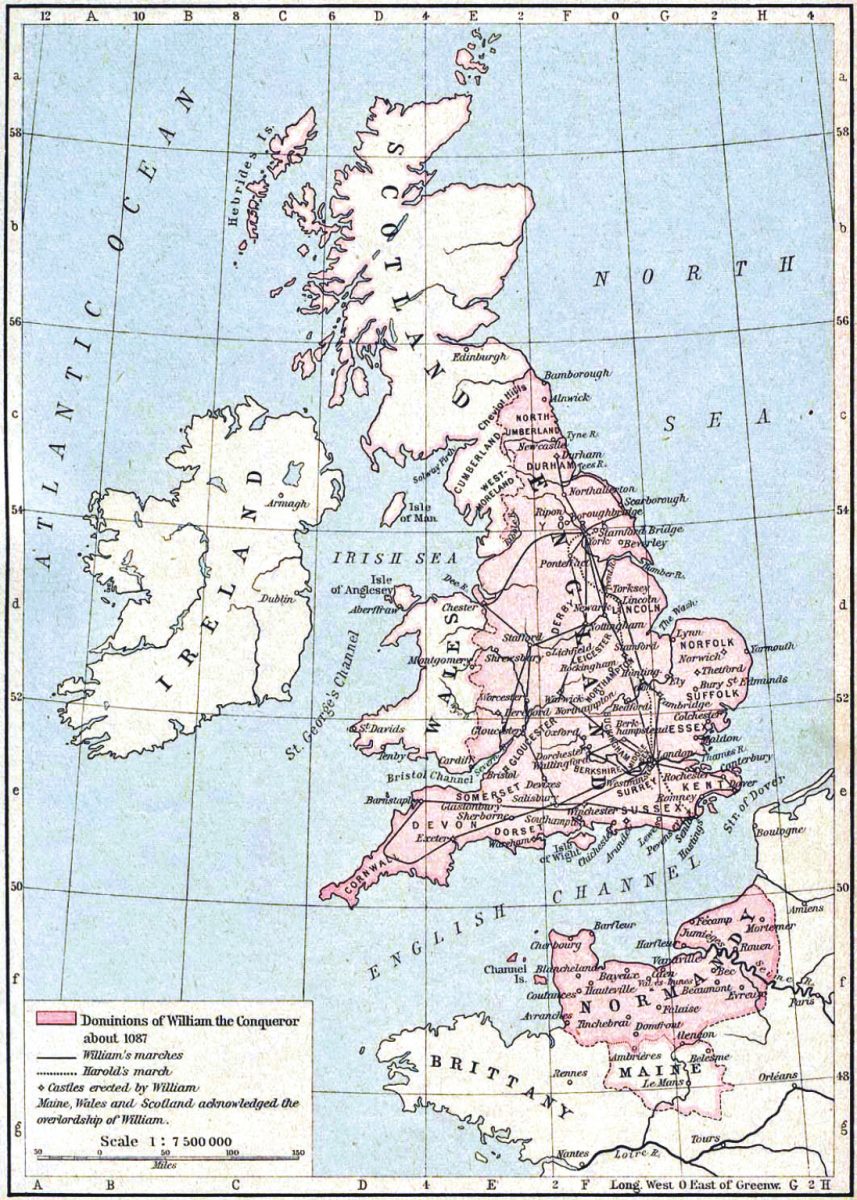
We think we know the story of Harold Godwinson’s reign so well. We know that the last crowned Anglo-Saxon king of England came to the throne after the death of his childless brother-in-law Edward the Confessor, who ruled from 1042 to 1066. And we know that he had to face two invasions: a Norwegian invasion led by Harald Hardrada (‘hard ruler’) up in Yorkshire; and just days after that Norwegian army was destroyed at the Battle of Stamford Bridge, a Norman invasion down in Sussex, led by Duke William of Normandy, who claimed that Edward had in fact nominated him as his real successor.
It’s a story that, for generations of schoolchildren, has had at its heart three ‘established facts’, which have been repeated over and again as the decades have passed. First, that Harold’s exhausted army had to march the long distance from Sussex to Yorkshire and then back again in record time, in order to counter the quick-fire double-threat to his territory. Second, that at the Battle of Hastings the entire Norman cavalry had pretended to retreat, tempting the Saxon infantry away from their positions and into the open, where they were cut down as they made their pursuit. And third – perhaps most famously – that Harold was killed by an arrow to the eye, with that most dramatic of kingly deaths marking the end of England’s Anglo-Saxon age, after more than six centuries.
Times change, however, and as a result of more recent historical study we are now pretty sure that all three of these so-called ‘facts’ are myths – so, as the British Museum in London prepares to open its blockbuster new exhibition, which returns the Bayeux Tapestry to England for the first time in nearly 1,000 years, it may be time to take stock of what we know (or think we know) about 1066 and all that.
Double trouble
Completed by an anonymous author in c.1067, Edward the Confessor’s biography makes no mention of William’s claim to the English throne – but William himself insisted that Harold had sworn an oath on holy relics to support his claim, after the latter had been shipwrecked in Normandy and released by William from the local count’s jail. For his part, Harold wasn’t aware of William’s invasion plans till spring 1066: the invasion was supposed to have taken place in the early summer – but William was delayed by the inclement English weather. If it had been better, Harold might not have faced Norman and Norwegian invasions at the same time.
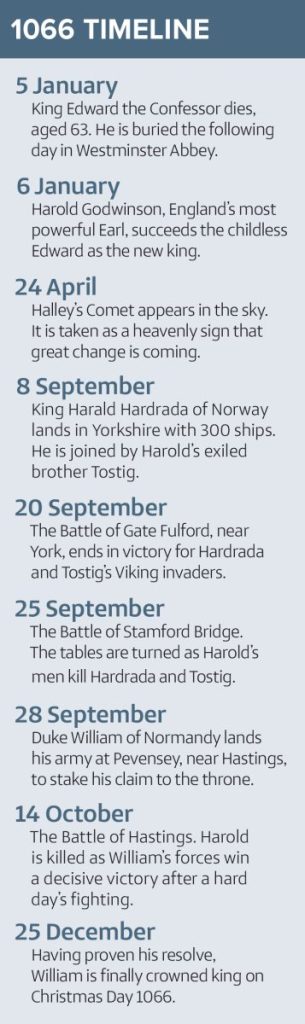
That spring, Harold’s exiled brother Tostig, who also claimed the throne, raided England’s south coast with 60 ships manned by Flemish mercenaries. In response, Harold raised a fleet, which drove Tostig to Scotland, along with the 12 ships he had left. Tostig allied with King Harald III Hardrada of Norway, who landed in Yorkshire in early September with 300 ships under the raven banner used by Scandinavian rulers. Tostig joined him at the Tyne – and on 20 September, they defeated the Northern Earls Edwin and Morcar at Gate Fulford, before capturing the nearby city of York.

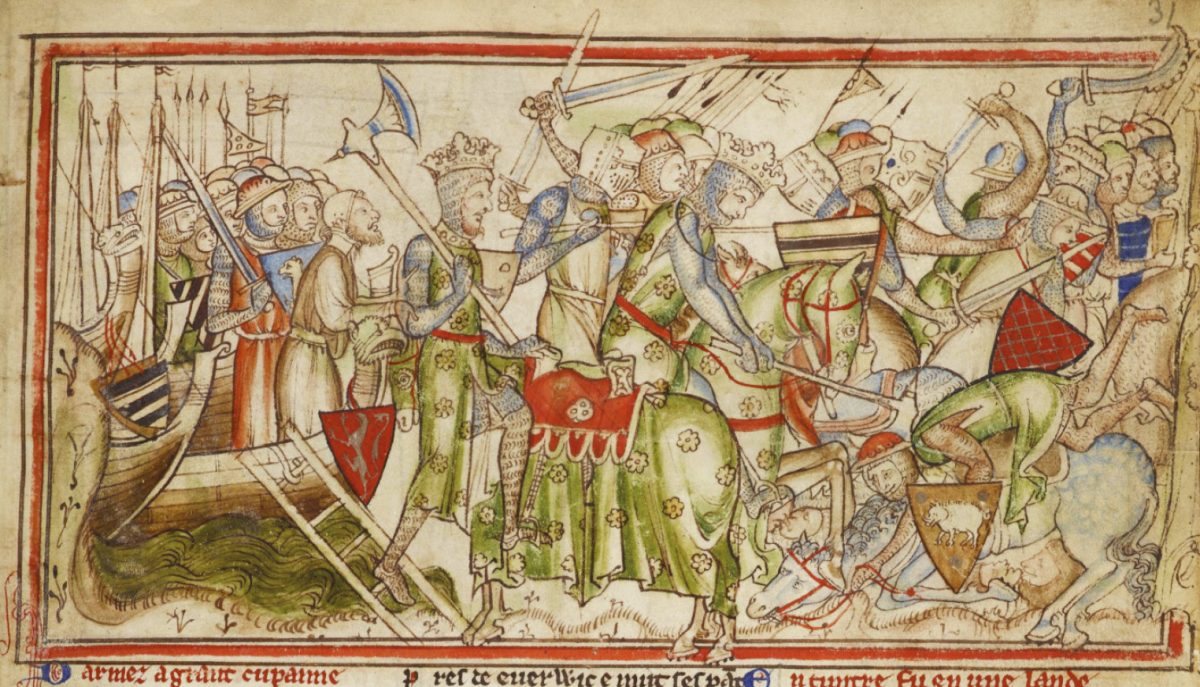
Meanwhile, Harold’s army was marching the 190 miles northwards at a phenomenal pace – arriving on 25 September at York, where Hardrada was unaware of its presence. The Norwegian king had left a third of his army guarding his fleet and armour under his son Olaf and brother-in-law Eystein Orre at Riccall, a few miles south of York on the banks of the River Ouse. The remainder were surprised by the Saxons at nearby Stamford Bridge, where they were waiting for hostages. This group had left their chainmail behind because of the now-sweltering weather.
According to the most reliable contemporary account, the early English Anglo-Saxon Chronicle, one Viking who was wearing mail that day guarded the very narrow Stamford Bridge, where he managed to hold up the entire English army on his own, cutting down more than 40 Saxons, before being stabbed with a pike from below: ‘There was one of the Norwegians who withstood the English folk, so that they could not pass over the bridge, nor complete the victory. An Englishman aimed at him with a javelin, but it availed nothing. Then came another under the bridge [possibly floating in a barrel] who pierced him terribly inwards under the coat of mail. And Harold, king of the English, then came over the bridge, followed by his army; and there they made a great slaughter… of the Norwegians.’
During the battle, Hardrada was thrown from his black horse; and he and Tostig were both killed by arrows. Olaf, who arrived too late to turn the tide, was allowed to escape with his father’s body.
Scholars may have been misled into thinking Harold disbanded his fleet.
By sea or land?
The Anglo-Saxon Chronicle records that such was the slaughter at Stamford Bridge only 24 of the original 300 ships were needed to take the surviving Norwegians home. Harold may have captured some of the remaining vessels to transport his men back south, the Saxon and Norwegian fleets having fought in the River Wharfe at the same time as the land battle. Here, however, we enter territory that has recently become the subject of much debate – and which throws much of what we think we know about what happened next into new doubt.
For two centuries, most historians had interpreted a key passage in the Chronicle to mean that Harold had already disbanded his fleet, which had been stationed on England’s south coast, in early September, when William did not invade, and that these ships had been dispersed back to their individual ‘home’ ports: ‘When the ships were come home,’ the Chronicle reads, ‘then came Harald [Hardrada], King of Norway, north into the Tyne, unawares, with a very great seaforce.’

But, while researching a new biography Harold: Warrior King, a professor by the name of Tom Licence, who teaches medieval history and literature at the University of East Anglia, noticed that this same source elsewhere used the word ‘home’ to mean ‘London’ – for instance, in an entry for the year 1052, which refers to the fleet journeying ‘homeward to London’. Licence realised that this apparently slight change of interpretation altered the meaning entirely – with the result that earlier scholars may have been misled into thinking Harold had disbanded his fleet, when the reality was that he had retained it all along.
The earliest accounts of the Norman invasion are contained in The Song of the Battle of Hastings, published in 1067 by Guy, Bishop of Amiens, and The Deeds of Duke William, published in c.1070 by William of Poitiers. Both describe hundreds of Saxon ships (500 and 700 respectively) sent to cut off the Norman army at Hastings in October 1066. When Licence looked into the old texts, however, he found that the English version of Poitiers’ original tome also seems to mistranslate a crucial Latin sentence – referring to a ‘forced march’, when what was meant was simply that Harold was ‘moving’ his army southwards. All of this allowed Licence to ‘join the dots’, as he put it, and to piece together an alternative narrative – one in which instead of forcing his exhausted army to march 250 miles from Stamford Bridge to Hastings in double-quick time to meet the Norman threat, Harold was able to transport them with at least relative ease by sea.
Already lauded as a ‘fascinating discovery’ by Professor Michael Lewis, curator of the British Museum’s upcoming Bayeux Tapestry exhibition, Licence’s conclusion upends the history books. Among the questions it raises is whether Harold himself is really more to blame for his army’s ultimate defeat at Hastings, now that we think there was no forced march – or whether he simply looks less reckless in opting to float his army from Stamford Bridge to London.
Why did Harold choose only to sail his army south? Why not also use the fleet on the journey north? Licence explains:
The reason Harold would have taken the land route north himself [as suggested in the Anglo-Saxon Chronicle] was to gather recruits along the way – possibly armies from the Midland shires that may not have been mobilised for the defence of the south coast earlier that summer. He wouldn’t have been able to do so if he went north by sea.
The same logic would not have applied on the way back, he adds, as Harold needed to move south in a hurry, to take command of the situation from London – ‘and so hadn’t the time to recruit additional men (assuming any remained) in the Midlands or the North’.
Preparing for battle
The battle of Stamford Bridge took place on 25 September. Three days later, William and his army crossed the Channel from Normandy, landing in Pevensey on the night of 28 September; once ashore, they hastily erected fortified positions, from which to raid the surrounding area. It would take at least five days for a messenger to get the news of the invasion to Harold in Yorkshire – though the local militia would have mobilised immediately, and there was also a token force guarding the south coast.
At this point, William’s little army comprised roughly 4,000 infantrymen, 2,000 cavalry, and 1,500 archers. These included 1,500 Flemish and French troops plus 2,000 Bretons, who were led respectively by Eustace of Boulogne (colourfully also known as ‘Eustace with Long Moustaches’) and William’s brother-in-law Alan Fergant. The size of Harold’s army is unknown, though varying estimates put it somewhere between 5,000 and 13,000 men.

When he first landed, William is famously said to have tripped and fallen on the shingle, cutting his hands as a result. According to legend, his close counsellor William FitzOsbern dismissed this bad omen, arguing that William was taking England with both hands, and would thereby guarantee it for his bloodline. Later on, William would put his chainmail hauberk on back-to-front just before doing battle – but, again, he is said to have turned this into a good omen about him transforming a duchy into a kingdom.
Back in the 11th century, Hastings was sited on a narrow coastal peninsula, bordered by two river estuaries, which today are silted up. Having made the long journey south, Harold now sent his navy and army to trap the Normans in a pincer movement there. The route out of the peninsula went over a ridge, known as Senlac (‘sand lake’) Hill, which is where the battle took place.

It was previously thought that Harold was provoked into attacking prematurely by William burning down settlements in Sussex, the Godwin family’s ancestral home – while, for his part, William could not risk being trapped in the Hastings peninsula, or being cut off from his fleet if he advanced too far inland. According to the account given by William of Poitiers in The Deeds of Duke William: ‘The furious king was hastening his march all the more because he had heard that the lands near to the Norman camp were being laid waste.’
It now looks like Harold was deliberately trapping William by land and sea – though it should be added that his chances of winning might still have been improved had he followed his brother Gyrth’s advice to ravage Sussex himself and starve William out.
Whichever way it was, on 14 October 1066 the battle began.
Hastings: first blood
Neither of the early chroniclers, Guy, Bishop of Amiens, and William of Poitiers, were eye-witnesses, relying instead on oral accounts. They agree, however, on many things – including that the Saxons were defending a wooded ridge; and that the Norman front line was made up of archers and crossbowmen, the second of infantry in chainmail, and the third of Breton and Norman cavalry (though they disagree on which flank they held).
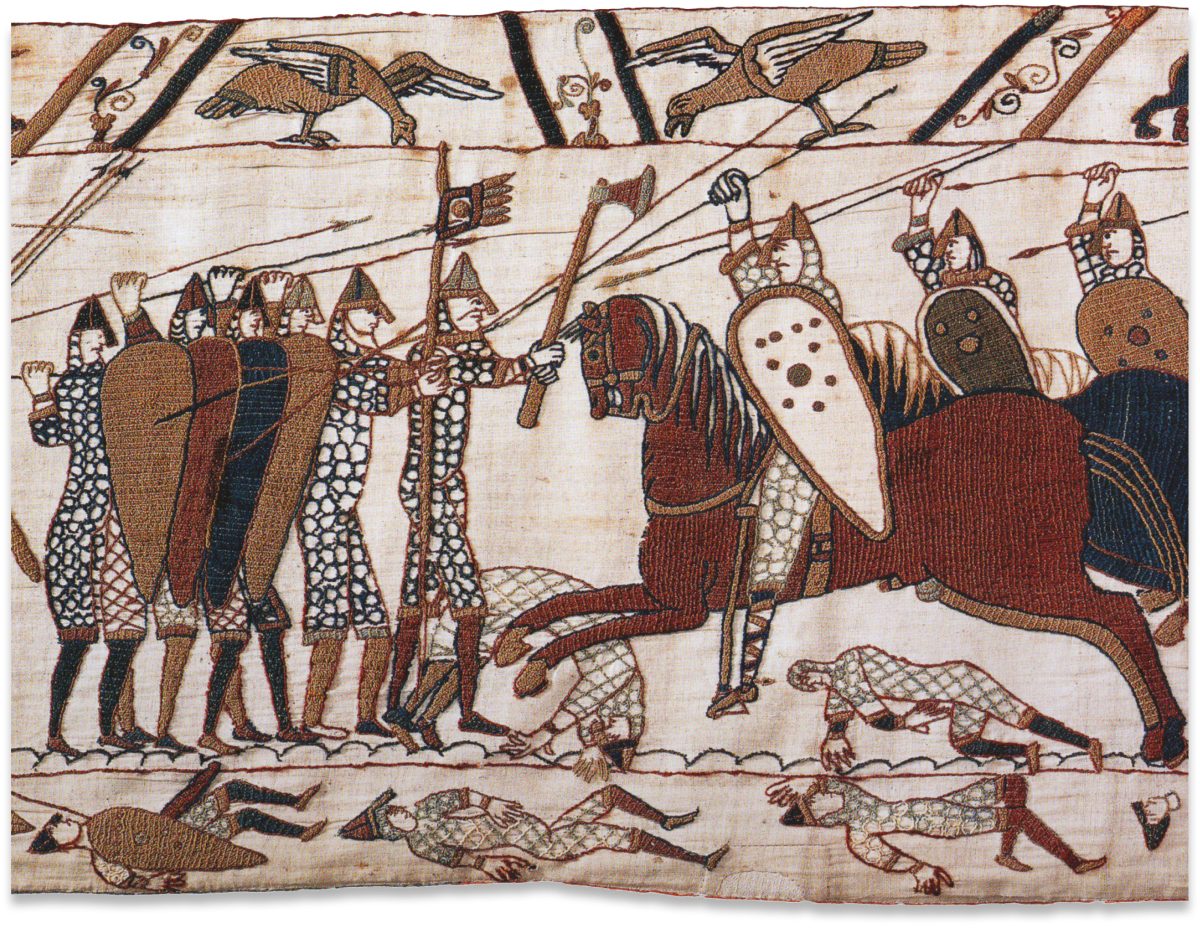
The Saxons fought under the wyvern (or dragon) banner of Wessex, and banged their shields while shouting their old pagan war cry: ‘Out! Out! Out!’. They did not have enough time to construct trenches or palisades. For their part, the Normans cried ‘Dex aïe!’ (‘God aid us!’) and carried a papal banner featuring a golden cross and dots in the corners. The Norman cavalry wore knee-length hauberks, split at the front and back, with hoods. On the Saxon side, only the thegns (lords) and c.1,000 elite huscarls (the king’s bodyguard) could afford hauberks, leaving the fyrdsmen (levies) without. Most soldiers on both sides wore conical iron helmets with nose guards – though the Normans tended to have short hair that was shaved at the back to make wearing a helmet easier, while the Saxons favoured moustaches and long hair. Norman knights were armed with swords, javelins and spears, while the introduction of the stirrup from Central Asia gave their lances a powerful striking force. They carried kite-shaped shields to protect their legs, while infantrymen tended to have round shields.
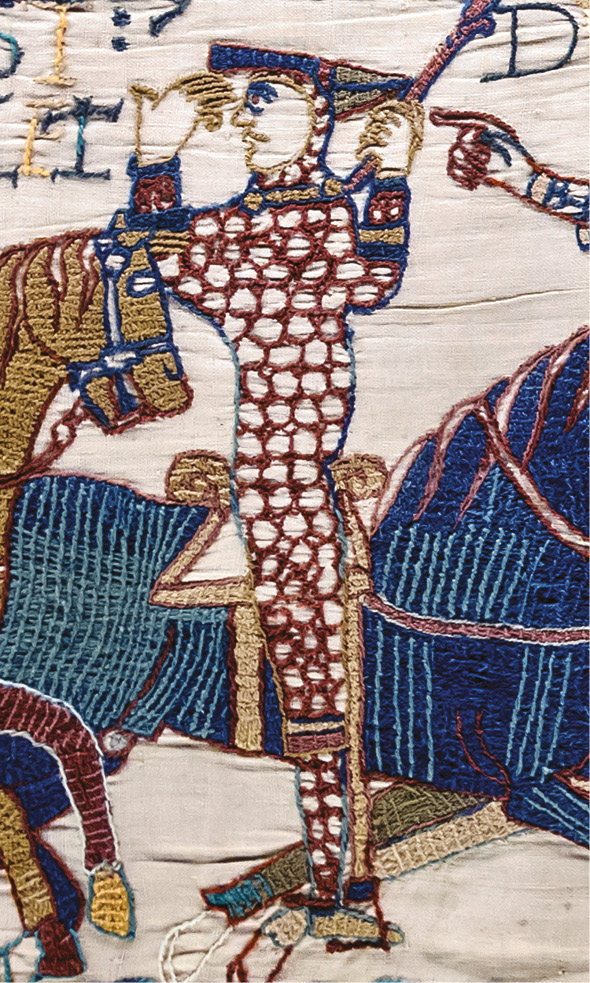
It was common for medieval armies to take a long time to strike the first blow – but Guy (though not Poitiers) tells an extraordinary story about the first deaths. Taillefer (‘hewer of iron’) was Duke William’s giant jester. At 9am, he rode out between the armies juggling swords and hurling poetic insults, before killing an English soldier who challenged him. He then charged the English lines alone, taking several more Saxons with him, before finally succumbing himself. Why does this tale not feature in any other account, or on the Bayeux Tapestry? Perhaps because the Norman knights would have been utterly ashamed that a mere jester had been braver than them. On the other hand, it should be said The Song of the Battle of Hastings also claims that Duke William himself was one of the men to kill Harold, which surely would have been reported by the other sources if true.
Guy and Poitiers agree that the Norman archers fired, that the infantry advanced with little effect, and that this was followed by a failed cavalry charge. It seems most of the arrows were overshot, or stopped by the shields, and there were no Saxon arrows to reuse. Instead, the infantry and cavalry could not penetrate the Saxons’ shields, and were cut down by their axes.
The Breton cavalry, probably charging up the gentler slope on the left before the rest of the army, were driven back. Mistakenly thinking William was dead, they now panicked. This spread to the Normans, who retreated with the Saxons following them. But William showed his face, and rallied his men. He rode a black horse, wore around his neck the holy relics on which Harold had sworn his oath, and carried a wooden club as a symbol of his royal authority.
According to The Deeds of Duke William, Count Eustace of Boulogne seized the papal banner and pointed to William, who said: ‘Look at me. I am alive, and with God’s help I will conquer. What madness is persuading you to flee? What way is open to escape? You could slaughter like cattle the men who are pursuing and killing you. You are abandoning victory and imperishable fame, and hurrying to disaster and perpetual ignominy. Not one of you will escape death by flight.’
With this, they turned on the pursuing Saxons, killing many, including Harold’s brothers Gyrth and Leofwine.
Feigning retreat?
What of the idea that William staged a series of ‘feigned retreats’ (as they are often characterised), by which his cavalry tempted the Saxon infantry away from the ridge? It is worth recalling here that the Saxons had no cavalry themselves – though horses would not have been much use anyway in defending a ridge. In his version of events, William of Poitiers thought the first Norman withdrawal was genuine, and gave Duke William the idea to feign retreat twice more, while Guy implied that all three of the reported retreats were staged. Either way, it may be that Norman authors simply invented this tactic to excuse the many times William’s forces ran away.
The late, great military historian Richard Holmes (famous for his War Walks television series) argued that the entire Norman cavalry was not well trained enough anyway for feigned retreats: ‘Horses are notoriously difficult to stop once they get galloping,’ he observed. He thought it more likely that small groups of horsemen raided the Saxon flanks, with perhaps a series of more local feigned retreats slowly eating away at Harold’s army.

Most medieval battles lasted less than an hour, due to sheer exhaustion among the participants. When William ordered his final assault at 3pm, however, they had already been fighting for six hours. William instructed his archers to fire high over the tattered shield wall. With this, the fyrdsmen finally started to desert, and Harold was killed while his huscarls fought to the death. The escaping Saxons made a stand near a valley with ditches – and, by the end of the day, there were about 4,000 Saxon and 2,000 Norman corpses on the battlefield.
After the battle, William’s army would take Dover, Canterbury, Southwark (where they failed to cross London Bridge), Guildford, Winchester, Wallingford, Little Berkhamsted, and, finally, London, where William was crowned on Christmas Day 1066.
Don’t leave your archers behind
So if there was no forced march, why did Harold lose? On one side of the register, it seems that letting William land unopposed was probably his most crucial – though understandable – mistake. But set against that, it should be added that he was fighting a defensive battle, on a ridge, in his own country – all factors which might ordinarily have given him an advantage.
With hindsight, Harold should perhaps have waited for more men, as time was on his side, and not on that of the Normans. His latest biographer Tom Licence theorises that one factor may have been that the Saxon archers were with his fleet, and arrived too late for the battle. We know there must have been Saxon archers at Stamford Bridge, because Hardrada was killed by an arrow to the throat – but there is only one such archer depicted in the Bayeux Tapestry, and his size suggests he was just a boy. No other sources mention any Saxon archers, despite several references being made not only to Norman archers, but also to crossbow-men (these crossbows would have been drawn by hand, as the winch had not been invented yet).
Licence thinks William had another card up his sleeve, too: he knew that some of Harold’s allies were not going to show up – including Robert FitzWimarc, the Norman Sheriff of Essex, who had told William about the Saxon victory at Stamford Bridge, and who also (according to William of Poitiers) wrote a letter to the Norman Duke saying he wouldn’t support his rival. The early chronicler Florence of Worcester put it succinctly: ‘Half of his army had not arrived,’ he wrote.
Harold Rex Interfectus Est
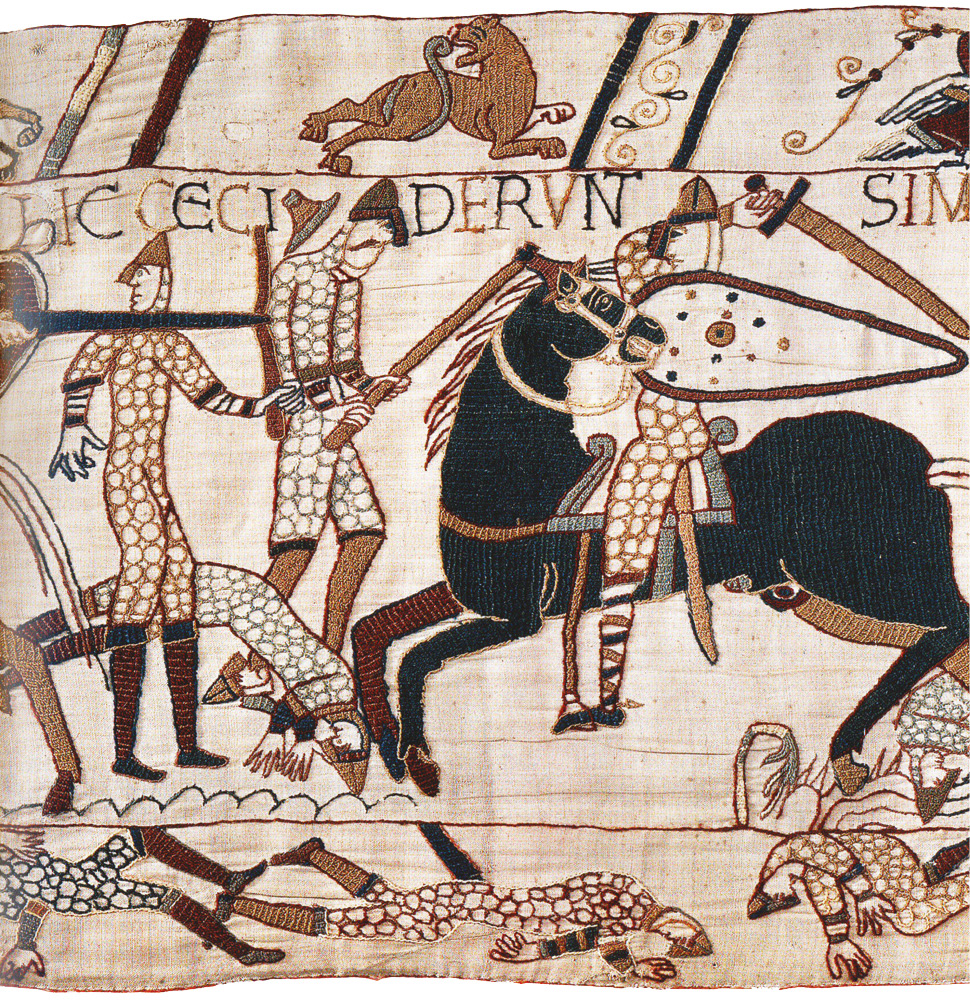
For a long time, it has commonly been believed that Harold was killed by an arrow in the eye – but scholars have shown that the wool used to illustrate the arrow in perhaps the Bayeux Tapestry’s most celebrated scene is actually from the 19th century, and that the scene was most likely altered to fit with later medieval literary traditions. After all, an arrow to the eye was seen as appropriate punishment for a perjurer, and Harold was accused of going back on an oath, sworn to Duke William, to support his claim to the English throne. As further evidence, a 1729 illustration of the Tapestry shows the figure in question holding a lance instead of taking an arrow in his eye.
Then there is the famous writing that appears above the image of the ‘arrow’, and which reads: Harold Rex Interfectus Est (‘King Harold has been killed’). Here, scholars point out that the writing in the Tapestry usually refers to the people pictured at the end of the sentence – so, in this case, not the unfortunate figure with the arrow in his eye, but the equally ill-starred and almost supine figure to the right, who is being cut down by a man on horseback.
According to the 12th-century historian William of Malmesbury, the man who killed Harold was expelled from the Norman army – a view that fits in with our earliest account of his death in The Song of the Battle of Hastings:
The first of the four, piercing the king’s shield and chest with his lance, drenched the ground with a gushing stream of blood. The second with his sword cut off his head below the protection of his helm. The third liquified his entrails with his spear. And the fourth cut off his thigh and carried it some distance off.
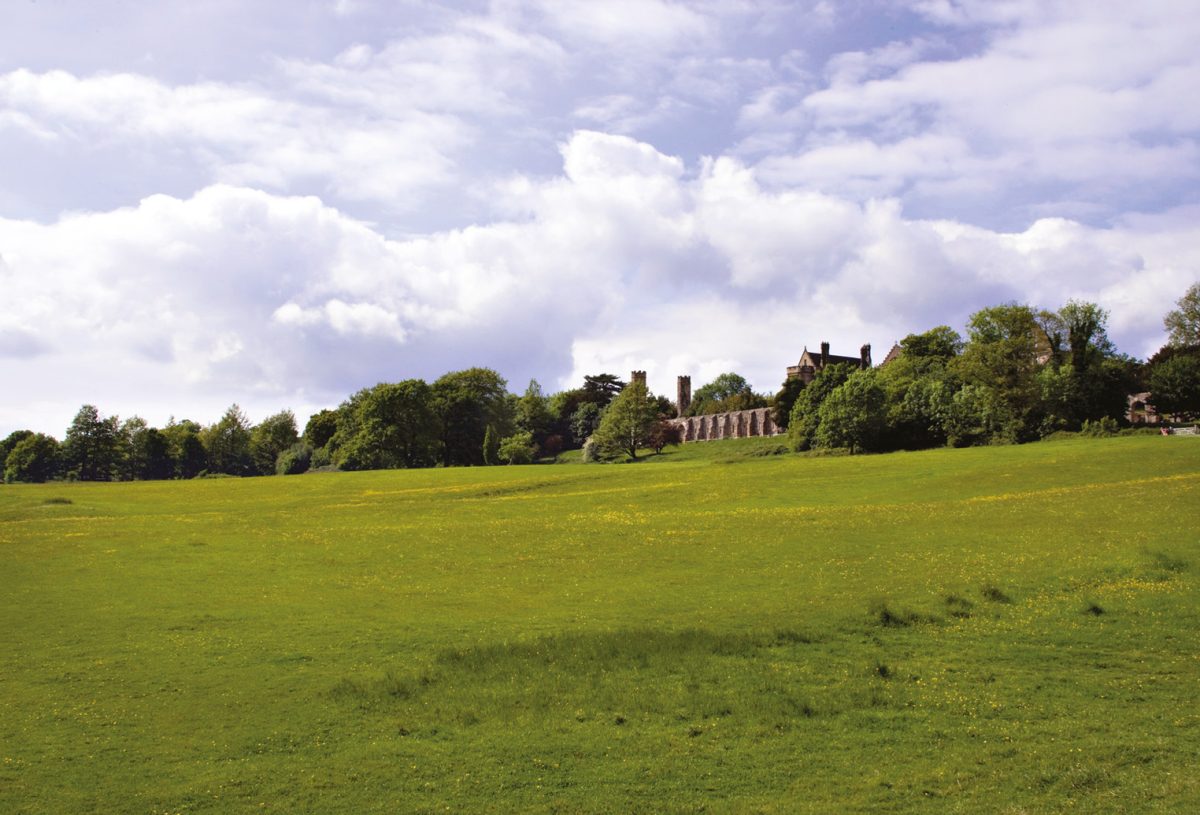
Harold’s first wife Edith the Fair (known as ‘Swan-Neck’, perhaps for her graceful appearance) was waiting near the battlefield. Only she was able to identify his mangled body. His mother, the Danish noblewoman Gytha Thorkelsdóttir, begged William to allow her son a proper burial, offering his weight in gold – but William refused, burying his rival in unconsecrated ground. Battle Abbey would later be built on the spot where Harold died. A final glimpse of the battlefield is provided by Ordericus Vitalis, the Anglo-Norman Benedictine monk and chronicler, who reported seeing bones there 70 years later. Most of the bodies had never been buried.
Edmund West is a freelance journalist with an MA in History from the University of East Anglia. Since 2008, he has written for MHM, Wired, and History Today, among other publications.
• Harold: Warrior King by Tom Licence is published on 11 August by Yale University Press (£25, hardback)
• The Bayeux Tapestry runs at the British Museum, Great Russell Street, London WC1B 3DG, from 10 September 2026 to 11 July 2027. See http://www.britishmuseum.org for more details and ticket information.
• The 1066 Battle of Hastings, Abbey and Battlefield site is open 10am-5pm daily (last entry at 4pm) at High Street, Battle, East Sussex, TN33 0AE. See http://www.english-heritage.org.uk for more information.
All images: Wikimedia Commons, unless otherwise stated