Subscribe now for full access and no adverts
Excavations in Egypt have identified the long-lost tomb of King Thutmose II, the fourth pharaoh of the 18th Dynasty. Thutmose II is believed to have ruled for just a few years around 1493-1479 BC, and is perhaps best known as the husband (and half-brother) of Hatshepsut, one of ancient Egypt’s few female pharaohs, who ruled in her own right after Thutmose II’s death as co-regent to Thutmose III.
The recent discovery was made in the Theban Mountain area, near Luxor, by a joint English–Egyptian team. The structure known as Tomb C4 was first uncovered in 2022, and was initially thought to have belonged to a consort of one of the Thutmosid kings, due to its location near the tomb of the wives of Thutmose III. However, it soon became clear that the owner was somewhat more illustrious. Further excavations revealed that the burial chamber was decorated with a blue ceiling with yellow stars, a feature found only in the tombs of kings. The archaeologists also identified wall paintings showing scenes from the Amduat, a funerary text almost exclusively reserved for kings. Finally, inscriptions on fragments of alabaster vessels revealed the name of the ruler in question. The first set of fragments gave the titles of the king and part of a name that could have been Thutmose I or Thutmose II. Then more pieces were found, featuring Thutmose II’s full royal name, Aa-khpere-en-re, as well as several references to ‘his great wife Hatshepsut’.

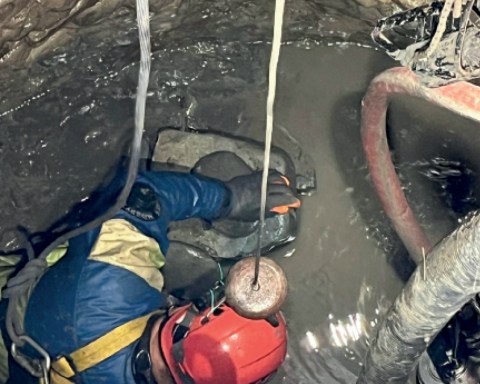
Apart from these alabaster fragments and a few ceramic sherds, the tomb was empty. It seems that, soon after the initial burial, it was disastrously flooded and the contents relocated to another tomb nearby. The archaeologists who discovered Tomb C4 are still searching for the location of this second tomb, and believe that it could be concealed by a 23m-tall manmade mound in the same area. Efforts to clear this large conglomerate pile of material are currently under way.
The identification of a new Egyptian royal tomb is a rare occurrence, making the discovery of Thutmose II’s original burial place one of the country’s most important finds in recent years, even without the potential revelation of a second tomb.
Text: Amy Brunskill / Image: New Kingdom Research Foundation