Subscribe now for full access and no adverts
Over the last few decades, a number of fragments of window-pane glass have been discovered at sites across Viking Age Scandinavia. However, it is generally accepted that glass windows were not found in this region until several centuries later, when they started to appear in medieval churches and castles. Any window glass found at Viking Age sites was therefore assumed to be a later intrusion and ignored. That is, until a new study was carried out by a team of researchers who suspected that the quantity of window-glass fragments turning up at Viking Age sites was too large to be coincidence.
To test their hypothesis, the team analysed an assemblage of 61 fragments of plane glass found over the past 25 years at six sites dating to between the 9th and 11th centuries: Hedeby (Haithabu) in Germany; Birka and Uppåkra in Sweden; and Sorte Muld, Tissø, and Strøby Toftegård in Denmark. This selection encompasses a variety of site types including high-status residences, religious sites, and early emporium-type settlements. All have evidence of activity spanning at least a few centuries – and some up to a millennium – but, significantly, several of these sites appear to have come to an abrupt end, producing no notable finds from the early medieval period onwards (post-1050). This means that the window-glass fragments found here are highly unlikely to be the result of later contamination. So how did they end up in contexts that pre-date the supposed introduction of glass windows in Scandinavia?
To answer this question, the researchers used a type of chemical isotope analysis known as Laser Ablation-Inductively Coupled Plasma-Mass Spectrometry (LA-ICP-MS) to investigate the composition of the glass and compare it with examples known from other regions. This offered clues to when, where, and how the glass was made.
The chemical makeup of the glass fragments revealed that they all correspond to types made before the 12th century and confirms that they are most likely to date to the Viking Age, between the 9th and 11th centuries.
But where did the glass come from? We have no evidence that the Vikings were making their own glass; instead, it looks like they were obtaining both inspiration and raw materials from other regions. The study identified three main compositional groups in the glass analysed: one group that shared all the characteristics of glasses produced in the Near East (namely Egypt and the Levant), and two that probably originate from workshops in northern and north-western Europe. The possibility of glass being taken from monasteries and churches during Viking raids has been considered, but given the origins indicated by the chemical signatures and distribution of the glass across various Viking sites, it is thought more likely that it was obtained through trade. Many of the sites where the plane glass was found already had significant quantities of other imported goods – it is no stretch to believe that the Vikings may also have imported the practice of placing glass in windows at prestigious sites, as they would have seen at contemporary Frankish, Anglo-Saxon, and Byzantine palaces and churches.


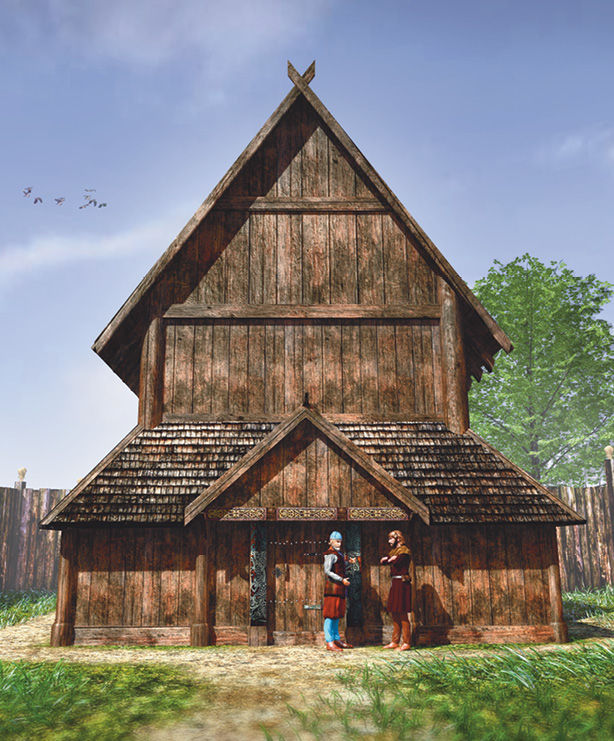
Of course, none of the window glass from Scandinavia has been found in surviving structures, so we can only guess where it may have been used, but monumental hall buildings at aristocratic sites like Strøby Toftegård, Uppåkra, Sorte Muld, and Tissø were built with impressive architectural features intended to make them stand out in the landscape, making them prime candidates for glass windows, too. This glass would have acted as a status marker, and may also have had an additional significance due to the ‘magical’ qualities that were sometimes attributed to the material in Iron Age and Viking Scandinavia.
This recent study, which has been published in the Danish Journal of Archaeology (https://doi.org/10.7146/dja.v12i1.131493), indicates that while they may not have been common, glass windows were almost certainly being used in elite residences and pre-Christian religious buildings in Scandinavia several hundred years earlier than thought; the evidence had simply been overlooked. This discovery adds another dimension to our ever-changing view of the Viking world, dispelling images of Viking kings sitting in dark, smoky rooms and replacing them with spaces dappled with colourful light filtering through different shades of green and brown glass windows.
Text: Amy Brunskill / Images: C S Andersen, Moesgaard Museum / © T Sode; C S Andersen, Moesgaard Museum, Museum für Archäologie Schloss Gottorf; Arkikon/Pre-Christian Cult Sites, © National Museum of Denmark