Subscribe now for full access and no adverts
On the Elbe floodplain, south-east of Magdeburg, vast monuments rose up in the 4th and 3rd millennium BC. Today, this region is a place of agriculture – and of landscape archaeology. The initial focus of archaeological research here was a circular enclosure near the village of Pömmelte, which was identified in aerial photographs taken in 1991. Excavations started in 2005, and by 2008 the enclosure had been uncovered in its entirety. To the researchers’ surprise, the revealed wooden henge-like structure and its associated finds dated the complex to the late 3rd millennium BC (late Neolithic/ early Bronze Age), and not, as was initially assumed, to the early Neolithic period. Thus, the ‘German Stonehenge’ was found.
Research at the site continued: several square kilometres have now been geophysically prospected, and comprehensive archaeological investigations carried out since 2018 have produced almost 10,000 new findings across an area of more than 14.5ha.
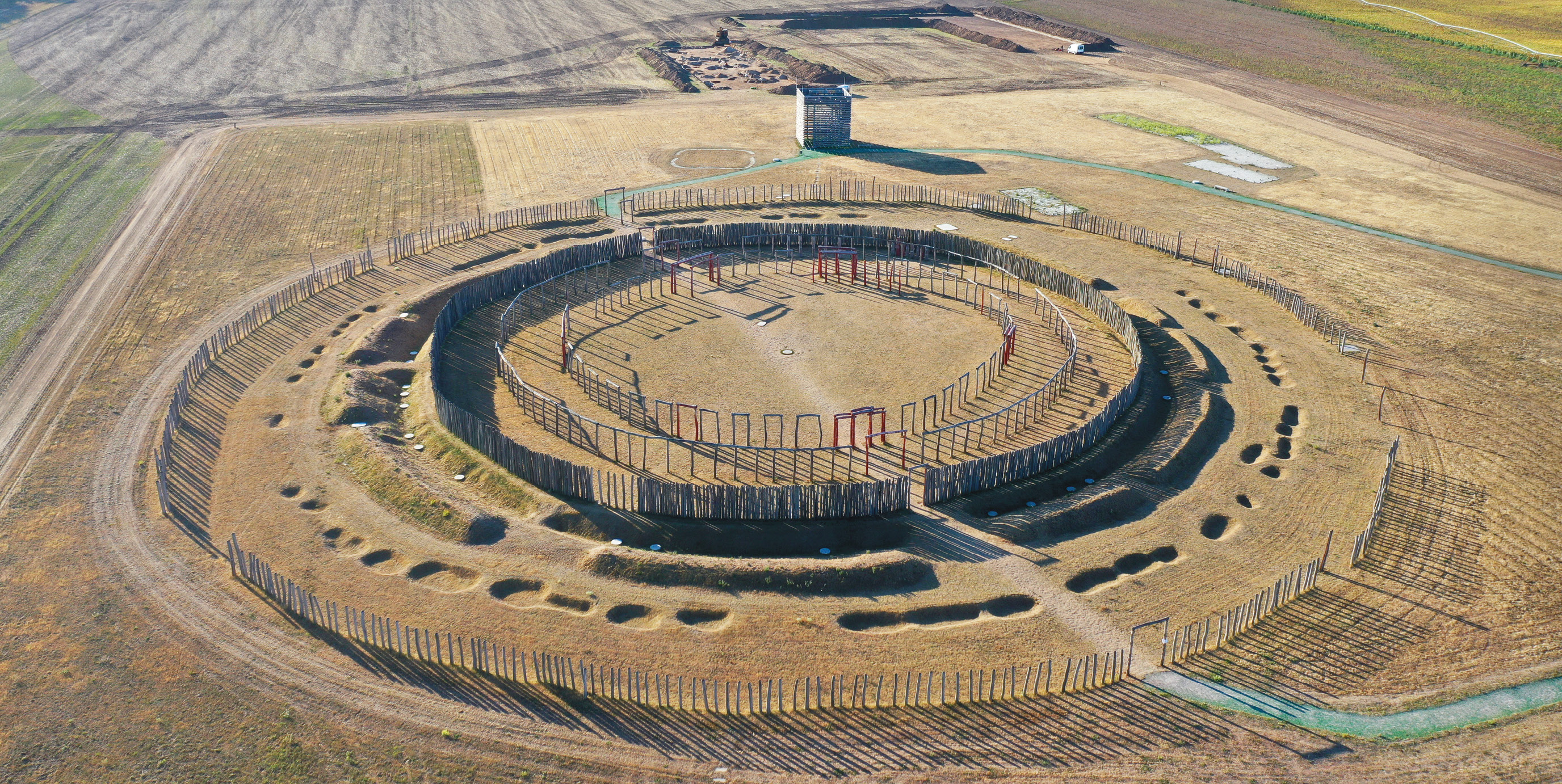
The wooden ‘German Stonehenge’
The comparison with Stonehenge is not (just) a clever marketing gimmick. Both structures are roughly the same size (approximately 115m in outside diameter) and composed of complex ring sequences made up of ditches, banks, and palisades. And both – at least during the expansion phase of Stonehenge from around 2500 BC – were designed by the same builders: the Bell Beaker people. However, the sites also differ in more than just the material used to construct them.

While several of the ‘Aubrey holes’ unearthed around Stonehenge have produced Neolithic cremation burials, the circular ditch of the henge at Pömmelte was found to contain 29 deep shafts filled with carefully selected deposits potentially connected to ritual activity, including grinding stones, cattle bones, and storage and drinking vessels. They also produced seven human skeletons belonging exclusively to women and children, some with traces of perimortem violence. Were these the victims of an attack on the site, or even human sacrifice? Such extreme legitimation may have been necessary during the transition from the Bell Beaker culture, which was associated with the original construction of the ring sanctuary, to the Únětice culture (of Nebra Sky Disc fame), which emerged here around 2250 BC.
Just 1km away from Pömmelte as the crow flies, another, contemporary wooden henge site has been identified: the Schönebeck Rondell. This makes it clear that the two monuments were part of a larger ritual landscape, à la Stonehenge. But why here of all places? Today, the area is anything but a supra-regional centre. However, it has a lot to offer in terms of raw materials, and its location on the Elbe is extremely convenient. The river was probably closer to the monuments 5,000 years ago, and the structures were certainly not protected by dykes back then as they are now. This could explain the choice of location, as all of the findings are concentrated on the strip of land between two oxbows of the river, which can still be seen in the digital terrain model today. Perhaps – like the River Avon near Stonehenge – the Elbe could be considered an integral part of the ritual landscape. A favourable location par excellence, then, and one that was recognised as such long before the 3rd millennium BC.
Ongoing occupation
Following an initial occupation during the Baalberge culture in the first half of the 4th millennium BC, reflected in a few early buildings and monumental graves, it was the Corded Ware culture who actually built the first small sanctuary at Pömmelte, around 2800 BC. Of this, only a square ditch measuring around 15m on each side has been preserved, with passages aligned to the winter and summer solstices. Some grave mounds with wooden fittings date from the same time. By the final stage of the Corded Ware culture (2500-2300 BC), the site had two pit clusters as well, created to store various types of grain. Just one of these contained 78 silos: based on modern grain consumption per capita, the contents of this pit alone could have fed more than 700 adults for a year.
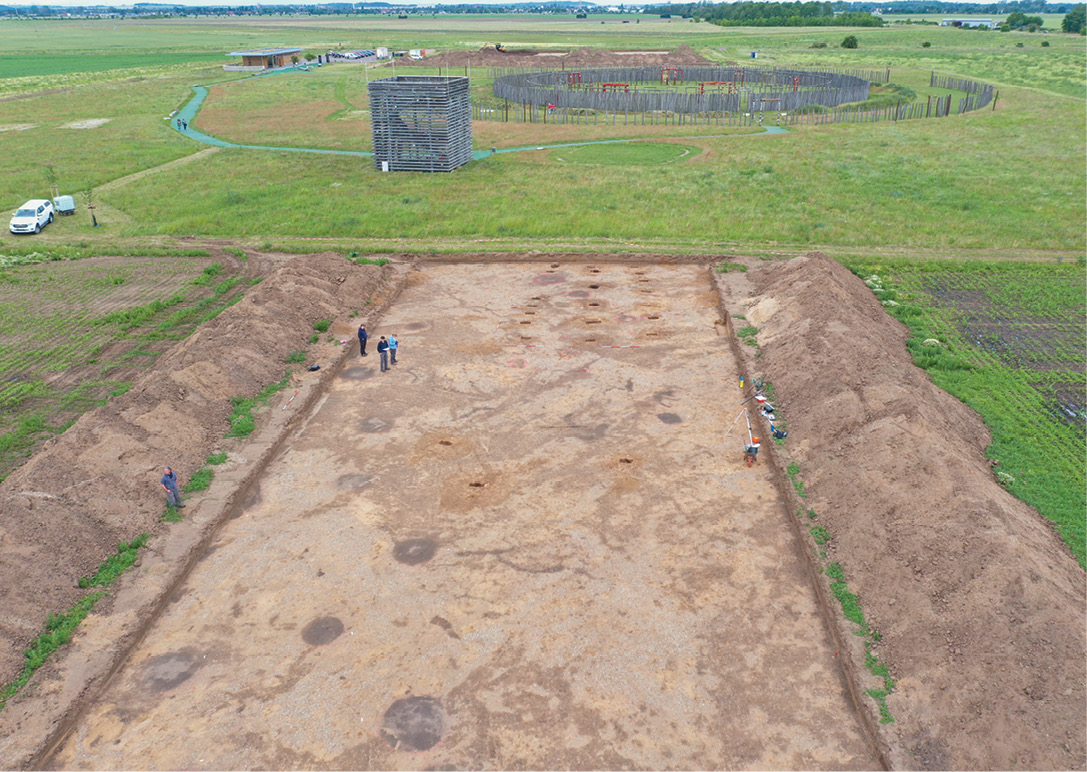
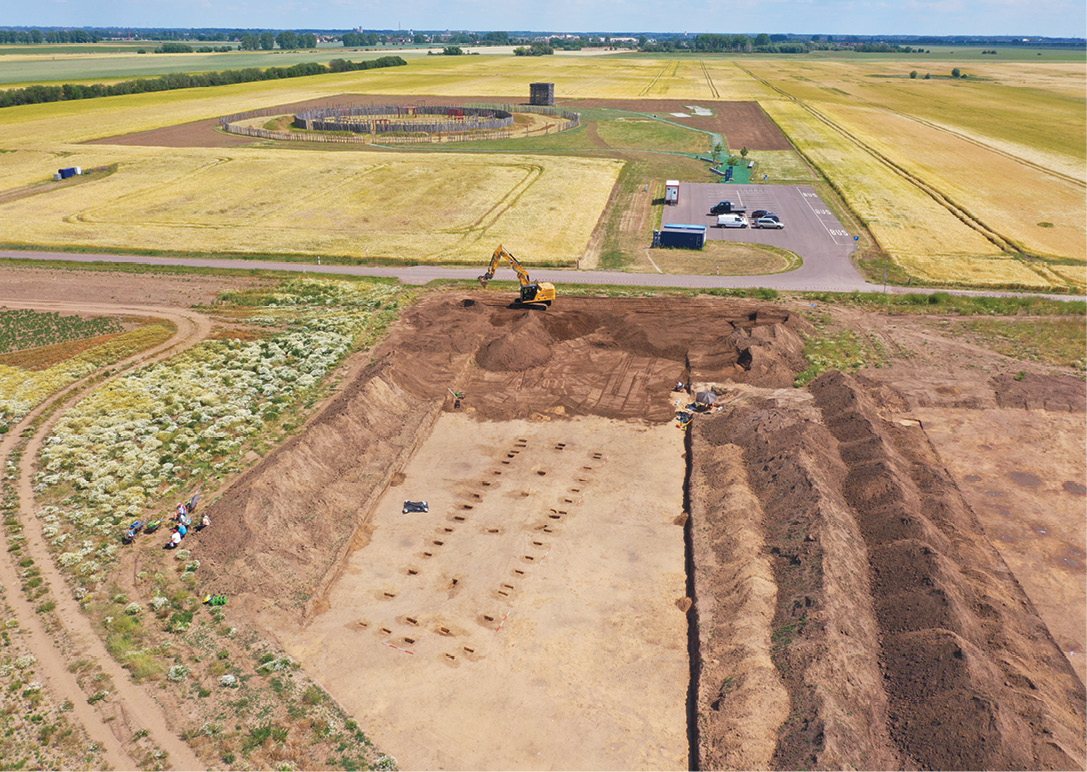
Where and how these early inhabitants of the site lived has not yet been identified in the archaeological record. However, this is not the case for the subsequent Bell Beaker and Únětice cultures: the builders and users of the ring sanctuary created the largest known settlement of its kind here. A total of 140 clearly identifiable house plans were uncovered, extending over an area more than 800m long and just under 190m wide, which follows the natural shape of the ‘island’. The first buildings of this mega-settlement are 12 smaller structures with the typical cigar-shaped house plan of the Bell Beaker culture, which were built at the same time as the ring sanctuary from around 2350 BC. The majority of the buildings, however, are from the Early Bronze Age Únětice culture, with a minimum of 106 floor plans – the New York of the Early Bronze Age, if you will. We find burial grounds, too, along the streets leading out of the settlement at both ends.
First interdisciplinary study results
With a total of around 150 burials and plenty of ‘waste’ from the settlements, there is more than enough material for an interdisciplinary research network to evaluate. Despite the enormous grain stores, diets at Pömmelte were anything but one-sided. Animal and aquatic resources were also used: beef was common on the menu, and as a first series of lipid analyses on ceramic vessels has shown (CWA 126), in addition to animal fats, plenty of dairy products were consumed. Carbon-nitrogen isotope analyses are currently being carried out in order to better understand the nutritional habits of individual people in context. Starting next year, aDNA analyses will be carried out, too, on the graves of Pömmelte by Wolfgang Haak at the Max Planck Institute in Leipzig as part of the ERC grant ROAMANCE, which will, among other things, clarify the family relationships of the buried. Who knows? Perhaps connections to southern England will even be found.
Since 2016, the reconstructed Pömmelte ring sanctuary can be visited all year round. In 2023, the visitor centre, the first modern rammed-earth building in the country, opened, replicating the shape and orientation of an Únětice longhouse. The most important findings of the research will be presented from 2025 in the newly designed Early Bronze Age section of the permanent exhibition of the State Museum of Prehistory in Halle.