Subscribe now for full access and no adverts
The frontiers of Rome are staggering in their scope. Often shown as simply a line on a map, sketching out the edge of the Empire, this formidable network once stretched for more than 13,000km through numerous modern countries spread across three continents. Although scholars continue to dispute how exactly these frontiers functioned, it seems clear enough that they reflect a massive investment in tightening security. This investment could, though, take many different forms. Although the Roman army lay at the heart of efforts to control the Empire’s edges, military solutions varied from province to province, and also over time. In some places, significant natural features like rivers, mountains, or deserts were judiciously garrisoned to tighten access. In others, great artificial barriers, such as Hadrian’s Wall or the Upper German and Raetian palisades were installed. Clearly, all of these different approaches need to be considered if Rome’s specific motives for establishing this network are to be understood. Here, though, different modern research traditions, languages, and alphabets can present a significant stumbling block to scholars. Efforts to overcome such challenges with a book series have always faltered after the first few volumes. Until now.

Final frontiers
At the 2022 International Congress of Roman Frontier Studies, held at Nijmegen in the Netherlands, five books on Roman frontiers were published. At the time, these were expected to be the last in a series of multi-language books on Roman frontiers, forming part of a project to nominate all of the frontiers of the Roman Empire as World Heritage Sites (now branded as World Heritage Properties). At the launch, the scope of the publishing project was revealed. Twenty books had been produced in 20 years, with 44 authors writing in ten different languages supported by 25 translators, several cartographers, and very many suppliers of illustrations – and finance.
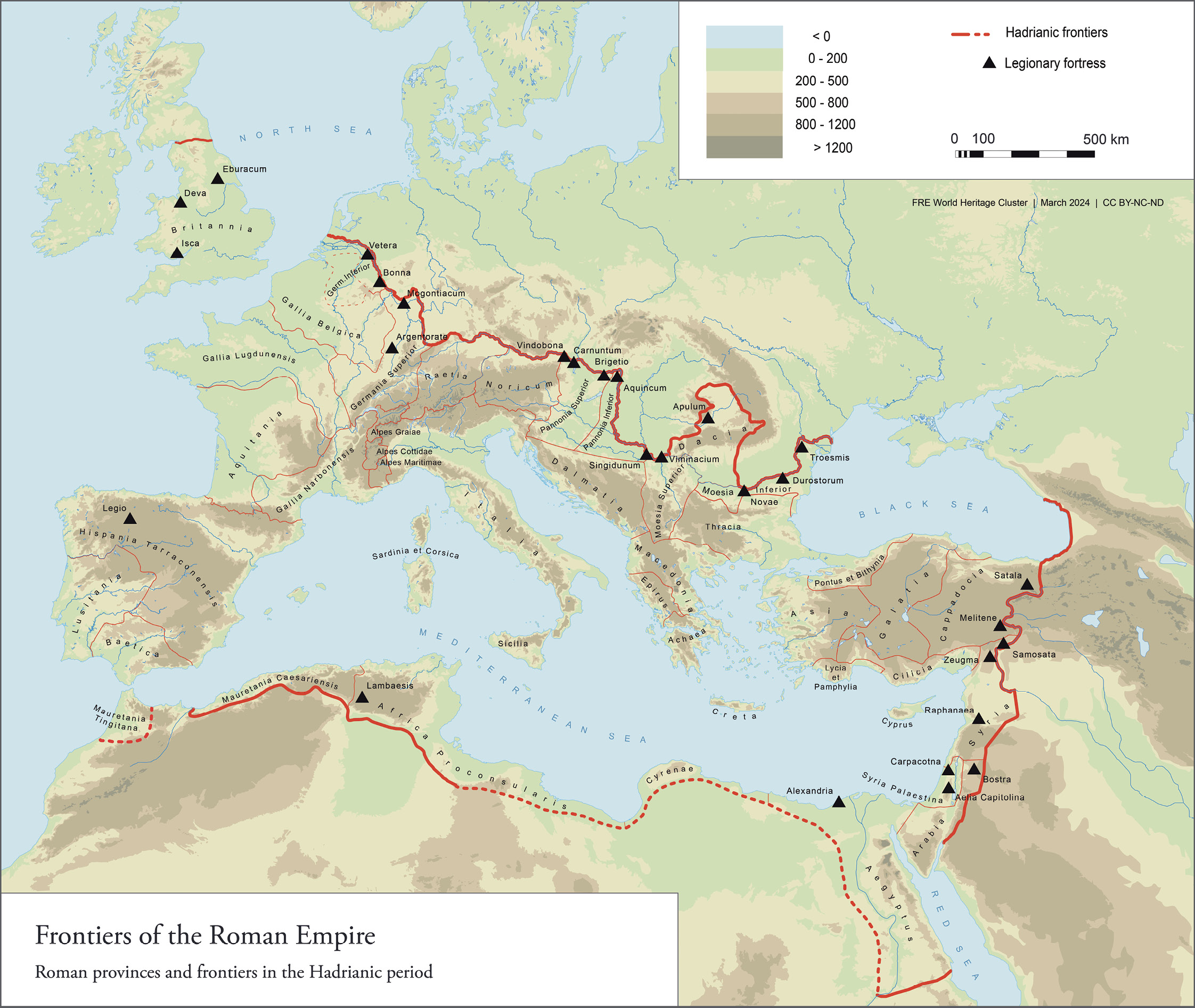
The series started by chance. In 2002, German colleagues presented to the World Heritage Centre in Paris a proposal to nominate the 550km-long Roman frontier – known as the limes – in Germany as a World Heritage Site (WHS). Their documentation indicated that this was part of a wider plan to give the same accolade to other Roman frontiers in different countries. Andreas Thiel, the coordinator of the German nomination, was asked to go to Paris to discuss the proposal and invited me to accompany him. The World Heritage Centre liked the proposal, but it was clear that it required more clarification and also much wider dissemination of information about the aims of the project. As a result, Andreas – together with Sonja Jilek and myself – prepared a booklet intended to offer that explanation. It was published in Arabic, English, French, and German in 2005. In the same year, the World Heritage Committee approved the nomination of the Upper German and Raetian limes as a WHS.
As part of a wider discussion of the World Heritage project, a meeting was held at the European Archaeological Association’s Annual Conference at Thessaloniki in 2002. All agreed that refinement of the project and clarification of its aims were required, and that the European Union was the best place to seek the money to achieve these ends. At the third attempt, a grant was awarded, embracing the work of nine modern countries along the northern border of the Roman Empire in Europe. From Spain to Romania, we were in business.

A key role was broadcasting information about the Frontiers of the Roman Empire project. We sought to achieve that by establishing a website, providing information on Roman frontiers for local museums, offering advice on the conservation of Roman military sites, and undertaking further research into Roman frontiers. During the course of the three-year project, new ideas came to mind. One was the production of a DVD on Roman frontiers. This was produced by Erik Dobat and Sandra Walkshofer of limesfilm and produced in seven languages: 70,000 copies were distributed.

Another idea was a rather more old-fashioned method of distributing information: the production of more material in hard copy. The idea was hit upon of using the existing 2005 book as the basis for further volumes: they were – and are – as I see them, public information publications that provide up-to-date and accessible statements about the various different frontier systems that make up Rome’s network. One of the early meetings of the EU’s Culture 2000 project on the Frontiers of the Roman Empire was held at Svishtov – the site of the long-lived Roman legionary fortress of Novae – in Bulgaria. The fortress was being excavated by Piotr Dyczek of Warsaw University, and he hosted the meeting – and offered to write the first book in the projected new series.
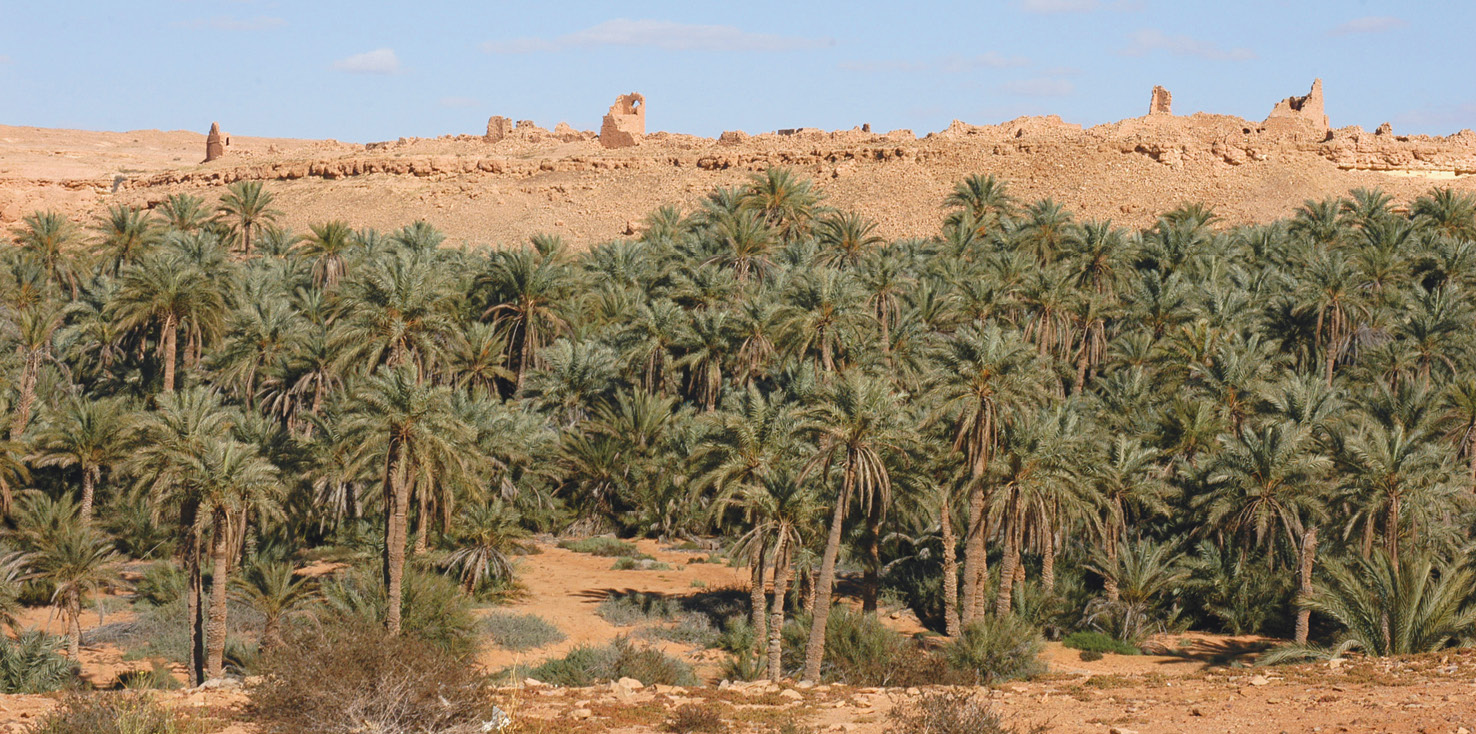
This volume set the template for all future volumes. The first part is a general discussion of Rome’s frontiers and the Frontiers of the Roman Empire WHS project. After that, the remainder of the book, about two-thirds of it, presents an account of the frontier in a particular country or region. This is usually written in both the language of that country and an additional ‘international’ language or languages. The books are in colour throughout, with an extensive bibliography on Roman frontiers in general and the subject of each book in particular. Publishing the books in two parts allows those living in a particular country to see how their section of the frontier relates to the whole and to the wider project. At the same time, each book acts as a source of information on a particular frontier for local people – and those further afield – as it proceeds on its course to WHS status.
The Roman Frontier in Bulgaria proved to be so successful that other books swiftly followed. Those on sections of the frontier in Europe were relatively easy to publish, with each state authority agreeing to bear the cost. Stepping outside Europe proved more difficult. The Roman Society and the Society for Libyan Studies generously grant-aided the publication of The African Frontiers. Egypt and The Eastern Frontiers proved to be more difficult, until Richard Beleson stepped in and offered the necessary financial support, which he later extended to other books in the series. With the publication of The African Frontiers, Egypt, and The Eastern Frontiers, the Roman Empire had been encircled.
Beyond the frontiers
This venture has developed since the first volume in the series. While the focus has been on those sections of the frontier that are embraced by the Frontiers of the Roman Empire WHS project, it has been extended to cover other military areas within the Roman Empire. This flowed from the initiative of Peter Guest, who offered to write one on Roman Wales, an area that was home to a long-standing military presence, but not a linear frontier. The Saxon Shore – a sequence of later Roman forts on both sides of the English Channel – was another obvious candidate. The hinterland of Hadrian’s Wall also contains many forts with visible remains and is the subject of the latest book in the series. And – who knows? – in time such areas might achieve WHS status.
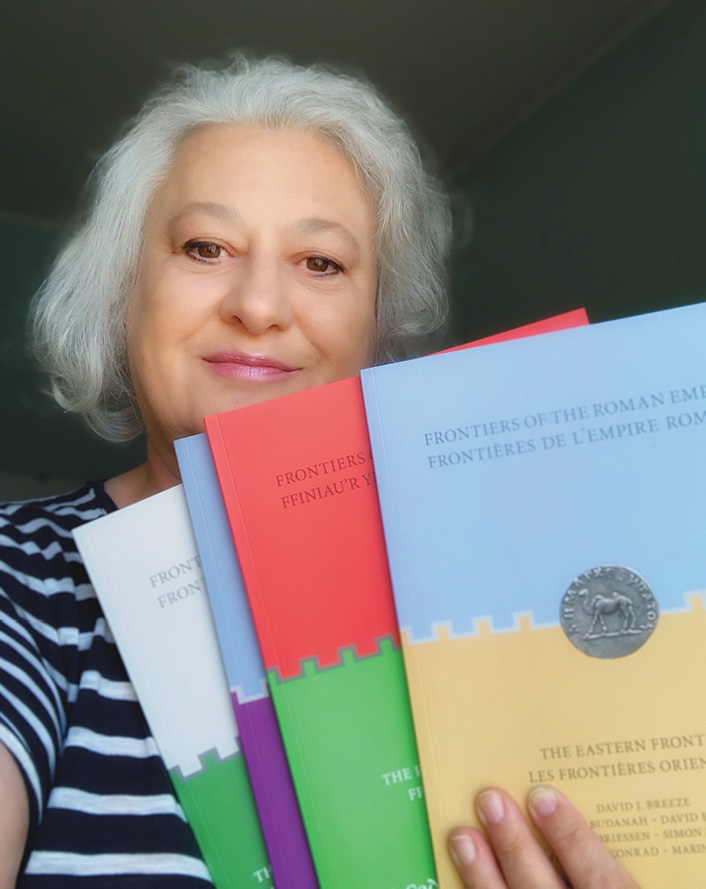
While preparing for the launch of several books in Nijmegen, I decided that a more permanent home for the series was required and approached David Davison at Archaeopress. This archaeological publishing house readily accepted the challenge, and now the titles have been transferred to it. As it turned out, my belief that the five books launched in Nijmegen would be the last in the series was proved spectacularly wrong. Before the end of the Congress, I had several new offers that would fill gaps in the present series. These include Croatia, Georgia, Israel, Slovenia, and Switzerland.
So it is that a series, developed almost by chance, has become successful. Thousands of these books have been distributed across the world. They help underpin the project to achieve WHS status for Rome’s frontiers. All are now available in hard copy and also as free .pdf downloads via Archaeopress (see ‘Further reading’ below). They encourage visitors to travel to the furthest reaches of the Roman Empire with a companion that has been written by the foremost scholars of each particular frontier sector. In spite of having visited so many of the frontiers of the Roman Empire myself, I still learn so much from the erudition of my colleagues.
There are other Roman military remains in addition to Roman frontiers, such as siege works. Next year, Archaeopress will be publishing a book on Roman sieges in western Europe by Ángel Morillo Cerdán, Michel Reddé, Michael Dobson, and Alan Wilkins. We hope that this will be the first of a new series of books relating to Roman frontiers and other Roman military matters.

As for the Frontiers of the Roman Empire World Heritage Properties, these now extend from the River Clyde in Scotland to the fort of Iža in Slovakia. The nomination of the frontier in Dacia is with the World Heritage Centre in Paris awaiting a decision next year. Work on the frontier in the eastern Danube countries is in preparation. We look forward to the day when the whole of the Roman frontier line from the Clyde to the Black Sea has achieved WHS status. To move forward from there will be difficult, but not impossible: discussions are already taking place about extending into the Middle East and North Africa. This work has been supported by a thematic study of the frontiers of the Roman Empire outlining the way forward. It will certainly be an achievement to accomplish WHS status, and so unite once more all of the frontiers that defined the boundaries of the Roman Empire.
FURTHER READING
For hard copies, or free .pdf downloads, of the frontier volumes, visit the Archaeopress website http://www.archaeopress.com. You can save 25% by using the voucher code: CWA FRE-24.
All Images: courtesy of David Breeze, unless otherwise stated