Subscribe now for full access and no adverts
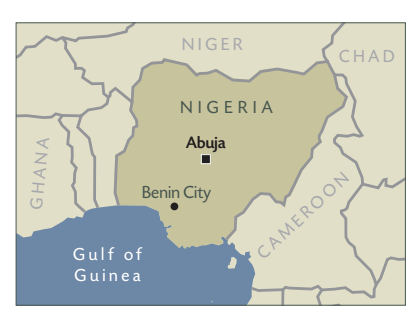
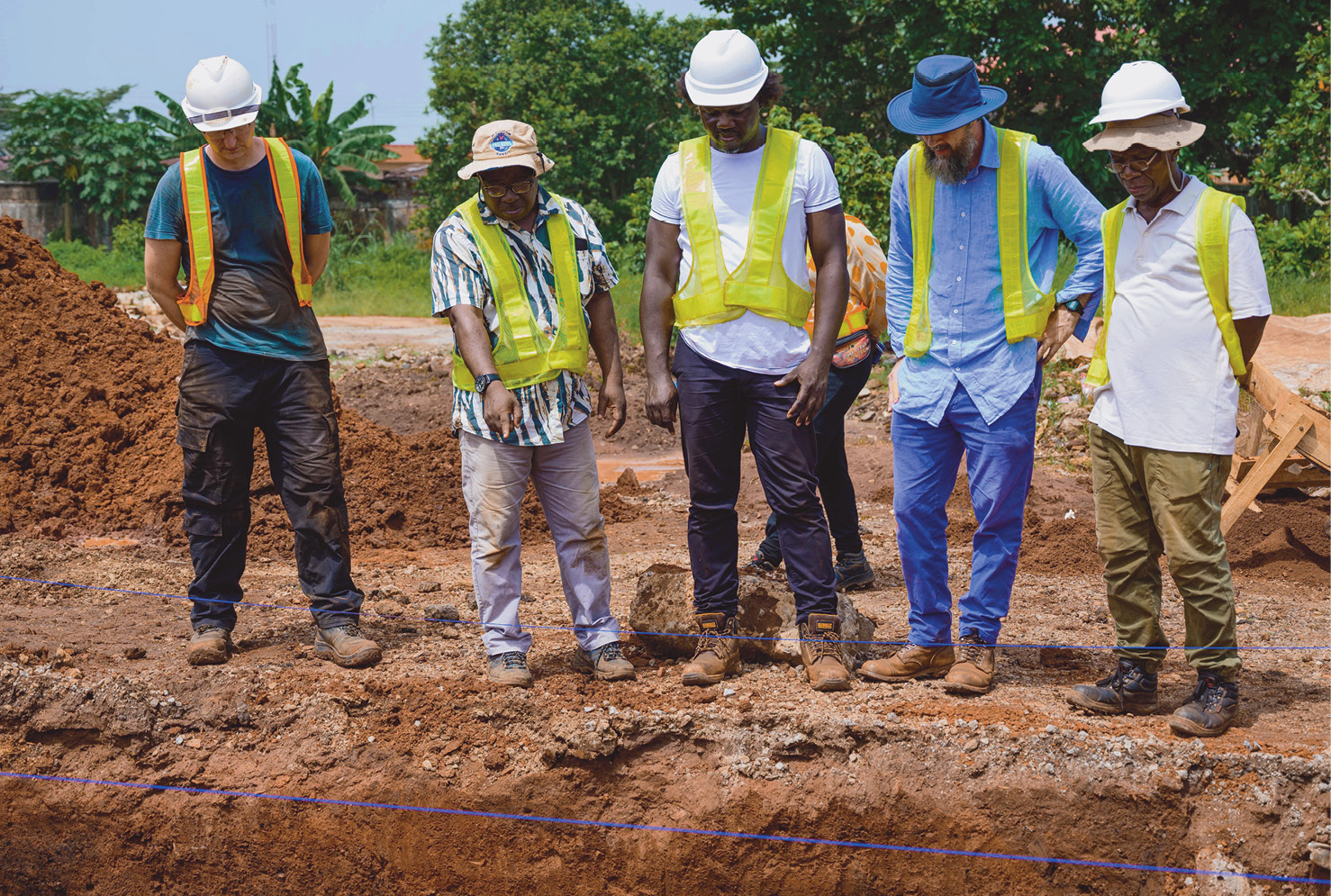
Niyi Adegoke, an archaeologist with a degree from the University of Ibadan, Nigeria, is standing in a trench with a drawing board. It’s November and officially the dry part of the year, though the monsoon-like rainy season seems to have other ideas: the excavations filled with water overnight, soon to be cleared by pumps and the burning heat. We are in the historic centre of Benin City. Adegoke is telling me about the dig.
‘My experience here has been wonderful,’ he says. ‘This is massive for Nigeria. I’m seeing a new dimension of archaeology.’

The excavation spreads over a large area. The site is of global interest. The locally based project in a country with one of the largest archaeological communities in Africa, is working with an international team. They have aspirations not just to discover, but also to train, inspire, and create new opportunities for young archaeologists. Add in a pioneering emphasis on excavation ahead of development (the latter itself a daring concept embracing archaeology, art, and public engagement), and it’s easy to see what excites Adegoke. He tells me about site-recording.
‘In my ten or 15 years’ experience in the field’, he says, ‘this is more intensive. We are making detailed connections even before excavation. This method’, he adds, ‘is called the Harris matrix technique.’
I am unexpectedly taken back 50 years to when, in a housing squat in the centre of Winchester amid large-scale excavation, an animated Ed Harris told me about a new way of seeing stratigraphy. His ideas developed into a record system, which Adegoke is now using in the heat of southern Nigeria. I feel the same thrill that I did back then: students, volunteers, and experienced archaeologists are learning, experimenting, and finding things, sharing a sense that what they are doing is revolutionary. That working with architects and contractors, they are writing a past that will become part of their nation’s future.

A powerful kingdom
Where not long ago were a police station and barracks, and now relocated hospital and state health offices, just a few blocks remain of disused one- or two-storey concrete buildings sprouting weeds (archaeologists have converted one into a site office and lab). Red earth is splashed with bright-coloured greenery. In a distant corner a miniature forest of banana and hardwood trees hides a small, overgrown graveyard known as the European Cemetery.
You wouldn’t think, just to look at it, that this is one of Africa’s most celebrated, and notorious, historic places. For it was once the centre of a powerful kingdom that traded across the continent and beyond, attracting Renaissance and later Europeans to its markets and impressing them with its great cities. The excavations are within the grounds of the former Royal Palace, home to the Oba, or king, of the Edo people, surrounded by his warriors, ritual specialists, chiefs, diplomats, musicians, wives, children, servants, and outstanding craftworkers in metal, wood, coral, and ivory.

Hereditary Obas still live in the city, retaining important national status and authority as traditional rulers. But the historic palace and its autonomous kingdom were wiped out in a British raid in 1897, mounted after an unauthorised expedition went wrong. Buildings were burnt to the ground, citizens killed or expelled, and the grounds turned into a centre of colonial occupation. Here is where the ‘Benin Bronzes’ were made (they are actually brass, a zinc – rather than tin – alloy). Some are now in the Benin City National Museum just over the fence. But most are in Europe and north America, seized in the raid and sold by British soldiers and the colonial government to collectors and museums – and often now subject to complex negotiations over rights and ownership.

Benin City, one of Nigeria’s largest urban centres and the capital of Edo State, doubled its area in the first decade of this century. This continues a path that was well under way by the 1950s, its population rising from tens of thousands to approaching two million. Like British cities before the 1970s, such rapid growth has rarely allowed the recording of lost buildings and historic remains. The current project, in its scale and significance, is remarkable.
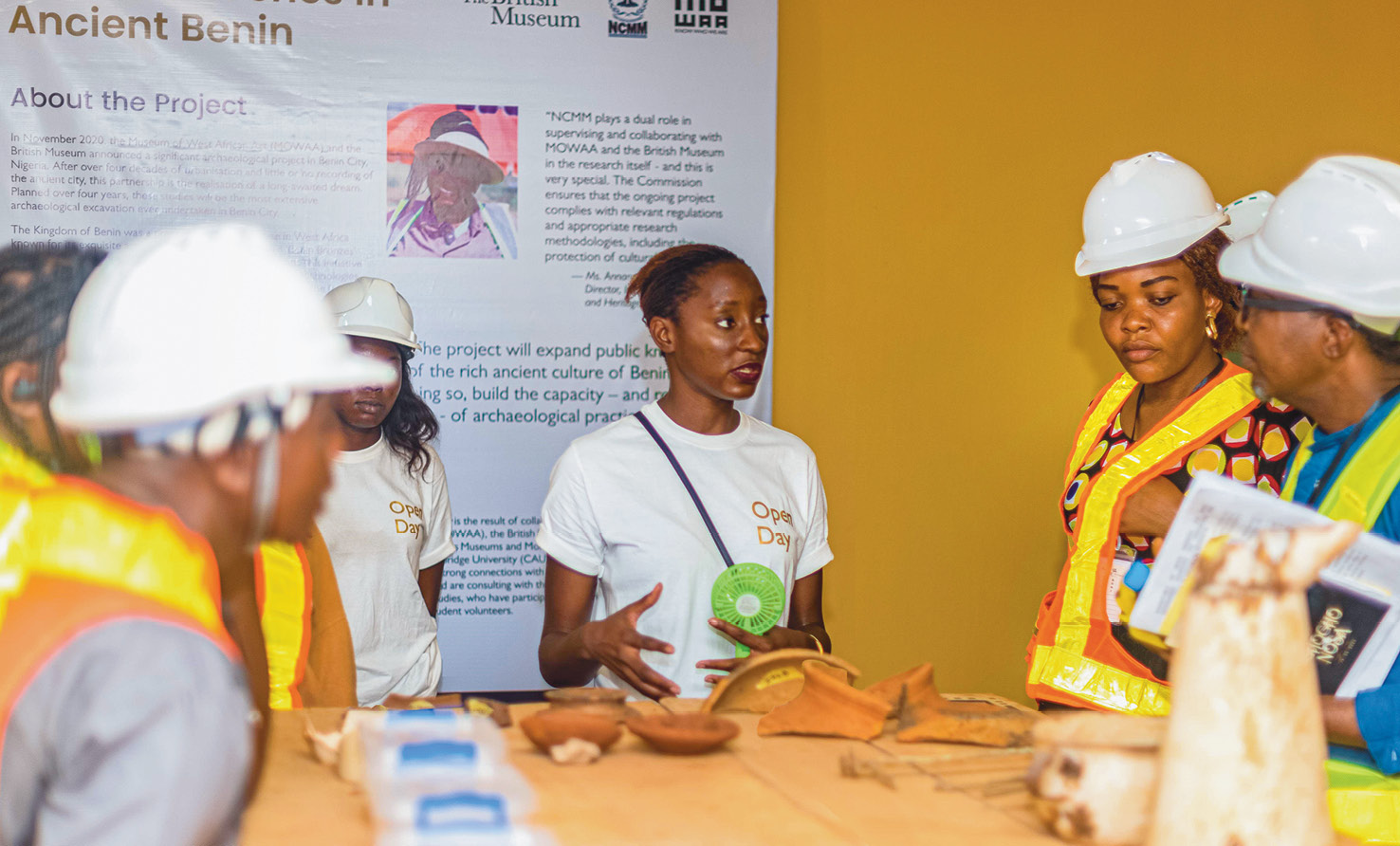
Excavation and geophysical survey are happening within footprints of projected new builds, within a compound panel-fenced apart from the busy streets. A new 10ha ‘cultural campus’ is the heart of an ambitious vision to celebrate West African arts and heritage, with a museum, a conservation and research centre, and artist studios and performance areas – the trenches around me are on the site of a future Rainforest Gallery, to be set among indigenous trees once more widespread in the city. Excavation ahead of construction works is integral to the scheme, which is led by the Museum of West African Art (MOWAA). The MOWAA Archaeology Project brings together MOWAA, the National Commission for Museums and Monuments, and the British Museum and colleagues from British archaeological practices.

Adebayo Folorunso, Professor of Archaeology at the University of Ibadan, is MOWAA’s research lead. With consultants from outside Nigeria, he was determined that practices should not compromise local standards, travelling to England to meet archaeologists and museum staff during the COVID era. ‘You want everybody to be comfortable,’ he tells me, ‘to be respected.’
Sam Nixon, head of the Africa section at the British Museum and its research lead for the MOWAA project, says that earlier excavations in Benin (see below) showed the importance of pre-construction archaeology and indicated the nature of remains that would be impacted by building. Working closely with architects and developers and in coordination with MOWAA, the museum contracted two UK archaeological and heritage services: the Cambridge Archaeological Unit, part of the university, and Wessex Archaeology, an educational charity. Focused on pre-construction practice and methods, they would work with Nigerian archaeologists recruited by MOWAA, and help support knowledge-exchange programmes.
The year before my visit, the focus was on the site of a building due to open in 2024, to be known as the MOWAA Institute. Ore Disu, with degrees in architecture and urban development from the University of Cambridge and UCL, is the Institute’s director. It will be a centre for archaeological research, conservation, and collections management, she tells me, as we watch reinforced concrete panels going up and a team of skilled men turn a heap of red dirt into a long stretch of beautifully crafted rammed-earth walling. It will be a distinctive, low-rise hub of secure spaces, labs, and public visitor areas, being built by a number of African architectural practices.
‘We are thinking about sustainable ways of construction,’ says Disu, ‘presenting the message that local materials and traditional methods can be part of a modern hi-tech building.’ Archaeologists investigated the ground before works began, in search of what remains of the old palace (the site was thought to be where the ‘wives’ quarters’ were), and here too messages are important. ‘We want to demonstrate that first-class archaeology happens on the continent,’ Disu tells me, ‘and have that be led by people who are from here, working with international institutions, to reverse that pattern where archaeologists come from outside, materials are extracted, and knowledge is taken away.’ She wants Nigerians to get proper credit for the work, and to exploit opportunities for training and career development. The Edo State Governor, she says, is very supportive of heritage. The Institute is leading a programme to build infrastructure and bring in local communities.
First findings
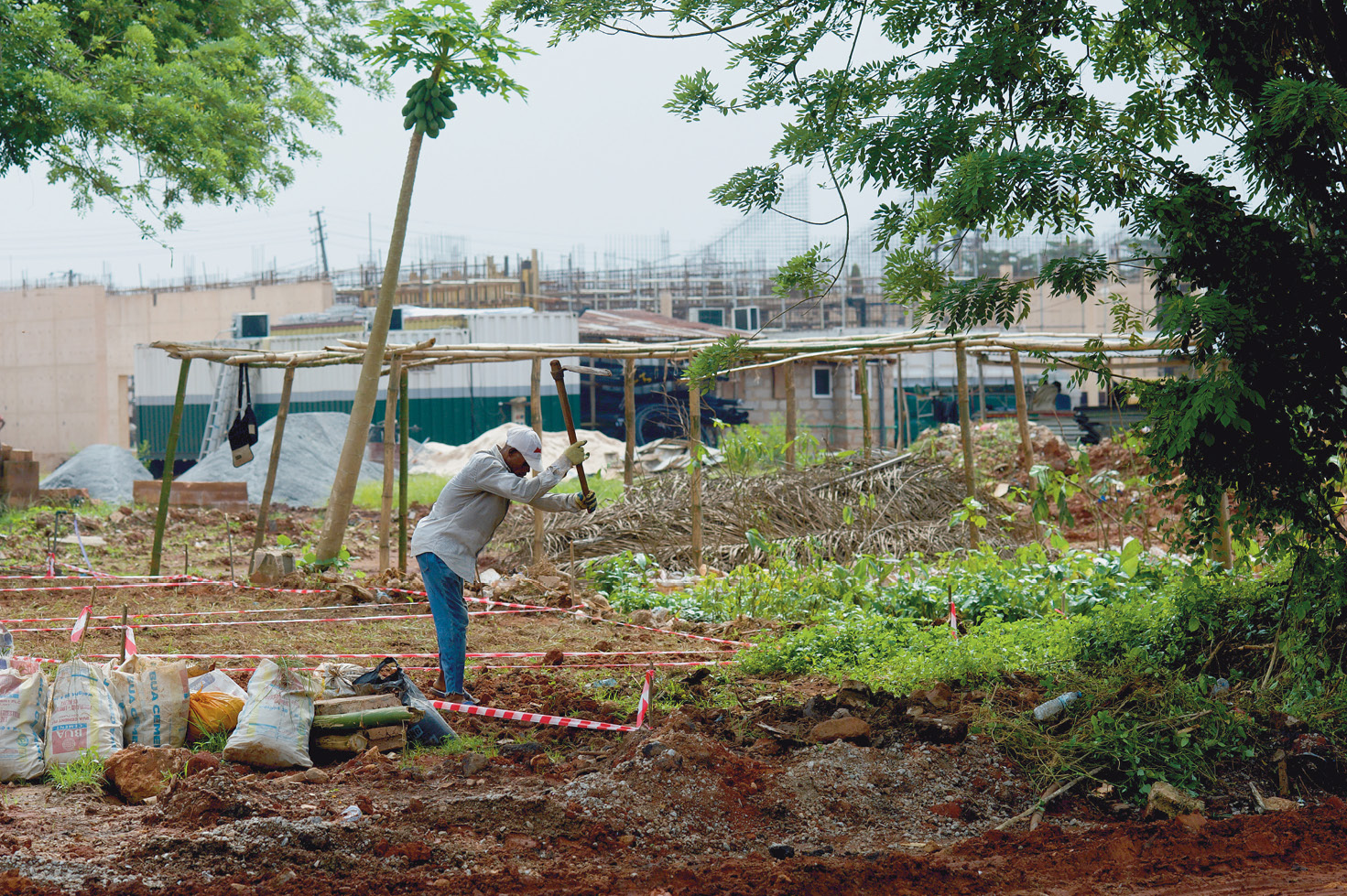
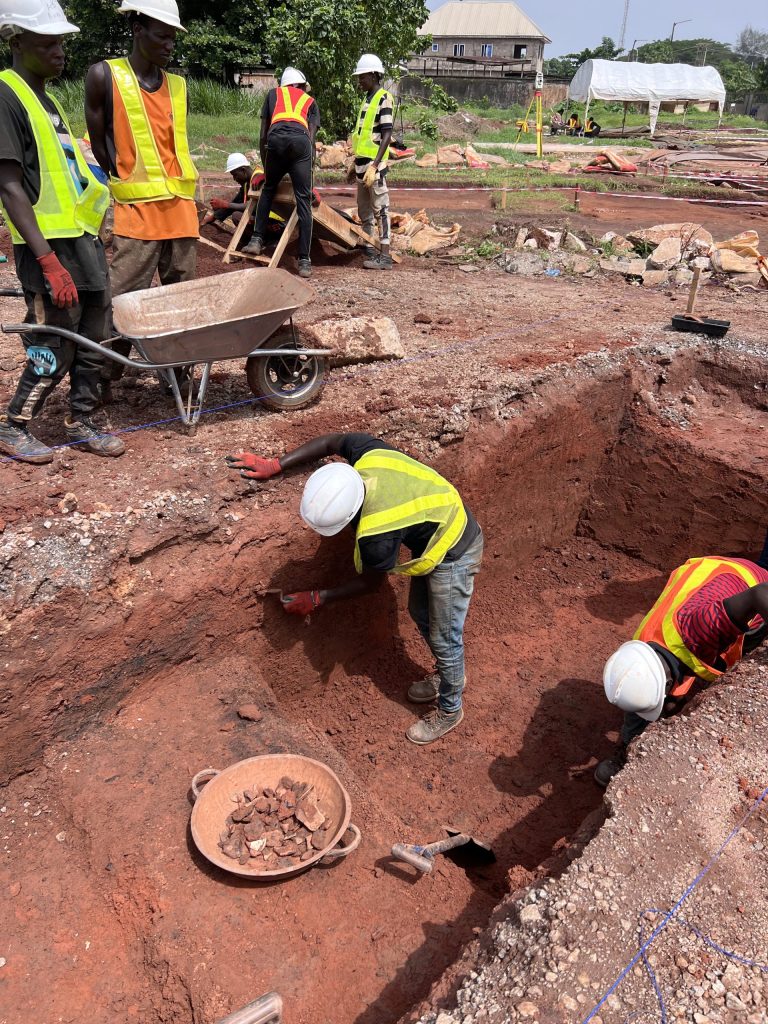
In what has become traditional practice in Britain, then, archaeologists were the first to break ground at the Institute site. Early in 2022, they began with geophysics (magnetic survey and ground-penetrating radar, or GPR) and a walkover artefact collection, after units from the hospital had been cleared away. Evaluation consisted of eight test pits with all the trimmings – dry sieving, context sheets, soil sampling, wet sieving, and flotation for environmental data. The MOWAA Archaeology Project crew returned later in the year for mitigation excavation at two sites where deep pits were to be dug for water and sewage tanks.

Chris Breeden, spatial data and digital innovation manager at Wessex Archaeology, explains that for the geophysics the deposits are consistent and homogenous – a good thing. The challenge is the climate. ‘You don’t want it to be bone dry,’ he says. That’s rarely a problem in the UK, but in Nigeria timing is key – avoiding the monsoon, but getting in while there is still a bit of groundwater. ‘You want a certain amount of conductivity,’ he says. Wessex brings global experience in survey and data-processing, and are working closely with MOWAA’s geophysics lead Jacobs Babalola – MOWAA has its own equipment – on the crucial task of trying to map the wider area.
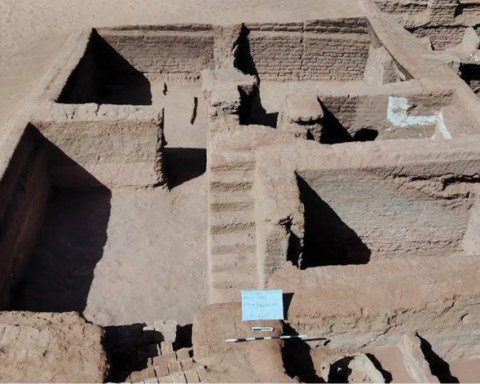
North of the Institute site, geophysical anomalies appeared to indicate the course of the ‘wives’ quarters’ enclosing wall, whose location is broadly known; several anomalies in the wider area shared alignments, suggesting possible associated structures. Twentieth-century building foundations and variations in local geology showed up too, but many excavated features were absent from the GPR plots. That may be resolved elsewhere by better subsoil conditions, muses Breeden – or it may be that mud walls buried in mud will always be elusive. They can be found, however, with careful excavation. And there were, as Matthew Brudenell, director of the Cambridge Unit tells me, a lot of finds.
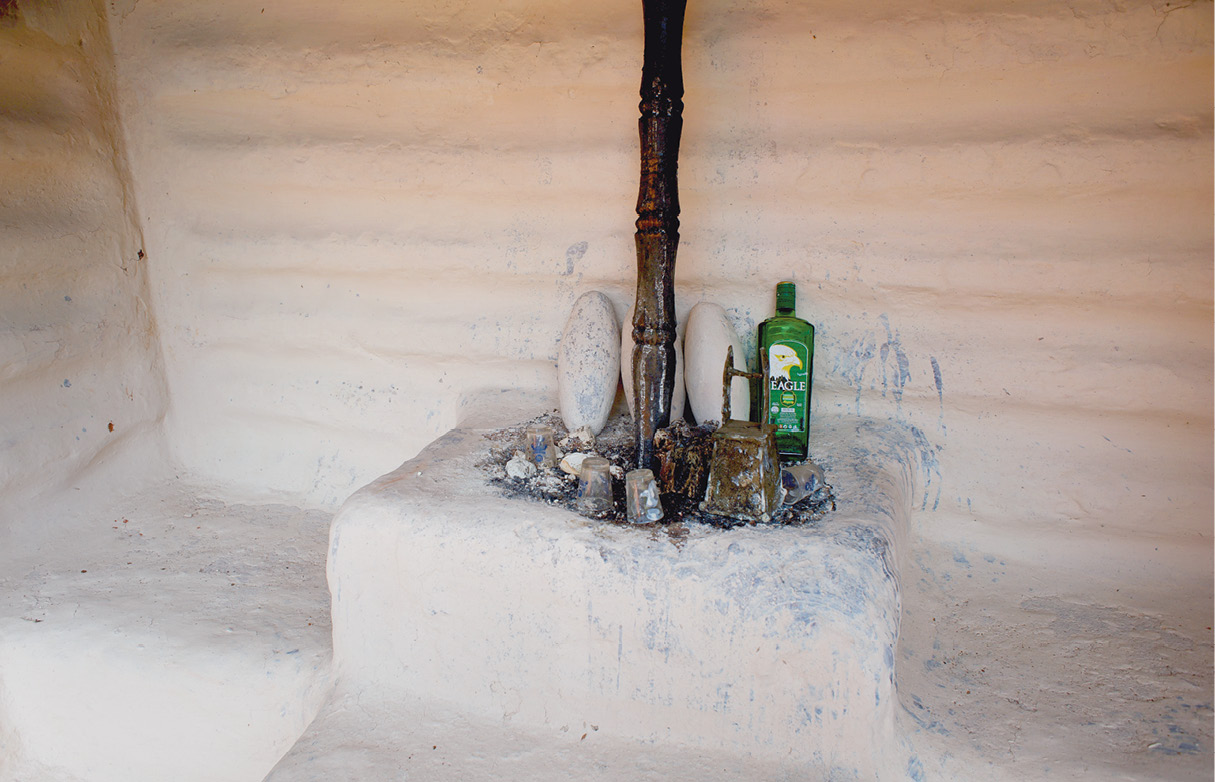
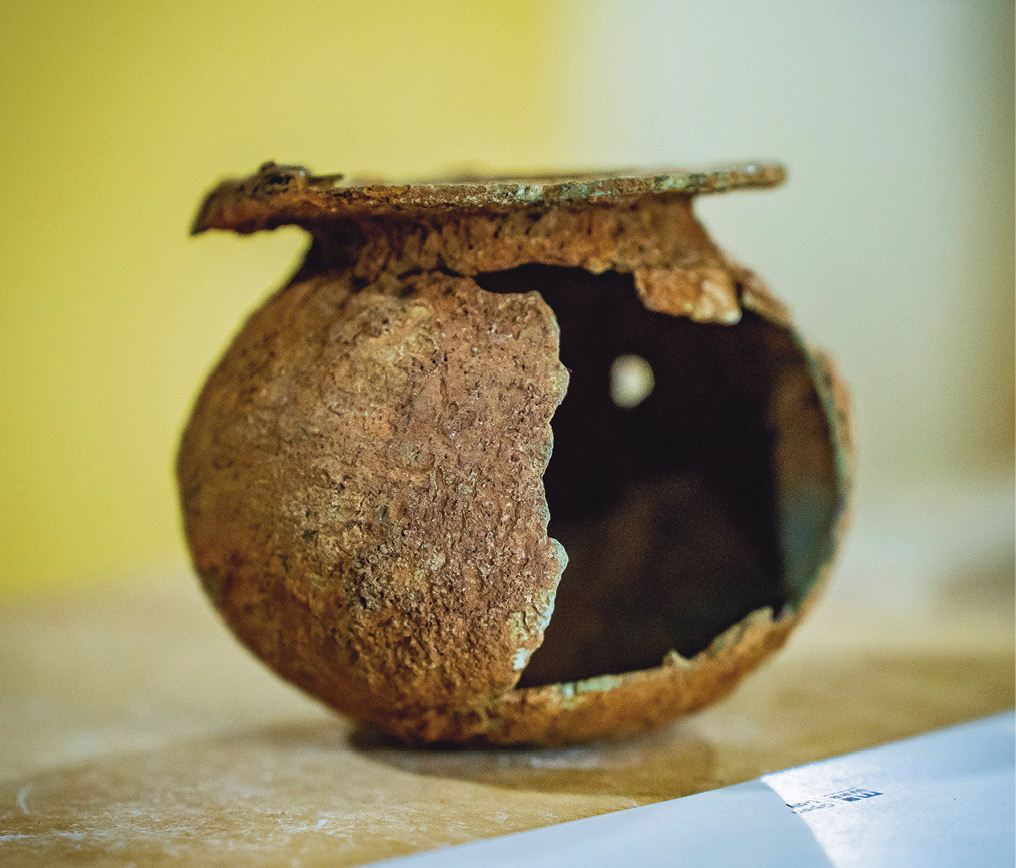
Some of them relate to the former hospital buildings, but much pre-dates them. They include 15,000 sherds of local pottery, nearly a hundred kilos of mostly iron metalwork, and 112 complete glass bottles. A working hypothesis is that much of this is a field kitchen assemblage linked to the British military presence after 1897. In support are a service button bearing an Imperial King’s Crown insignia, a .303 cartridge case for a gun, and a rusty iron blade that the Royal Armouries have identified as part of a British naval cutlass. From 1905, maps show barracks within the former Royal Palace grounds near the Institute site.

However, another possibility is that some of the material was deliberately deposited in ceremonial events. ‘One needs to be careful,’ Folorunso tells me. What might look like the castaways of soldiers and expatriate bureaucrats – bottles that once contained gin, soda, ginger beer, and even, perhaps, champagne – could have been deployed in traditional shrines, and some may pre-date the British invasion. Marcus Brittain, the Cambridge field lead, agrees. He points to West African smoking pipes and pottery, and says shrines with gin bottles are documented in southern Nigeria; alcohol, particularly gin, often accompanied ceremonies in West Africa. A miniature ground-stone axe blade found in the test pitting, a curated antiquity, is likely to have been placed on a shrine, seen as embodied lightning with power to fuel curses and blessings. The ‘wives’ quarters’ were a sacred space, otherwise open only to the Oba. They were badly damaged in the British attack, when, it is recorded, the area was ‘emptied of its shrines and contents’. Analysis of the finds continues.
The geophysics team went beyond the development area into the ring road, a giant roundabout at the north end of the cultural campus containing gardens and the Benin National Museum. This had been the site of early pre-construction excavations in the 1960s, and the plan was to provide context for the work there and nearby, not all fully reported.
The first recorded excavation in Benin City was by A J H Goodwin, a South African archaeologist, who dug for the then Nigerian Department of Antiquities in the 1950s, reaching 4.5m down. But more significant was a project led by the late Graham Connah. While studying history at the University of Cambridge, Connah worked in vacations with leading archaeologists of the time at iconic sites in Wessex. In 1961, he saw an advert in The Times for a government archaeologist in Nigeria, and before year-end was opening the first of 19 trenches on the site of the future museum. In challenging conditions, he trained a dozen local men – some of them professional well-diggers – praising in particular Umoru Gol, a skilled excavator whose facial scarification identified him as from the Tera community in the north of the country, and Julius Tilleh, from the Tiv community and known to Connah as Mr Fixit, who appears in photos surveying, rebuilding pots, and supervising excavations. The two men worked with him for nearly a decade.
Connah drew up a provisional chronology with pottery and radiocarbon dating, and his excavations were truly jaw-dropping. The old city was famous for its rings of defensive earthen walls, claimed by The Guinness Book of Records as the longest earthworks of the pre-modern world. At one of Connah’s sections, the bank rose 15m above the bottom of a partially silted ditch – comparable to the ramparts at Britain’s greatest Iron Age hillfort at Maiden Castle in Dorset. His barely supported trench, just wide enough to take a wheelbarrow (and, with modern practice, probably unrepeatable), went down to the old ground level beneath the bank, from which he obtained a carbon sample dated to around AD 1200-1500. In the Royal Palace, close to the current development site, he uncovered the remains of 45 people, mostly young women wearing copper-alloy bracelets and glass beads, buried together 12-13m from the top of a deep shaft. There were huge pits he called water cisterns whose fill sometimes contained quantities of pottery, and rammed-earth floors and occupation deposits 3m deep. Mortimer Wheeler came to visit – and was apparently impressed.

To find such deep stratigraphy in the palace grounds was remarkable. So half a century later, a two-season strategy was devised for a return to the site, bracketing the rains with evaluation early in the year and excavation later. The chosen location for the Institute was targeted in 2022. They moved closer to the early excavations in 2023, and fieldwork will conclude this year with two more seasons.
An archaeological milestone
I have never been to an excavation that received so many visitors. Schoolchildren, celebrities, politicians, chiefs, stakeholders – they came every day, assembling in the field centre for a presentation and then a view of the site. MOWAA has engaged with local people who can bring skills and knowledge to the project. Uwagbale Edward-Ekpu, a specialist in Benin oral history and traditional culture, tells me that being there during excavation means he can help archaeologists ‘make sense of what they are seeing. This is a big milestone for archaeology in Benin,’ he adds, ‘I’m very happy to be part of it.’ John Igbineweka, whose father was a chief of the royal guild of carvers and carpenters, has come out of retirement to resume woodworking. He finds the excavations ‘very impressive’, and hopes the initiative will encourage young people who have left the area to return, and ‘learn more about our cultural values’.
For Abidemi Babalola, archaeology and community are inseparable. He grew up in Lagos. After studying archaeology at the University of Ibadan and writing a PhD at Rice University in Houston, USA – and post-docs in Qatar and Harvard, as well as a fellowship at Cambridge University – he became the British Museum’s lead archaeologist in Benin City. ‘Either you do the archaeology, or you lose it,’ he says, noting that pre-construction excavation is not typical in Nigeria. The work will bring a sense of history to the landscape, he tells me, and the wider MOWAA vision will incorporate archaeologists from students to professors, building research capacity in the country and drawing in the community at large.
On site, tents and umbrellas offer some protection from sun or rain, depending on that day’s weather. Red-and-white tape, and paths made with dirt-filled old sacks of Mama’s Choice rice, guide you through the red mud and away from trench edges. One morning, after the rain, the hot, humid air seethes with dragonflies, and the amplified voice of a preacher in a nearby church wafts over the kneeling archaeologists.
It is early days, but a picture seems to be emerging of 19th-century palace buildings in the north, and deep, stratified sequences in the south. In the north are low, broken lines of mud wall, particularly clear in one trench where there are two types: the local mud-coursed walling, in which a layer is built up and allowed to dry before the next is applied, and a wall made with mud bricks. ‘We didn’t expect the bricks,’ says Brittain. They look suited to a European building style, and documentary research found evidence for an early colonial- era mud-brick factory. Significant indications of metalworking in the south – fired clay, charcoal, scraps of copper alloy, and possible crucible fragments and lead spills – hint at what might be yet to come.
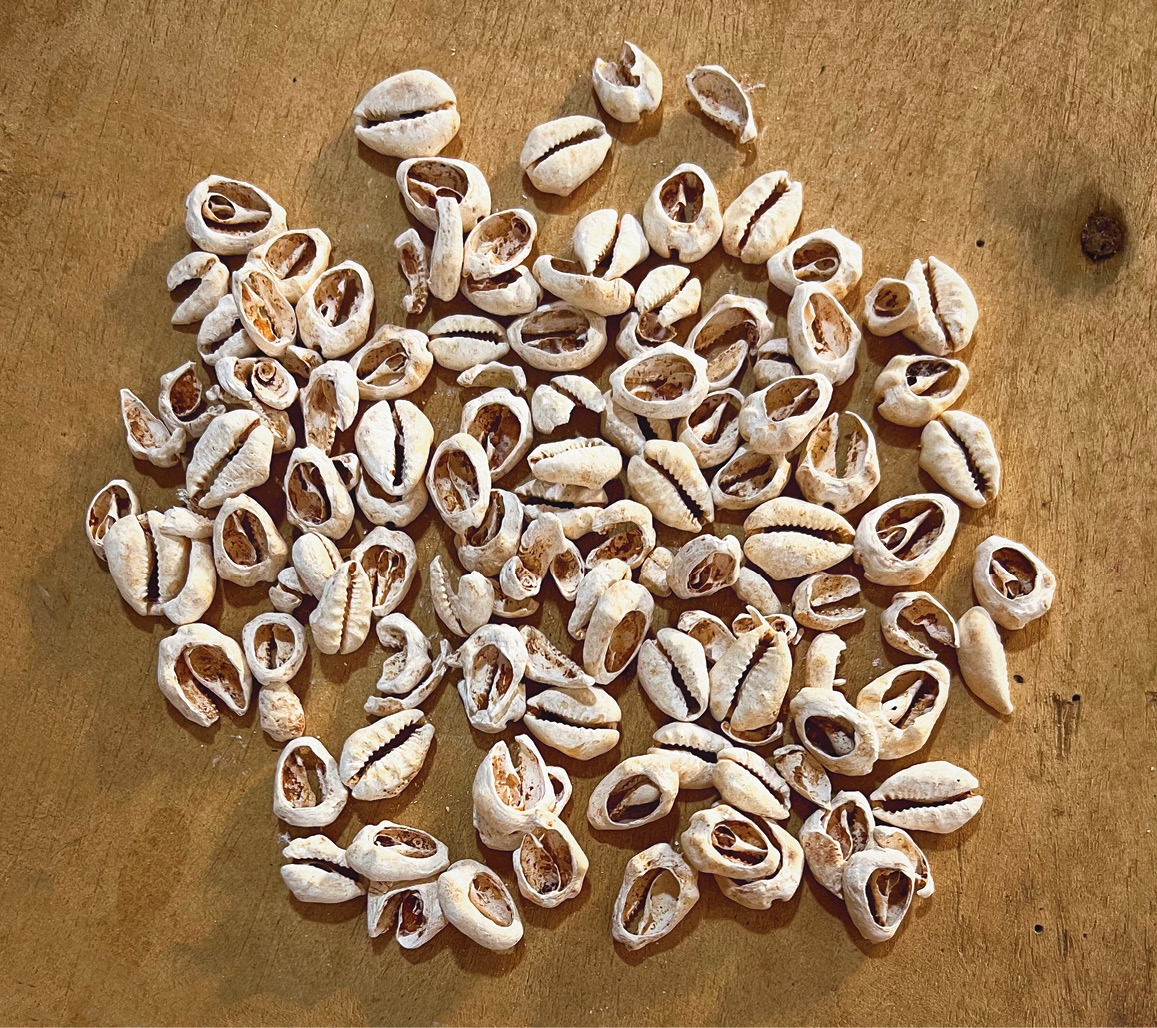
Groups of locally made decorated pots and floors featuring tightly packed pottery sherds around arrangements of worked chalk look like the remains of shrines – an early map of this area shows several buildings with ‘altars’. Ceramics are very common (‘I’m no Africanist,’ says Brudenell, ‘but this is nicer than British Bronze Age pottery!’). That’s the same everywhere in West Africa, Emmanuel Olaleye, MOWAA finds manager, tells me. Cowrie shells too are common, in one case in a cluster of over a hundred – intentionally deposited, he says, as an offering or concealed currency.
Olaleye is enthusiastic about the dig. ‘Things you’ve heard, old traditions, read in books,’ he says, surrounded by shelves of labelled plastic tubs as he talks to me in the finds store, ‘you can see them for yourself. It makes me feel I am part of history, interacting with the dead, the ancient Benin people, through the things that they used – getting to know the reason for living the kind of life they did.’

Unerasing the past
What next? More excavation, the opening of the Institute, tending rain-forest seedlings, another building, bringing in more of the community: there is much to keep people busy. One might imagine the Benin Bronzes to be on everyone’s lips. When he talked to younger archaeologists, says Breeden, the subject rarely came up. Perhaps it’s too complex, too freighted, for casual remark.
‘Conversations about restitution are primarily happening overseas,’ says Disu. ‘What matters in Nigeria is protecting what we have, and working towards reunification of knowledge through public projects such as MOWAA’s excavations and campus.’ The project, says Abidemi Babalola, grew from a need to understand the city’s archaeology and to respond to the building programme. Nonetheless, expectations are high that many historic artefacts now abroad will one way or another find their way back to Nigeria, and be displayed in a future museum.
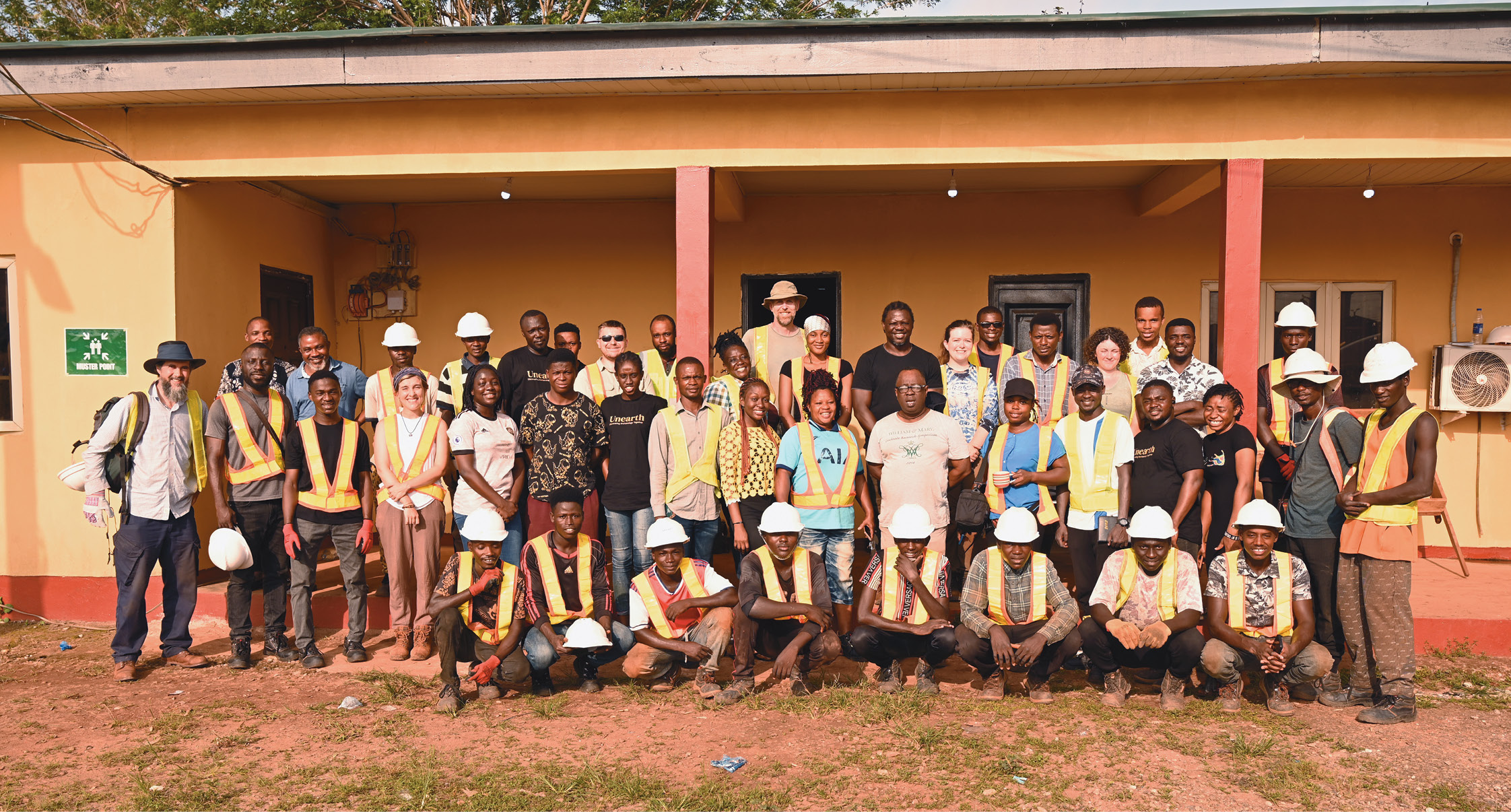
Segun Opadeji, MOWAA’s archaeological field director, tells me that not all Benin citizens think of the site as part of the old palace. What followed the invasion in 1897 – colonial offices, police barracks, hospitals, a mortuary – ‘all this has erased the memory of people.’ MOWAA ‘is going to change the face of archaeology,’ he says, influencing government and individuals across Nigeria. ‘I’ve been wanting this for a long time.’