Subscribe now for full access and no adverts
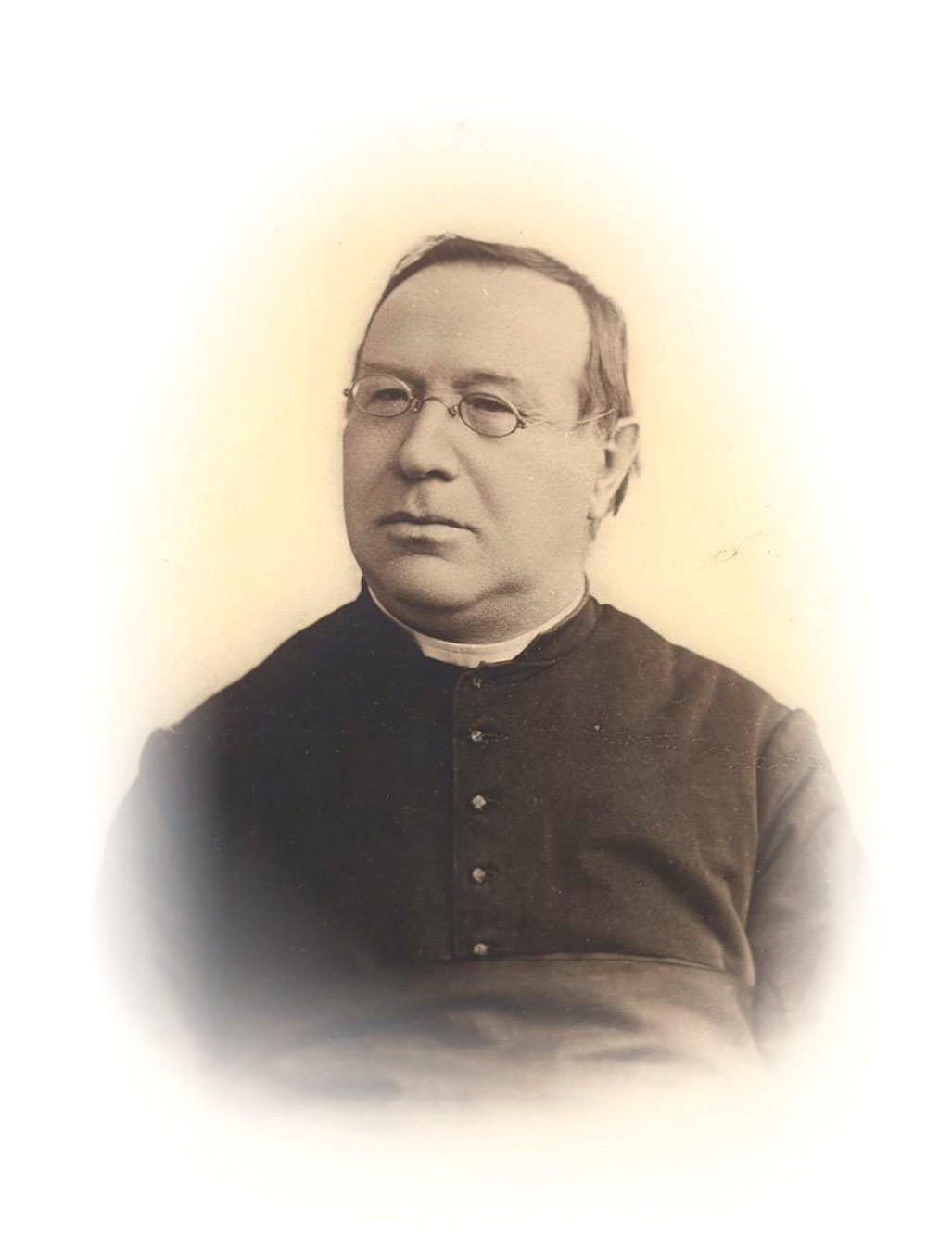
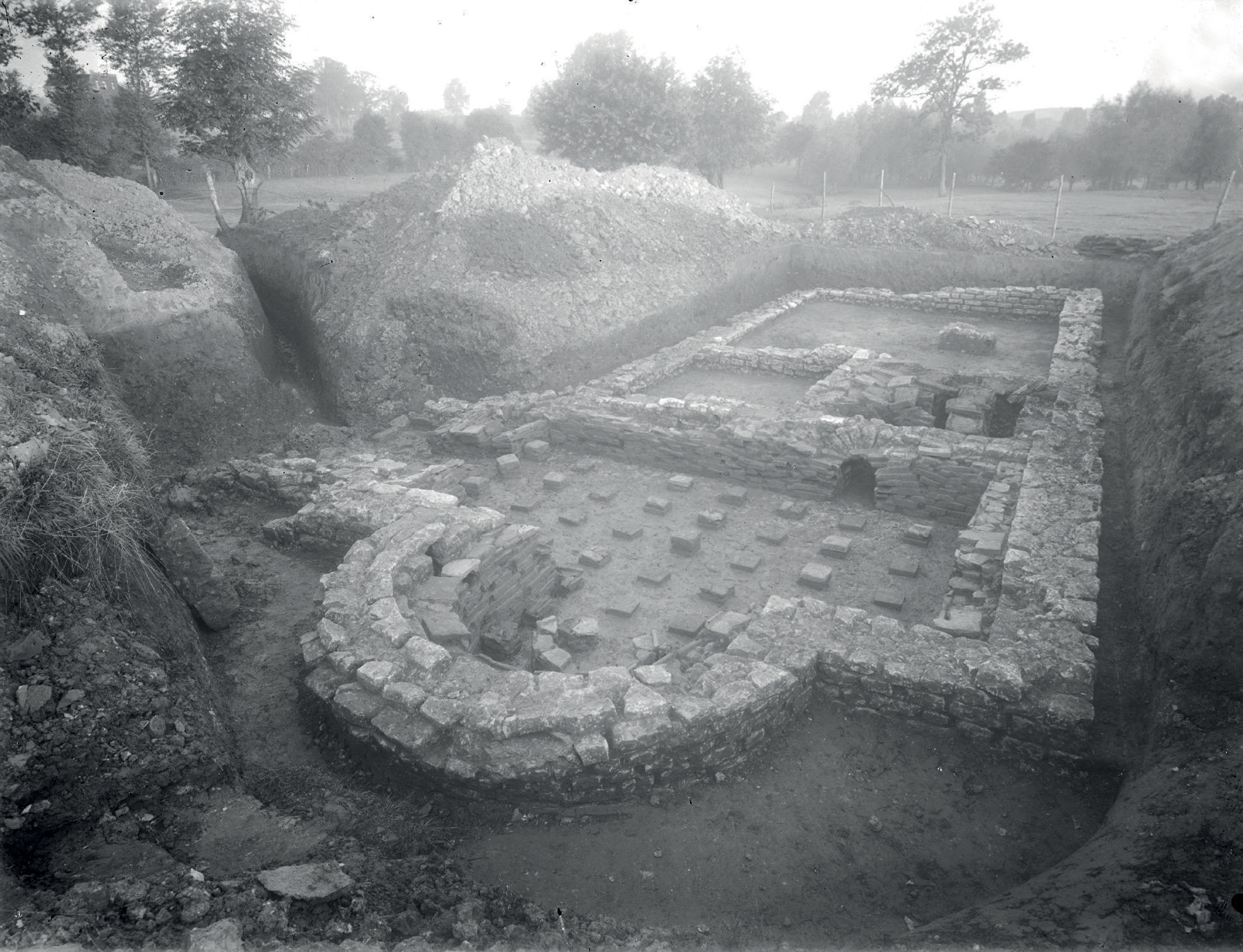
In 1891, a set of stone foundations were discovered in a field near Ten Hove farm, Voerendaal. Jos Habets, record keeper at the state archives and enthusiastic antiquarian, was not surprised. He already suspected that the field harboured Roman ruins, and from the very beginning the discovery was flagged as a probable villa. Habets’ intuition was understandable, as the Limburg region in the southern Netherlands, where Voerendaal lies, had already proven to be rich in such relics of the imperial past. Indeed, Habets had first-hand experience of many of them. After being ordained as a priest in 1856, he had both the time and the inclination to dig a series of villa sites in Limburg from the 1860s through to the 1890s. Voerendaal, though, was destined to be his last project. Excavations commenced in 1892, with Habets securing a grant of 150 guilders from the Ministry of the Interior. It swiftly became apparent, though, that this largesse was not equal to the task. Even though the sum allowed some 125m of a building to be exposed, in what Habets called ‘the most extensive [excavation] ever in the Netherlands’, it was clear that there was plenty left to investigate. As Habets observed, with some understatement, ‘the size of this villa far exceeds our expectations’. In April 1893, he was chasing more funding, but passed away in June of that year, before work at the villa could be completed. There was no question, though, that the diggings at Voerendaal had revealed a stunning illustration of the wealth that the region generated under the Roman Empire.
Habets’ methods for investigating the Limburg villas were very much of their time. Rather than attempting to unearth the entirety of most rooms, he was much more interested in establishing the plan of a building. One technique was to chase the walls through the earth by digging along them, or simply using a probing rod to verify the presence of masonry. Only especially interesting elements of a villa would be fully opened up, such as the subterranean cellars they featured, or a bath suite. It would be fair to observe that the results could be mixed, with one recent write-up of Voerendaal observing that the outcomes were ‘sometimes no more than a number of finds and an incomprehensible villa plan’ (see the ‘Further information’ below). Equally, though, Habets took a keen interest in his findings, questioning what wood was used to fire the villa hypocausts, and noting cut marks on some of the animal bones that were recovered. Interest in the villas long outlived Habets, with many sites, including Voerendaal, receiving investigation in the 20th and 21st centuries. The result is a wealth of evidence for the nature of these estates that was extracted in many different times and circumstances, and documented and studied to very different standards. Now the Rijksmuseum van Oudheden, the Thermenmuseum, Limburgs Museum, and the Cultural Heritage Agency of the Netherlands has researched this material for a new exhibition: Roman villas in Limburg (again, see ‘Further information’).
An empty land
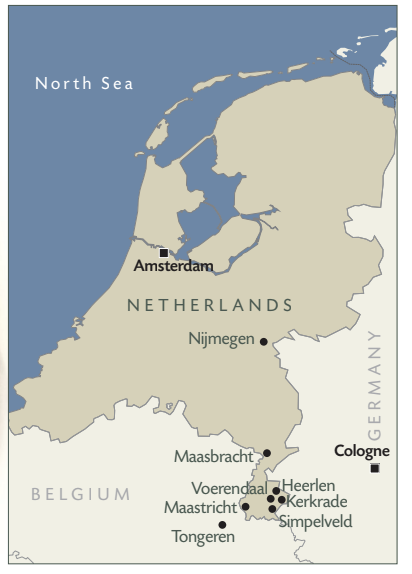
‘The province of Limburg is only a small part of the Netherlands’, explains Jasper de Bruin, exhibition curator at the Rijksmuseum van Oudheden. ‘It is squeezed in between Germany and Belgium, and the landscape is completely different from the dykes and tulips that people often imagine when they think of the country. We say that going to Limburg is like going abroad, because it is so hilly. This difference also applies to the Roman period. People often think about the frontier that was built along the Rhine. This was really a military zone with a lot of forts, while the region immediately to the south was very wet and characterised by a rural landscape with small, scattered timber settlements, where there is little sign of obvious influences from the Roman world. It is a very different story further to the south in what is now Limburg. There, you have this very fertile loess soil – I’m told loess is the best agricultural soil that you can get in the world – and it is on this prime farming land that the villa estates developed. You don’t find them in these kinds of quantities away from the loess soils. I should emphasise, though, that we have been studying the Dutch part of this region, but it is important to see it as part of a wider landscape that stretches to Tongeren in the west, and Cologne in the east.’
The region is one, too, that witnessed dramatic change over time, particularly as it came into the orbit of the Roman Empire. When Caesar campaigned there in the 1st century BC, he found it home to a group known as the Eburones. Their bold resistance to Roman rule included a surprise attack on a force preparing to spend the winter on their territory in 54 BC. With a lethal combination of inspired trickery – or low treachery, depending on your point of view – and brutally effective fighting, they managed to wipe out the occupants of one winter camp and came within an ace of destroying a second. Caesar was not amused. The very next year his forces retaliated: settlements were torched, cattle rustled, and crops either consumed or spoilt. In 51 BC, Caesar returned to the Eburones’ territory, with The Gallic War recording that he ‘wrought general devastation by slaughter, fire and pillage, killed or captured a large number of persons.’ The harsh measures described in the literature also appear to be visible in the archaeological record.

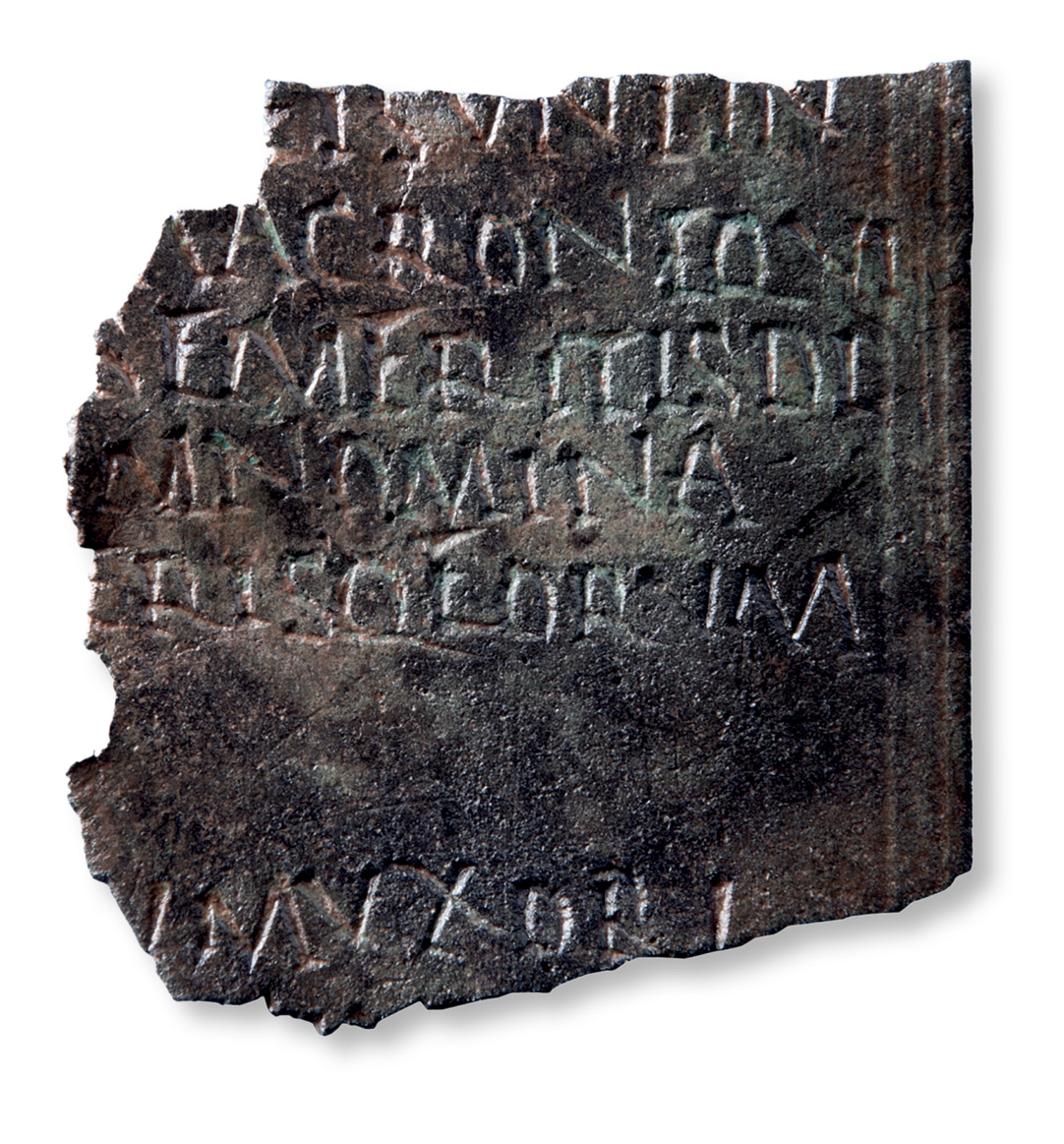
Above & below: Details of the inhabitants of Limburg comes from numerous sources. Here we see the tombstone for Ammaca Gamaleda, whose name references her local origins (above). It dates to AD 100-300 and was found in Maastricht. Veterans also lived in the region, as indicated by this fragment of a bronze diploma (below) that was awarded to a retired soldier and found in Rimburg. Not shown to scale. Images: © Limburgs Museum
‘We can see that the Limburg area became empty at around the time of Caesar,’ says Jasper. ‘Apparently the people living there either fled or suffered from Roman retributions in other ways. It was only repopulated at around the beginning of our Common Era, when a large number of people seem to have been migrated to the region, presumably under some kind of Roman control. This is reflected in the number of settlements that suddenly pop up. They seem to have been planned to some degree, with wooden houses set within rectangular yards and enclosures. Initially, these sites look very similar to the contemporary ones that were being established on the wetter ground to the north. Very slowly, though, the Limburg sites became more prosperous. One thing that our research has been able to confirm is that almost all of the villas developed from earlier buildings. In most cases, these timber houses survive into the 2nd century, with them only being transformed into a more recognisable villa style with stone walls, hypocausts, and tile roofs in the late 2nd or early 3rd century. So people were living in this region for two centuries of the Roman period before these monumental buildings and great colonnades started to be built.’
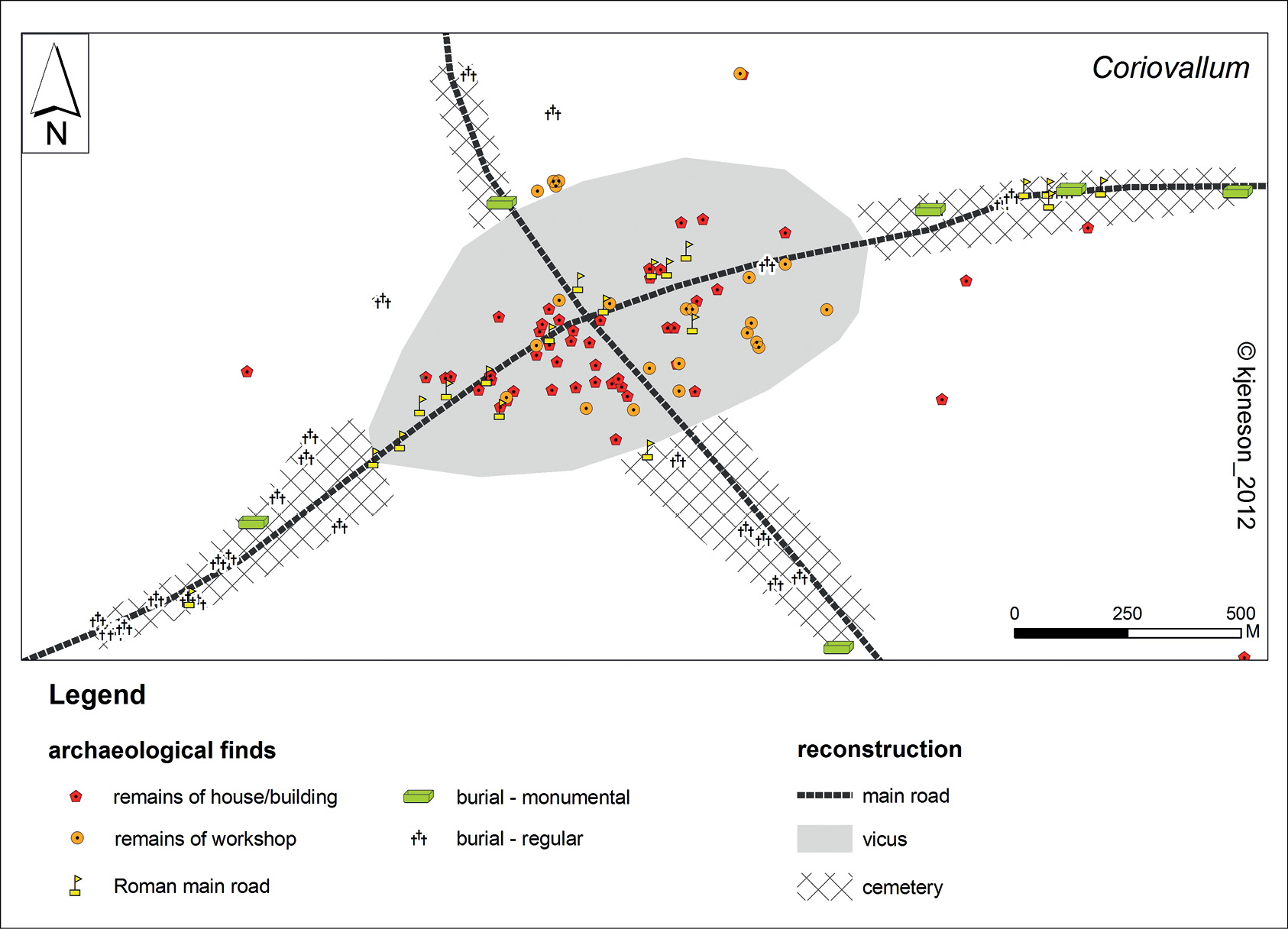
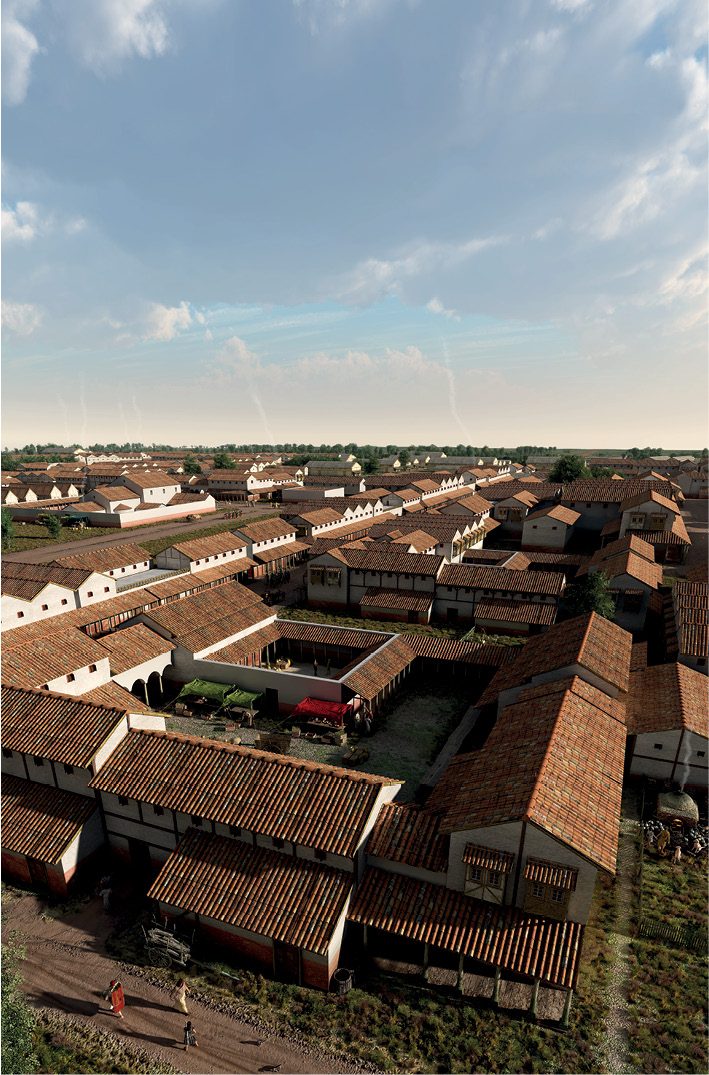
‘There can be a tendency to think that we have this fertile, hilly area, and then the Romans came and started building these grand houses on it, but the archaeology shows a much more organic development. It is clear from inscriptions found in the area that many of the villa owners were the descendants of owners of some of these earlier wooden houses. They were people with Germanic or Gallic names, so even in the 3rd century we can find these traditional forms of expression existing alongside more “Roman” styles of architecture. That said, there was definitely some mixing of people, because we have also found a Roman military diploma that was issued to an auxiliary soldier when he retired, so we should imagine veterans living in the region as well. But I think most of these people were farmers who knew how to get the most out of the local soil and could then sell the grain at a profit. Of course, the army offered one obvious and lucrative market that – thanks to the Rhine frontier – was right next door. Some estate owners may not even have sent their produce that far, though, as Limburg itself was home to a number of small Roman towns. Most of them started off as fairly modest roadside settlements, but some – like Maastricht and Heerlen – developed into much bigger centres. Heerlen, for example, grew to be larger than the town at Nijmegen in the Roman period. Presumably the wealth of these small towns was also linked to them providing agricultural markets.’
Trophy houses
Wherever the grain was sent, it brought in a lot of cash, which the farm owners chose to spend – at least in part – on stone houses, which were then upgraded over time as resources allowed. ‘This situation is very interesting’, says Jasper, ‘because it reminds me of the villas in Britain, which I studied many years ago. There, many of the houses seemed to develop out from a smaller, original stone house, which acted as a sort of standardised nucleus. It is almost as if the owners went to a guy with a catalogue and said “OK, I want this one.” Then, as their fortunes grew, they could add towers, or corner pavilions, porticoes, and so on.’
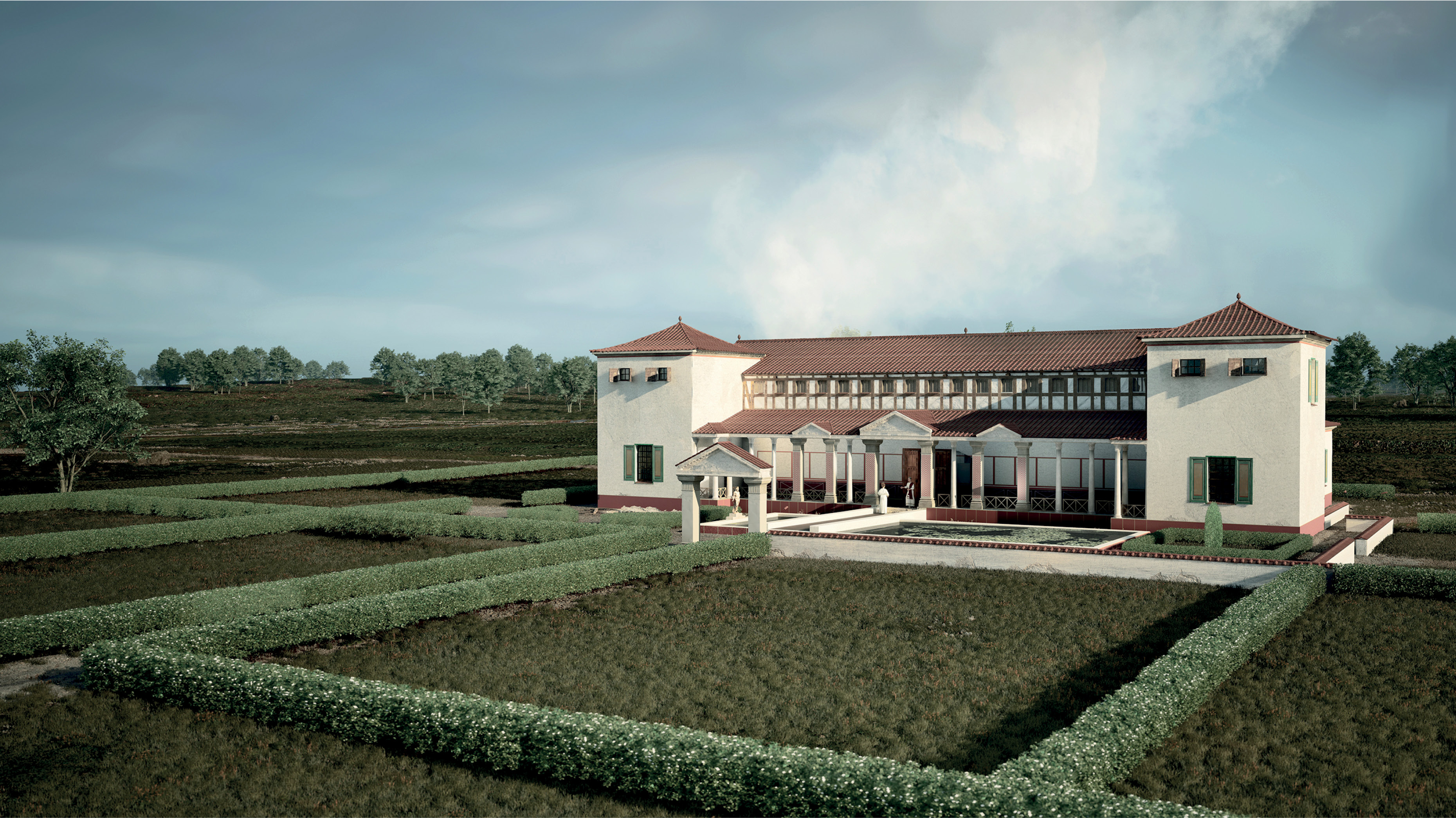
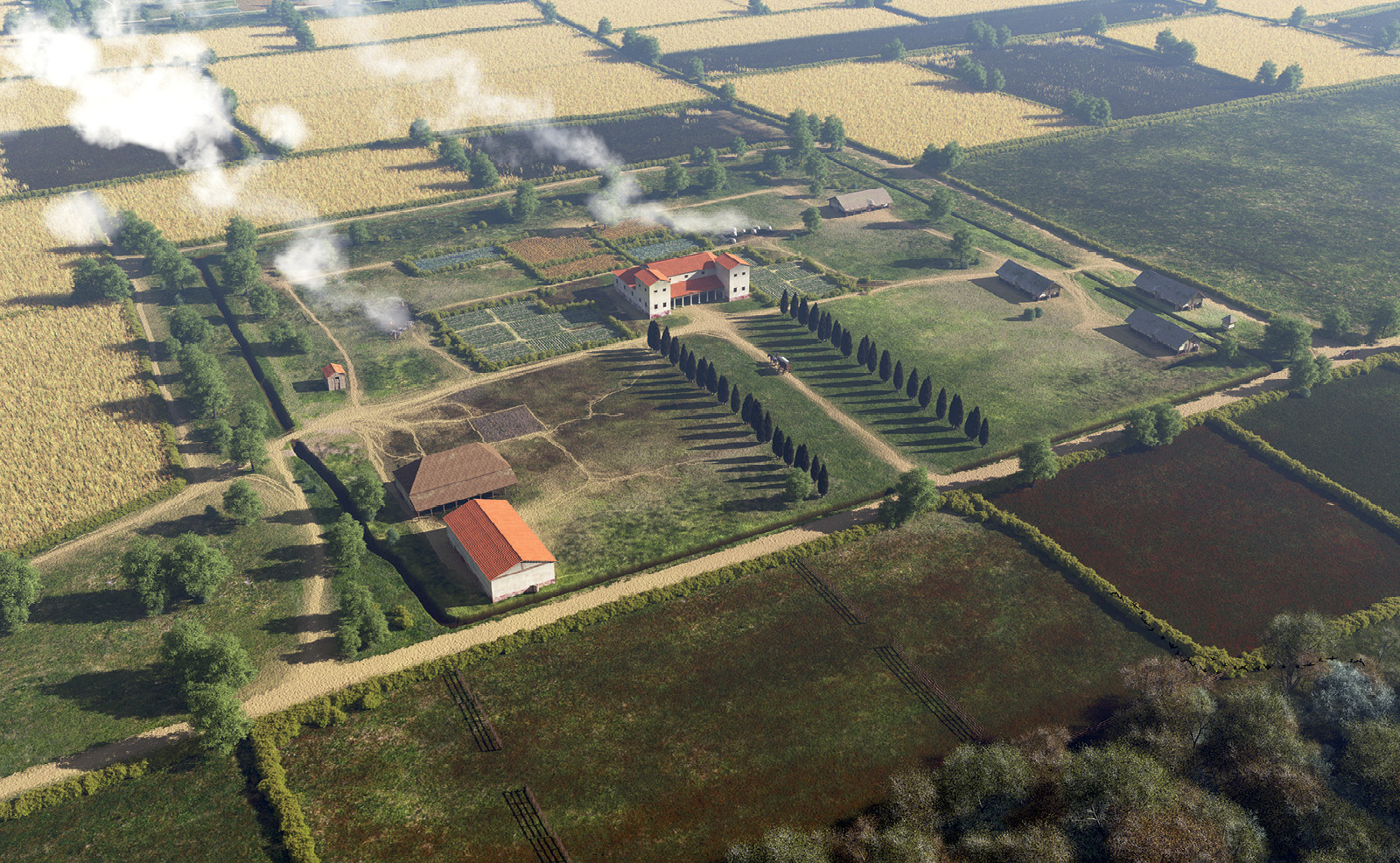
When it comes to elaborating properties, Voerendaal must be the outstanding example. At the pinnacle of its opulence, this villa estate featured a portico that was over 100m long and boasted at least 40 columns that were 3m tall. To visitors it would have looked like an enormous palace, but the appearance was a little deceptive, because in reality the portico was connecting numerous different structures, rather than being the façade of one gigantic one. It must have been intended as a way to show off the owner’s wealth. Visitors to the exhibition will be able to get a taste of this by taking an interactive tour of the villa. Voerendaal is not just exceptional for its architectural excesses, though, because it also had an unusual abundance of rather more mundane facilities: outbuildings, and in particular two or perhaps even three granaries. Intriguingly, these provide storage for more goods than can have been produced on a single estate, raising questions about whom they were serving.
‘It might be that this was a collection point for crops being grown over a wider area,’ says Jasper. ‘Something that we haven’t really been discussing in the Netherlands is the significance of watermills. There were some interesting finds next to a stream at Voerendaal, which got me thinking about whether people were collecting their crops and then bringing them to a local mill. Once the grain had been processed it would allow them to transport bags of flour rather than the raw crops. Having access to a wider range of facilities would also help us to understand why the owners of some villas appear to have grown richer than others.’

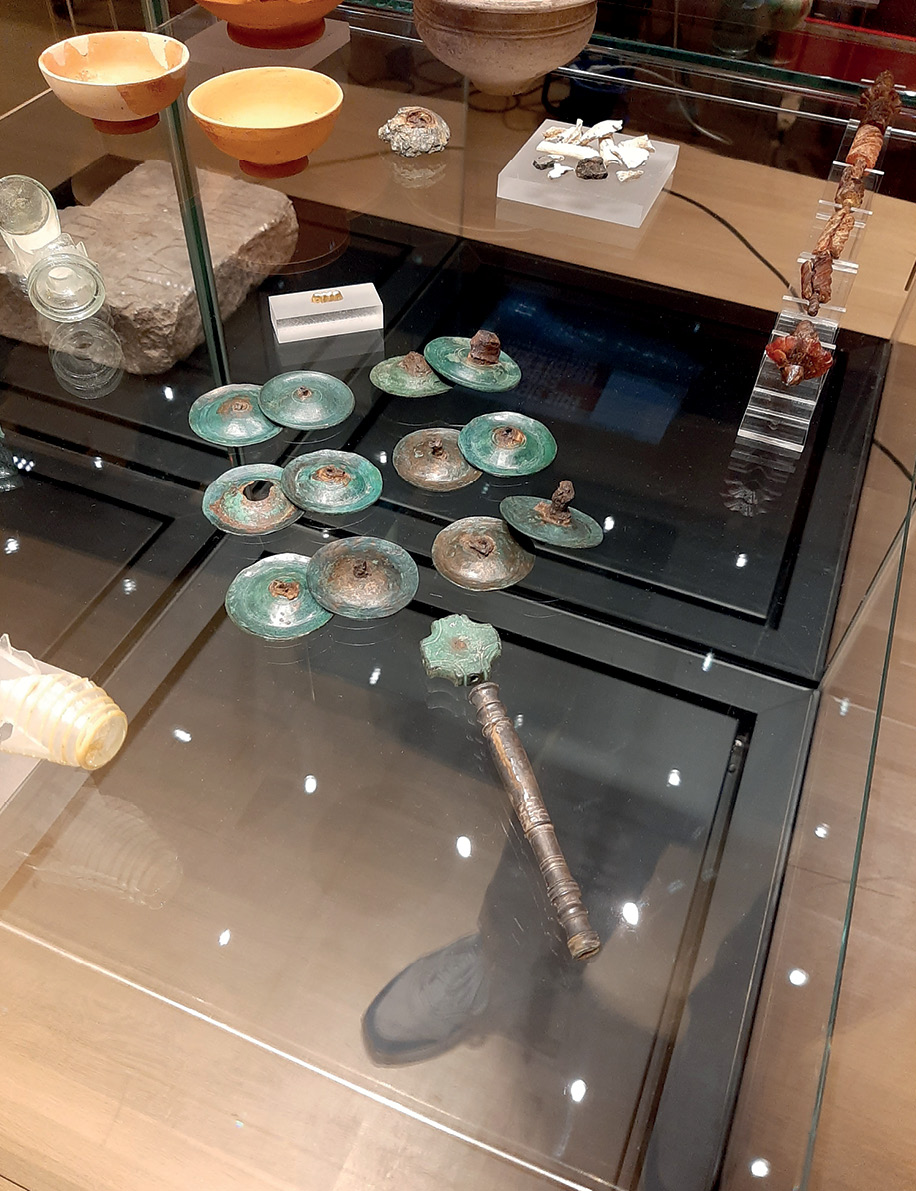
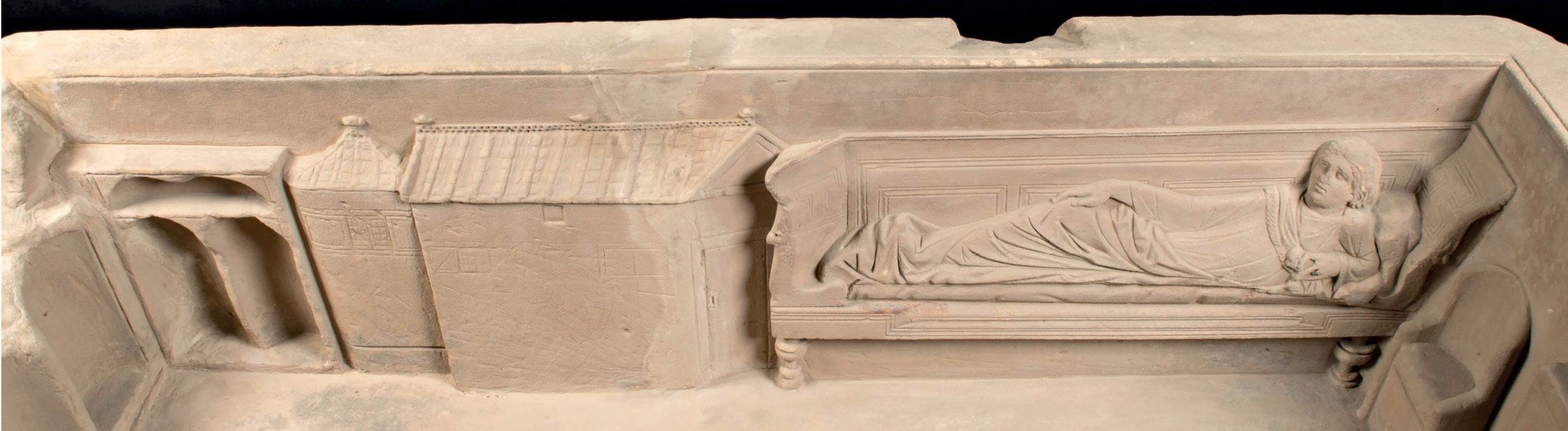
Who, then, were these owners? ‘We have found a number of wealthy burials associated with the villas, and most of them were for women,’ says Jasper. ‘They provide a rich source of evidence for the nature of elite life. One common theme is that you find all sorts of materials linked to writing, which was presumably intended to show that they were literate. Another interesting find – which hadn’t been noticed before – is that one of the women was also buried with a sistrum, which is a religious musical instrument. It is a good illustration of just how much could pass unremarked during early excavations. Probably the most well known of these burials was found at a villa at Simpelveld, though, where a woman was buried in a sarcophagus that has some remarkable carvings inside it. These show the complete interior of a room, as well as a woman reclining on a bed and a villa building. Some of my colleagues think that she must be the wife of the man who looked after the estate while the owner was away, but I think she was the owner of the villa, and this was just another way to show off her wealth. I have been discussing this with Carol van Driel, who has done a lot of work on women in the Roman world, and how this might work in terms of inheritance. It does look as though it was legally possible for women to own a villa, so why shouldn’t we see these wealthy women as owners?’
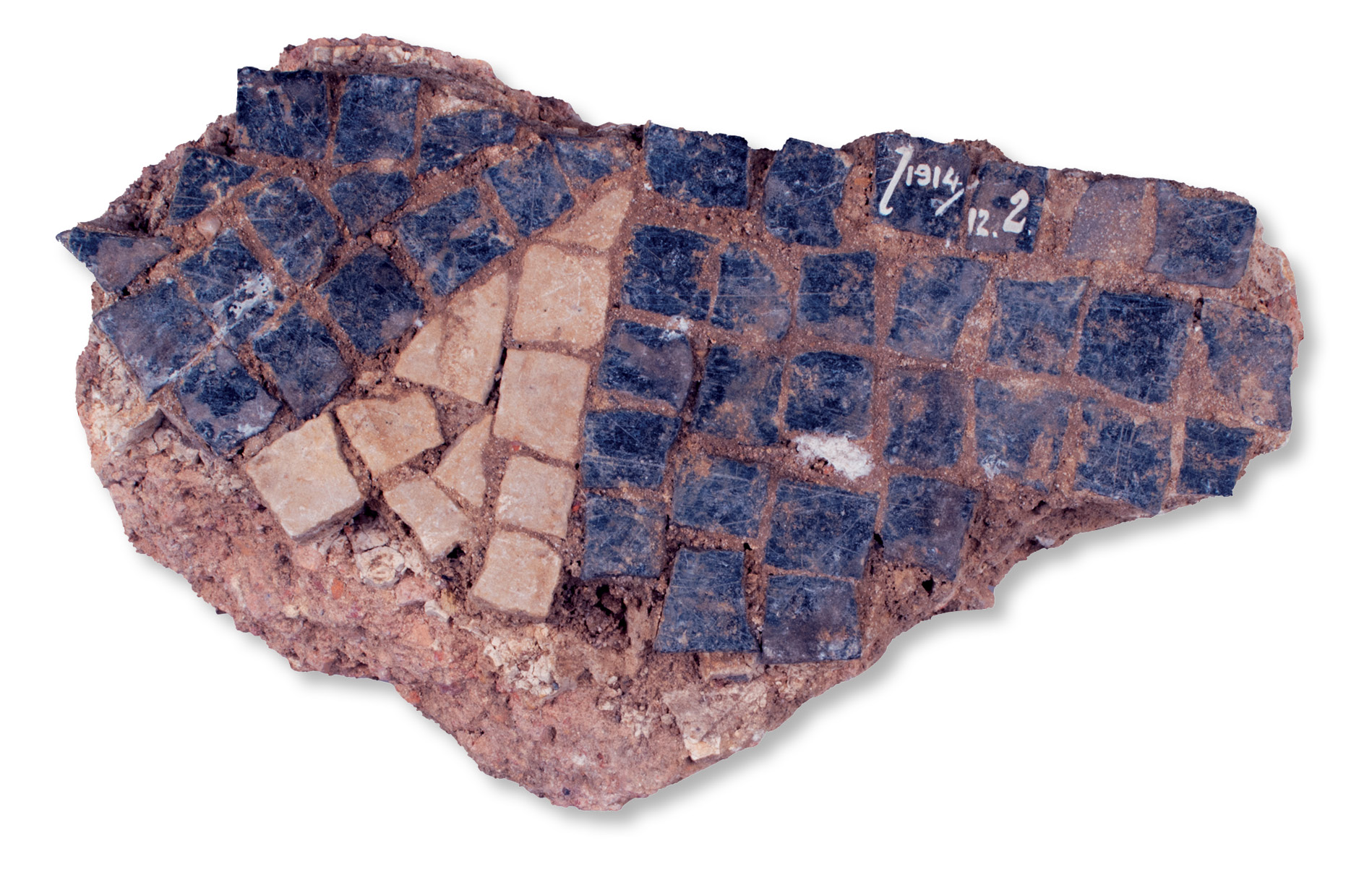
The décor of the villas provided another way to show off to visitors, although some of the classic Roman decorative options were rather more popular than others. ‘Mosaics are very, very rare in the Netherlands’, Jasper points out, ‘and when they are found they are usually in urban settings. Only one is known from a villa site, and unfortunately it was dug in 1914. They took out some fragments, but we can see from their plan that they didn’t excavate the whole room. We also have an aerial photograph that shows this villa, so we can pinpoint the exact location of this room, and I know that tesserae from the mosaic are still found in the field, which really makes me want to grab my shovel and finish the job of digging the room! At first, I thought the mosaic was very simple, with a pattern of lines and triangles, but some additional fragments turned up containing blue and green stones, so it looks like there was more to the decoration.’
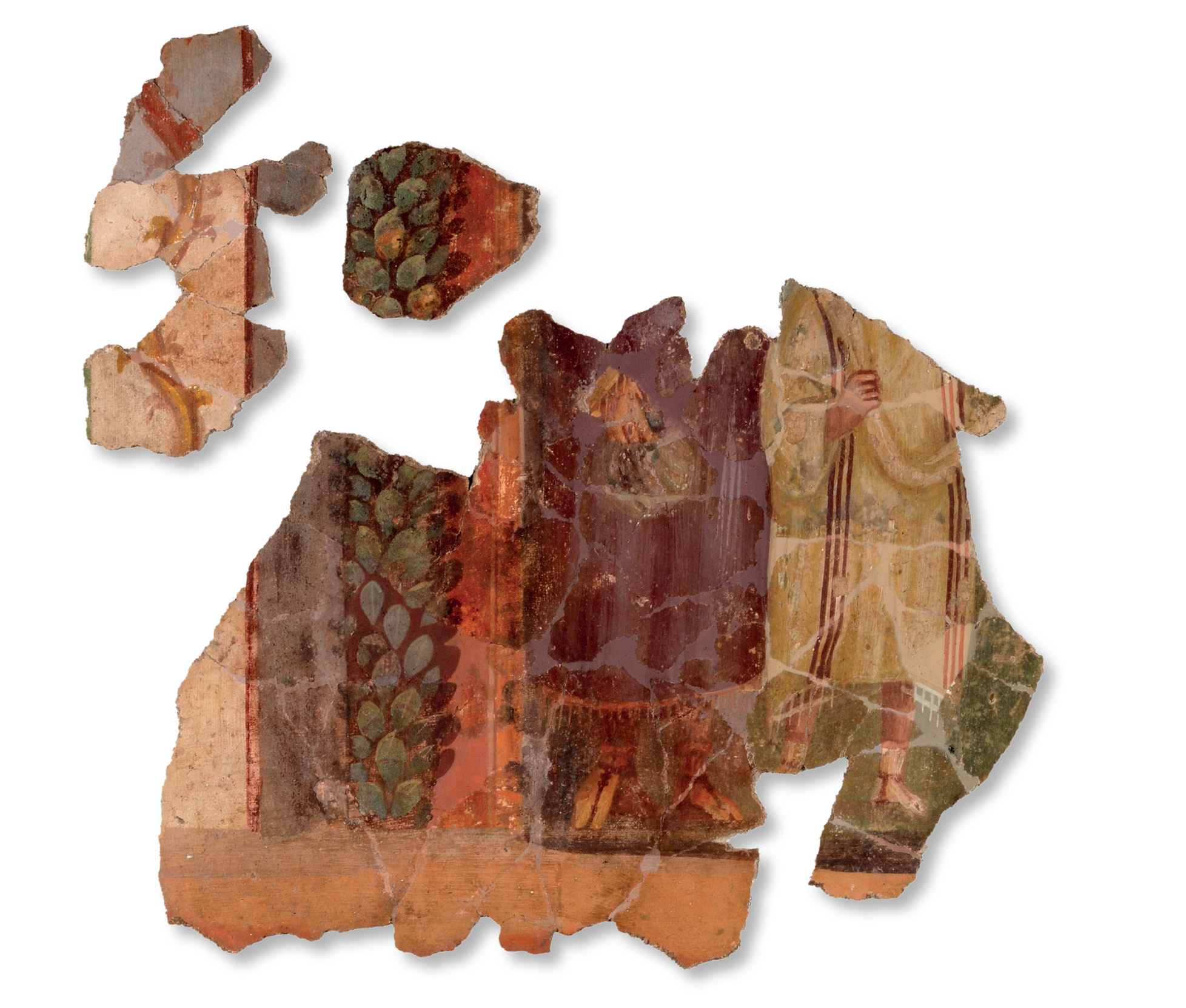
Above & below: A reconstruction of the original appearance of the wall painting from Maasbracht. Although gladiators dominate the decoration, note the individuals wearing Gallic clothing with purple stripes in the upper band (above). Image: after Swinkels 2017, p.85, fig. 5.1, ed. Henk Hiddink and Jasper de Bruin; L Swinkels (2017) ‘The wall painting fragments’, in W K Vos, C C Bakels, and T A Goossens (eds) The Roman Villa at Maasbracht: the archaeology and history of a Roman settlement on the banks of the river Meuse (province of Limburg, the Netherlands), Analecta Praehistorica Leidensia 46, Leiden: Universiteit Leiden, pp.83-127
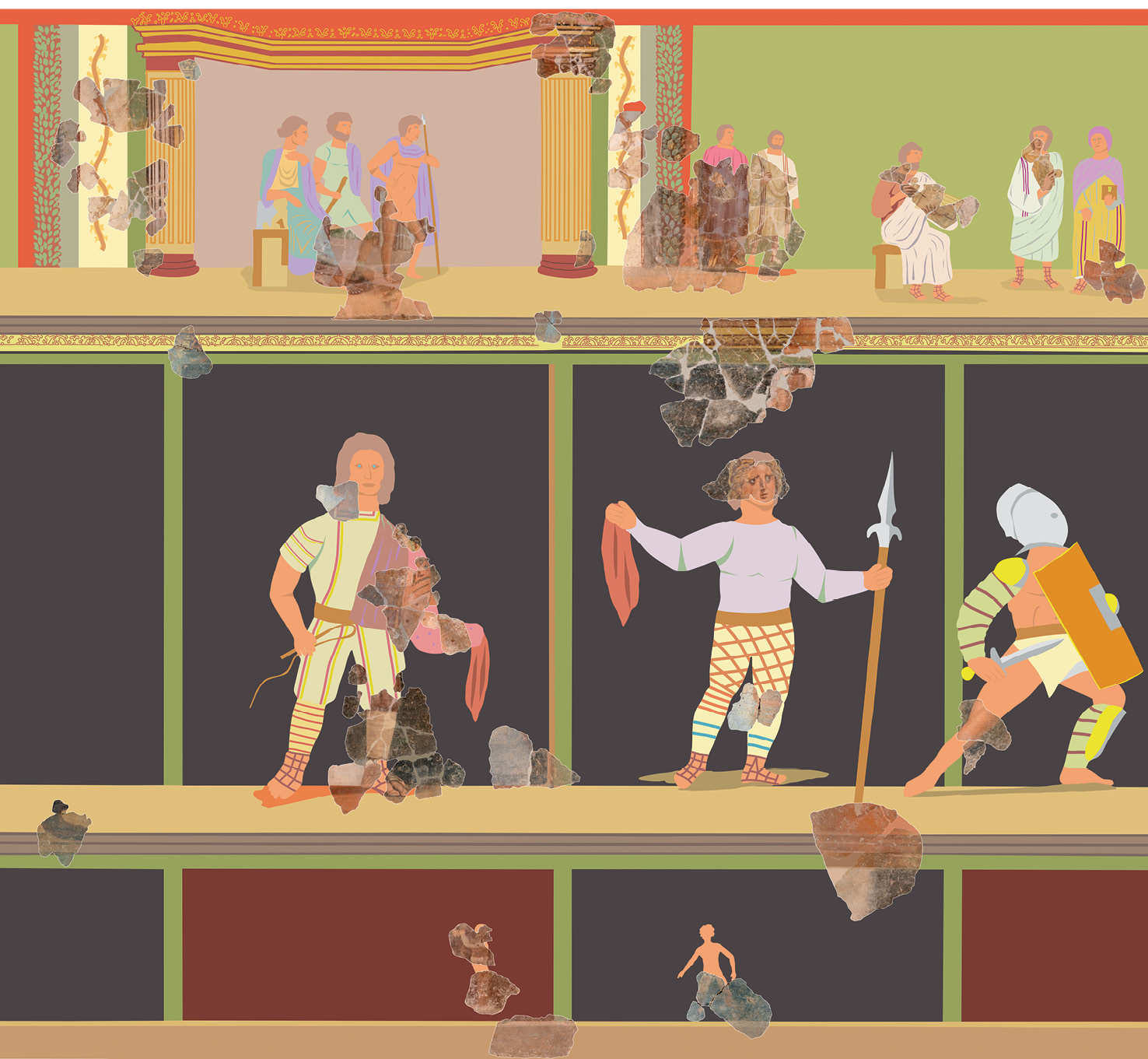
While mosaics are rare, wall paintings have been found at all of the villa sites. In most cases, they take the form of simple lines, but two examples feature people and animals. One is from Kerkrade, and it seems to show some gladiators and perhaps also mythological scenes. This would fit with the famous wall painting from Maasbracht, which was divided into three different bands. The lower and central portions depict scenes of gladiatorial combat, quite possibly commemorating games sponsored by the owner, while the top section featured both mythological scenes – complete with text that probably explained what was going on to less learned visitors – and images of the villa inhabitants. They are shown wearing typical Gallic clothing, which had been enhanced with the addition of very Roman-looking purple stripes. The end result could act as a perfect illustration of the processes at work in the region: local people who wanted to act like Romans to a certain degree, while also retaining some of their traditional ways.
Boom to bust
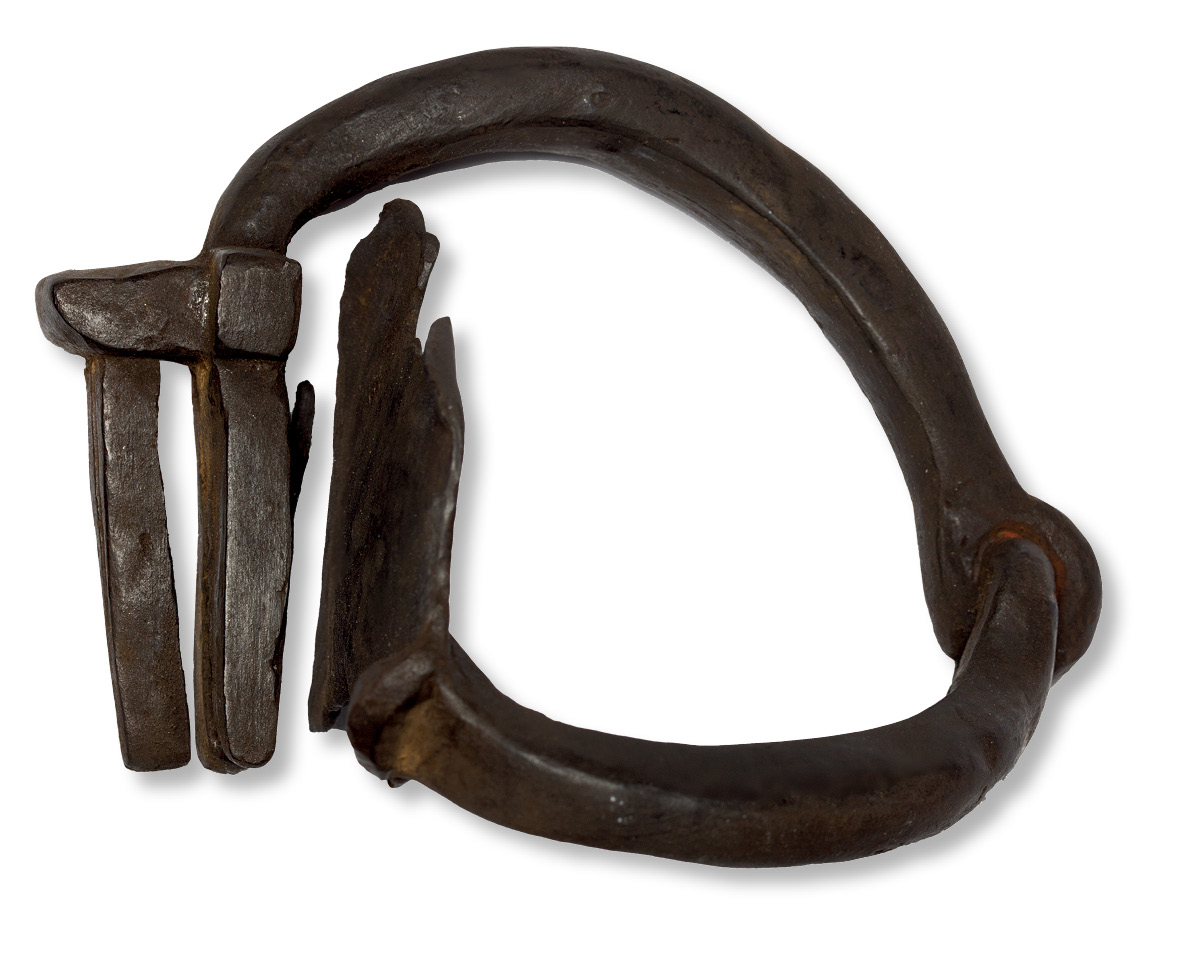
Of course, the villa estates were not only home to the wealthy elite. ‘Not much is known about the average inhabitant of a villa site’, Jasper says, ‘so we have been looking at that very carefully. But it is difficult to see individuals from archaeological finds. Because early excavators were almost exclusively aiming for the main villa houses, they didn’t examine the areas where lower-status burials are likely to lie, so we don’t have those. We do have one example of a shackle, though, which might indicate the presence of slaves, although we have to be a bit careful, as such devices could also be used on cattle. That said, this is a very small shackle with an elaborate lock, so it might suggest that it was intended for humans. But apart from that we don’t have that much evidence for slavery. One reason might be because slaves are expensive to feed, and there were only brief periods during the farming year – such as harvest time – when lots of workers were needed in the fields. Obviously, there must have been some slaves, but I don’t think they were present in the same large numbers that you see on some estates in Italy. I think they were organised in a different way in Limburg. In particular, there is a good chance that some seasonal labourers would cross the frontier from free Germany to work in the fields. After all, people from these regions were allowed to fight in the Roman army, so why couldn’t they work on the villa estates as well?’
Some suspect that the explanation for the end of this landscape of wealthy villa owners lies in the actions of the inhabitants of free Germany, too. ‘In most cases the end of these sites is quite clear’, Jasper explains, ‘because they were burnt down and afterwards only a handful were rebuilt. So our villa landscape ends with big fires, and from the pottery it looks like this happened in the second half of the 3rd century. A lot of historical sources refer to Germanic invaders and raiders at the time, so some scholars see that as the explanation. Human bones aren’t found associated with the burning, though, so it doesn’t look as though anyone was killed. There were also problems within the Empire at this time, as a large part – including the Limburg regio – had broken away from the central Roman authorities to form the so-called “Gallic Empire”. The period when this was reconquered by Rome under Aurelian coincides with the era when the villas collapse, so I think there could be a link with that. In the aftermath, though, almost everyone leaves the region. A handful of sites – including Voerendaal – have traces of earlier 4th-century occupation, but most of them were deserted until the late 4th century, when Germanic groups moved in. So the story ends, as it began, with an abandoned landscape. In this part of north-western Europe, both the rise and fall of Rome changed everything.’
FURTHER INFORMATION
The exhibition Roman villas in Limburg is a joint production by the Rijksmuseum van Oudheden (Leiden; curator Dr Jasper de Bruin) and the curators of the Thermenmuseum (Dr Karen Jeneson) and of Limburgs Museum (Bibi Beekman).
It will be on display in the Rijksmuseum van Oudheden until 25 August, and will then travel to the partner museums in Limburg.
The associated research and public project ‘A Roman idyll’ (2020-2024) saw the three museums join forces with the Cultural Heritage Agency of the Netherlands (RCE). The results from the research project will be published in 2025 in the publication series of the National Museum of Antiquities.
The publication of work at Voerendaal can be found (in English) on the RCE's website at: www.cultureelerfgoed.nl/publicaties/publicaties/2023/01/01/villa-voerendaal.
CWA is grateful to Jasper de Bruin and Selkit Verberk.