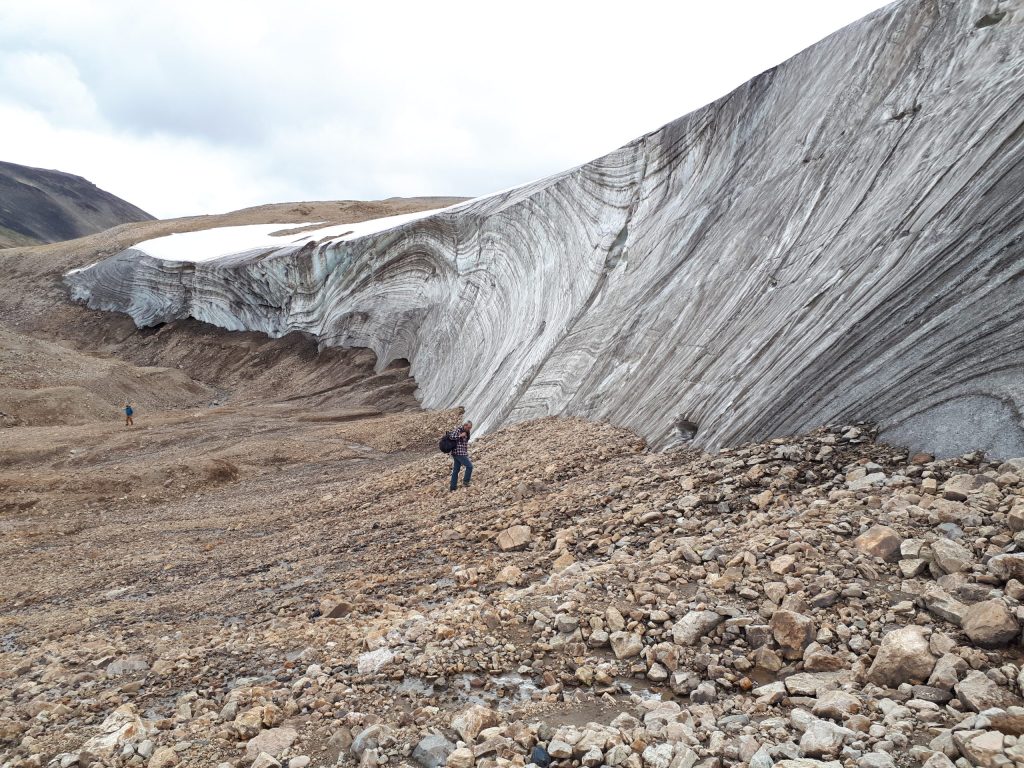
Archaeological survey of ice patches in the Mount Edziza Provincial Park, Tahltan Territory, British Columbia, Canada, has identified an array of perishable artefacts associated with ancient obsidian mining dating back thousands of years.
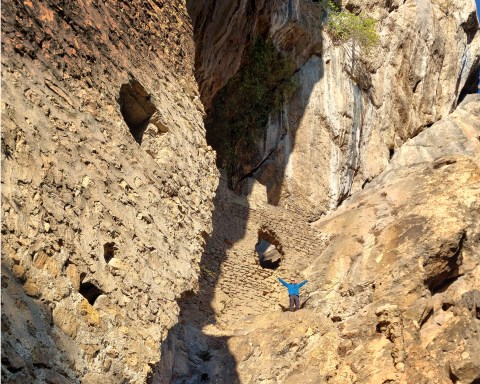
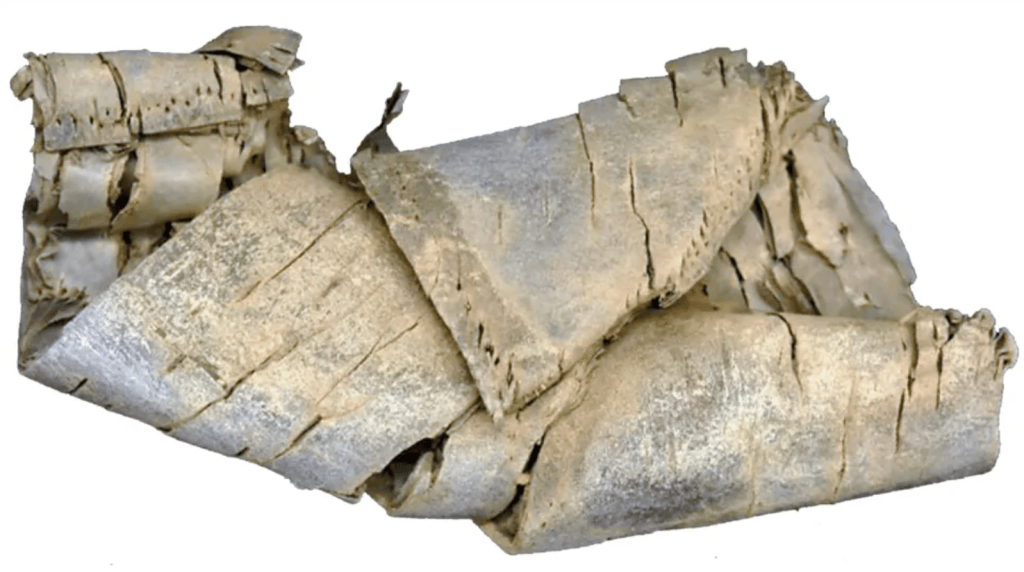
Exploitation and trade of Mount Edziza obsidian is thought to have begun at least 10,500 years ago, and the landscape around Goat Mountain and the Kitsu Plateau, in particular, is scattered with millions of obsidian nodules, flakes, cores, and tools. Recently, a survey was conducted of nine ice patches in this area, looking for artefacts made of organic materials exposed by the receding ice. The team uncovered more than 50 perishable objects, including two stitched birch-bark containers – one with extra reinforcements sewn in – thought to be baskets used for carrying the heavy obsidian out of quarries (below). Other finds included ten wooden walking staffs and a hide boot; 19th-century photographs show Tahltan people, the historical inhabitants of this region, using and wearing almost identical objects. Also found were pieces of worked wood and several tools carved from antler and animal bone, among other things. Radiocarbon dating of some of the objects has revealed ages ranging from 7,000 to 1,150 years ago.
The findings differ from most other Canadian ice patches studied to date, which are largely associated with caribou hunting, supporting the idea that the primary reason that people were in the Mount Edziza area was for quarrying obsidian. The results enhance our understanding of ancient activity in the region and provide clear evidence that it was used consistently for resource-gathering for thousands of years. The area is still important to Tahltan culture today, and the discovery of perishable artefacts associated with these ice patches further contributes to the landscape’s significance. The research has been published in the Journal of Field Archaeology (https://doi.org/10.1080/00934690.2023.2272098).
Text: Amy Brunskill  Images: Duncan McLaren and Genevieve Hill.
Please send your images to cwa@world-archaeology.com. They must be high resolution (300 dpi) and in landscape format, ideally 20cm high by 30cm wide.